Tag

DU

Browsing

Various undergraduate (UG) and postgraduate (PG) courses may not begin this year in the University of Delhi (DU).

30 UG and PG courses that were to begin in about 20 colleges may not commence from this academic session. It has also been speculated that due to various technical difficulties, the admissions to regular courses would also be delayed further.

The Academic Council which had initiated this decision of introducing 30 courses in 20 colleges in the month of January this year, had approved to introduce the following courses in various colleges:

UG Courses                                                         

  1. B.A. (H): Bhim Rao Ambedkar College
  2. B.A. (H) Economics: Dyal Singh College(Eve), Guru Nanak Dev Khalsa College                                
  3. B.A. (H) Philosophy: Hansraj College
  4. B.A. (H) Psychology: Lakshmi Bai College, Bhaskaracharya College
  5. B.A. (H) History: Dyal Singh College
  6. B.A. (H) Political Science:  Bhim Rao Ambedkar College
  7. B.A. (H) Hindi Journalism and Mass Communication: Jesus and Mary College
  8. Bsc Environmental Science: Vivekananda College, Indraprastha College

PG Courses                                                         

  1. M.A. English: Shri Gurunanak Dev College
  2. M.A. Hindi: Shri Venkateshwara College, Shaheed Bhagat Singh College
  3. M.Sc. Operational Research: Shaheed Sukhdev College of Business Studies, Keshav Mahavidyalaya

“The council has also approved ten more vocational courses in some colleges from the upcoming session,” Professor Hansraj Suman, a member of the Academic Council stated.

There has also been an increase in the number of seats in colleges; with the B.A. (Programme) seats being increased from 40 to 200 in Hansraj College in the next session. Aditi Mahavidhalaya has also increased the number of seats in B.Sc. (Programme) from 55 to 80. The college will also have 50 more additional seats for B.Com (H), the minutes of the council mentioned.      

Mr Suman further said that even though these courses have been approved, the admissions may have difficulties as the Principals of these colleges have not been able to appoint teaching faculties. However, it is mandatory for the colleges to run these courses from the next academic session. He further added that the colleges can take loan from the Higher Education Financing Agency (HEFA), if needed, to pay the new teachers.     

“It’s terrible news because the competition for Operational Research (OR) has always been very high. The introduction of more seats would have surely helped with making it into the course more easily.” Joel Mathew, a student who has been preparing for the entrance test for OR said. This news has surely been a blow to entrance aspirants with respect to the PG course.


Feature Image Credits: Hindustan Times


Stephen Mathew

[email protected]


The placement season in the University of Delhi (DU) is a period of adrenaline rushes and great havoc. After shedding sweat and efforts of three years, the students have passed with flying colours as top recruiters visit the campuses of one of India’s premier universities.

The highest package, this year was provided to a student of B.A. Economics (Hons) from Lady Shri Ram (LSR). The student received an offer of INR 38 Lakh per annum, which is a Rs. 1 lakh per annum increase from last year’s highest package offered, which was INR 37 Lakh per annum. A total of 127 students were placed this season with more than a hundred companies with stellar companies like BCN, EY, ICICI, KPMG, Schoogle among the many, this placement season.

Students from LSR, St. Stephen’s College and Shri Ram College of Commerce (SRCC) are usually the top performers, with respect to packages offered. B.A. Economics (Hons), B.Com. (Hons) and B.A. Statistics (Hons) continue to be the most sought after degrees by companies. Highest offers have increased, and so have the average salaries offered.

A B.A. Economics (Hons) student from St. Stephen’s, Nitish Korada bagged a package of Rs. 31 Lakh per annum, from consultation firm Ernst and Young-Parthenon. St Stephen’s College has seen an increase of INR 12 Lakh per annum, from the highest salary being 19 Lakh per annum last year. At SRCC, a B.Com. (Hons) student has been offered a package of Rs 31 Lakh per annnum from EY-Parthenon. At Hindu College, the highest offer witnessed an increase from Rs 29 lakh last year to INR 31 lakh this year.

While colleges like Hansraj College received packages shooting to Rs 31 Lakh per annum with companies like Macquarie Global Services, Deloitte USI, Deloitte India, ICICI bank, Outgrow, Boston Consulting Group among the many coming for campus placements. The average package rose to 5.5 LPA as compared to 5 LPA in the previous session. An impressive number of 168 students have already been placed out of a total of 220 applicants, with the most popular job profile offered in this placement cycle was of Business and Financial Analyst

Ramjas College saw the highest package worth INR 21 Lakh per annum with companies like TresVista, PWC, Decathlon, Growisto, BCG,  Zee Media, Tata Consultancy services, ITC Group, and EY being some of the companies out of the total 32 companies that visited the campus this placement season.

Maitreyi College saw a 100% hike in the highest placement, which is Rs 12 Lakh per annum as compared to INR 6 Lakh per annum in the previous season. They conducted their very first Placement & Internship Fair which saw a participation of almost 600 students in the fair. Over 50 companies provided internship opportunities to the students in a multitude of profiles ranging from digital marketing, content writing, graphic designing, business development, finance, blogging, teaching, volunteering, and research. The stipend ranges from INR 3,000-15,000.

Sri Guru Nanak Dev Khalsa College saw highest packages worth INR 6 Lakh per annum with companies like McKinsey, S&P Global, L&T Construction, Red Carpet, Six Red Marbles, Just Dial, Life Easy, Jaro education, Decathlon, EY India among the many, with around 128 students being placed into the 37 companies that came this placement season.

Sri Guru Tegh Bahadur Khalsa College saw highest salaries at INR 9 Lakh per annum with companies like Egon, Byjus, Patent Yogi, Smith and Drucker, Eigo, Paathshaala, etc. recruiting students from all fields of study.

Sri Guru Gobind Singh College of Commerce, University of Delhi received of 10 LPA and an average package of 4.5 LPA. Companies like PayTM, Dell, Tata Power Delhi Distribution Ltd, Wipro (Computer Science scholar program), Byju (Computer Science Associate), Zycus, Deloitte (Computer Science Associate) and CVent came to the campus.

It is observed the most generous packages have been offered in the consultation field, which attracts many young students aspiring to carve a niche for themselves in the corporate world. Top Companies also look for Extra Curricular activities, Social Work, Analytical and Logical abilities and communication skills, apart from good grades.

Following are some statistics that explain the colleges with the highest placements.

College Highest Placement [Rs] Average Placement [Rs] No. of companies visited that  campus this placement season Number of students that were placed this year
LSR 37.8 Lakh per annum 8.9 Lakh per annum >100 127
Hansraj 31 Lakh per annum 5.5 Lakh per annum 70 168
Ramjas 21 Lakh per annum 4 Lakh per annum 36 80
SBSC 20 Lakh per annum 4.89 Lakh per annum 20 160
 Maitreyi 12 Lakh per annum 4 Lakh per annum 7 62
Sri Guru Nanak Dev Khalsa 6 Lakh per annum 3.5 Lakh per annum 45 128
Sri Guru Tegh Bahadur Khalsa 9 Lakh per annum 4.77 Lakh per annum 48 66

DU Beat congratulates all students for their extraordinary achievements.

Image credits: Debaangshu Sen for DU Beat

Avnika Chhikara

[email protected]

Antriksha Pathania

[email protected]

Shreya Agrawal

[email protected]


Considering difficulties that the applicants might face, Delhi High Court has ordered DU administration to continue with previous year’s admission criteria. The decision comes along with the extension of registration dates.

The last day for registration which was ought to be June 14 has been extended to June 22 by Delhi High Court. The HC order which reprimanded the varsity of its abrupt decision of changing admission criteria has also asked the university to revoke it. The decision was met with criticism by teachers and students alike, as reported by DU Beat earlier. The recent changes involved inclusion of maths in the best of four subjects for admission in B.Com (Hons.) and BA(Hons.) Economics.
While hearing three petitions against Delhi University the bench made it clear that changes in eligibility criteria have to made in accordance with law, which would require a minimum of six months of public notice to the public at large. It also debarred the university from making changes to the eligibility criteria in the forth coming year to its UG courses.
Lawyers representing the varsity told the judges that DU changes its eligibility criteria every year and the Bulletin of Information (BIS) was meant for this specific year and therefore it didn’t qualify as a statutory rule. Lawyers also argued that no student will be deprived of admission due to changes in rules and if anyone is affected then they can approach the grievances committee.
“The High Court order to quash Delhi University’s new admission guidelines is good because the timing of DU’s decisions can be questioned as it can disrupt how people plan their admission. It’s not about questioning the quality of this decision but the timing could have been better.” says Ayaan Kartik, a Journalism undergrad at Delhi University.

On the issue of extension of dates, Kartik Pande, an aspirant says “I believe that this has two sides to it. The positive thing is that the people who accidentally missed the registrations or did some mistake can re register, while the negative thing is that the competition will increase for students. I don’t think I’m inclined towards any side as the decision is alright according to me so yeah that was it.”
Admission to various UG courses that commenced on May 30 has witnessed an entry of 3.31 Lakh applicants. The HC decision might extend the date of first cut off which has not been announced yet. As speculations suggest, the first list might release somewhere around the end of June.

Image Credit- Dainik Jagran

Priyanshu
[email protected]

The effigy burning, along with a rally, organised on 14 June, came as a follow-up to the protests of 11 June.

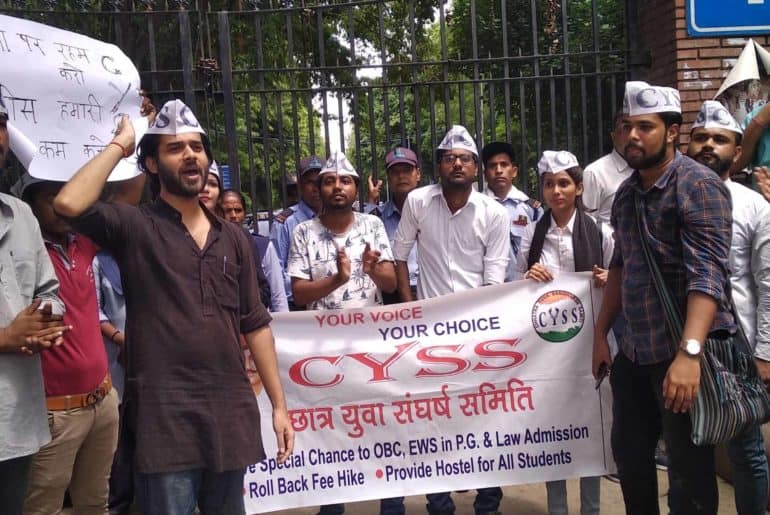
On the morning of 14 June, student organisations gathered at the Gate No. 4 of the Arts Faculty building to protest against “fee hike and faulty admission process in Delhi University.”

Over ten student organisations – among them, All India Students’ Association (AISA), Bhagat Singh Chhatra Ekta Manch (BSCEM), Collective, Krantikari Yuva Sangathan (KYS), Parivartankami Chhatra Sangathan (Pachhas), Pinjra Tod, Students’ Federation of India (SFI) – organised a protest rally and burnt the effigy of the University Vice-Chancellor to raise their demands.

The rally began from the Arts Faculty building and went around the North Campus of the University. The proceedings ended with a public meeting and the effigy burning. This came as a follow-up to an earlier protest by these organisations, raising the same issues, on 11 June.

The protesting students demanded the following:

1. Decreasing the registration fee for Other Backward Classes (OBC) to Rs. 300 and apologizing for the “inconvenience caused.”
2. Decreasing the fee for unreserved category students from Rs. 750 to Rs. 500.
3. Refunding the “extra fee” collected from students.
4. “Immediately resolving” the technical problems in the online registration form.
5. Giving two days to applicants to make corrections in their form after filling it up.
6. Setting the entrance exam question paper in Hindi as well.
7. Providing “proper facilities” should be at the exam centres.
8. Revoking the fee hike in Ramjas College & Bharati College.
9. An “unconditional apology” from the Dean of Students’ Welfare (DSW) for giving “false information” regarding the eligibility criteria for OBC and Economically Weaker Sections (EWS) reservation.

The University had set the registration fee for undergraduate admissions at Rs. 250 and Rs. 100 for OBC and EWS students respectively. The ‘additional registration fee for each entrance-based course’ for the former was Rs. 750 and Rs. 300 for the latter. The same distinction of Rs. 750 and Rs. 300 also applies to the application fee for the postgraduate, MPhil and PhD courses. Even though one of the demands of the protesters was refunding the “extra fee collected from students”, the admission guidelines of the University mention that the registration and entrance exam fees are non-refundable.

The first eight demands had been raised in the previous protests as well. A memorandum had been submitted to the Dean by the protesting organisations, which detailed their position. The protesting students had argued that since the income cut-off limit for both the ‘non-creamy layer’ OBC category and the EWS category was similar; and that the former had been given reservation on three bases – social, economic and educational backwardness – while the EWS was given reservation only owing to their economic backwardness, the fees charged from OBC students should not be higher than that of the EWS ones.

According to some protesters who had met the Dean on 11 June, they were allegedly given wrong information by him about the reservation criteria of the OBC and the EWS categories. Upon discovering the alleged falsehood of the information, the protesters had begun a dharna outside the Dean’s office. Hence, the protesting parties this time demanded an “unconditional apology” from the Dean for the alleged false information as well.

According to Amarjeet Kumar Singh, the DU Law Faculty In-charge of AISA, “The Dean refused to meet today and we were informed that he will response (respond) only on Monday.”

A statement issued by SFI alleged, “Before the rally could even start, the police started manhandling SFI activists and detained several protestors. Seeing pressure mounting from the student community, the police was forced to immediately release the detainees.”

Sumit Kataria, Vice President of SFI Delhi, told DU Beat that he and Ravi Shankar, also an SFI member, were “manhandled” by the police, but didn’t suffer any bruises.

Pachhas also issued a statement which read, “Protest ke dauran police ne apna tanashahi roop dikhate hue Pachhas ke sathi Deepak aur BSCEM ke sathi Ujwal ko maarpeet karte hue giraftar kar liya. Baad mein chhatron ke dabav ke baad unhein chhod diya gaya” – during the protest the police showed their dictatorial nature and arrested Deepak of Pachhas and Ujwal of BSCEM. Later, the police released them due to the pressure of students.

Speaking to DU Beat, Deepak Gupta said that he and Ujjwal were arrested by the police and taken to the Maurice Nagar Police Station. There they were allegedly detained for around half an hour. As the rally approached the police station, the police were brought under pressure to release both of them. He also alleged that he had suffered bruises from the encounter with the police.

We also spoke to Ujwal of BSCEM, the other person who was detained by the police. “SI (sub-inspector) Rohit of Maurice Nagar police station started tussle with a comrade named Deepak who is from PACHAAS (Pachhas). SI was trying to bully him by saying that you don’t have the permission to meet the DSW. I intervened in the conversation and said that we are students of the university and we don’t need police permission to meet the administration officials. I also asked him to show me the notice/permission by the university administration that lead (led) to the entry of police in campus. At this he got ignited and pushed me in the van. He asked another policeman to arrest us. I and Deepak were pushed into the van, we were beaten up by the policeman. Deepak’s slipper also got torn. In a van we were carried to Maurice Nagar police station, the police illegally detained us and ensured that we (do) not join the march. (Afterwards) when the protesting students started approaching the gates of (the) police station they released us,” he said.

The protests are expected to continue in some or the other form if the protesters don’t receive a satisfactory response from the Dean by Monday.

Image credits- Sumit Kataria from SFI

Prateek Pankaj
[email protected]

University of Delhi is set to get a new hostel, as a proposal by the Delhi University Students Union (DUSU) President Shakti Singh is approved by Chief Minister Yogi Adityanath to allocate funds of INR 48 crore.

According to a press release by the Akhil Bhartiya Vidyarthi Parishad (ABVP), Yogi Adityanath, the Chief Minister (CM) of Uttar Pradesh is set to provide INR 48 crore for a new University of Delhi’s (DU) Hostel.

A proposal by Shakti Singh dated the 10th of June was approved by CM Yogi Adityanath the same day. The proposal addresses the difficulties faced by DU students while looking for student accommodation. The proposal also highlights that only 1-2% of students from Uttar Pradesh get hostel accommodation.

The new hostel requires approximately 3 acres of land to be built. The hostel is said to have 500 seats, and sports facilities over INR 3 crore. The total cost, including overhead charges amounts to INR 48 crore. The hostel is set to be constructed on the Uttar Pradesh government’s land in Delhi.

DUSU President Shakti Singh said on Twitter, “A big thank you to CM Yogi Adityanath Ji. I am highly thankful to you for the assurance of sanction of (INR) 48 Crore for the budget to build hostels for students of Uttar Pradesh in Delhi-NCR. It would be one major step towards accommodation.”

The promise of a new hostel brings relief to students even though the dates of construction and its unveiling remain unclear.  Finding cheap accommodation on campus, or in Delhi is not easy for the regular DU student. With rising costs of commercial accomodations (Paying Guests), and limited number of seats in the hostel, students are left with no choice but to opt for private accommodation which usually burns a hole in their pocket. In some cases, students are also subjected to harassment by brokers and landlords.

The move sounds promising, as currently, the University hostels lack various facilities, and the number of seats remains low. The University also has a history of protests related to the hostels, with the recent ones being the Hindu College hostel and the Daulat Ram College hostel rows. This move also leaves one wondering if the implementation of the new hostel would mean a revision in the current hostel rules and guidelines.

Feature Image Credits: Shakti Singh on Twitter

Jaishree Kumar

[email protected]

The Cluster Innovation Centre (CIC) is an institution of University of Delhi, established in 2011. Based on interdisciplinary learning, it has been designed to seek and derive answers to the real world problems in all spheres, and look for innovative solutions for problems of the society.

It is a Meta College as well as a Meta University concept with an innovative curriculum, which is more project-oriented and tailored to the need of the society and industry.

Located in the quaint premises of Rugby Sevens Building, University Stadium in North Campus, it is a promising course for students who wish to seek the connect of research with its practical application.

COURSES OFFERED AT CLUSTER INNOVATION CENTRE:

Currently there are three courses offered at CIC-

  1. B.A. (Honours) Humanities and Social Sciences
  2. B. Tech (IT and Mathematical Innovations)
  3. M.Sc. (Mathematics Education)

SEAT MATRIX FOR B.A. AND B. TECH COURSE:

In 2019 – 20 there will be 44 seats each in both the courses. They are distributed as:

General Category – 20 seats

EWS – 2 seats

OBC Category – 12 seats

SC Category – 7 seats

ST Category – 3 seats

Apart from these there are 6 supernumerary seats distributed as:

PwD Category – 2 seats

CW Category – 2 seats

Foreign Nationals – 2 seats


  • B.A.(Honours) Humanities and Social Sciences

This is an off-beat course compared to other regular honours programmes offered by University of Delhi.  It is based on interdisciplinary learning, which presents an opportunity to the student to design his/her own degree.

This course is divided into four streams:

  1. Journalism
  2. Counselling
  3. Historical Tourism
  4. Art & Design

Based on these four streams a student can study a variety of subjects offered in different colleges of University of Delhi in semesters two to five, and study some basic courses at the centre itself in semester one and six. Apart from the core papers, the distinctive aspect of the curriculum is the hands-on research project, which gives the students a grass-root level experience of the functionality of the society.

One can schematically study Political Science at Hindu College in one semester and Economics at SRCC in another! The interdisciplinary nature of the course gives a holistic view in the field of humanities and social sciences.

Commenting on the course, Rishabh Gogoi, a third year student of CIC says, “It’s unlike any other course in the country, and a much needed alternative in an otherwise restrictive education system. We all know the efforts of the University of Delhi to enhance the flexibility of its course structure through the Credit Based Credit System (CBCS). The course at CIC takes the same concept several steps ahead to present its scholars an absolute freedom to design their own degree. Although there are a number of nuances associated with the aforementioned “freedom”, but regardless, the B.A. course at CIC is undoubtedly the best decision any indecisive student can make who wants to study humanities and/or social sciences.”

Niharika Dabral, an outgoing student of CIC reminisces her experience at CIC as, “I would never change my experience at CIC for anything. It’s a college experience like none other. Since I’ve survived the project presentations I think I can survive anything. It has been intense.

There are so many things that have to improve, but that University stadium is comfort. Four colleges in six semesters is bound to make one like a nomad, but today I’m more independent than ever.”

However, a person may feel detached and have a certain sense of instability due to changing colleges in each semester, from semester two to five. It may not be the best fit option for students not willing to feel so.  But this rigorous course would surely develop leadership qualities and improve one’s perspective towards humanities and social sciences.

  • B. Tech (IT & Mathematical Innovations)

Cluster Innovation Centre offers a four-year B.Tech. programme in Information Technology & Mathematical Innovation.

According to the official website of CIC, “The B. Tech course offered is a unique programme, is designed to inculcate an innovation mind-set as part of the curriculum and pedagogy. Building strong analytical skills through Mathematics and application skills of Information Technology (IT), this course encourages students to recognize the connectedness of various disciplines.”

The streams offered in the B. Tech programme are-

  1. Robotics and Embedded Systems
  2. Economics and Management
  3. System Biology

The innovation lab known as the “Engineering Kitchen” is the place where students carry out hands-on projects, experiments and model implementations which are linked to the curriculum.

Yatharth Rai, a third year student from B. Tech. says, “The curriculum, although hectic, is quite flexible. The three minor streams grant a clarity. There is a focus on practical applications, rather than theoretical expertise. Each paper in the semester has an accompanying project. I personally find these projects extremely beneficial as they provide an outlet to the theoretical concepts learnt during the semester paper.”

The B.Tech course offered is comprehensive with a special emphasis given on practical learning. In last semester of the course i.e. 8th semester, the programme is based on industrial internship to give students the necessary work experience.

Unlike other B. Tech courses, a student of Arts or Commerce having Mathematics and English can apply in the B.Tech (IT and Mathematical Innovations) course on the condition that he/she fulfils the eligibility criteria as laid down by the Cluster Innovation Centre.

  • M.Sc. (Mathematics Education)

It is a meta-university concept, which offers a two year post graduate programme jointly offered by University of Delhi and Jamia Milia Islamia. The course is developed to give students theoretical as well as hands-on experience of mathematics education.

There are total 20 seats in the programme distributed as:

University of Delhi: 10

Jamia Millia Islamia: 10

Seat Matrix:


IMG-20190612-WA0046


Source: www.ducic.ac.in

All the three courses offered at Cluster Innovation Centre are uniquely designed and promote hands-on learning in addition to building theoretical concepts. Therefore, these courses offer a different experience of academics altogether.

Selection to these courses is based on an entrance test which is to be conducted by National Testing Agency (NTA) this year.

The entrances for the Undergraduate and Postgraduate programmes are to be conducted between 30th June, 2019 – 6th July, 2019.

Feature Image Credits: www.ducic.ac.in

Sriya Rane

[email protected]


University of Delhi (DU) took the decision to increase the number of seats under the sports quota without exceeding the 5 percent limit in the intake. This was only applicable to extra curricular activities (ECA) quota till last year, and now has been extended to the sports quota as well.

In a meeting held last week, the varsity decided to increase the number of seats, in case there was an increase in demand of said quota at the department level.

This gives colleges complete freedom to decide the increase in the number of seats for either sports quota or ECA category. They can allot particular number of seats according to the demands and needs of the college.

An official was quoted by The Asian Age as, “Usually, it is seen that the students in the sports and ECA categories opt for humanities and social sciences programmes, rather than science, since they feel they may not be able to cope with the pressure in the latter. So, in case there are no admissions under the sports and ECA categories in the science department, the vacant seats can be transferred to another department where there is greater demand, but without breaching the total number at the college level.”

In the situation where the seats allotted under the categories in the departments are vacant, then the college can shift these vacant seats to other departments, where the demand is more. Hence ensuring that the students fill all the vacant seats, and the demand for a particular course is also met. This step also ensures that the five percent cap of intake is not breached by the colleges.

According to a circular issued by the authorities, “However, in case of greater demand in a particular course, up to a maximum of double the number of seats sanctioned under the ECA and sports categories in the said course may be admitted by a college, subject to the overall ceiling of five percent.”

Rasal Singh, member of the DU Academic Council, assured that this move would pave way for only the deserving students to get admission in the university.

Lavanya Ratauri, a football sports quota student said, “This move allows more flexibility for authorities to allot the number of seats but also at the same time it should consider the demands of the student. I hope this move gives students more liberty to take only that course which they want.”

Feature Image Credits: Akarsh Mathur for DU Beat

Antriksha Pathania
[email protected]


Presenting a detailed guide to applying to one of the most premier institutes in the country, St. Stephen’s College. 

University of Delhi (DU) admissions have begun and it is important for all DU aspirants to be able to understand the admission procedures. The admissions to all colleges in the university follow a similar pattern. However, this pattern differs in the case of semi-autonomous colleges . One of these colleges includes St. Stephen’s College. This Christian minority college has a slightly different form of admission for taking in students.

Applying to St. Stephen’s College is a double-layered process. The applicant must start by applying to the university, that is, going through the standard procedure of filling the university application. Once that has been completed, the applicant must then apply on St. Stephen’s admission’s portal. This portal can only be accessed with the applicant’s DU form number. After accessing the admission portal, the applicant must register at the portal using their DU form number. This is followed by a verification email sent by the college. Once verified, the applicant can proceed to the next stage. The application procedure is very simple and comprehensive. The admission form has various sections that need to be filled or completed in order to move to the next aspect of the form.

Given below are the various steps for the same:

  1. After the verification is done, the first page begins with the form requesting various kinds of personal informations like the name of the applicant, the father’s name, the mother’s name, their occupations etc. After filling all such details correctly we move on to the next page.
  2. The second page deals with various documents that are to be submitted by the applicant with respect to various kinds of reservations that the college has allotted for non-Christian applicants. These are divided into various categories that include SCs, STs, and OBCs. In case of Christian students, documents that declare their churches and denominations are to be submitted. All Christian students are to submit scanned copies of their baptism certificates along with a declaration from their parish Priest stating the authenticity of the Christian upbringing of the applicant. The applicant can also select multiple categories, if it applies to him or her.
  3. The third page deals with course selection. This page provides details for the various courses that the institution provides, and the subjects that need to be added for the same. After the applicant selects the subject or subjects he or she wishes to apply to, the applicant can proceed to the next page.
  4. The fourth page deals with various aspects of the applicant’s education qualifications. This space is meant for the applicants to put in details like the address of their school, the form of syllabus or the board that they followed, their school etc. The scanned copies of tenth and twelfth class mark sheets are to be uploaded here. Followed by whether their result has been declared or not. If the applicant chooses “Yes”, then four columns appear for the subjects. The applicant can also add more subjects. Based on the subject chosen, the site automatically calculates the best of four. For example: If the student chooses chemistry, then chemistry would be automatically added in the best of four.
  5. The fifth page deals with three questions. This page is a very important step in filling the form. It can also be said to be the most important because it deals with the applicant answering questions posed by the college. The answers play an important role in further selections. The first question deals with the goals, aspirations, and various interests of the applicant.
  6. This question is followed by the statement of purpose (SOP). This basically asks the applicant to state the reasons for choosing the subject they have applied for. The applicant must answer this question carefully. The last question is “Why St. Stephen’s College?”

These three questions are to be written within a word limit of 100 to 300 words.

Applications are filtered from here, based on the answers written by the applicants. Thus, it is important to write carefully with valid reasons for your arguments.

Once the SOPs have been filled, the payment has to be made for the form. The applicant has to pay 200 INR per course. If the applicant wants to apply for the residence facility, then another 350 rupees is to be paid. The residence facility is the hostel facility that the college provides for its students, who do not belong to Delhi or the NCR regions.

This is the basic format that is followed by the college for its admission process. Do not be worried about the SOPs ( Please take a copy of your SOPs as they might be needed for the interview that would follow).

A thorough background of your course and the college would be good pointers for a great SOP. DU Beat wishes good luck to all applicants applying to St. Stephen’s. May the odds be in your favour!

Feature Image Credits: DU Beat Archives

Stephen Mathew

[email protected]


Dear Aspiring Students,

Here is a list of things I feel you should keep in mind before taking admission into the University of Delhi (DU).

  • ADMISSION PROCESS

The admission process for DU seems tiring, laborious, and everlasting. Trust me, it is. After carefully filling in the forms, wait and have the patience for the cut-offs to come out. Keep in mind your favorable course and calculate the Best of Four (BoF) percentage accordingly. Keep all your documents ready and extra photocopies as well. Upload all essential documents on your Email ID’s and Google Drive for it to be easily accessible in case you forget something. Keep extra passport size photos and Aadhar-card copies of your parents and yourself. Read the UG Bulletin of information available on the website and check if you are applicable for any of the quotas. Keep dates in check (I had marked my calendars), stay in touch with your friends and peers, help each other and support each other.

(Read the DU UG Bulletin 2019-20 here: Click

  • EXPLORE

Going for admission procedure to colleges once the cut-offs come out takes time. It might take you a whole day, in the Dilli ki Garmi to get your admission done, and you might have to do this more than once, after subsequent cut-offs come out and you upgrade to different courses and colleges (I did it thrice). You might get tired, but don’t sit in one corner waiting, scared and anxious. The college you go and visit will most probably end up being your home for the next three years. So, explore the canteens, the gardens, the classrooms, the staircases, the markets nearby, the metro stations and bus stands. Familiarise yourself with the environment. It helps in the long run. Take a good company with you, take friends and family, take loads of food and make a picnic out of your admission visit. Make it as fun as you can, as it will be your first experience of being inside the college you will call your own for the next three years.

  • COURSE VS COLLEGE

Many of us don’t score high enough to get our favourite courses and colleges. So, once the cut-off comes out, it becomes a hysterical decision, to chose which course to pursue, and from which college. It will end up in a series of heated discussions between you, your family members, and your well-wishers, and constant visits to websites like collegedunia to read about the ‘scope’ of different courses. Your father will suggest one course, your mother will suggest another college, while you will be at the center of this dilemma, choosing your career just after finishing off with boards (I felt like taking a year-long vacation to decide my college). But in the midst of all this, keep in mind that while making this choice, you might end up losing your preferred course or college or even both, but in the end it won’t matter because once in college, you can helm the journey of your college years to follow the awaited dream you had. You can take your preferred course as an elective and earn a minor degree and participate in different colleges all over the DU circuit to make friends in your favourite college. Although, this decision should be taken with the utmost care, but in the end, you will never regret giving up on one particular thing, because the college life will reward you with so many others that you will be filled up to the brim with happiness and satisfaction.

  • LIFE AT DU

The life at the University is not what you might be envisioning right now, it is not all fun and games, but it is so much more. It is exposure and experience, new friends and families, perspectives and politics, fests and euphoria, academics and attendance, and crowds and metro. It is the flavour of chai that burns at your tongue, and sleepless nights you pull off to finish that one academic paper. It is commuting in an empty metro early in the morning to reach your college on time for an extra class, for it to get cancelled. It is crying, curled up in your bed missing your families, small events and birthday celebrations back home. It is managing the month end with minimal finances asking for udhaar because you are broke. It is also listening to your favourite songs non-stop in the long metro rides, reading your favourite authors or academic papers, it is also celebrating the small festivals you miss back home with your newfound family at college, it is also the breath of relief when you see your parents face to face on a skype call and it is also filling your tummy up with freshly-made Maggi on days you don’t like the PG food. It is a rollercoaster of freshness and it is going to be a beautiful journey!

All the best, students! Make a good choice without any regrets, and enjoy this time to the fullest, you will surely miss it once it is over.

Regards,

Sakshi Arora


Feature Image Credits: Saubhagya Saxena for DU Beat


Sakshi Arora

s[email protected]


Hey there! How are you? I am plastic. Not plastic like your college friends; I’m the real deal. My breed is straw, and my colour is white, but out here in the plastic world, we don’t judge each other in terms of colour or breed. Who does anyway?

I was last used at PAM, this eating joint at Hindu College. PAM stands for Pizzas and More, but the funny thing is there are no pizzas here. I feel like I should petition to change PAM’s full form to ‘Plastics and More’!

So, I was a fresh new kid ready to be dipped in a nice cup of not-so-nice cold coffee. But then members of this college society told the owner, a grumpy white-haired uncle, that he should stop using plastic straws in his shop. They called me and my plastic family murderers and said that he should play his part in saving the environment by banning us. To this, PAM uncle did what he’s best at: he told the students to bugger off.

I felt offended that those students called me a killer but as I realised later, that’s the sad truth. I could have said this is my autobiography but this is more like a confessional. You see no one is a natural born killer. Killers are made, rather than born. I too was made a killer by my creators, human beings.

You see I look good when you are French kissing the life out of me, sipping on your drink. But then, you dispose me off. And when I am disposed, I wish for a nice, calm death. The purpose of my life has been served. However, it seems that I’m borderline immortal. The problem with being immortal is that you can get extremely…bored.

Now I lay in this pile of garbage to rot but I won’t even rot; the organic things have it easy, I tell you. No one would pick me up and reuse me. And just to add to my concerns, I have unintentionally started destroying and killing things.

This bird was scrounging for some food in the garbage and the dumbo swallowed me down too. The feel inside his body was gross but what felt grosser was when it vomited me out. The poor creature couldn’t ingest me. I told you right, I just can’t die!

The bird kept on choking for some time and to my horror, it just stopped breathing in a few minutes. That was when I became a killer. I imagine how so many members of my family might have become such unintentional murderers. Those ‘woke’ students were right.

I have blown with the wind now to some littered road in Delhi (there are many in the city), waiting for my death. But instead, all I do is just stay in my non-biodegradable state killing Mother Nature slowly (I heard this science kid talk about me like that once; he also said that some of the straws kill marine creatures).

I wish that in the next life, I’m not reborn as a plastic straw. Maybe in the future, humans stop using plastic straws altogether so we’ll never be created and we’ll never be killers. Maybe…


Shaurya Singh Thapa

[email protected]