Tag

DU Admissions

Browsing

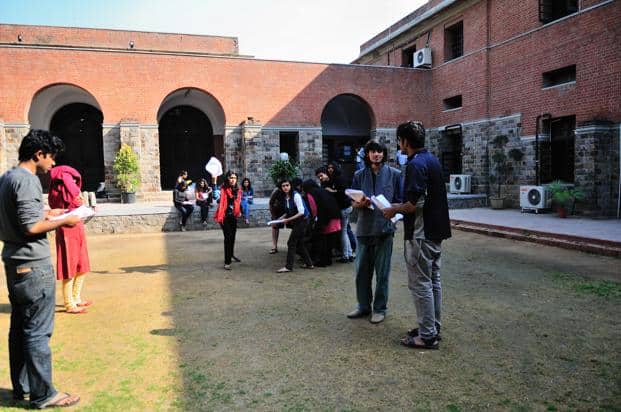
St Stephens is the only college in the University that admits its students based on an interview. This interview may or may not be after an entrance test.

Arts-based courses certainly have an entrance prior to the interviews. The weightage given to the interview is 10%. The entrance has a weightage of 5% and the BFs carry 85% weightage in terms of admissions.

Be wise, they are not searching for your knowledge of the subject, of course, you need to have a certain amount of knowledge but it’s not primary. What they seek is your confidence, your character and your personality. The part that shows your Stephanian spirit. The quality in you that showcases your ability to fit into the culture that Stephens portrays. The fact that you can be a Stephanian out in the world after three years is what they want to find in you. They are looking for that spark or character rather than a know it all. Knowledge is abundant in all those who have cleared the cutoff but not all have the X factor.

All you have to make sure is that you present the best version of yourself in the 20 minutes of time that you sit in front of the Panel.

What is it that makes you different? your personality, your confidence, your understanding and your maturity. How capable a person you are? Diana Oommen who cleared the interviews for English, History and Philosophy in St Stephens and is now a Philosophy student shares her experience “When I was asked my opinion on the Medieval history of India during the Mughal period, I gave the panel an answer that was incorrect, the teacher corrected me stating that it’s not the right answer. ” My response was that even if my answer is wrong I am here today to correct myself. I have been able to learn this from you and thank you for telling me that this is the case and not the way I thought of it” The Panel was impressed by her answer. Thus, your ability to handle a situation calmly without being argumentative or aggressive is a quality that they seek she says.

Here are a few pointers to keep in mind as you approach your interview

  1. The candidate receives a call letter from the college. It is also a formal invitation to attend the interviews. If you have received one, then congratulations! Your SOP (statement of Purpose) has surely left an impression. You must keep the dates in mind. Also, do read the college prospectus carefully as the college tends to make changes in their admission procedures annually.
  2. Based on the courses you have applied for, you would have to prepare yourself. Here your SOP plays a very vital role. It becomes central to the way your interview might proceed, the information provided in your SOP gives out to the panellist, the kind of person you are. Thus, your interview may be on the lines of how you have presented yourself. For example: If you have mentioned a certain book that you like in your SOP for English Honours. You should have read it thoroughly enough to be able to answer questions on the same if asked.
  3. If you have applied to the college on the basis of quota, then you must carry original and photocopied relevant documents without fail. Make sure you double check your file so that you have everything at hand. The prospectus gives you clear instructions for the documents you need to have. *YOU MUST NOT FORGET YOUR CALL LETTER* Time is the essence if you are not aware of the nearby places you might get lost and thus, It is fundamental to have a clear understanding of the route you plan to take to reach the college. It is advised that you carry additional photocopies and passport size photographs along with a pen, glue and whitener.
  4. Dress to impress: You cannot compromise on your appearance, Men must wear light coloured formal shirts, Formal pants and black or brown formal shoes. Women should prefer western or Indian formals and semi-formals. There have been instances where candidates in shorts and casuals have been turned away! Try to avoid Jeans, T-Shirts, Sneakers etcetera. It is advised to not colour your hair during the interview dates.
  5. The entrance test for arts mainly examines your analytical skills, your writing style and your ability to express. It gives the panellist, who will have your paper at hand during the interview, an opportunity to form an opinion of your thought process. They might ask you the reasons for writing certain things in the entrance, be attentive to your answers. Be calm so that you do not forget what you wrote.
  6. The interviews are based on hourly slots. If you are lucky it might happen very early, if not then try to relax, listening to some music, going through your SOPs or (if you are a Christian) going through the bible would help. Based on the number allotted you would be made to sit in a line. It’s here that you meet many of your future batch mates. Carry certificates along, in case you have won various awards and prizes. That is always a plus.
  7. The key to a good impression of your personality is to be balanced in your presentation. If you sound too confident it is not a good sign. Basic etiquettes are definitely an add on. The interview happens in the principal’s office. The office is a huge space. It might seem intimidating, but the panellist would give you time to calm your nerves. Do not forget to ask basic questions like ” May I come in?”, ” May I sit?” and thank you. Be aware of the time when you greet them. The panel would have five individuals. The Principal would be at the centre, and two panellists each by his side (This might vary with an additional member being there in the panel). One of them would be observing you throughout the interview, observing your posture and responses. After general questions like “why the course?” and “why the college?” The panellist would then move on to questions pertaining to the course. For a Science based course, there are two questions that are always asked, one is a theory-based question and the other an application-based question, Students may be asked to draw graphs or solve questions in front of the panel. For arts, the students may be asked questions on authors or books they might have read or mentioned in their SOP.
  8. If you are a Christian student, be well versed with the Bible. Gather information on various Biblical characters. Know the different books and have a Biblical verse learned already. ” What is your favourite Bible verse?” is a very popular question for Christians.
  9. The panel is clearly aware of your academic potential but is prepared. Honesty is an ultimate if you do not know an answer, a polite ” I am sorry”,” I do not know the answer” or ” I am unable to recall the answer for the time being” would do. Being argumentative with the panel is negative. Humility is highly appreciated, it should not be confused with self-doubt. Be optimistic in your answers. Try to be pleasant with a smile, if you are confident cracking a joke or two won’t do any harm. The panel may ask you questions that might seem confusing. If you do not understand a question, politely ask them to repeat the same. Do not consistently look at the person who has posted the question, you are talking to the whole panel.
  10. Carry a handkerchief, if you are sweaty. do not fidget, try to keep your tone at a moderate volume. Stammering or stuttering is big ‘ NO’. Gather your thoughts, the panel won’t mind a few seconds of silence.
  11. The interview is very haunting at times but does not be disheartened. Students who came out crying (because they thought they underperformed) have been selected. We never know what the panel is looking for. The panel tries to make the selected crowd as diverse as possible so that the students have a great learning experience. It’s completely okay if you are not the state topper or the national topper if you have cleared the cutoff, your chances of getting in are as real as of the others. Remember the selection ratio may be as high as 1: 10, One person selected for every ten individuals interviewed, the competition is there, but you are as good as any other player so relax. If you have any unique quality or talent, you can certainly inform the panel of the same.
  12. As you get out, be aware of the DOORKNOB. Many students lose their cool when they are unable to open the door. It’s just a gentle turn and you are out. A parting smile and a thank you would be a great way to end the session.
  13. You would get many hints as you go through the interview, about whether the panel is pleased or not. Be alert of their reactions.

These are some of the tips that you need to keep in mind. DU beat wishes you all the very best! For any further queries on admissions do not forget to DM us!


Featured Image Credits- LiveMint


Stephen Mathew

[email protected]

Psychology, Journalism, Geography among others are not available to men in DU. Despite being popular choices, male aspirants need to turn to alternate universities to pursue these courses.

University of Delhi (DU) gains as much criticism as is the prestige around its colleges. With the cut offs rising so fast students invest their all to ensure they can secure a seat in a top college. Is it possible for some to lose in this race even before they begin? Or for some students to win the race but not the prize?

This is the fate of men wanting to pursue courses such as Psychology, Journalism, Geography and Sociology in DU. These and several other courses are only offered in girls’ colleges or in very few co-ed colleges, which has gained the University a lot of criticism. It then becomes a matter of approaching different Universities or choosing a college among the few that offer the course of choice.

Journalism is only available to men in three colleges including Delhi School of Journalism, Delhi College of Arts and Commerce and Maharaja Agrasen College. Among the 16 colleges for Philosophy, ten colleges are for women, leaving St Stephens, Hindu College, Ramanaujan College and few others for male aspirants.

Sociology is available in only two colleges- Hindu and Sri Venkateshawara College. Psychology is offered to men in Zakir Hussain, Keshav Mahavidyalaya and Dr Bhim Rao Ambedkar College.

Geography is offered in co-ed colleges such as Dr Bhim Rao Ambedkar, Dyal Singh College, Kirori Mal College, Shaheed Bhagat Singh College, Shivaji College and Swami Shardhanand College.

Home Science not offered to boys in any of the 90 colleges in DU. Some of these courses are included in BA Programme and are offered as minor or General Elective courses. But this means the students will have to compromise on an Honours degree in the subject they love.

These courses remain restricted to girl’s colleges and our education system remains regressive.

Rishabh Kumar, a student of Psychology from Christ University expressed his grievance, “This is an appalling scenario for an institution like Delhi University. Since we are transcending the biological differences that did exist, a decision of that sort needs to be revised. It’s unimaginable to exist in an environment where comprehension of knowledge is limited to certain gender.”

Raunaq of Shaheed Bhagat Singh College commented, “For me it was a choice between Political Science and Psychology as my major. The latter was offered in only few colleges, where I was not keen on studying, therefore I went ahead with Political Science. I do believe I am one of the lucky ones as compared to the guys who only want to do Psychology.”

Turning to private universities also means a huge increase in the annual fee and pouring lakhs of rupees each year. While some are saving up for their Masters, others simply do not have this privilege. This can become distressful, especially with those lacking flexibility in course.

On speaking to a national daily, Ms Anupa Siddhu, Principal of Lady Irwin College said how there was no “gender bias” but identified the problem as co-ed colleges not “showing interest in starting the course”.  On speaking to the same daily, the Principal of Aryabhatta College expressed that there exists a “lack of demand” for Home Science and offering these can be difficult due to limited resources. He further went on to suggest that the women’s colleges offering these courses should accommodate male students as well.

“It was extremely difficult to find a good college which offered Sociology for boys, without having to dish out ten lakhs. This reflects on the prevailing mentality in DU that only girls take Sociology”, remarked Kabir Madan a student of Sociology from Shiv Nadar University.

The race will soon begin as the cut of lists will be released this week, students wait in anticipation not knowing what the future holds. On asking many students, who faced this situation in the previous years, what advice they had for aspirants they all emphasised on how happy they were wherever they had ended up. Many talked about how with the existing mindset it is already difficult for many to open about how they are now aiming for these courses, it becomes further demotivating to not be able to qualify for DU. However, one year down the lane, it will seem like the right decision.

Madan added, “I think most of my batchmates ended up in places we least expected to end up in at the beginning of 12th grade. And it all turned out to be great for me, even though I did not initially expect it to (at that time). After a year, I am very happy with my decision.”

Image Credits: Hindustan Times

Shivani Dadhwal

[email protected]


The University of Delhi (DU) has modified its list of academic subjects to include all 21 Modern Indian Languages (MILs) mentioned in the Eighth Schedule of the Constitution. These languages are Assamese, Bengali, Bodo, Dogri, Gujarati, Kannada, Kashmiri, Konkani, Maithili, Malayalam, Manipuri, Marathi, Nepali, Odia, Punjabi, Sanskrit, Santhali, Sindhi, Tamil, Telugu and Urdu.

The Admission Committee of DU has decided to relieve the students who have an MIL as one of their main subjects by forgoing the deduction in their percentage. Previously, there was a subtraction of 2.5% from the aggregate Best of Four (BoF) if the student had an MIL because these languages were not mentioned in DU’s academic subjects list.

The University’s Standing Committee of the Academic Council wanted to make the admission process more inclusive for the students who generally take the language they speak as an elective subject in class 12th. “This move would be advantageous to the state board students,” says Rasal Singh, a member of the committee as reported by Hindustan Times.

The Committee also decided to include a few state education board subjects, such as those of Uttar Pradesh (UP) Board, Maharashtra Board, Andhra Pradesh Board, and Jammu and Kashmir Board, in the academic list. Till last year, only those subjects which were taught in the Central Board of Secondary Education (CBSE) were included in the list. However, this move will bring state board subjects such as Biochemistry from the J&K Board, Civics from the UP Board and Statistics from the Maharashtra Board, etc. under this list. These subjects were treated as vocational subjects and now are considered main subjects.

The students can now consider their state board subjects, which were previously not included, in their BoF and this will not result in any reduction in their overall aggregate. The colleges, till now, were known to provide relaxation in cut-offs only when the candidates took up MILs as a subject while taking admission in B.A. or B. Com. (Programme).

The University has also directed the state board students to get an attested letter from their school in case their class 12th subjects are missing from DU’s academic list. Hence, this ensures that these subjects also get priority as given by the constitution.


Image Credits: Saubhagya Saxena for DU Beat

Antriksha Pathania
[email protected]


To stay relevant in the 21st century – the University of Delhi (DU) needs to let go of its laissez-faire attitude. Read our Editor’s take on why DU is trapped in its own history.

Making it into DU was a dream for so many of us. We battled the unpredictable and exhausting board examinations, obsessed over  cut-off lists, and withstood the impossibly frustrating admission process to finally make it here. Once here, all the effort seemed worth it. To study with the brightest people in our generation, participate in DU’s competitive society culture, absorb its active protest culture, and learn under its brilliant faculty, made it a one of a kind experience. This, coupled with a relatively relaxed attendance policy and reasonable fee, was enough to make this place a dream come true.

However, three years in the University and my rose-coloured glasses have finally worn off. What I saw as the culture of protest is actually teachers and students demanding basic resources and rights. What was seen as thriving society culture is the students’ way to keep themselves occupied and challenged since the varsity offers few opportunities to do so. The affordability of DU is constantly at threat, with newly established schools like Delhi School of Journalism charging a hefty fee and offering sub par education in return. With the Higher Education Funding Agency and the current government’s obsession with privatisation, DU’s accessibility is historically most vulnerable right now.

However, this is not all. The bigger problems with DU are related to its academic rigour. The truth is, towards the end of our three years, there is very little that the institution has taught us.

This facade of DU’s reputation has limited influence; recruiters and major corporations are distinctly aware of how little a DU degree teaches you, which is perhaps why they avoid us like the plague. Navigating the process of landing your first job on your own is chaotic and most people seek the security of campus placements. However, in DU, the word ‘placement’ is reserved for commerce students from the five top – ranked colleges in the varsity. It’s not as if commerce students or those in top colleges are necessarily more skilled than the rest of us but selective elitism goes a long way. The rest, pursuing other “non-employable” degrees in the remaining colleges, cannot aspire to be recruited in any capacity.

Don’t get me wrong, I am grateful to DU for the exposure and experiences but they were by and large the product of the hard work of the students who made societies their life and gave them their competitive edge. Apart from its reputation, there is very little that DU offers us. My resentment stems from the fact that I, like my peers, am horribly under-prepared for the real world. It is responsible to revive the curriculum to make it competitive with other universities, and it is their responsibility to realise that their job does not end by offering students mere theoretical knowledge.

Sports facilities in DU are underwhelming and most sports’ quota students find their own way of training themselves independently. Certainly, there is a funding crisis that the varsity is experiencing and the threat of a bigger impending crisis looms above the surface, but even existing funds aren’t appropriately utilised. For example, in 2017, the varsity returned 108 crores to the University Grants Commission (UGC) because it could not find an avenue to spend it. Three crore rupees allocated by the UGC remained under-utilised and had to be returned as well.

As I reflect upon my three years in DU, I am grateful for the creative minds I got the opportunity to interact with. However, nostalgia has not clouded my judgment and I know that there was so much more that DU could have offered and so much more that I deserved. The only people who graduate from DU and make it in life should not be B.Com. students, IAS officers, rich kids whose resources get them into an Ivy – league college for Master’s or those studying in Hindu, Lady Shri Ram, Stephen’s, and Hansraj. The rest of us also deserve access to an education that teaches us the required skills, has a curriculum abreast with top international universities, and offers us the opportunity that allows us to get employed if we wish to be. Like an egocentric, ageing actor who cannot get over their glory days, DU is iconic but stuck in the past. It needs to catch up with the times and enter the 21st century. After all, reputations alone can only last so long.  

Kinjal Pandey
[email protected]

The rainy season is here. This season is also a busy time for the University of Delhi, and a lot of students who aspire to seek admission. High humidity levels and overflowing potholes aside, what is so enamouring about this season to DU students?

Monsoon has struck late in Delhi, but as always, the season has brought the city alive with the much needed rain beating the heat. It also happens to be the time of admissions with cut-offs coming out and students wandering across different colleges to seek admission. However, it is just not about the admissions and the freshers. There’s a bit more between this season and the university.
June and July are the go-to months where students seek internships for at least a month or two. Startups, corporates, government organizations, NGOs and other institutes have a plethora of students reaching out to them for internships. The first years are a bit more relaxed taking them but it’s a must for those who have completed their second year. Moreover, it becomes ever so important for students who want to further go into corporates and audit firms.
And the best part of monsoon- it’s holiday time for us! Yes, not for the entire seasons, but this is probably one of the best seasons to head out on treks, and head out on long rides. And this is exactly what the university students do too. Heading out to remote locations or trips- both domestic and international-are a common phenomenon. And why not, who wouldn’t enjoy sipping a cup of coffee from a hotel balcony or being at the top of a hill dancing in the rain?
Holidays also means that outstations can finally head home after an eventful and equally tiresome semester. They miss ghar ka khaana beyond imagination and you bet, dal chaawal has never tasted this delicious ever.

For outstation students, the rainy season is slightly more on the problematic side. Puddles of muddy water and heaps of dirt pile up on the streets, and walking through them is a nightmare. Being Indians, we are jugaadu, and finding out those dry spaces and skipping past those puddles is like an add-on skill we all were born with. But you realize your clothes are a mess by the time you’re home. And for outstation students, it’s a pain because they need to wash it all by themselves!
In a few days, the university will re-open and there will be a lot of commotion. Bright new faces lurking around the campus exploring their dream university, the new second-years meeting their friends and looking forward to doing new things, while most of the final year students will be running around wearing a tie and carrying a file for placements. But at the end of it all, be it new students or old, the canteen will be full and so will the roadside stalls with everyone sipping tea and enjoying munchies looking at the rain. Once again, students will be on a run to find shelter, drying their clothes, and heading out for long walks of drives through the breezy wind. New romances will bloom beneath the cloudy skies, and lifelong friendship pacts will be made in the midst of dewy leaves.

This season, as always, will bring a ton of new things with itself. New faces, new energy, new tasks, new accomplishments, new friends, and most importantly, new memories. Because in all the simple little things that students do and experience within this season, it becomes so special to us. Giving us all a fresh start.
Karan Singhania
[email protected]

For applicants applying under the ECA category, the best place to be informed is the University website, college websites and college notice boards which will notify the number of seats available, the list of students selected from the ECA trials. However, admission into a college only depends upon the availability of seats in that particular college and is not subject to clearing the final trials.

General Guidelines

Here are the general guidelines for the students applying under the ECA category:

  1. The applicants are required to apply separately under the ECA category under the UG admissions portal for an additional fee of Rs. 100/ (per event).
  2. The applicants are required to upload only one certificate (preferably the highest achievement one) issued after May 1, 2015 to April 30, 2018 in each activity they wish to apply for as a proof of their involvement in the relevant activity.
  3. Trials will be held at two levels:
    (i) Preliminary trials
    (ii) Final trials.
    The dates for the same will be notified on the University and college websites as well as the college notice boards.
  4. The applicant shall be allowed to appear in the preliminary trials only once in an event.
  5. Not more than 15% concession/relaxation in academic merit vis-à-vis UR category applicants (for the last relevant cut-off) may be given for admission to specific programmes (subject to the minimum eligibility of the programme).
  6. Weightage in the final trials will be given to the trials and certificates in the following ratio: Trials: 75%, Certificates: 25%. The Certificates are verified by the ECA committee of the college.
  7. The applicant must secure at least 50% marks in the final trials (38 out of 75) to be eligible for the final list of selected candidates
  8. All students should carry a copy of their application registration form as well as their certificates which they would have to submit in the venue of the trials.
  9. The trials for admission under the ECA category shall be the conducted by an ECA committee (Admissions) appointed by the University Admission Committee.

Colleges offering NSS quota

17 colleges of the University are currently offering ECA quota under the  National Service Scheme (NSS) category such as Deshbandhu College, Miranda House, Satywati College, Kamala Nehru College, and Motilal Nehru College.

The trials

The two rounds of trials basically revolve around the social work applicants did in their schools. Garima, a 1st year Economics honours student at Miranda House who was an ECA quota applicant under NSS said, “In the first round, they ask you to pick a number of areas where you might have worked on for instance tree plantations, awareness drives, rallies etc. In the second round, they cross-reference your choices along with proofs that you must provide especially photographs. In addition, a panel of 6-7 judges also pose some general questions on the NSS motto, its symbol, its members, and its origins. In my ECA trials, held in Ram Lal Anand College, the DU coordinator for NSS was also present along with other evaluators.” Evaluators are basically looking for applicants with a strong drive towards working for social welfare.

Feature Image Credits: Navratna News

Sara Sohail

[email protected]

After the first phase of admissions done and dusted with, the University of Delhi will be releasing the second cut-off list tonight. Before that, individual colleges have started releasing lists on their respective websites. The varsity has received over 2 lakh applications for admission into 60 undergraduate programmes.

The University has uploaded a consolidated second cut-off list for all colleges on its website. You can access it here.

Here are the live updates on the cut-off lists as well as colleges. (You can check the cut off list by clicking on the names of individual colleges) 

College wise list:

6:55 PM : Maharaja Agrasen College  has also declared its second cut off with 94.5% for B.Com Hons. The college also offers B.A Hons. Journalism for 93.5% for the general category.

6: 40 PM: Maitreyi College has also declared opened its portal which would declare the second cut off.

6:35 PM: Shivaji College has declared its second cut off with B.Com Hons having the highest cut-off at 96.5%. The college offers 1% relaxation to girl candidates for all its courses.

5:55 PM: Zakir Hussain College has also declared its second cut off with cut-offs for several courses going down.  The college would be admitting students from 9:30 AM to 1:30 PM starting from 1st July to 4th of July.

5:45 PM: Daulat Ram College has released its second cut-off with B.A Hons Psychology grossing the highest at 96.50%. Meanwhile, the admissions have been closed for several courses like B.A Hons. Political Science and B.A Hons. History.

5:20 PM: Kirori Mal College releases its second cut off with B.A Hons Economics  at 96.75%. Admissions for course like B.Sc Hons Physical Sciences, B.A Hons. English, B.A hons.Urdu and  B.A Hons. Sanskrit have closed admissions in general category.

5:00 PM :  Shri Ram College of Commerce

The admission process for phase 2 will commence from tomorrow and will register applicants till July 4th. Candidates who meet the requirements can visit the college between 9:00 am to 1:00 pm on July 1st, 3rd, and 4th. The subsequent steps to complete the admission process can be found here.

Admission process under the first cut-off list culminated on June 28th, 2017. The first bout witnessed a low uptake, with the students experiencing technical glitches, confusion about the requirements, and the high cut-offs dampening the admission day reach.

If you want to withdraw your admissions from any college you can follow the procedure mentioned here

We will keep updating the list as and when the colleges announce their cut-offs. Stay tuned!


Feature Image Credits: University of Delhi

Saumya Kalia
[email protected]

Srivedant Kar
[email protected]

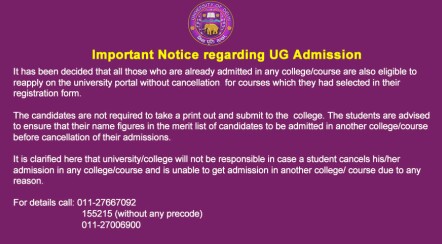
In a major relief to several aspirants, the under graduate admissions committee of Delhi University has allowed students to apply for the vacant seats in various courses across colleges under this round of admissions. Students can now apply for the same by logging into their respective accounts in the undergraduate admissions portal. The link for the same shall be made available from tomorrow i.e-26th July 2016. Tomorrow is also the also the last date for accessing the admission portal for applying for the same.

The students who have already been admitted in any college of Delhi University need not require to withdraw their admissions from their current colleges to apply to other colleges. Furthermore the candidates are not required to submit the print out of their application form at the colleges they are applying in.

The students are also advised to confirm their name in the merit list of the colleges before cancelling their admissions at their current colleges. Neither Delhi University nor the college shall be responsible if the student cancels his/her admissions in one college and fails to get admission elsewhere.


For any further clarifications regarding the issue the students can call University Helpline numbers given below.

011-27667092

155215(Without any pre code)

011-27006900


Picture from www.du.ac.in

Srivedant Kar

[email protected]

Every year, thousands of students join Delhi University to take their dream flight with their courses at various colleges. Most of them face common challenges such as beating the cut off bars, facing admission hassles of cumbersome paperwork and then, hunting for a perfect accommodation in the campus. Some students and alumni of CIC who once faced the same set of problems have come up with a new app which helps to make the entire admission process a lot easier. 

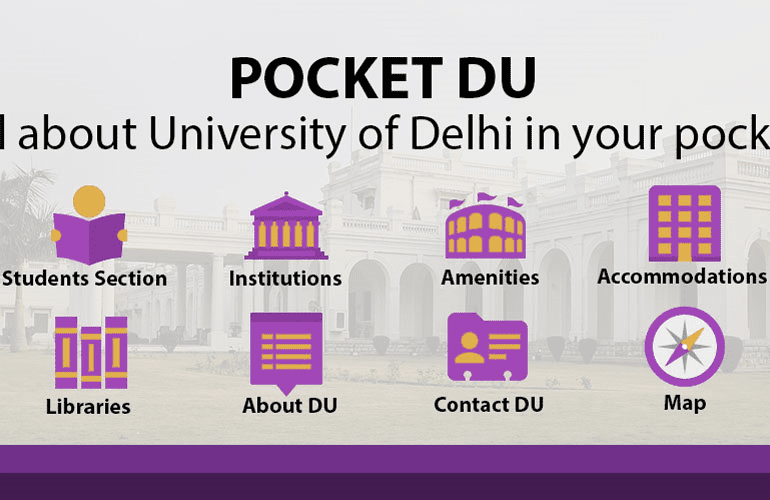
The app called ‘Pocket DU’ is an android based app which helps students from keeping a tab on all the cut offs to finding cheap hostel accommodation in a single platform. The app helps students in a number of ways. Starting from finding previous year’s question papers to detailed information about all colleges, centres and departments and latest updates of important results of the university, this app covers all possible information regarding DU. “The star feature of the app is the way it eases out cut-off viewing. Typically when cut-offs are released, students visit the website of university, download the whole PDF document which has the cut offs for all colleges and courses and scan through the document to find a relevant cut-off. Pocket DU eases out this process by providing e-shopping like filters to the cut-off and display the relevant cut-off through just a touch of finger. I feel it’s a must-have app for this admission season.” says Puneet Kumar who is an alumnus of CIC and one of the app developers.

One of the most unique features of this app is that it provides detailed information about all libraries of Delhi University and even provides students the ability to search the books available in the library through this app. The app also provides you with contact details of Administrative officials of the University as well as colleges.

You can download the app on:  https://play.google.com/store/apps/details?id=in.ac.du.delhiuniversity

Srivedant Kar
[email protected]

St. Stephen’s College has been known to be the recipient of the crème de la crème of applications. However, this year there are lesser people fighting for those 410 seats. This year St. Stephens received 23,500 applications as opposed to the 29,672 applications it received last year.

The main perpetrator, according to the teachers has been the confusion caused by Stephens’ differentiated admissions procedure and schedule. Almost all disciplines witnessed a downfall in applications. Economics saw a 29% decrease, Mathematics 31%, English 20%, Chemistry 39%, Physics 34%, and BSc programme with chemistry 28%. For a few disciplines, the number of applications increased, like for, B.A Programme (12%), philosophy (17%), Sanskrit (39%) and BSc Programme (Computer Science 28%).

The Admissions Committee has been in quite an unpleasant position regarding St. Stephens’ admission procedure. “The Committee is of a unanimous opinion that St. Stephens and even Jesus and Mary College must follow the centralised procedure as notified by the varsity. The whole purpose of the High Court directive was to help the students skip the hassle of multiple trials. If the directive is not adhered to, then the university holds the right to withhold enrolment numbers of any student taking admission in these colleges. We have notified St. Stephens College about the same and are awaiting their response” said the Admissions Committee as told to DU Beat.

Despite the numbers, the public information officer of the college, A.D Mathur seems untroubled. “The numbers dropping by a few thousand doesn’t mean anything because 23,500 is still a huge number considering the very few seats available” said A.D Mathur as told to Times of India.

The communication from the St. Stephens has thrown people as this time it has not mentioned as it is every year that the admission process and applications are different. The dates for admissions are normally synched with those of the other DU colleges but that was not done this year either, making way for disconcerted feelings.

One of the teachers at Stephens told Times of India that a fee hike maybe a reason, also that it is important to see if it is just this college or if the number of applications have declined across the University.

On the Sports and ECA front, Delhi University has asked St. Stephens and other minority institutions to join the common admission procedure for these quotas and failing to comply will lead to their admissions being cancelled. Meanwhile, Jesus and Mary College has announced its ECA criteria.


Image Credits: indiatoday.in

Baani Kashyap
[email protected]