Tag

democracy

Browsing

Democracy is often hailed as the ‘perfect’ government system. However, in a political system which rests heavily on its questioning nature, it is rather rare that we see questions being put up on the democratic system itself. However, this was not the case with Socrates, what was his criticisms? Read ahead to find out.

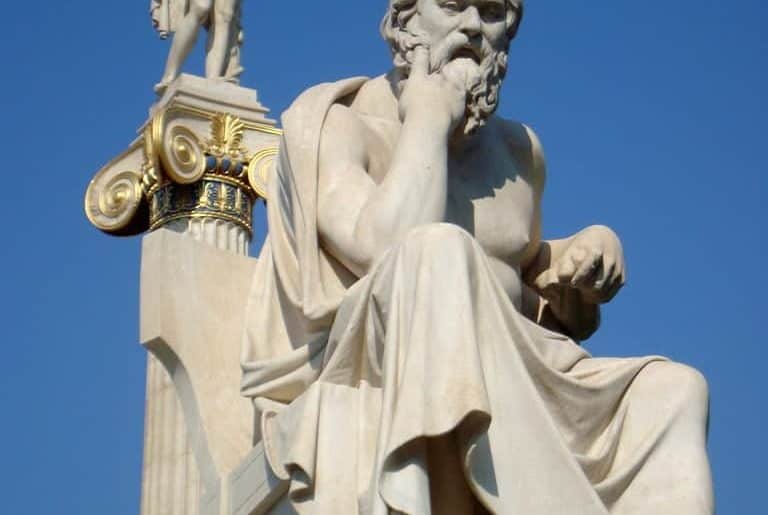
Ancient Greece is hailed for two of its prime contribution to the humankind, on being the system of Democracy and the other being Greek Philosophy. While Socrates is regarded as the father of Greek Philosophy, he did not have the same regard towards his civilisation’s other great social invention, Democracy. His problems with democracy are stated in Plato’s ‘Republic of Plato’.

Plato regarded Socrates as a pessimistic person and hence in Book Six of ‘Republic of Plato’. Plato describes Socrates falling in a conversation with an imaginary character, Adiemantus, trying to get him to see the fallacies of democracy. If you were heading out on a journey by sea, asks Socrates, who would you ideally want deciding who was in charge of the vessel? Just anyone or people educated in the rules and demands of seafaring? The latter of course, says Adeimantus, so why then, responds Socrates, do we keep thinking that any old person should be fit to judge who should be a ruler of a country? Thereby Socrates emphasises on the fact that voting is a skill and not an intuition.

He further states that citizens should be taught the ‘art of voting’. According to him, letting citizens vote without any teaching is as catastrophic as letting random people in charge of a ship heading straight into a storm. Another example, given by Socrates, is that of two contesting candidates. wherein one was a doctor while the other was a sweet shop owner. The sweet shop owner in his arguments accuses that the doctor is evil, he gives everyone bitter potions and refrains people from eating everything. While the sweet shop owner himself, says, that he on the contrary never stops anyone from eating anything and moreover gives people delicious sweets. It is not difficult to think that the doctor can’t defeat the sweet shop owner with just the argument that whatever he does is for the benefit of the people itself. And therefore, we see so many sweet shop owners and not doctors in parliaments all over the world.

Socrates never attacked on the ideals of democracy, however, he had problems with the system which we today know as Universal Adult Franchise. Moreover, Socrates advocated for the democracy which we today know as ‘intellectual’ democracy rather than democracy ‘by birth’. He warned us that this indiscriminate granting of voting rights to people without proper education would lead to Demagoguery or the practice to getting votes by appealing to the desires and prejudices of the voters rather than using rational arguments. We can clearly see today, as to why Socrates was concerned for democracy.

Taking the example of India itself, we as voters have been swayed by political parties for a long time by issues that only appealed to our prejudices and not to our needs. Be it reservation or agricultural loan waivers, political parties often use these issues to gain votes. On the other hand, the public also has become so familiar with this form of appeasement that elections are used as pressure points on various parties by the people wanting to get their job done.

Moreover, the voters also vote for leaders who provide short term lucrative solutions rather than the ones who implement long term measures. It is this political illiteracy because of which our parliament houses a total 43% Ministers of Parliament (MPs) with a criminal background. Be it the Indian National Congress MP from Idukki, Dean Kuriakose who has over 204 criminal charges like homicide, robbery, etc. or Bhartiya Janata Party’s MP Pragya Singh Thakur who is the prime suspect of Malegaon Serial Blasts or Bahujan Samaj Party’s MP Atul Singh who has charges of murder on him.

Faizan Salik, a student of Jamia Milia Islamia, said, “In my opinion, teaching fundamental rights and duties of Liberal Democracy at primary level doesn’t help, as most just study it for the sake of studying they fail to understand things, which is really problematic, teaching of essential politics is as essential as basic banking, else wise things can go in dungeon”.

An alumna of Delhi University, Mrinalika Chauhan, said, “We as voters have to understand that it is not in our favour to vote for leaders who aren’t rational enough. Yes, it will take time but we have start at the grassroots level. Each and every person in India is interested in politics, whatever their leaning maybe. What needs to be changed is that people vote based on their understanding of politics, instead of sticking to their traditional party.”

The question which arises is that whether we can change this setting or not? And here also it is Socrates’s thoughts which can help us, “Struggle is like a steep hill which looks just impossible to scale at once but when you reach the top, you don’t think about the climb but the triumph.”
Featured Image Credits: Flickr
Aniket Singh Chauhan [email protected] 
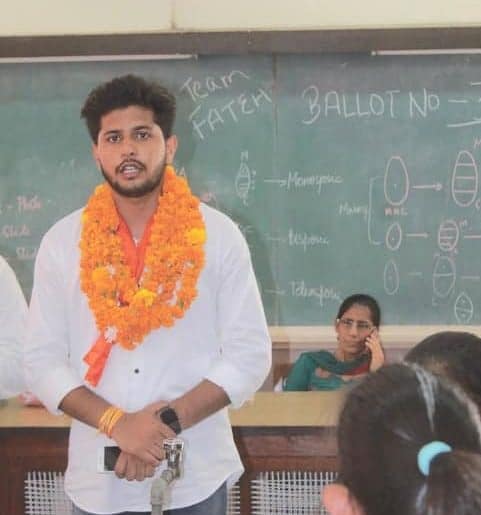
 

On 5th September, 2019, DU Beat conducted an interview with Akhil Bharatiya Vidyarthi Parishad’s (ABVP) Vice Presidential candidate, Pradeep Tanwar to know him and his perspective regarding the upcoming Delhi University Students’ Union (DUSU) elections.

Pradeep Tanwar, is a graduate in B.A. Programme from P.G.D.A.V College. He’s currently pursuing his masters in Hindi from Deshbandhu College. He has been a part of ABVP since 2015, and believes his true interest lies in politics and solving students’ problems.

What are the main issues you and your party will focus on for DUSU 2019? 

The main issues we will focus on are:

  1. Metro concession pass: it’s unfair to ask a student who comes from a middle-class family to spend so much on travelling. Our biggest fight is for metro concession passes.
  2. Hostels in South Campus: Except Venky (Sri Venkateswara College), there aren’t a lot of colleges that have hostels in south campus. We will work to establish these hostels.

To the common student, DUSU feels like an unapproachable political entity, what will you and your party do to ensure accountability to the students of University of Delhi?

I, along with other ABVP members, have went to each college to personally listen to the problems of students and solve them. Students get help from ABVP from the time they get their admission done to the date of their farewell. I will personally organise campaigns in each college to listen to students.

The incidents on Old Gupta Road and Hindu Rao Hospital highlight security concerns for those living in North Campus, what steps will you take to ensure safety and security on campus?

Of course, we’re working towards making campus safer. We’ve made a committee to look into this, and asses the cases to make campus student-friendly.

Campaigning every year uses up a tremendous amount of paper for pamphlets, posters etc., which then leads to litter on campus, what is your say on the matter?

These are how elections take place, it has become a method by all parties. ABVP doesn’t do littering as we’re always fighting for a clean campus.

University of Delhi (DU) was recently declared an Institute of Eminence by the Union Government which entitles DU to a payment of a 1000 crores over 5 years, however,  the trend in 2019 in DU has been of increasing fees and hostel rates, why do you think this is so? And what will your party do to reduce fee hikes and hostel rates?

It’s the staff and other people involved who are using this money for their own benefits. We’re working constantly towards fighting fee hikes. We protest or petition, but we always get success for students. Deshbandhu College had raised its fees, we had protested there with the students.

The Lyngdoh Committee lays down 5000 rupees as the maximum expenditure amount, how does your party maintain it?

We always manage our campaigning under the budget. We follow all rules of the committee. ABVP works all year round so we don’t require high campaigning.

Which element differentiates you from the other contenders for the post of Vice President?

What differentiates me, is my affiliation to ABVP. Students will vote for me as ABVP is the only party that works year-round for the students on a ground level, unlike other parties.

Last year, there were allegations of EVM tampering against ABVP, also to be noted, the EVM’s were privately supplied and not by the Election Commissions, how do you plan to make sure elections are held fairly?

You ask this question to us on every meeting. I would like to inform that ABVP follows the rules of Lyngdoh committee very well. At this point, all other parties are non-existent and then they use these dirty tactics making politics intimidating for all.

IMG_3775

ABVP Panel

President: Akshit Dahiya, Ballot No.1

Vice President: Pradeep Tanwar, Ballot No. 5

Secretary: Yogit Rathi, Ballot No. 3

Joint Secretary: Shivangi Kharwal, Ballot No. 4

Feature Image Credits : ABVP

Chhavi Bahmba

[email protected]


In July, 2019, the Allahabad University replaced the 96-year-old Student Union with a Student Council. Running on the same track, in October 2018, the Odisha Government notified that the Students’ Union polls will not be held in five major universities and 35 colleges due to violence . On June 7, 2017, the West Bengal government issued an order that replaced the term student union by student council . Although the Lyngdoh guidelines are mandatory for all colleges and universities and its first clause says that elections must be held in the institutes, but many universities like the Banaras Hindu University and Osmania University do not have a student body and elections have not been held since long. Out of the total 789 universities, only 50 or 60 universities are properly conducting student election . The mandatory elections norm continues to be violated by several
universities across the country.
However, student elections will take place this year in Maharashtra’s 11 state universities and affiliated colleges more than a quarter century after they were banned in 1993 by the then Congress government of M Sudhakar Rao Naik. The decks have been cleared for holding the student union
elections in Bihar universities after a gap of almost three decades in August ,2012.
The states and universities authorities take all the decision arbitrarily on the serious issue of students politics .The authority gives two grounds – first violence and second violation of Lyngdoh Committee. There are violence and hooliganism in the Lok Sabha and Vidhan Sabha Elections as well. If Election Commission can conduct free and fair election in Baster and Kashmir then why
authorities are failing to conduct it in campuses.
So on the ground of violence, administration can’t deny electoral right. Actually, student politics need to be systemized with the law and order . Even, Indian parliament has failed to address and readdress student election problem. In spite of the fact that most of the famous and established
leaders come from student politics.
Presently, student election is being regulated in India by the judicial order not by any executive or legislative order . After the Supreme Court in University of Kerala v. Council, Principal’s Colleges, Kerala & Ors., (2006) 8 SCC 304, (referred to as “University of Kerala 1”) case , Lyngdoh Committee
was formed in 2006 by the HRD ministry to suggest reforms in the student union elections at the college/university levels. It was argued that these were becoming places of political tensions escalating into violent encounters between students. Under the leadership of J.M. Lyngdoh, it submitted its report to the Supreme Court of India on May 26, 2006. The Supreme Court on
September 22nd of the same year issued an order directing the college/university to follow and implement the committee’s recommendations. Lyngdoh Committee aimed at making elections cleaner, non-violent, and curbing the use of money and muscle power in the elections. In the
committee ,there were . Mr. J.M.Lyngdoh, Retd. Chief Election Commissioner (Chairman), Dr. Zoya Hassan, Professor Pratap Bhanu Mehta and Dr.Daya Nand Dongaonkar (Secretary General of the
Association of Indian Universities). Justice Markandey Katju and Ashok Kumar Ganguly held the order of Lyngdoh committee report as legislative order.
Lyngdoh Committee aimed at making elections cleaner, non-violent, and curbing the use of money and muscle power in the elections but it has failed on all fronts. There is a long list of recommendations, which are flouted in every elections, like the Committee explains that (6.6.1) the maximum permitted expenditure per candidate shall be ?5000, clause 6.7.5: No candidate shall be
permitted to make use of printed posters, printed pamphlets and 6.7.9: clause says that during the election period the candidates may hold processions and/or public meetings, provided that they do not, in any manner, disturb classes and other academic and co-curricular activities of the
college/university. Lyngdoh prohibited political parties from contest election and said that only
independent candidates can contest. The Lyngdoh also confused student council and student union.
Sections 6.1.2 and 6.2.1 of the Lyngdoh committee reports that only universities with a small
campus and fewer students, like JNU and Hyderabad University, should be allowed to form their
student unions via direct elections. The Allahabad university administration’s scrapped the Union
into council on this basis. The model Student Union differ from student counselling on fundamental
structures. Various positions of this council including President and Treasurer will not be elected by
students but nominated by the head of that specific institute. The Class Representatives will vote
and choose it’s General Secretary instead of direct elections. Basically, this body would be stripped
of its political voice or ability to reconcile under a banner to raise demands of the students. It would
be limited to organize cultural events and other such activities.
In reality Lyngdoh has failed and students politics needs major intervention by the Parliament.
Students politics needs a valuable legislation to scrap the Lyngdoh like National Student Union Act.
Instead an idea of one nation one election should be implemented in all the university. Election Commission of India should conduct elections instead of the university authority.
In reality, students politics is not only important for students but it is in national interest. Without the strong students politics Indian democracy can not run energetically. The democracy needs aware citizens , movement , intuitional awareness and those who can resists for their right .The students politics has all these character.
The youth is largest stake holder in Indian politics .The largest identity has its own challenges .

Without the integration of youth, Indian democracy can’t survive .The Indian parliament is one of the oldest parliament(in terms average age of parliamentarians) in a young country like India. The present day politics has excludes youth from politics as they think it to be highly nepotistic and filled
with unnecessary money-muscle power. This can be corrected through student politics . It is one of the easiest way through which a marginalised can become a leader. The philosopher likes of Plato as well as contemporary thinkers including American philosopher Martha Nussbaum have emphasised the need for political consciousness among the youth, which student politics create. Nussbaum has
written in her work, Cultivating Humanity: A Classical Defense of Reform in Liberal Education, “It would be catastrophic to become a nation of technically competent people who have lost the ability
to think critically, to examine themselves, and to respect the humanity and diversity of others .”
The Indian youth have the capacities to take democracy in their hands .He has capacity to
revolutionise the people like international students movement . The Vietnam War Protests – 1966-1969 , Anti-Apartheid – 1976 and Tiananmen Square Protest – 1989 ,these three student protests that changed history of the world. Even, Indian student movements have had some successful movements like, indian freedom struggle ,1977 Sampoorn kranti JP movement and 2011 Anti
corruption movement .
In the first week and second week of September,2019 ,Asia’s biggest Students Union election would be happening in the Jawahar Lal Nehru University and University of Delhi. Let’s celebrate youth democracy and demand to regulate the law of National students union election and open the door
of youth into politics .
Raja Choudhary
(Former DUSU Presidential candidate and student of Faculty of Law , University Of Delhi . He is also the author of a book titled ‘Ayodhya’)

A true democracy is where everyone is equal. The one who sits on the chair and the one who stands below have equal rights and powers. This equality comes when everyone has the right to question those in power. This makes the authority accountable to people and also allows those who don’t hold any position of power demand the rights guaranteed to them by the Constitution. In the Indian scenario, where questioning elders is deemed as disrespect, a majority of the country never learns this art of critical thinking which is essential for the soul of every democracy to survive on.

The University of Delhi (DU) is considered as one of the most politically active campuses in the country. Every other day, you can find a protest, gathering or a rally for various reasons in its north campus. This protest culture of the University offers a lot to learn from the students. These protests not only gather support for various demands but also become an important chapter in your learning process. It teaches you how to question authority and how to register dissent in person or as a community. This lesson further helps you to speak your mind and share your thoughts without any fear of authority.  Regardless of the immediate goal at hand, be it high hostel fees or poor infrastructure, it trains you to be proactive against larger issues throughout your life.

These protests also instil in you the courage to fight and the resilience to survive opposition from systemic forces. Many a time, people face oppression because the victim either lacks the courage or the knowledge required to speak up. This courage won’t just help you grow as a leader but also helps you in articulating your opinions on public platforms. Be it in corporate boardrooms or political meetings, courageous leaders are the need of the hour today. Given the history of the University, some student protesters such as Arun Jaitley and Shashi Tharoor have grown up to become senior politicians in the country. The ability to stand up for what you believe in determines your position in the society.

Be it the case of adhocism of teachers, a fake encounter in a Naxalite area or the plight of Syrian refugees, every major injustice, be it local or global is highlighted through protests in the University.

Today, as incumbent governments across countries are cracking down on dissent and vilifying the protest culture as ‘anti-national’, the time requires you to learn how to protest more than ever before. The next time you see a protest or find an invitation regarding something you feel strongly about, make it a point to participate. By staying silent or avoiding protests you are killing someone who is most important to your future, the leader inside you.


Srivedant Kar

[email protected]

Now that the MBA entrances are over, it’s time for the Group Discussions, Interviews and so the preparations are in full swing. When it comes to mock GDs, there are always those clichéd topics that never seem to get old and make the students feel like they’ve hit the jackpot.

One such evergreen topic relates to the success (or the lack thereof) of democracy in India. This seems to ignite such passion in the contestants that the best you can do is to hide under your chair to prevent being caught in the crossfire as they try to rip each other’s throats out. But the one emotion that seems to stand out in such a heated discussion is the absolutely loathsome outlook that they share for the politicians across the country.

While some argued that the numerous scams that pop up each day spelled the death of democracy, yet others argued that it wasn’t irreparably damaged and that effective policies could go a long way in helping it rise from the ashes. One gentleman vehemently argued that there was no antidote, for the system had completely failed. He went on to add that India should emulate the American bipartisan system of democracy and that he would rather migrate to the USA than live in India. There were a few who tried feebly to counter his arguments but were soon convinced by his arguments and nodded meekly as they were swayed by his ‘eloquence’.

Conclusion: We’re tired of such rampant corruption and lack of even a shred of morality in the political structure of this country. But we’re much too involved with our own lives to take a step forward and own up to our responsibility; to ever make an active contribution to cleaning up the mess that is politics for the fear of tarnishing our own image by mere association.

That right there, I believe, is the death of democracy; where the people have the freedom to make a choice but don’t want to exercise it. If we can’t forgo our own selfish interests, regardless of what they might be, and choose to curse from afar, then why do we expect the politicians to put national interest ahead of their own needs? Be the change you want to see, isn’t it?


Surya Rajappan
[email protected]

As part of an international campaign to free the apprehended Burmese leader, Daw Aung San Suu Kyi, Lady Sri Ram College organized a series of events to enhance the impact of the campaign. Aung San, who happens to be a distinguished alumna of the college (1964), has been imprisoned many times in course of her struggle for a free and democratic Burma.

In order to celebrate this indomitable spirit , LSR organized an exclusive screening of the film ‘Burma VJ: Reporting from a close country’, which through it’s hard hitting visuals and singular footage strongly reflected the difficult fight for democracy in Burma. The screening was accompanied by a panel discussion which saw participation from some of the most eminent personalities including G Parthasarthy, distinguished diplomat; Jaya Jaitly, political and social activist; Ravi Nair, human rights activist and Sagarika Ghoshe, TV anchor who acted as the mediator for the event.

Dr. Meenaxi Gopinath in her welcome address said, “We feel empowered by the struggle of this illustrious alumna for democracy and human rights in Burma.”

Parthasarthy expressed the need for international pressure to solve the Burmese issue- “ We have to work with others in the world, we have to persuade ASEAN.” Jaya Jaitly stressed on the effectiveness of independent action from each nation by means of a letter to the UN Secretary General. Introspection and suggestions for the future formed a part of Ravi Nair’s opinion, who further went on to muse over how the world should deal with generals who had no “eyesight, insight or foresight”.

Also present were Burmese monks Ashin Pannasiri, one of the many mistreated at the hands of the military and who had to escape from jail; Ashin Thavara, who featured in the above mentioned movie ‘Burma VJ’ and Thin Thin Aung from the Women’s League of Burma. Ashin Pannasiri’s version of the famous Saffron Uprising of 2007 deeply touched and inspired the audience.

LSR organized an essay writing competition based on Aung San Suu Kyi and a cross country race for her release. The Cross Country which was held on the 28th of August saw the participation of over 600 students.

A message from Dalai Lama to LSR said,” I am happy to learn of LSR’s initiative. It is my hope that Ms Aung San Suu Kyi will not be kept captive for long and that under her leadership the people of Burma will soon achieve their aspirations for which she worked so hard and so courageously.”

Lady Sri Ram College proudly celebrated the struggle of a woman who symbolizes democracy and is an epitome of courage and values. It held this event with the hope that the world will unite in this fight for justice and see participation from the youth, just as Aung San Suu Kyi herself participated in the struggle to alter the lives of millions!