Tag

Delhi University

Browsing

Newly out of the sheltered and cocooned environment of a school, falling into the uneven and harsh terrain of a college, often we find ourselves drawing outlandish parallels between the two institutions.

While the first to twelfth grades are even steps of a progressively heightening ladder, college is the tight rope that one is expected to walk on immediately thereafter. And the latter is a tough nut to crack. As students conditioned into adherence of the stringent school norms, the liberal atmosphere of a college can be both restrictive and intimidating for many of us, depending on how sensitive we are to the changing environs around us. As with any other species, adaptation is key for college newbies too.

Students step into the University with almost bizarre pre-conceived notions, picked up from either word-of-mouth or unintended dialogue, which is usually only unproductive blabber. Well, college is hardly the illusion it is made out to be. While there are some facts that do hold true, there are quite a few which are completely irrational.

From waking up at 6:00 AM to getting dressed for school at 8:00 AM, five days a week, to contemplating attendance for the first lecture thrice a week and deciding against it, finally giving up and going back to bed every single time, college life is a complete U-turn. The massive change which comes with some flexibility, though necessary for students engaged in other activities besides their core academics, can also be exploited. Unfortunately, as soon as a leeway if given in terms of attendance, everyone is content with not showing up for classes as and when convenient. But the contentment usually backfires by the time the semester examinations approach. By then, the ritualistic practice of running after professors for notes and internal marks begins automatically.

College allows for a certain degree of independence, both emotionally and physically, that a school restricts in many ways. Quite a lot of people move out for pursuing degrees in undergraduate courses, some even going abroad, which requires prior preparation on various levels. From finding an accommodation and evaluating comparative benefits of the same to managing finances and holding oneself responsible for one’s own safety, college requires a person to brave against all odds. And as daunting as it may sound, it is the only thing that can probably set a person free from the habit of overindulgence.

While school is a great breeding ground for the simulation of ideas, there is a lot of ‘spoon-feeding’ involved. Pre-formulated notions are fed to the students without inculcating in them a thirst for questioning those notions. College, in this regard, guarantees severe mental exercise on an individual level, on a daily basis. With myriad incidents occurring in campuses on a routine basis, a person is compelled to take notice and address the problems responsibly. It coerces you into thinking about these issues with a latent sense of detachment. With ongoing campus debates and protest rallies for everything from LGBTQ rights to indiscriminate hostel curfew, youngsters attempts to pose questions and challenge the diktat of the authorities.

A college, as mentioned above, instills in us a plethora of good dispositions. When in school, a student generally aims to strike the right balance between academics and extra curriculars and in many cases, the latter ceases to exist. But when in college, it is the world that you are competing with and the competition is relentless. Owing to the rat race that we all unintentionally enlist ourselves in, we pave way for ruthlessness. It is not so much the consideration of the grade point average in isolation as much as the cumulative assessment of an individual’s personality in various arenas of prominence that set him/her apart from a crowd.

With both having their fair share of importance, a school nurtures you into its cocoon, long enough for you to build yourself up from scratch. And a college acquaints you with everything that you need to have, to be well equipped in life.


Feature image credits: Team Fuccha


Lakshita Arora

[email protected]

Graduating from University of Delhi (DU) is still considered prestigious, but why do the same students with all the merit, never want to return as teachers to their own University?


In a few months, a prestigious University of Delhi (DU) degree in hand, the real world with its blankness and stiff competition will begin to look curiously topsy-turvy for most third-year students. Those rose-tinted glasses, which made life in college appear idyllic for two years, will have to be inevitably chucked aside in favour of the grittier, ‘realistic’, adult perspectives which only point to one of these two scenarios, in case you are a third-year student: either you have zeroed in on an employment/higher education opportunity which you feel reasonably confident about cinching, or, you have your feet pointing in multiple directions and in no particular direction at the same time. Either way, your ultimate goal is viable employment. But what if your feet took a U-turn and chose to come back to the University, looking for employment? In fact, how do students in DU truly feel about coming back and teaching at the University one day?

“I don’t feel comfortable with the idea of becoming a university lecturer. It’s highly unstable [as an employment opportunity]… Look at the state of our universities today; there is no freedom of speech and the way our ad-hoc teachers are treated is inhumane. My teachers themselves tell me not to become a lecturer. What more do I need as a proof?” says a Botany student from the North Campus.

Delhi University Teachers' Association strike
Delhi University Teachers’ Association strike

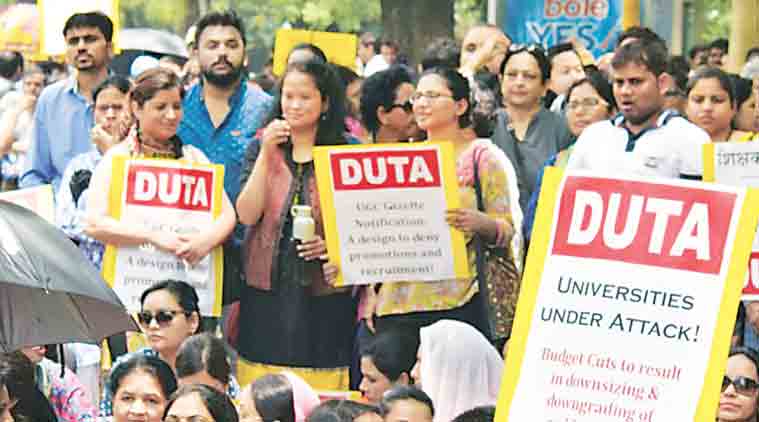
I remember one of my teachers in the English department attesting to something similar: the foundations of higher education in India are so shaky that the next generation dare not step on it, from fear that the existing plane may collapse too. Over the last one year itself, numerous national dailies have covered the Delhi University Teachers’ Association (DUTA) protests for pay-rise and against the lack of permanent positions for lecturers, the overwhelming despair and suicides of PhD research scholars when they stared at their bleak future, shutting down of centres for the Humanities in several colleges, protests against the teaching of liberal ideas and values in universities such as Jawaharlal Nehru University (JNU), and many other related events. If a severe lack of funding plagues the Arts departments across India, the treatment meted out to lab assistants and ad-hoc lecturers in the Sciences fares no better. Teaching in a university, in short, comes with more perils than advantages.

“It’s sad, but the truth is that even I would not recommend any student to become a lecturer these days,” I recall overhearing a teacher telling another in the corridors of my college once. One after the other, as attacks mount upon the state of university education in our country from all sides, it becomes viable to look for alternatives. There are private-sector jobs and the ever desired civil services exams eyed by more and more students as the pool of competition widens further and further. Some even question what the point of an M.A. degree is, if the road to research scholarship and teaching appears this murky.  And if things are bad today, how much worse can they get tomorrow? It seems as if one door will shut forever for most of us, by the time we leave DU with our degrees next year.


Feature image credits: YourStory

Image credits: DU Beat


Deepannita Misra

[email protected]  


Do students who are fluent in English have more resources available at their disposal and is there a linguistic bias prevalent in the University of Delhi?

The English bias is a very real phenomenon, especially in a country like ours, which hasn’t been able to completely break free from the chains of colonialism, even after 70 years of independence. In the University of Delhi (DU), an institute where the medium of communication is primarily English, this becomes especially problematic for a lot of students. An education in DU is not exclusive to private school students, and the teaching methods should reflect that, doing justice to the diverse student body.

While some professors try to accommodate students from a Hindi-medium background, this practise varies from college to college.  For instance, The Directorate of Hindi Medium Implementation publishes translations of various books from English to Hindi every year. But these translations are not enough to cover the curriculum’s width and depth. Supplementary readings and handouts that professors circulate in the classroom are majorly in English, and students who are not comfortable with the language miss out on them. For them, the only way to understand the syllabus and its contents is either to seek help from guides or helpful friends. They spend long hours looking up words in the English-to-Hindi dictionary in order to understand their curriculum better. This task is tedious and the language barrier and lack of resources leads them to spend immense energy on something as basic as having access to the study material in a language which they are comfortable with. Similarly, students fluent in other regional languages face a drawback too.

Rinki, a student of B.A. Programme, studying Psychology and English from Daulat Ram College, says, “Bohot Hindi-medium students class mein bolne mein hesitate karte hain. Yeh zaroori hai ki aise motivational programmes college mein hon jisse unka stress aur hesitation kam ho (A lot of students from the Hindi-medium backgrounds hesitate in speaking in their class. It is important that colleges organise motivational programmes to help students reduce their stress levels and hesitation.)”

It is essential that we acknowledge that this emphasis on our education being imparted in English results in other students not comfortable with the language suffering immense academic losses. It is important that we establish this fact – having the ability to read and write in English is an additional skill, not a minimum requirement to have access to a good education. It is imperative that we remember that fluency in English should not be a prerequisite to be able to understand your professors.  Fluency in English is closely linked with education in private schools. It is a product of one’s privilege as much as it is the product of one’s dedication and hard work. It would be highly unfair if these criteria were allowed to determine and influence the quality of education imparted to students who don’t speak in English.  Colleges must actively seek out and encourage the faculty to bridge the gap between the resources available to English speakers and those more comfortable in regional languages.  Apart from ensuring that reading material and secondary readings are translated, they must also ensure that the faculty encourages all students to actively participate in class. The purpose of a language is to facilitate discussion, debate, learning and expression. But when language starts restricting people from actively seeking a good education, it becomes highly problematic. The first step in solving a problem is realizing that we have one.

September 8th was World Literacy Day, and it reminded us that education is the greatest gift mankind gave itself. Today, we are living in  times where we can see our mother tongue slowly fading out, both in terms of its relevance and common use.  And therefore, it is even more important that those who speak the language should be encouraged to pursue it further. If students who prefer regional languages over English keep encountering challenges while trying to pursue an education, it would lead to the slow demise of the language and would act as a deterrent for others wishing to pursue it.


Feature Image Credits: Pinterest

Kinjal Pandey
[email protected]

It seems that the University of Delhi’s feud with the Delhi government is here to stay for a while longer, albeit more serious than before. The Delhi Government has ordered to continue with the decision to freeze funds for the 28 colleges it funded either partially or fully, till the time governing body is not appointed by the Varsity.


Furthermore, the government has asked Delhi University not to conduct recruitments for ad hoc or permanent teachers, or make any severe changes in the administration staff until this issue is resolved. This to-and-fro of documents has been going on since October last year, but has gained momentum only recently. On 31st July, Manish Sisodia, the Delhi Minister of Education directed a stop to funds inflow for the 28 colleges it funds, and in a tweet he claimed that it was a “deliberate and malafide attempt to delay formation of governing bodies by DU”. On 14th August, the list of governing bodies was finally sent by DU, but was rejected by the government citing procedural grounds.


The governing body of a college comprises of five members from the university panel, five members from the government, two university representatives, two representatives of the college faculty and the college principal. The Varsity recommended just 5 candidates for governing body to the government, whereas it was supposed to send a pool of names out of which the government had the liberty to select any five. Since the options weren’t provided for the same, the government has given DU stern warnings to not “infringe upon its rights” of nominating members. At this stage, the government reportedly wants DU to accept the nominations cleared by them and has sent the university a fresh list.


Since February 2017, the list concerning these recommendations has been tweaked with minor changes, edited because of change in format and rejected on procedural grounds. If the government plans to pursue its impromptu decision to halt funds, the 28 colleges that it funds will soon sway in an array of confusion and chaos.


Feature Image Credits: Manish Sisodia’s Twitter Handle

Vijeata Balani

[email protected]

The Delhi State Committee of Students’ Federation of India (SFI) has decided to join hands with All India Democratic Students’ Organisation (AIDSO), with an aim to fight against Akhil Bharatiya Vidyarthi Parishad (ABVP), the student wing of the Bharatiya Janata Party for this year’s DUSU election.
In a press release, AIDSO said, “We believe in forging a broader unity of the left and democratic forces.” The radical transformation of university space in DU cannot be accomplished without building the broadest possible unity of all the progressive forces in the campus based on students’ rights, which are being attacked by the ruling ABVP led DUSU in collaboration with the Central government”.
Furthermore, their statement also stated, “SFI believes Left politics wholly depends on mobilising the masses, and this can happen only by forging broad alliances of progressive political forces in the University. In pursuance of the need for a greater unity, SFI-AIDSO has come together in Delhi University Students’ Union Elections to forge an alliance of struggles.”
The student panel standing for the election from this alliance is as follows:
1. Rafat Alam: DUSU President (SFI), M.A, from Department of Social Work
2. Jitendra Kumar: DUSU Vice-President (SFI), LLB from Campus Law Centre
3. Kolisetty Lakshmi: DUSU Secretary (SFI), from Shri Ram College of Commerce
4. Roshan: DUSU joint Secretary (AIDSO), from Satyawati College.
All India Students’ Association (AISA) is the only other Left aligned party contesting the election. Earlier this week, ABVP, NSUI and AISA also released their student panels for this year’polls.

Image credits: Asian Age

Joyee Bhattacharya
[email protected]

The National Green Tribunal is strongly set against the blatant use of paper in the DUSU elections in violation of its order abstaining the students’ body from using pamphlets and splattering the walls of the varsity campus with posters. A bench headed by NGT Chairperson Justice Swatanter Kumar issued contempt notices to Delhi University Students’ Union, Delhi University and University Grants Commission on the issue of wastage of paper during students’ union polls and sought responses. They were asked to appear on Wednesday. The tribunal in 2016 had asked the university and the student’s groups that participate in the elections to go paperless during the canvassing.
The directions came on a plea by Delhi University law student Nithin Chandran, who had approached NGT against indiscriminate wastage of paper during the students’ body elections. “On every election, tonnes of paper are wasted for canvassing by the candidates and their supporters. Wherein, there is no accountability for usage of paper and neither there is any norm or procedure for recycling of this waste paper,” the plea had said.
It had has also cited the Supreme Courts 2006 order directing universities to implement the recommendations of the JM Lyngdoh committee in their students’ union elections.

The NGT Act 2010 has provisions for a penalty under section 26 of the act in case of failure to comply with orders of the tribunal. Maximum punishment of three years imprisonment and Rs 10 crore as fine.

DUSU elections are scheduled to be held on 12th of September.

Image credits: DU Beat archives

Sandeep Samal

[email protected]

On 31st July, Manish Sisodia directed the Finance Department to stop the funds to 28 colleges of University of Delhi, over what he termed was “mala fide to delay the formation of governing bodies” which had been pending since October 2016. The purpose of these governing bodies was to facilitate and keep the check on the funds provided to Delhi University by the government of Delhi and to ensure accountability.  There are twelve fully-funded colleges, while sixteen others recieve 5% funding from the government. This landmark decision could directly affect colleges like Deen Dayal Upadhyaya College, Maharaja Agrasen College, Shaheed Sukhdev College of Business Studies and nine others as they recieve direct funding from the government. Whereas colleges like Kamala Nehru College, Delhi College of Arts and Commerce, Shivaji College, Gargi College and fourteen others come under the partially-funded category.

In a last minute save, Delhi university (DU) sent a list of names for the governing bodies. However, that list was rejected by the Delhi government on 14th August on procedural grounds. A government official told Hindustan Times “DU has sent a list of five members for appointment of as governing council members.” Whereas the university had to send numerous names from which the government of Delhi chooses five, as the government warrants the members of the council, not Delhi University.

The contention between the government and university seems to persist because the state government has now nominated five members, that according to sources, includes names of those from diverse feilds to uphold balance in representation. The Aam Aadmi Party (AAP) led government has asked DU to “duly constitute” the governing bodies which will include the five members included in the list sent to DU by the government before appointing any teachers or making severe administrative changes.

Image Credits: DUB Archives

Bhavya Banerjee

[email protected]

As the election season is round the corner, there are a few questions we need to ask ourselves before you cast your precious vote. For the past many years these student unions have been releasing majestic manifestos. Has there been any progress? Has the University witnessed a change?
If you go through the manifestos of different parties, you’ll realise how similar they are in the amenities, provisions and campaigning techniques. The consecutive years have seen no major change in these manifestos; they remain focused on providing a safe environment for women, affordable hostel facilities, proper implementation of the Choice Based Credit System, formation of a North Eastern Cell, encouragement of anti-ragging and anti-discriminatory practices, and so on.
One might argue that change doesn’t happen in a day but the fact that certain parties have backed a seat or two (or more) in DUSU elections year after year and still the agendas they put forth remain the same is a matter of great concern. The students of the University of Delhi need to question their political presence and the allocation of resources that they garner.
Talking of ABVP, since 2014, certain bullet points have maintained their place in the list of agendas even after them coming consecutively to power. They include having a bank account for all the students of the University, hostels, safety from sexual harassment and discrimination, North East progression and preservation of their culture and rights, etc. It is alarming that such issues of grave concern still remain left to be addressed. The same story continues if we look at the manifesto of NSUI or even that of AISA.
Political ideology and inclination is what separates them because the demands and needs of the students are basic and every party knows the importance to assure the basic minimum requirements in their own ways. The problem arises when after capturing the seats, the funds are misused or muscle power becomes the means to address issues, staff and students alike.
One way by which we, being aware citizens of this University, can ensure greater credibility, responsibility and participation from their side is by continuously questioning them through the means of different forums regarding their earlier manifestos and the allocation of funds. The fact that we are the largest democracy of the world gives us an advantage over these parties who live in a constant fear of losing elections if they don’t perform to the best of their abilities. We have to target this weakness of them because this one vote that all of us have is our greatest strength.
Feature Image Credits: PV Purnima for DU Beat
Ananya Bhardwaj
[email protected]


The recent policy change in calculation of points for teaching experience will affect hundreds of DU’s ad-hoc teachers.

In an environment where ad-hoc teachers face uncertainty and battle for fair-play on a daily basis, the University of Delhi (DU) has come up with a new policy which could make things even more difficult. In this unprecedented move which only tips the scales further, DU has altered the 2013 University ordinance which allotted twenty points for teaching experience. According to the new policy, one year of teaching experience will now equal a mere four points. But if the teacher has five years of teaching experience, he or she shall be rewarded twenty points.

The magnitude of blatant disregard for ad-hoc teachers’ toil, experience and time is clear in the policy which slashes the points rewarded in a brutal manner. It is expected to affect as many as 4,500 ad-hoc teachers vying for permanent positions. A report by The Indian Express marks out how significant these points are during the screening process for permanent recruitment.

Pankaj Garg, a Mathematics lecturer and member of the academic council, spoke to The Indian Express on this issue, stating: “We have submitted a new formula to Dean of College and coordinator core committee screening for calculating points of teaching experience.” Indeed, the teachers and members of the academic and executive council have been unanimously vocal in their condemnation of the new policy, while actively raising an objection to it. The massive reduction in points not only affects the current teachers, but will also have an adverse impact on the points for teaching experience calculated for the future generations of DU’s lecturers.

This change, brought about after the University centralised the screening process for recruitment of assistant professors, leaves not only the current ad-hoc teachers, but also the students who might have desired to become university lecturers one day in the future, in an utter flux. Such unforeseen and adverse policy changes on the part of a major, reputable central university like DU, do not reflect well upon the state of higher education in government institutions. They are only the mirror reflections of a sad, deeply infested public education system, now rotting away at its core. While a University official refused to comment beyond stating to The Indian Express that they would look into the issue, only time will tell which side finally wins, and whether or not the ad-hoc teachers get their due.

Feature Image Credits: The Indian Express

Deepannita Misra

[email protected]


DU has finally sent in a list of the governing bodies of its colleges. Here’s a quick run-down of events that lead up to Delhi government’s massive decision to freeze funds for the 28 colleges it funded. 


In what can be called a last minute miraculous save, the University of Delhi has finally sent a list of names for governing bodies of the 28 Delhi University colleges to the Delhi government. This is in response to the Delhi government’s repeated reminders and an ultimate threat to withdraw support for the 28 colleges it funds. On 31st July, Manish Sisodia announced a landmark decision to freeze funds since the respective colleges had failed to form governing bodies in time.

Devesh Sinha, the Dean of Colleges confirmed that DU had sent the list of the reviewed panel, and said, “A few changes were made to the list and it was sent to the Directorate of Education”. He also mentioned that the Executive Council has tried to maintain a diversity of occupations and included at least 2 female candidates. When he was questioned by Indian Express about the delay in the formation of the governing bodies 2 weeks back, he had said, “Since our Vice Chancellor and other top officials are involved in the Law Faculty interviews, there has been some delay in the process.”

The Directorate of Education is yet to verify if it received any list concerning this.

In what has been a to-and-fro of documents since long, the saga has been ongoing since October last year. The term for the last governing bodies ended in October 2016. According to a picture tweeted by Sisodia detailing the sequence of events, repeated reminders were sent to Delhi University by the Director of Higher Education, Government of National Capital Territory of Delhi(GNCTD).

In February this year, a panel of names was sent to GNCTD. The government then sent its recommended panel to Delhi University for approval. Since then, the list has been hanging, either due to a change required in the format or the list not being approved by the Executive Council of DU. Finally, the list was passed albeit after tweaking minor changes, to include recommendations from diverse backgrounds and evenly divide. The governing body of a college comprises of five members from the university panel, five members from the government, two university representatives, two representatives of the college faculty and the college principal. An ideal governing body consists of a wide range of members to ensure a healthy mix of lawyers, educationists, journalists etc.

Delhi government’s decision to hold on to funds had sparked a huge furor among both, students and teachers. Members of ABVP challenged the move and burnt an effigy of Sisidoa on 31st July near the Faculty of Arts, North Campus. The National Democratic Teachers’ Federation, too, protested against the government’s decisions citing financial reasons. According to sources, 360 crore is annually allotted to those 28 colleges. With the list finally sent, it remains a dubious question if the decision to freeze funds would be pulled back.


Image credits- Financial Express


Vijeata Balani

[email protected]