Tag

Admission

Browsing

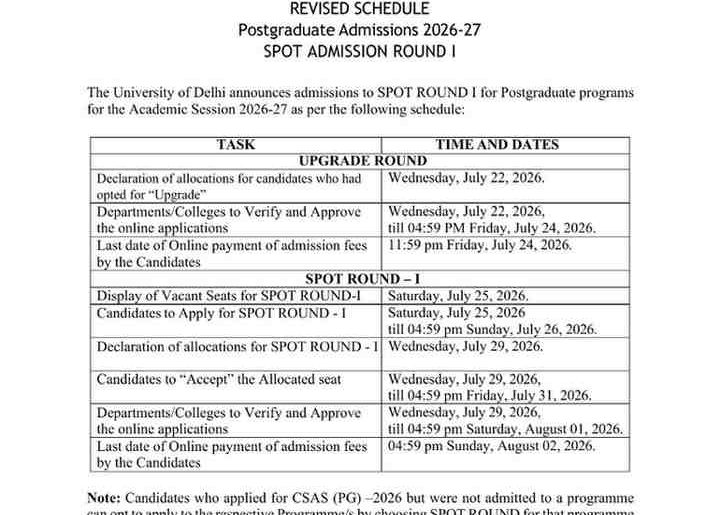
DU has announced a revised postgraduate admission schedule, updating the timeline for the upgrade round and spot round 1 under CSAS-PG.

With the admission process for the academic session 2026-27 underway, a revised schedule announcing dates for the upgrade round and spot round 1 under the Common Seat Allocation System for Postgraduate Admissions (CSAS-PG) has been released by DU. 

Candidates allotted seats through the Delhi University PG upgradation round are required to complete the admission process by paying the prescribed fee on or before July 24, 2026. Colleges and departments will verify and approve online applications until the same date. Students who receive upgraded allocations must complete all admission formalities within the stipulated deadline to retain their allotted seats.

The university has also introduced spot round 1 to fill seats that remain vacant after the completion of the regular allocation rounds, ensuring that available postgraduate seats across departments and colleges are utilised efficiently. The round provides an opportunity for eligible applicants who were not allotted seats in the earlier rounds to secure admission to their preferred postgraduate programmes. It also enables the university to fill seats left vacant due to withdrawals, non-payment of fees, or candidates opting for admission elsewhere after previous allocation rounds.

According to the revised schedule, the list of vacant seats for spot round 1 will be published on July 25, 2026. Candidates who wish to participate must opt in for the spot round between July 25 and July 26, 2026 by 4:59 pm. To opt in, applicants are required to log in to the CSAS-PG portal using their CUET (PG) application number and password during the specified window. Only candidates who opt in during this window will be considered for seat allocation.

The university will announce the Spot Round 1 allocations on July 29, 2026. Candidates allotted seats must accept their allocation by July 31, 2026 by 4:59 pm. Colleges and departments will verify and approve online applications from July 29 to August 1, 2026 by 4:59 pm, while the final deadline for online fee payment is August 2, 2026 till 4:59 pm.

Candidates are encouraged to follow the revised schedule thoroughly and keep track of important dates to avoid any inconveniences and ensure a smooth admission process.


Read Also: DU Forms Committee to Review One-Year PG Admissions Amid ABVP Protest Over Seat Crunch 

Image Source: DU’s official website


Bishakha Gogoi

[email protected]

Ahead of the 2026–27 academic session, DU has set up two joint control rooms, ordered bilingual anti-ragging banners, and directed colleges to strictly implement anti-ragging measures before classes begin on July 28.

The University of Delhi held an online meeting on July 20 with college principals, heads of departments, hostel authorities, DUSU office-bearers, and Delhi Police to finalise anti-ragging arrangements before the arrival of the new batch, in accordance with the academic calendar notified by the university. As part of the measures, DU will establish two joint control rooms – one each on the North and South Campuses – from July 28 to August 7, providing students and college authorities with a direct channel to report incidents of ragging.

The university has also directed colleges, departments, and hostels to install bilingual (English and Hindi) anti-ragging banners at strategic locations, prominently display rules prohibiting ragging, and restrict the entry of outsiders into their premises. Delhi Police will deploy women personnel in plain clothes both within university campuses and outside individual colleges. The university has also stated that women’s colleges will receive additional police assistance.

In line with the Supreme Court’s directions on ragging and UGC regulations, all incoming students and their parents or guardians must submit an anti-ragging undertaking through the UGC’s official anti-ragging portal at the time of admission. Colleges have further been instructed to strictly enforce Ordinances XV-B and XV-C of the University of Delhi, along with the provisions of the Sexual Harassment of Women at Workplace (Prevention, Prohibition and Redressal) Act, 2013.

These measures form part of the UGC Regulations on Curbing the Menace of Ragging in Higher Educational Institutions, 2009, which are mandatory for all higher educational institutions and were framed following Supreme Court directions on preventing ragging.

A comparison with previous years shows that the university’s anti-ragging framework has remained largely unchanged. In 2022, DU operated joint control rooms from November 2 to 11, along with NCC/NSS vigilance squads and police deployment outside colleges. In 2024, it issued an 11-point anti-ragging notification, set up control rooms from August 1 to 10, detailed disciplinary penalties, and observed Anti-Ragging Day on August 12. In 2025, the university retained the same structure, with control rooms functioning from August 1 to 8 and the addition of the Himmat app and campus security helpline numbers.

For 2026, the principal change is the timeline. The control rooms will operate from July 28 to August 7, with the existing anti-ragging framework brought forward to coincide with the earlier commencement of the academic session rather than introducing significant new structural measures.


Name: Arshia Sharma

Email- [email protected] 

Image credits: DuBeat

Read Also: NCWEB applications open for B.A. (Prog) and B.Com; last date to register: July 24

Delhi University has announced the second round of PG seat allocations under CSAS-PG 2026. Candidates must accept the allotted seats by June 24, while fee payment remains open until June 27.

DU is conducting admissions to postgraduate programmes for the 2026-27 academic session on the basis of scores obtained in the Common University Entrance Test (Postgraduate), or CUET-PG. The university allocates seats based on candidates’ entrance examination scores, programme preferences, and seat availability through the Common Seat Allocation System for Post-graduate Programmes [CSAS-PG].

According to an official notice issued by the University of Delhi Admission Branch, the second round of seat allocation results for post-graduate admissions has been released. As per the admission schedule, applicants who accept their allotted seats will be able to pay the admission fee until June 27. The second round of allocations was announced on June 22, hence continuing the ongoing postgraduate admission process.

The university has made 2964 fresh allocations across various postgraduate programmes during the second round. Alongside the allocation list, DU has also released programme-wise minimum allocation scores for candidates. Candidates can log in using their credentials to view their allotment status and complete the required admission formalities within the given time. Admission data released by the university indicates significant participation in the first round of admissions, with over 8,000 candidates completing the process by paying the prescribed fees. Though several students have opted for upgradation in subsequent rounds, others have chosen to retain their allotted seats.

As the second round is underway, candidates are advised to check their allotment status carefully and complete all the required admission formalities within the stipulated time. Failure to meet the deadlines for seat acceptance or fee payment may result in the cancellation of the allotted seat 

Students should regularly monitor official university notifications through the admission portal and the CSAS-PG portal for updates regarding future allocation rounds, upgrades, and admission-related announcements. The postgraduate admission process is expected to continue through additional rounds of allocation based on seat availability and candidate preferences. 


Image Credits: Devesh for DU Beat

Read Also: Delhi University begins postgraduate admissions for 2026-27 academic session


Aarushi Chaubey

[email protected]

If you missed earlier rounds of DU admissions, the mid-entry window gives you another shot. Apply by August 10, update your preferences, and grab a seat in Round-III.


The University of Delhi (DU) is set to flag off the registration process for mid-entry undergraduate admissions on August 8th, 2025. According to the press release, the link to the application will be open by 5 PM, along with the display of vacant seats.


Through this provision, candidates who either failed to apply for CSAS UG 2025 Phase I and/or could not complete Phase II, and are desirous of participating in the admission process, can now participate. They can do so by paying a mid-entry fee of Rs. 1000, which is non-refundable.


Only candidates who were rejected in Round I or Round II due to incorrect subject mapping, unmet program-specific eligibility, or invalid documents can use the mid-entry option to correct their subject mapping and update their preferences. Candidates who have not been allotted any seat till Round II are also eligible to edit their preferences during this period.


The mid-entry window will remain open from 5:00 PM on Friday, August 8, 2025, to 4:59 PM on Sunday, August 10, 2025.


All candidates seeking consideration in Round III must carefully review the vacant seat matrix and submit their preferences within the above timeframe. Ensure that preferences are saved and submitted by 5:00 PM on Sunday, August 10, 2025, as only those will be considered for further seat allocation.


The third round allocations will be based on the data of candidates available as of 5:00 PM on Sunday, August 10, 2025, and the minimum allocation marks and ranks for this round will be entirely independent of those in the earlier rounds.


The third CSAS allocation, Round I of performance-based programs, and ward quota results will be published on August 13, 2025, while Round I results for CW, ECA, and sports categories will be announced on August 15, 2025.


Candidates can accept their allocated seats between August 13 and August 17, 2025, while colleges can verify and approve the online applications from August 13 to August 18, 2025. The last date for candidates to make the online fee payment is August 19, 2025.


The University has announced that this year’s undergraduate admission process will conclude by August 19, 2025. Candidates are advised to regularly monitor the official admissions portal for updates. Meanwhile, classes for the new academic session have already commenced, welcoming both first‑year students and those entering the fourth year of the Four-Year Undergraduate Programme (FYUP).


Read Also: DU Gates Open with Spirited Momentum – Over 70,000 Souls and as many Smiles


Image Credits: Devesh for DU Beat


Neeraja Unnikrishnan

[email protected]

With just days before reopening, students and teachers remain in the dark, syllabi remain unnotified, decision-making bypasses experts, and institutional autonomy is under threat.

With less than two weeks to go before Delhi University reopens, teachers and council members are raising concerns over the rushed, unclear rollout of the NEP. The University is set to introduce over 82 postgraduate courses under the new PGCF and begin the fourth year of the UGCF for the first time. But shockingly, the syllabi for these new courses haven’t even been notified yet.

Associate Professor of  Physics at Miranda House Abha Dev Habib, and also Secretary of the Democratic Teachers’ Front, posted a detailed statement on Facebook titled “Killing a University!.” She wrote,

Courseworks and syllabi for the UGCF courses for semester VII and VIII, which concern over 60,000 students have not been notified even as these were passed by the EC of 23 May and 12 July 2025. Without information on time, how labs will be prepared or students informed of Elective papers or teachers will prepare for new courses, nothing concerns the University anymore,”

Dr. Mithuraaj Dhusiya, elected member of DU’s Executive Council, shares the same alarm.

DU is still not prepared for the 4th year NEP-UGCF in terms of infrastructure, manpower and academic syllabus. It is extremely shocking that both students and teachers don’t know yet what they would be studying or teaching in the 4th year,”

And such problems go beyond syllabus interference as Rudrashish Chakraborty, an Associate Professor at Kirori Mal College and an elected member of the DUTA Executive says,

The colleges are looking at a situation where theoretically there is a potential increase of 33% students in the institutions with no promise of extra funds. This is a very well-planned effort to dismantle the largest public-funded University in the country”

What’s most alarming is that recent syllabus changes aren’t coming from within departments, but are being imposed by people with no expertise in the subjects, highlighted by Professor Rudrashish Chakraborty:

These outsiders are neither experts nor even belong to the subjects concerned, they act as paratroopers in Standing Committee meetings at the behest of the University administration.” He points out that academic decisions are being overridden, and “no self-respecting academic is allowed to survive in the University of Delhi without compromising on his/her academic integrity.” Referring to the resignation of the Head of the History department,

Abha Dev Habib warns,

Committees have been set up to dictate terms on syllabi already passed by AC-EC. This is unconstitutional and is the result of excessive interference by BJP-RSS.”

Media coverage in recent months has highlighted growing concern among faculty over DU’s readiness to implement NEP-based curriculum. According to India Today, faculty members have also raised alarm about rising teaching loads. Faculty members are expected to engage in 40 hours of work weekly, yet there has been no new staff recruitment. Abha Dev Habib told India Today Education, “The UGC regulations, 2018, clearly specify 14–16 teaching hours. Forcing teachers beyond that violates norms,”

With only days remaining before the university reopens, the situation remains uncertain for thousands of students and their professors alike.

Read Also: Uncertainty Shadows The Fourth Year of Delhi University’s NEP Rollout.

Image credit:  Arush for DU Beat


Juhi Bansal

[email protected]

Delhi University asks CW quota candidates to submit ECC and documents by July 28 for UG admissions 2025-26.


The University of Delhi has released notification for candidates applying under the Children/Widows (CW) of Armed Forces Personnel supernumerary quota for undergraduate admissions for the academic year 2025-26. A tentative list of eligible candidates has been published, and those included must complete their document verification by submitting the Educational Concession Certificate (ECC) and other required documents no later than 11:59 PM on Monday, July 28, 2025.

 The notice explicitly states that this date will be the last and final opportunity for CW candidates to submit the necessary documentation. No extensions or special requests will be entertained after the stipulated deadline.

All CW category applicants aspiring to secure admission under this quota must check their eligibility and priority classification, which ranges from Priority I to V, as detailed in the attached Annexure I available on the official DU Admissions 2025-26 portal.

Required Documents by Priority

The type of documents required for verification varies depending on the candidate’s priority status:

Priority I:

Pension Payment Order (PPO) and subsequent PPOs (if any)

Service/Discharge Book issued by respective records

Battle Casualty Certificate


Priority II:

PPO and subsequent PPOs (if any)

Complete Service/Discharge Book

Battle Casualty Certificate

Proceedings from the Invalidment Medical Board


Priority III:

PPO and subsequent PPOs (if any)

Service/Discharge Book


This categorisation ensures that concessions are granted in a structured manner to the most deserving candidates based on the nature of service and sacrifice made by their family members in the armed forces.

The document submission process must be completed online through the official University of Delhi admission portal, under the “Undergraduate Admissions 2025-26” section.

This move is part of the university’s broader commitment to honouring the contributions of armed forces personnel by providing educational support to their wards and widows. However, university officials have urged candidates to act promptly and accurately, warning that incomplete or delayed submissions will lead to disqualification.

Candidates and parents are advised to keep a close eye on official communication channels and ensure that all documents submitted are authentic, complete, and legible.


Read Also: Delhi University CSAS UG ADMISSION 2025 – First Allocation List Released; Check Here!


Image source : Devesh for DU Beat


Madhav Choudhary 

[email protected]

With new academic sessions in full sway across DU, St. Stephen’s is still embroiled in headlines over its admissions concerning  single girl child quota.

A quick recap of the situation up until now: Delhi University had initiated admissions under single girl child quota for the academic session 2024-25.  

As reported by DU Beat, under the new mandate, one seat per program in every college is reserved for a single girl child to promote gender equality and inclusivity. 

Haneet Gandhi, Dean of Admissions , stated:

Our primary aim for this initiative is to promote the education of the single girl child. Secondly, we are encouraging people to address population control and respect couples raising a single girl child and giving her proper education.

St. Stephen’s College, already at loggerheads with Delhi University over extra allocation percentages took legal recourse for admissions under the single girl child quota, citing the university’s interference in its admission process as unconstitutional and violative of its rights as a minority institution.

The college considered 13 subject combinations within the BA Program as a single whole, thus, reserving only one seat for a girl child across all combinations. This formulation of a distinct seat matrix by Stephen’s, different from one provided by Delhi University was violative of the university guidelines.

Thus the court ruled that, 

St. Stephen’s College, being an aided minority educational institute also, cannot claim to have absolute unbridled powers to exercise discretion against the policies framed by the University to which it is affiliated.

Therefore, it was seen that although St. Stephen’s is a minority institution with a certain degree of autonomy, it must adhere to the regulatory framework set by Delhi University. While some students were admitted after the court’s decision, many remain uncertain as the dispute between the college and the university continues.

The latest development in the case is formation of a three member committee by Vice Chancellor Yogesh Mishra to be directly in contact with Principal of St. Stephen’s, John Verghese, over admissions issues including those pertaining to the single girl child quota. Constituted by Professor Harendra Nath Tiwari, Alok Pandey and Maya John, proper communication will be undertaken towards the resolution of these issues.


Featured Image Credits: Free Press Journal


Read Also: St. Stephen’s College Faces Allegations over Minority Quota Violations in Admission Process


Afza Khan

[email protected] 

The Hindu Studies Centre has been inaugurated at Delhi University with a ‘Havan-Yagya’. It has both major and minor options for students.

The Centre for Hindu Studies has been added as a recent addition to the University of Delhi. It comes with a flexible programme where students can select minors according to their own choice. If students wish to choose a minor along with their major Hindu Studies, they will be able to study subjects like Computer, Commerce and even Political Science. Among these subjects, subjects related to Gandhi, M N Rai, Pandit Deen Dayal Upadhyay, Kautilya, Manu Smriti will also be taught giving the students a holistic picture.

The Centre for Hindu Studies provides Master programmes with 60 seats on offer and nearly 500 students had applied for those limited seats. Students must have completed their Undergraduate Course to apply for admission in the Centre for Hindu Studies. Dr. Shriprakash Singh, Director of DU’s South Campus has confirmed that the programme also contains papers like Sanskrit, English and communication skills. He also confirms that the entire syllabus of UGC has been maintained only with certain additions. Dr. Prerna Malhotra, co-director for the Centre of Hindu Studies has confirmed that the admission process has officially ended. 

An orientation session will be conducted post which classes will be conducted a few days later. Dr. Shriprakash Singh also mentioned that the syllabus for Hindu Studies is quite vast in order to give students proper career opportunities. The syllabus of Hindu Studies is divided into Major papers and Minor papers. In the Minor syllabus, there is a paper on Ramayana, one on Mahabharata and one on Western Method. Compared to that, in Major, one paper is on Bhagwat Geeta and another is on Upanishad. The main focus is on the Major papers with Hindu texts with extensive lectures and detailed study material. Dr. Shriprakash Singh also added that Hindu religious texts are being taught in the major because that is the core of the study centre. University of Delhi has also released the academic calendar for the Centre and the wait is now only for the classes to start. 

Read Also: Hindu College Develops Hybrid Air Disinfection Machine to Tackle Delhi’s Air Quality Crisis

Featured Image Credits: IAFN

Priyanka Mukherjee

[email protected]


After the introduction of the five-year integrated Law programme, a wide-scale demand seems to bring potential for Law courses at the university.

Over 1700 applications have been received by the University of Delhi since the induction of the 5-year integrated programme for Law. There is much competition after it was revealed by the university that only a total of 120 seats are being offered for the first batch.

The classes for the two courses that are being offered, BA LLB and BBA LLB, are set to begin on November 10. The classes shall be held temporarily at the Faculty of law in North Campus as of now; later, the specific permanent location shall be decided.

The determination of admissions shall be through CLAT scores, and the university strives to complete the admission process soon. It is noted that the Bar Council of India approved the five-year integrated programme on July 26th, this year, after the university was planning to introduce the course.

Hindustan Times reported:

There were over 1,700 applications for 120 seats, proving that there is a demand among students. Admissions, which are based on CLAT scores, will be completed soon. We aim to begin classes by November 10,

said Prakash Singh, director of DU’s South Campus.

Earlier this year, in August, a student filed a petition in Delhi High Court for the university to consider Common University Entrance Test (CUET) scores instead of CLAT scores for admission in the course. In September, the High Court granted permission to the University to conduct admissions on the basis of CLAT scores. The registration for the same began on September 27 and ended on October 12.

We have not done away with the three-year law course since it is a sought-after course. The new course is an add-on, keeping in mind the growing demand among students.

said Professor Anju Vali Tikoo, dean of the Faculty of Law.

Some of the faculty professors have questioned the fee structure of the programmes, which is Rs. 1,90,000 per year and might not be affordable to many.

“Naturally, the courses will be slightly more expensive than regular courses, as it has all the facilities being provided by other law colleges, such as international exposure, placements, and moot court competitions, among others,”

said Professor Tikoo.

Students whose parental income is Rs. 4 lakh or less per annum shall be eligible for a 90% waiver in tution fee, and those with a parental income of more than Rs. 4 lakh and less than Rs. 8 lakh shall be eligible for a 50% waiver.

Image Credits: The Sunday Guardian

Read Also: Delhi HC Slams DU for Arbitrary Admission Denial 

Aanya Mehta

[email protected]


The last two batches have faced unique hurdles from CUET that are unfamiliar to everyone else. So, here is a letter full of warmth written by a senior to a junior that will help the freshmen to overcome their anxiety. We got you!

Since the results of the CUET 2023 exam were released a month ago, there has been a tinge of nostalgia in the air for the Pilot Batch of CUET students. Only 8-9 months ago, we experienced the same emotions as our juniors. The paradox I experienced on the day of orientation was looking at the strange faces of juniors and finding myself there.

As a new semester began, a fresh batch of students, full of energy and excitement, toured the campus that would be their home for the next four years. They look out the creamy white corridors of my college at the high ceiling classrooms and lush green lawns. They are witnessing their seniors’ soft, welcoming smiles and the worried expressions on the faces of their classmates.

I can still feel the overwhelming emotions, anxiety, and excitement that coming in as a fresher brought about. Even while you may be eager for the future as a freshmen, there is a hidden despair. That could be the sadness of leaving your home or the stress of not knowing what lies ahead.

I’ve been in your shoes, so I understand this struggle to choose between happiness and confusion. So, before I take the role of a senior who advises juniors on these life’s curiosities, let me give you a warm hug and assure you that what you are feeling is valid. Feeling overwhelmed and exhausted is reasonable given the obstacles we had to overcome on the way.

The recent batches have faced some uncommon difficulties, including fighting the pandemic and learning online away from the comfort of a school and its warm memories. None of the previous batches had ever gone through this. In a same manner, my class of 2022 was juggling double exams and online classes. As our teachers struggled with these new adjustments, I recall how my other peers and I felt utterly unprepared to handle them. We all worked to achieve the best grades in the face of huge competition to get into this prestigious 100-year-old university.

The atmosphere around us, which is preoccupied with the idea of an ideal education and career, compels us to think about whether the suffering we are presently going through is worthy. However, the introduction of CUET was what really put our determination to the test.

Its sudden advent changed this belief system of getting good grades in the 12th system. We had no experience with competitive tests, in contrast to our peers in the Science and Math fields who had been preparing for their entrance tests for the previous two years. In our field, we are the first two batches to face this new task, which made us more anxious due to the limited resources and lack of experience from our teachers and seniors. Life taught us patience in the midst of this uncertainty and confusion.

As I followed this year’s exam as well, it felt like déjà vu to see the same things happening again, this time with juniors. The social media overloading students with information, while coaching offered a wide range of courses. The rank predictors were constantly evaluating grades and worth, and NTA’s websites crashed frequently, adding to our anxiety.

This time, I was delighted and grateful that I could help my juniors with this procedure, but at the same time, I was thinking immediately of the conversations I had with my seniors and how they told me that this system was completely foreign to them. They exclaimed, “Thank God! This didn’t occur with our batch” it matched with my exclamations of “Why our batch?” Our paths and experiences just diverged so much within a year that they were no longer related. Despite their best efforts to assist us, we were aware that we needed to prepare for the difficulties ahead. This year, a special senior-junior relationship was developing as we introduced our juniors to the idea of preference lists, informed them of the realities of college, and provided them with advice on how to ace the entrance exam.

As a new batch embarks on a new journey, I understand the plethora of emotions and doubts you are confronted with.  Believe me when I say that your Batch 2022 seniors are the best people to talk to about this. I can relate to you even more when you ask naïve questions and show your apprehension because I did the same things just a few months ago. What I can tell you is that you must allow yourself to experience each of these emotions and allow the reality to sink in. Yet don’t sit around lamenting about these issues. This is the stage when anything is possible if you just take more risks and learn from your mistakes.

I also want you to know that taking competitive tests will teach you a lot of things, but the most essential lesson is learning to believe in yourself despite the little voice in your head that tells you differently.

Please remember that you can’t plan everything. It’s okay to take a step back, choose the second-best option, or modify your plans if that’s what you want to do. I want you to remember that not everyone gets into the colleges of their dreams, and that worrying about it is futile. Some of us will also be accepted to our preferred colleges, which may be disappointing if your expectations and the reality fail to match.

It can take you months to adjust to the new circumstances, and you don’t have to necessarily love all of it. What you can do is just identify things that make you happy and make good use of the resources you have.

You should also be aware that your interactions with your classmates and teachers won’t be determined by your CUET score or percentage of the 12th board. People will evaluate you and determine whether they want to be your friends based on who you are and how you treat them, regardless of how well you performed. Be honest to yourself and your goals.

And every time you think you can’t manage something or that it’s too much, go to the classrooms on the floor above you. There will be a group of students, your seniors from Batch 2022, who can identify with your problems and hear about your experiences. They will guide you and assist you as you go. By taking a look at them, you’ll be able to see how they overcame these obstacles and how you can too. They will admire your courage and patience. Then, perhaps, a senior CUET student and a fresher CUET student will walk to the canteen and talk over hot momos and coke.

Perhaps maintaining the warmth between senior and junior relationships is something that CUET couldn’t change.

And if you ever get in touch with me, I’ll give you the same advice my senior gave me: “Time flies fast; instead of overthinking, enjoy your life as a fresher; it is temporary.”

I’m hoping you’ll stick to it.

With love,

Your senior

CUET Batch 2022


Read Also :  https://dubeat.com/2019/07/28/dear-freshers-welcome-to-the-real-world/

Image Credits : New Indian Express

-Priya Agrawal