Tag

ABVP

Browsing

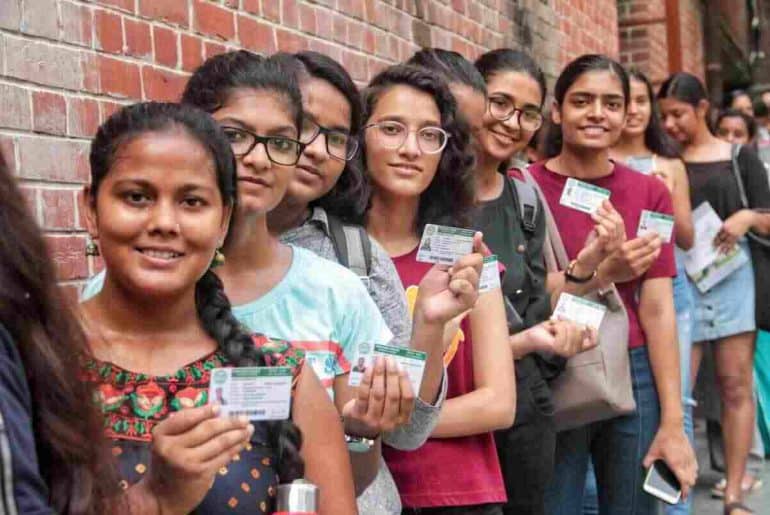
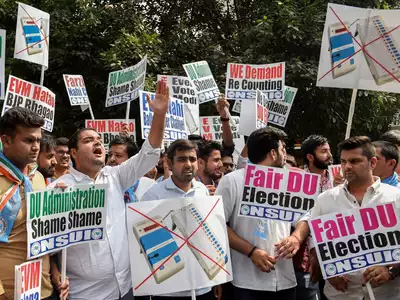
While the University Officials work on finalizing the dates, student leaders have started preparing for their election campaigns.

The student elections at Delhi University are scheduled to take place in September. The Delhi University Students Union is the representative body that stands for the majority of colleges and faculties’  students. Aside from this, elections are also  held each year for the students union at every college. The Delhi University Students Union is elected directly by the university’s and its member colleges’  students. Every year, the elections are typically held in August or September. Occurring every four years, it was last held in 2019, and was halted as a result of the Corona virus pandemic and its effects on the academic calendar.

Officials from the university stated earlier in July that election preparations will begin as soon as the university finished the admissions process for the upcoming session. Although the date has not yet been confirmed, DU registrar Vikas Gupta stated that it would be announced shortly and that one may anticipate it to happen in the final week of September.

Vice-chancellor Yogesh Singh, who will oversee the election process, named office bearers and members for the central council of the Delhi University Students’ Union (DUSU) for the academic year 2023–2024, according to a University announcement dated August 1. The VC also appointed college principals and heads of institutions to serve as office holders and council members in their respective colleges. The chief election officer, Professor Chandra Shekhar, has stated that the employing of Electronic Voting Machines (EVMs) will be done during the entire election process, which is expected to last between 10 and 12 days. In 2019, the Akhil Bhartiya Vidyarthi Parishad (ABVP) gained three seats, while the National Students’ Union of India (NSUI) gained one. Akshat Dahiya of the ABVP served as President, Pradeep Tanwar as Vice President, Ashish Lamba as Secretary, and Shivangi Karwal as Joint Secretary for the 2019–20 term.

Elections will be held for all four of these positions once again this year. All around the University, especially in the North Campus, preparations are being made for the same. While student leaders are planning, students are actively responding. The current president of the ABVP, Akshat Dahiya, states that they are getting ready to nominate their student leaders and will also begin disseminating information about the election procedure for students. Additionally, other organisations like the All India Students’ Association (AISA) and the Students’ Federation of India (SFI) are prepared to start their election campaigns. The previous president of SFI says that they will focus on issues that are specific to students, such as accommodation and other problems that students have on a daily basis, whereas ABVP will centre their election campaign on the four-year undergraduate programme, FYUP. In the meantime, the elections for the Delhi University Teachers’ Association (DUTA) have been set for September 27. The election calendar states that teacher nominations must be submitted by September 1. At the north campus of DU, the Arts Building complex and Satyakam Bhawan will serve as the locations for the voting.

On August 12, a number of teachers’ organizations, including the Democratic Teachers’ Front, merged to form the Democratic United Teachers’ Alliance. Among them were the Democratic Teachers’ Front, the Academic for Action and Development Teachers Association, and the Indian National Teachers’ Congress, which is a branch of the Congress. They declared Aditya Narayan Misra as a potential candidate for the position of DUTA president.

The University of Delhi student elections are unique and prominent, adding to the capital’s already politically charged climate. These elections hold value for the future of the University and also reflect student sentiments.

Read Also : https://dubeat.com/2023/07/12/dusu-launches-one-day-dusu-presidents-scheme/
Image Credits : Telegraph India

Priya Agrawal

The following piece seeks to understand the superimposition of dominant ideological narratives on cultural events. It does not, in any way attempt to disrespect the cultural/religious beliefs of individuals.  

Delhi University has often been described as an educational space for multiculturalism and diversity, where students from all over India intermingle and share their cultures with one another. Very often, students bring to the university campus, festivals and celebrations from different corners of the country which helps them create a sense of community far from home. It is an act of claiming a space, far from one’s homeland that initiates intercultural interaction and contributes to the richness of the campus spaces.

However, is the culturally diverse space that many of us would like the university to be, a utopian imagination? Cultural expression is often monopolised by dominant majoritarian communities that can afford to be more visible and vocal. How do we distinguish free cultural expression from ideological imposition? Furthermore, what happens when politically motivated ideologies are superimposed on cultural festivals?

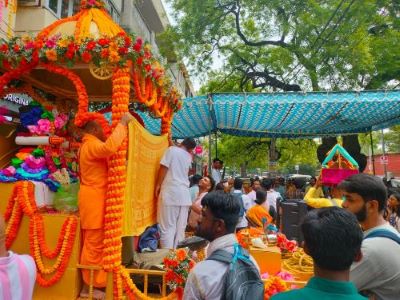
On 22nd June, the Delhi Odia Students’ Association (DOSA) in collaboration with the Iskcon Student Centre organised the Jagannath Rath Yatra in the North Campus of Delhi University. It goes without saying that the Rath Yatra is a festival that is extremely close to the hearts of the devotees of Lord Jagannath. People from different socio-economic backgrounds come to join the procession, hoping to get a glimpse of the deity. People are often seen crying, overwhelmed to see the lord.

But can an event that is often hailed for its inclusive quality, retain its cultural ideals and innocence when it becomes so visibly saffronised? It is true that perhaps every cultural or religious festival is influenced by certain belief systems, but when the belief system is aligned with an ideology which translates into an aggressively asserted political agenda, it becomes potentially dangerous.

The political alignment of the procession organised in the campus was not simply reflected in symbols, but was also verbalised on certain occasions. The event began with an open and unapologetic assertion- ‘Bharat ka dharam, Sanatan dharam’, (The religion of India is Hinduism) and ended with Jai Shree Ram chants. The procession, adorned by huge saffron flags, traced the campus with hundreds of people joining in. The devotees danced and sang along; the sentimental and cultural essence of the procession could be felt. At the same time, the markers of it being a politically aligned procession were hard to ignore.

One could obviously argue that Jai Shri Ram chants in a Jagannath yatra is not arbitrary because Ram and Jagannath are essentially different avatars of Lord Vishnu. In today’s India however, Jai Shri Ram is an immensely politicized slogan – one that is rooted in majoritarian beliefs of Hindutva. To say that it is an innocent appeal to lord Ram is to disregard the persecution faced by thousands of people from minority communities, against whom the slogan has been weaponised.

Before the commencement of the yatra, an elaborate speech was given which emphasised upon values of devotion, servitude and gratitude. The cultural belief system of a Brahmanical conception of Hinduism was presented as the moral standards of India. While science, modernism and ‘western’ values received censure, the ‘Indian’ way of life was pedestalised. It must be noted that the Jagannath Rath Yatra at Puri has no custom of preaching. Everybody joins the event as a devotee and no authority figure is given the centre stage. Representatives from the Akhil Bhartiya Vidyarthi Parishad (ABVP) – a right wing student organisation affiliated with the Hindu nationalist RSS – were formally present in the event.

The Rath Yatra was provided immense police protection. It is entirely valid to ensure police deployment in cultural festivals to ensure orderly execution of the same. However, the sincerity with which police protection is provided to events that exude right wing sentiments is entirely absent when students get attacked by mobs on campus. When a mob of men, gate-crashed the college fest at Indraprastha College for Women, raised misogynistic slogans and Jai Shri Ram chants and harassed women, the police did little to ensure their safety. The police has acted either as passive observers or violent upholders of law in situations like these.

When a religious event is distorted and appropriated to further a political ideology, the cultural and emotional essence of the festival is hurt and disrespected. Although the devotees attending the rath yatra did not express concern regarding the nature of the yatra, the ideological undertones were felt without doubt.

The Jagannath Yatra is very close to our hearts. Devotees wish to remain connected with the lord Jagannath and seek his blessings. It is an expression of unadulterated and innocent devotion. It is not supposed to be used to further any ideological agenda” – Aditi Routray, a student at LSR


Featured image credits – Tulip for DU Beat

Read also – https://dubeat.com/2023/04/04/the-invasion-of-ipcw-a-students-account/

Tulip Banerjee

tulipbanerjee2@gmail.com

The Akhil Bhartiya Vidyarthi Parishad organised a protest at the Aryabhatta College on 21st June, in order to express concerns regarding student safety and student welfare in the campus. The college administration received condemnation from the protestors for apathy and indifference towards student issues.

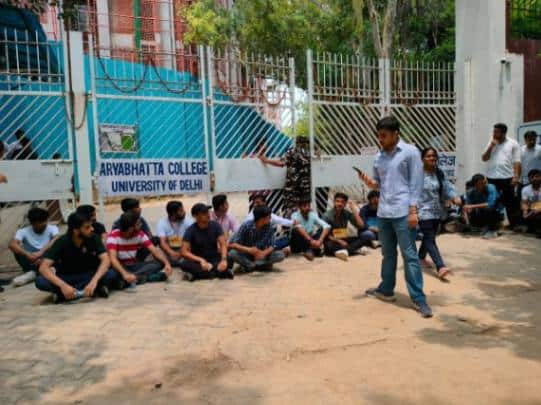
On the 21st of June, the Akhil Bhartiya Vidyarthi Parishad (ABVP) organised a protest at Aryabhatta College in the South Campus of the University of Delhi. The protest was reportedly organised in order to condemn the inability of the college administration to ensure student safety in and around the college campus. On 18th June, a 19-year-old student named Nikhil Chauhan was allegedly stabbed to death outside the Aryabhatta College. The protestors blamed administrative negligence and poor security conditions around the college campus for the murder.

The protest, which was scheduled at 10:30, finally began at 11:30 and lasted for about 2 hours. The protestors reportedly bolted the college gates, not allowing students and faculty members to enter the campus. The protestors raised ‘vande mataram’ slogans and ‘bharat mata ki jai’ chants while asserting their demands.

The members of the ABVP made a list of demands that included – recruiting more female security guards, ensuring the availability of sanitary pad vending machines, renovating washrooms across the college campus etc. While some of the demands were specific and aimed at student welfare, other demands such as – “proper and strict action should be taken against incapable and abusive admin staff” were vague and incomprehensible. The protestors were mostly men and very few women were present at the site.

A student getting murdered right outside our college is a big deal. This could have been prevented. No action was taken by the admin staff even though they were aware of the fight between the victim and the accused that happened a week before the murder. The administration has been apathetic to student concerns. Students have to struggle for days even to solve minor issues. Our sports ground has been out of use for the past four months. We have made a list of demands addressing these concerns that we intend to place before the principal.” – Tarun Yadav, ABVP President for Aryabhatta College

The students, after staging the protest outside the college, marched inside the campus, raising slogans and vocalising their demands. The members of the ABVP expressed that they intend to place their demands in a meeting with the principal. There was tussle between the members of the admin and the protestors that resulted in chaos. Four representatives of the ABVP finally met with the principal and a meeting was held in order to discuss the concerns raised by the protestors. After the meeting, the members informed the protestors that almost all their demands had been readily accepted by the principal.

There was considerable police presence at the protest site. On being asked about how they feel about the deployment of police forces at the college, an ABVP representative stated that the police was present to help them carry out the protest without interference.

The police forces are not here to suppress our protest. They are here to ensure our security and to prevent any unwanted interference from other parties.” – Tarun Yadav, ABVP President for Aryabhatta College

Read also – https://dubeat.com/2023/06/20/a-delhi-university-student-stabbed-to-death-outside-of-aryabhatta-college/

Featured Image Credits – Pratik for DuBeat

Tulip Banerjee

tulipbanerjee2@gmail.com

After issuing suspension notices and imposing fines on students for protesting, Hindu College is reconsidering its move. The students have submitted written apologies to the administration, and the principal is reportedly willing to let students explain themselves and address their concerns.

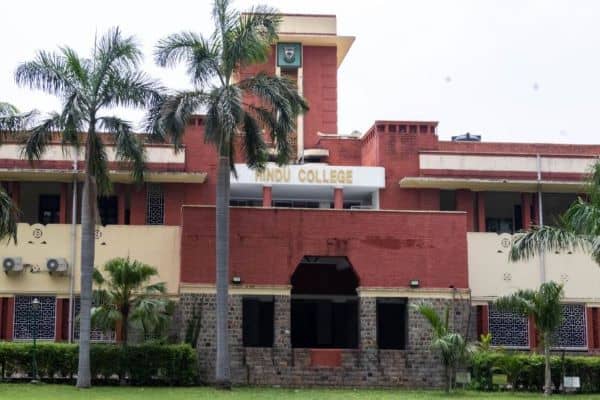
The Hindu College administration had issued notices suspending around 40 students and demanding a fine of Rs. 10,000, citing “gross misconduct” by students protesting against the administrative decision to reduce Mecca to a one-day event. The notice firmly stated that the students would not be allowed to take their semester exams if they failed to pay the fine. It further stated that they would not be allowed to hold any post of responsibility in the future and that “any repetition of such or other misconduct in the future will be treated with the utmost strictness, to the extent of rustication”. Additionally, 15 students have received a notice for financial fraud and cheating. The notice also alleged that the protesters caused damage to college property and behaved disrespectfully towards the principal, blocking her way and not letting her attend an official meeting.

However, after some deliberation and discussions, the principal, Ms. Anju Srivastava, is reconsidering the suspension. On the evening of May 9, a day after the suspension was issued, the principal reportedly held a meeting with the students. The students put forward their demands and concerns regarding the notice and requested that it be withdrawn.

They (the students) have given us verbal apologies and written apologies. We will give students another chance to put forward their sides. We are open to discussion with them. I have asked the disciplinary committee to look into each application separately on an urgent basis. The work has started. We will soon inform the students.

– Ms. Anju Srivastava, Principal of Hindu College, in conversation with PTI

The principal stated that the students will be given a chance to explain themselves and that their apologies will be accepted. It has been stressed that every student’s application will be reanalyzed in depth. The suspension notices drew widespread criticism from students involved in the protests. The students initially stated that they would resort to protesting against the suspension and the imposition of fines if they were not withdrawn.

The RSS-affiliated student body, Akhil Bharatiya Vidyarthi Parishad (ABVP), came out in support of the students and requested the administration withdraw the notice at the earliest. Despite all efforts to encourage dialogue between both sides, whether every student will be spared suspension is uncertain.

Read also: Hindu College Suspends and Issues Fines for Protesting Students

Featured Image Credits: Keshavi for DU Beat

Tulip Banerjee 
tulipbanerjee2@gmail.com 

Rejecting the alleged ‘sham of DU Literature Festival’ which was organised in Ramjas College from March 17–19, AISA organised a ‘People’s Literature Festival’ on March 17, coinciding with the former.

On March 17, the All-India Students’ Association (AISA) organised a ‘People’s Literature Festival’ at the University Arts Faculty from 11 a.m. to 6 p.m. The festival enjoyed the attendance of hundreds of students and prominent speakers from the fields of film, academia, and journalism.

With a slogan of celebrating ‘Krantikari’ literature in place of ‘Sarkari’ literature, the festival was organised in direct opposition to the DU Literature Festival, which was held from March 17–19, 2023, on Ramjas College grounds. The organisation alleged that the latter was hosted “with a whole range of BJP-corporate intellectuals”, who “spewed communal venom on the platform of a public university”, as accused by AISA’s press release and social media handles.

“Rather than calling for the cancellation of the Lit Fest, we wanted to bring about a positive campaign as an alternative” – Anjali, AISA DU Secretary.

Anjali further described the program as “an attempt to reclaim the democratic space of dissent in the University.”

The festival had a focus on “revolutionary traditions in literature”, hosting a range of interactive speaker sessions on the topics of resistance, cinema, media, caste, history, literature, and people’s movements. It featured a line-up of speakers such as ‘Anarkali of Aarah’ director Avinash Das, ‘Mooknayak’ editor and journalist Meena Kotwal, historian S. Irfan Habib, and professor Apoorvanand, among others.

The program also included an open mic session of poetry recitation by the University students, along with Professor Nandita Narain, who inaugurated the event with a rendering of ‘Hum Dekhenge’ by Faiz. The team of ‘Raschakra’ performed a theatrical reading of ‘Afghani Dukhtaran’, a play written by Purwa Bhardwaj and directed by Vinod Kumar, centring on the literature and resistance of the women of Afghanistan against years of oppression. The festival concluded with a cultural performance and songs of resistance.

Read also: IP College Lit Fest- The Artist, Society and A Pinch of Heroin

Feature Image Credits: DU Beat

Sanika Singh
email.sanika@gmail.com

If we turn the pages of our history, we will realise that our freedom struggle was an essential chapter in the history of the University of Delhi. It has been about 80 years since Mahatma Gandhi gave us the slogan “Do or Die”, and within weeks of the pronouncement of the slogan at the Bombay Session of 1942, protests started to take shape across the colleges of DU. From burning down an electric sub-station (by the students of Ramjas College) to marching in protest on 10 August 1942, against the authorities who jailed the Congress leaders the previous day (students of Hindu College, Indraprastha College, and St, Stephen’s College), DU was the political hub during the time. So, this culture of protest so firmly entrenched among DU students even today can be traced back all the way to our country’s struggle for independence.

Established in 1922, a time when India was engulfed by its struggle for freedom, both students and teachers were active participants in the anti-British movement. However, soon, the students realised a need for a union. It was in 1947, under the founder of the Delhi School of Economics, Vijayendra Kasturi Ranga Varadaraja Rao (V. K. R. V. Rao), when a provisional committee consisting of presidents of all the colleges was bestowed with the responsibility to draft the Delhi University Students’ Union (DUSU) Constitution and take necessary steps for the creation of this institution. On 9 April 1949, DUSU came to life and was inaugurated by our first Prime Minister, Pt. Jawaharlal Nehru. Since its inception, DUSU has become the first step toward the political scenario of the larger part of the country. Students belonging to various groups, having a range of ideologies, contest to be part of its panel. Some of the most notable student organisations that it represents are the Akhil Bharatiya Vidyarthi Parishad (ABVP), the National Students’ Union of India (NSUI), Students’ Federation of India (SFI), Chhatra Yuva Sangharsh Samiti (CYSS), All India Students’ Association (AISA), and many more.

Delhi University is as well known for its politics as well as for its historical significance and educational culture. Its political atmosphere is so important that at times, even mainstream political parties take keen interest in it. Nevertheless, it is worth noticing how the culture of protest and dissent was born in the sensitive pre-independence independence and how it has transformed since then to take its present form. Are the organisations doing their jobs correctly or are they just practicing dissent in the name of vote-bank politics? This is one of the most crucial questions we must seek the answer to.

The ABVP, a right-wing student organisation affiliated with the Rashtriya Swayamsevak Sangh (RSS), has had the most successful run in DUSU history in recent years. The root cause of this success can be traced back to the period of the Emergency in 1975, when DUSU once again became a centre of political resistance. Arun Jaitley, a former member of ABVP and Bhartiya Janata Party (BJP), was elected as the president of DUSU in 1974. He is known to have played the most instrumental role in bringing reform to DUSU. Until 1973, colleges used to elect 10 DUSU councilors, who further used to elect the panel of DUSU. However, from 1973 this policy was transformed into ‘one-student, one-vote’, turning the system from an indirect to a direct democracy. Also, Jaitley is famously known for being the first satyagrahi against the imposition of an internal emergency. In 1977, Vijay Goel, who was affiliated with ABVP, became the President of DUSU. His focus during the campaign was the excesses that occurred during the emergency.

More recently, Nupur Sharma, a former BJP national spokesperson, was elected DUSU president as the ABVP candidate in 2008. This broke the ABVP’s eight-year wait for power in the DUSU, which had been dominated by NSUI. That year, the other three posts (Vice President, Secretary, and Joint Secretary) went to the NSUI.

If we look at the last 10 years, the NSUI has only held the President’s seat only twice. This does beg the inevitable question of why the ABVP has found so much success. During the internal emergency, it can be credited to the country’s political atmosphere, which helped in garnering support. In its initial days, it is safe to say that people were more focused on work than their political inclinations and other interests. But what about today? Is it functioning the way the students desire or is it enjoying an undue dominance? Is it standing for the students and working for their demands, or are they too invested in getting memorandums signed in the name of vote banks? On the other hand, the left-wing parties, which emerged as a force to content with in DU politics quite recently, have centred their existence around fighting for or against various issues through protests and rallies. In this respect, their innovation and resourcefulness is beyond compare.

But the larger question remains: are any of the organisations working for the students, or has their functioning been overcome by their self-interest and blinded by lofty goals of perhaps being a part of the ‘real deal’?

But what is the real deal now, apart from the “glorious” past that DUSU holds? Since 2019, DUSU elections have not been held and even for this year as I type this out, there is no clarity or instruction about them. For a Student’s Union that has not seen elections in the past three years, to term this period as worthy of congratulations to the DU fraternity is a disaster in itself that reflects what sort of bizarreness surrounds DU politics today. At nearly every step the recommendations of the Lyngdoh committee (set up by the Ministry of Human Resource Development (MHRD) in 2006 as per the direction of the Supreme Court to reform students’ union elections and to get rid of money and muscle power in student politics), are sidelined. Even a short conversation with those batches who have witnessed the famous DU elections is enough to know the huge amounts spent to buy students’ votes with freebies.

Every party in this arena carries its burden of faults. With major players being invisible throughout the year, some parties have engaged themselves in constant show politics. earning a name for themselves as “far protestors”. Be it any event or protest, you are most likely to see the same faces appearing everywhere, carrying faulty lies around.

But what’s the real issue here? Are parties facing problems in mobilising the students of DU? Or has its flame died down? Maybe it has just become a mere shell of what it used to be with constant clamping down on dissent at the college level. Though efforts by left parties in the form of reading circles can’t be ignored, ABVP too has attempted to mobilise students. But the fault of parties lies majorly in being unable to maintain a connection with the students. Even with these events and attempts to get closer to the students’ community, student parties cling to rigid ideologies rather than adapting to the circumstances, often barring those without political influence from engaging in what remains of student politics at the university. Indiscriminate fights and beatings do the rest of the work of turning students away from politics, with only 39% voting recorded in the last elections.

One of the biggest shortcomings of the DUSU is the exclusion of various colleges, especially ‘women’s colleges’, whose students have been visibly political in their stance. The absence of political presence on these campuses is clear exclusion by the administration and the silence of student parties over this issue makes clear their lack of concern over diverse representation in their parties, which is often stressed upon by them to win brownie points.

With fringe protests occurring only for some matters chosen specifically to grab as much attention as possible, the majority of student issues largely remain ignored. So, it is the right time to question what is being done of the legacy DUSU had in the name of power and politics and, more importantly, to start a conscious and organised movement to politicise (or rather, repoliticise) DUites.


Image Credits: Times of India

Ankita Baidya

ankitab@dubeat.com

Kashish Shivani

kashishs@dubeat.com


Throughout its storied history, Delhi University has gained a reputation as a political university. This article takes a look at the political perception of DU and its credibility.

If there is one thing you know about me, reader, it is that I absolutely love telling stories. In fact, I was indulging this exact habit a few weeks ago in a conversation with a friend as I regaled him with the ridiculous tales of DU politics I’d come across during my first month as a correspondent at DU Beat. As I finished my story about yet another instance of some student organisation appealing to their college’s admin on some glamorous student issue that would be great for attracting votes, he laughed and said something that would stick with me for a while. He told me, “Man, you’re a DU student, of course you get dragged into political events.”

“What a strange remark,” I thought, “And really? With JNU right there?” Therefore, I decided to try and figure out why universities like DU have been entrapped in prisons to the politics of the time and here we are. The answer? It starts – just like DU – in the 20s.

Delhi University was established in 1922, with just four affiliate colleges: St. Stephen’s, Hindu College, Zakir Hussain College and Ramjas College. A place like Delhi University, with the space for intellectual stimulation and debate that it offers, was always going to be an incubator for students that cared about where their country was going and were ready to do something about it. Thus, it is not a surprise that students of the varsity were actively involved in the freedom struggle. St. Stephen’s and Ramjas actively participated in the Non Cooperation and Civil Disobedience movements. Hindu College was at the front of the nationalist movements in the 20s – it is the only college since 1935 in Delhi to have a student parliament. This parliament gave a platform to leaders like Mahatma Gandhi, Subhash Chandra Bose, Jawaharlal Nehru and Motilal Nehru. The people that walked the halls of these institutions – students and staff alike – were nationalists.

In the 70s, Indira Gandhi’s government declared the Emergency and the country grappled with an authoritarian regime that refused to listen to the opposition. In such a situation, it seems you can always count on the youth of a nation to bring their fire and their impassioned appeals for change. And they did not disappoint at the time either! Delhi University saw the rise of the two major student organisations, the National Students Union of India (NSUI) and the Akhil Bharatiya Vidhyarthi Parishad (ABVP). The former is the student front of the Congress while the latter is backed by the Rashtriya Swayamsevak Sangh (RSS). Alongside them, other student organisations such as Students Federation of India (SFI) and All India Students Association (AISA) also arose, albeit nowhere near to the dominance of the NSUI and ABVP. At the time, the ABVP regularly campaigned against the government, establishing itself with its anti-authoritarianism and anti-emergency protests. This period of tension culminated with the arrest of the Delhi University Student Union (DUSU) president at the time, Arun Jaitley. As Shraddha Iyer declares in her piece for DU Beat, “The arrest of Arun Jaitley had one implication for students: the centre fears their ability to mobilise against them.”

Delhi University has since been home to all kinds of political debates and discussions between different ideologies. While most students do not buy into the exact ideologies of the numerous student organisations waiting to spend lakhs to buy their votes, there is a general acceptance of free ideals and a willingness to raise their voices in favour of what is right and against what is wrong.

In 2020, with the controversial CAA being passed around in the Houses of Parliament, there was a line of protests across the nation. At the forefront? The young minds of one of the country’s most respected universities. DU students did not shy away from arranging mass protests against the bill. They showed, very adamantly, that the majority of the next generation of this grand nation did not agree with the kind of administration that was being set in place for the future that they were to inherit. They claimed that the CAA was unconstitutional as by excluding Muslims it went against India’s core tenet of secularism, Against the central government’s repeated attempts to shut them down – some of which were ridiculously dirty – the students raised their voices even higher. The protests were disrupted by the pandemic in the end, but the students had proved that 50 years on from the events of Emergency, the students of Delhi University were still ready to fight for what they cared about.

Alongside these admittedly impressive showings of power by the students, the dirtier side of student politics has also flourished. Student politics are seen as a platform before taking the next step and joining politics at the government levels. Every year in September, the DUSU elections take place at the university. The campuses are gripped by election fever as lakhs are spent by student organisations to butter up the newest batch of students. There is a frenzy for power and authority as the streets are filled with processions of people proclaiming slogans of their respective affiliations. Student organisations feel that the September winds bring back importance to the always prevailing student issues and decide to launch protests across campuses. As I write this article, on September 14th, there are protests taking place in various colleges such as Ramjas, Shyam Lal College, Zakir Hussain, Lakshmibai College and more. All of them are carried out by the ABVP on issues ranging from fee hikes to, for some reason, a boys’ common room. There are seemingly infinite wads of cash thrown by all organisations at alcohol, parties, trips to the water park and fast food for students in a bid to secure their loyal votes.

It gets darker, there are regular reports of politically incited violence on the campuses of the University. It is particularly harsh for the candidates in the running for the positions of the DUSU. In September 2019, the ABVP alleged that the NSUI attacked their candidate for Joint Secretary. Two days later, the NSUI alleged that the ABVP attacked their candidate for vice-president. In 2022 alone, there have been multiple allegations against the ABVP by the NSUI and SFI accusing the rightist organisation of violence.

In the end, it seems my friend was right about DU being political. It may be a perception that’s a little too absolute and dismissive, but it is right to some extent. Delhi University can be a political hotbed. However, more often than not, this is a direct consequence of being a space for debate and discussion of different ideologies right at the capital of the country. Hundreds of students from different backgrounds from different parts of the nation attend this famed university. That kind of exposure brings with it intellectual debates and discussions hidden within the fun of campus life.

All DU ever asks its future students is one thing: what are you willing to stand for? For the pre-independence students of the university it was freedom. For the students in the 70s it was anti authoritarianism. For the students in 2020, it was a sense of secularism and unity. As the elections roll around and the exaggerated showings of student support start, DU and its historically active alumni now ask you, dear reader, “what will you stand for?”

Read also: Prisoner to Political Parties

Featured Image Credits: The Hindu

Siddharth Kumar

siddharthk@dubeat.com

The Akhil Bharatiya Vidyarthi Parishad (ABVP) issued a press release Monday. The release outlines its plans for the country’s 75th anniversary of independence, as well as its own 75th anniversary in 2022-23. Education sector related issues and the formation of committees to aid in the implementation of the NEP were also discussed.

In a press release dated 9th August 2021, student organisation Akhil Bharatiya Vidyarthi Parishad (ABVP) announced its plan to hoist the National Flag at 1,28,335 locations across the country on 15th August 2021- India’s Independence Day. They have also planned to work on internships, Tiranga marches, social media campaigns, short films on forgotten warriors, and so on.

Sidharth Yadav, the National Media Convenor of ABVP, said “We plan to engage the entire young community with the celebration. In Delhi, we are hoisting at 647 bastis. A big number of students from DU have volunteered and the experience they are getting while visiting these bastis is already heart-warming. I am sure that we will be successful in taking the celebration to the last man in the line and also develop a perspective amongst University students.”
Bharat Sharma, ABVP’s Delhi Media Convenor, added “until now, flag hoisting has largely been a government ritual. We intend on taking it to the masses.”

Furthermore, the organisation has decided to form a committee in each state. This committee would make recommendations to the governments, administrations, and universities for ensuring timely implementation of the National Education Policy.

The organisation is also celebrating its 75th anniversary in 2022-23. In light of the celebration, the ABVP has decided to take on large-scale campaigns. A one-day National Executive Council meeting was held on August 1, 2021, in Bhopal via a virtual and physical medium. In this meeting, the organisation passed two resolutions and an appeal.

The first resolution referred to the problems in the education sector during the Covid-19 period. They have also demanded a solution from the Central and State Governments. The second resolution discussed the country’s current situation and called for action. The council has decided to expand the ‘Parishad Ki Paathshala’ activity nationwide. They have also decided to establish the ‘Ritumati’ campaign for women’s health and empowerment as an amplitude across the country.

Read also: ABVP Meets G. Krishnan Reddy; Talks on Increase of NSDs & Tribal Upliftment

Feature Image Credits: Akhil Bharatiya Vidyarthi Parishad

Sandhini Goyal
sandhini2k2@gmail.com

Akhil Bhartiya Vidyarthi Parishad (ABVP) substitutes a nine-point memorandum to the University Grants Commission (UGC) based on suggestions provided by students. 


On 23rd April 2020, in a press release, ABVP revealed that it has submitted a nine-point memorandum to the UGC Expert Committee based on students’ suggestions. The party took detailed suggestions from students from various institutions of higher education in Delhi to draft the memorandum. The institutions include- Jawaharlal Nehru University, Delhi University, Ambedkar University, and the Delhi Technological University, amongst others. The suggestions were taken via Google Forms regarding the issues that are being faced by the students during the COVID-19 lockdown and reached out to over 3000 students. The questions were regarding the conduct of examinations in online mode, internal assessments etc, seeking their opinions and suggestions.

The suggestions offered to the expert committee were based on the student replies to these questions. The nine points that were made are:


  1. The ABVP insisted upon refusal by the student community regarding the adaption of online examinations and insisted that all further decisions regarding the issue be taken after considering the stakeholders.   


  1. Priority is given to the examinations for final year students. These exams should be held after the lockdown is over, and not online. 


  1. The course content for final year students’ exams should be reduced. Only the course covered by in-class lectures should be considered. 


  1. The exams should be conducted at a time decided after considering the lockdowns is all states, so that outstation students can safely and comfortably travel back to their campuses. 


  1. Due to the fact that final year students would have to safeguard future options after the exams, priority should be given to them.   


  1. In case of extension of the lockdown further, examinations for 1st and 2nd-year students of Undergraduate courses and 1st-year students of Postgraduate courses be shifted to future semesters, with the number of papers being evenly distributed. 


  1. Online submissions should not be made compulsory. Students should be given an option for offline submissions. 


  1. ABVP requests that universities should relax the eligibility criteria as far as possible after deliberation with stakeholders to facilitate admissions for final year students and students joining after 12th boards. 


  1. Teachers and students should also be appealed to go the extra mile to complete their academic programs.  


Sidharth Yadav, State Secretary, ABVP Delhi, stated in the press release that, “The situation arising out of the COVID-19 pandemic is unprecedented. These are tough times and no such decision that augments the hardships being faced by students must be taken. The recommendations that we have submitted today to the University Grants Commission’s Expert Committee have been arrived upon after detailed deliberations and discussion with students. The suggestions offered by students have been attached with the memorandum. We have rejected the idea of online examinations and we hope that any decision taken by the government will take into account the welfare of students.”

Feature Image Credits: DU Beat


Shreya Juyal

shreyaj@dubeat.com


Akhil Bharatiya Vidyarthi Parishad (ABVP) introduced an online Google form soliciting opinions of students with regards to conduction of their postponed examinations, some of which shall later be added to a memorandum scheduled to be submitted to the authorities.

Amidst the shutdown of universities across the country and the indefinite postponement of semester examinations in lieu of the coronavirus-induced national lockdown, Akhil Bharatiya Vidya Parishad Delhi came out with a press release on 16th April 2020 announcing the release of a “Student Opinion Form” for students of universities across Delhi including University Of Delhi, Jawaharlal Nehru University, Jamia Millia Islamia, Lal Bahadur Shastri Sanskrit Vidyapeeth, Ambedkar University with an aim to collect concrete suggestions and opinions regarding the evaluation of their internal assessments and conduction of semester examinations.

This new initiative has been termed as the “Padhega Bharat, Badhega Bharat aur Jeetega Bharat” (India studies, India grows, India wins) campaign. After compiling the opinions and selecting a few notable suggestions, ABVP intends to add them to a memorandum which is due to be presented to the University Grants Commission and the Ministry Of Human Resource Development shortly.

Stressing on the necessity of this initiative due to recent developments such as the possibility of examinations shifting online, Sidharth Yadav, State Secretary, ABVP Delhi came out with a statement, “The pandemic has adversely affected the student community. There is a lot of uncertainty surrounding the resumption of normal civic life, reopening of campuses, conduct of internal assessments and conduction of semester examinations. The semester examinations have also been kept in abeyance. Since students are the primary stakeholders, their suggestions concerning the issues that can influence their academic progress, especially the possibility of organizing web-based semester exams merit specific inclusion on our memoranda.”

The fifteen-point questionnaire includes simple close-ended questions like “Have you ever given any internal exam/project/assignment during the coronavirus pandemic or prior?”, “Are you comfortable giving online assignments/assessments?”, “What online platforms do you use?” and also opinion-based open-ended questions like “Suggest a method for internal assessment during lockdown” and “In your opinion how should the semester exams be conducted?”. Most of the questions seem to seek the students’ opinions on the possible shift of internal and external assessments to online platforms.

“This new initiative was needed as this is an unprecedented situation. The questions are thoughtful and will surely help in revealing the views prevailing among students”, opined a first-year student of the University Of Delhi, on the condition of anonymity.

The link to the “Student Opinion Form” can be accessed through ABVP Delhi’s social media accounts.

Feature Image Credits: Akhil Bharatiya Vidya Parishad via Twitter

Araba Kongbam

arabakongbam@gmail.com