Tag

ABVP

Browsing

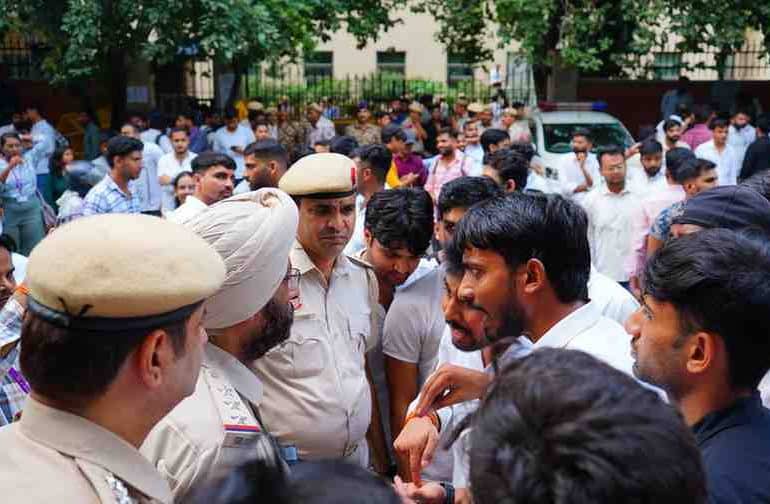
DUSU elections saw 39.36 per cent turnout, up from last year but below 2023 levels. Voting was peaceful yet marred by littering, clashes, traffic, and EVM tampering allegations amid tight security and 21 candidates contesting.

The voter turnout for this year’s Delhi University Student Union (DUSU) election stood at 39.36 per cent, a decent rise from last year’s turnout, which stood at 35.2 per cent, but it still does not meet the rate of 42 per cent, which was recorded in 2023. This was amidst a 3-year halt in the conduction of elections due to the COVID-19 outbreak. Polling was conducted at 52 centres with 195 booths, where 711 Electronic Voting Machines (EVMs) were deployed.

Chief Election Officer Raj Kishore Sharma said polling proceeded smoothly across most colleges.

Out of the 1.53 lakh registered voters, 60,272 students cast their votes. At Kirori Mal College, the turnout was 32 per cent.  Principal Dinesh Khattar said,

The college has successfully conducted polling, and the campus is clean… no defacement or waste lying around.

At Ramjas College, the turnout was slightly higher but still lower than the average at 37.52%. Principal Ajay Arora stated that,

Voting has been successfully held at seven booths.

Miranda House saw an active participation of over 2500 votes in the first phase. Polling in the college was conducted in two phases: from 8:30 am to 1:00 pm for day scholars and from 3:00 pm to 7:30 pm. Delhi Police deployed over 600 personnel, including 160 with body-worn cameras, while drones and CCTV surveillance covered sensitive areas.

The election was conducted not without its hurdles; the area surrounding the campuses saw littering due to cards of candidates being distributed. Despite tight police control, clashes still occurred between rivals, and supporters of each faction gathered in huge numbers, resulting in road blockages and significant traffic congestion. 

The elections also witnessed controversies due to allegations of malpractice by the National Students’ Union of India (NSUI)’s presidential candidate, Joslyn Nandita Choudhary, alleging that she observed blue ink on the EVMs near the name of Akhil Bhartiya Vidyarthi Parishad (ABVP)’s presidential candidate, Aryan Maan.

Delhi ABVP State Secretary Sarthak Sharma responded by stating,

Just as the Congress blames EVMs after every electoral loss, NSUI is following the same pattern. Their desperation is evident from their fear of defeat and declining popularity among students.

This year, 21 candidates were contesting for the four main student body posts – President, Vice President, Secretary, and Joint Secretary. Of these, nine contestants were competing for the president’s seat, while the remaining were contesting for the other three positions.

Read Also: What Does the Student Body Want? 

Image Credits-: Sameer for DU Beat 

Divyanshi Dusad 

divyanshidusad@gmail.com

With the Delhi University Students’ Union elections approaching, major student organisations have released their manifestos announcing promises, reflecting issues, and revealing both overlaps and contrasts in priorities.

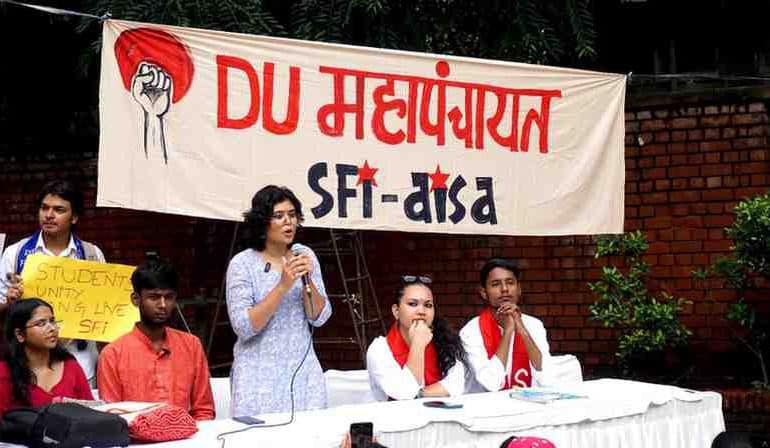
There are significant variances as well as obvious parallels between the ABVP, NSUI, and SFI-AISA coalition manifestos. The goals of these three parties are to solve persistent problems in Delhi University politics, such as women’s safety, campus infrastructure, and affordability. However, each uniquely presents its strategy, answering critiques of earlier DUSU terms and reflecting its ideological foundations.

Student health and welfare have been foregrounded more strongly this year. ABVP explicitly promised, “subsidised health insurance schemes for students”, a measure that responds to recurring demands for affordable healthcare after years of rising living costs. NSUI brought the conversation into the gendered domain, with its women’s manifesto pledging, “helpline numbers, menstrual health awareness, sanitary pad vending machines, and proper gender sensitivity measures.” The SFI-AISA alliance combined health and gender justice, promising menstrual leave and insisting on institutional structures like, “elected Internal Complaints Committees and gender sensitisation cells in all colleges”.

The only organisation to make a specific commitment on digital access is ABVP, which has pledged “free Wi-Fi access for university students.” Although the Left alliance and NSUI did not use the same language to emphasise Wi-Fi, they both emphasised infrastructure and accessibility in more general terms, implying a move away from band-aid technological solutions and towards structural reforms.

The affordability debate remains central, carrying forward unresolved issues from past years, such as fee hikes and opposition to the National Education Policy (NEP). The SFI-AISA alliance has taken the clearest stance, stating that it has, “pledged to oppose fee hikes” and presenting its programme as ‘a true student-centric manifesto.’ NSUI echoed this with calls for, “public funding for equitable education” and a rejection of NEP-linked restructuring. ABVP, while not quoted as directly opposing fee hikes, emphasised subsidised schemes and improved facilities.

Women’s safety and inclusion, an issue repeatedly raised after incidents on campus in previous years, has again appeared prominently. NSUI’s separate women’s manifesto is notable in its detail, listing concrete measures like, “helpline numbers, menstrual health awareness, sanitary pad vending machines, and proper gender sensitivity measures.” The SFI-AISA alliance, in line with its activist tradition, focused on structural reform: “elected Internal Complaints Committees and gender sensitisation cells in all colleges.” ABVP’s framing was broader, with its candidate speeches highlighting campus safety and “accessibility audits for students with special needs.”

Finally, housing and hostels continue to be a major theme, reflecting perennial shortages and past protests by outstation students. ABVP’s manifesto directly included, “construction of new hostels to accommodate growing student needs.” NSUI’s broader call for inclusive infrastructure implicitly covered hostel provisions, while SFI-AISA explicitly folded hostel expansion into its demands for resisting privatisation. 

While all parties echo recurring demands like safety, hostels, and digital access, their manifestos also respond to past gaps, some promising continuity, others pledging fresh reforms to long-standing student concerns.


Image Credits: Manan for DU Beat

Anjali Kumari Jha
anjali444work@gmail.com

Read Also: ASAP, The New Student Wing of AAP, Refrains from Contesting DUSU Polls Days Before the Election

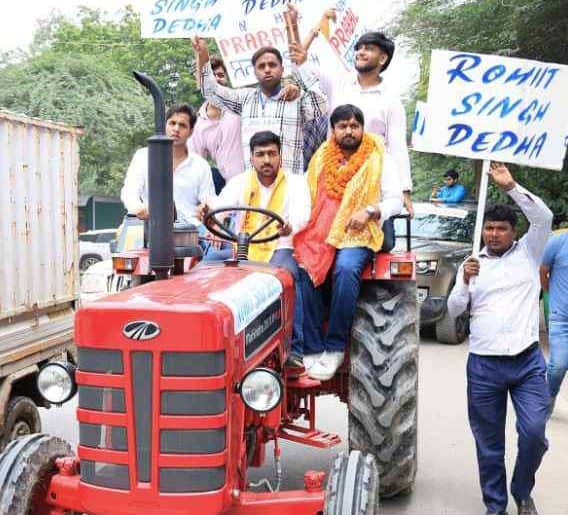
On Monday, 1st September 2025, the RSS-affiliated Akhil Bharatiya Vidyarthi Parishad (ABVP) launched its new, eco-friendly “Clean Campus, Green Campus” campaign for the Delhi University Students’ Union (DUSU) elections.

The campaign featured a bicycle rally that commenced at Vishwavidyalaya Metro station and proceeded to several North Campus colleges, including Ramjas College, Hindu College, Kirori Mal College and Daulat Ram College, before concluding at the Arts Faculty.

The campaign aligns with the efforts of the student union to keep the electioneering process “environment-friendly and campus-friendly”. According to ABVP leader Harsh Atri, the union will keep introducing thoughtful, eco-friendly campaigning practices such as bicycle rallies and clean-up drives. These endeavours complement the ABVP’s goal to keep the entire process of campaigning clean, transparent, and peaceful. The union is allegedly reaching out to students and strictly adhering to the Delhi High Court guidelines in its campaigning practices. 

The emphasis on responsible campaigning is well expected, as the 2024 DUSU elections had brought about legal trouble due to the violation of court directives and the Lyngdoh Committee’s guidelines for defacement of public property, leading to the halting of vote counting by the High Court until all defacement was undone and the restoration of public property had been completed.

On Thursday, 28th August 2025, the ABVP released a list of 11 probable candidates for the 2025 DUSU elections, which are set to take place on 18th September 2025. The final list of four candidates for the central panel will be released on Thursday, 11th September. The counting of votes will take place on 19th September 2025 under strict measures in order to avoid any form of defacement or disruption.

Featured Image Credits: @RohitDedhaABVP on X

Read Also:  ABVP and NSUI Welcome Freshers: A New Year of DU Student Politics

Souparnika
riverkingston.tle@gmail.com

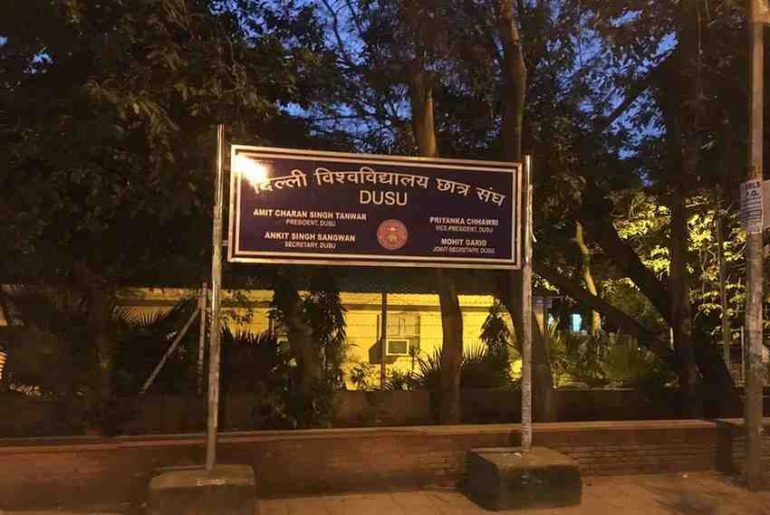
In a troubling incident the night of August 18, a group of around 20–25 unidentified individuals forcefully entered the Delhi University Students’ Union (DUSU) office. They broke open the main gate, attacked security staff, smashed glass doors, overturned chairs, damaged tables, and even destroyed an air conditioner, according to Delhi University officials. Campus authorities have confirmed that police are investigating the case, and the vandalised office has been sealed for now.

A day later, the Congress-affiliated National Students’ Union of India (NSUI) condemned the act, calling it “cowardly” and blaming the RSS-backed Akhil Bharatiya Vidyarthi Parishad (ABVP). NSUI national president Varun Choudhary alleged that ABVP had a long history of campus violence and creating unsafe spaces, particularly for women students. He described the vandalism as a “clear display of ABVP’s frustration.”

ABVP, however, rejected the charges, accusing NSUI of staging the attack to gain attention ahead of polls. In its statement, the student wing said,

Groups that are unable to work on the ground or connect with students resort to propaganda.

ABVP further alleged that the vandalism was a “media stunt” designed to tarnish its image.

Choudhary, meanwhile, said NSUI would continue to campaign on issues of affordable education, timely scholarships, social justice, and women’s safety under the banner of “Mohabbat Ki Dukan.” 

This is not the first time student politics at Delhi University has seen such flashpoints. From the defacement of DUSU offices in past years to violent clashes during presidential campaigns, incidents of hostility have increasingly overshadowed the democratic spirit of campus elections. In 2023, the election season was marked by allegations of physical intimidation and misuse of money power. Many students now argue that the real issues — ranging from affordable housing and better transport to the lack of hostels and deteriorating infrastructure — rarely find space in these campaigns. Instead, the narrative is often dominated by national party rivalries that play out on campus grounds.

All this paints a clear picture: DUSU politics have shifted from simply political debate to increasingly performative and destructive spectacles. Rather than fostering constructive dialogue, recent developments suggest that winning appears to have become more about leveraging force or acts of power.

Read Also: DU Cracks Down on Poster Politics Ahead of Election Season

Featured Image Credit: DU Beat

Juhi Bansal

juhibansal1606@gmail.com

As the much-anticipated DUSU elections dawn upon Delhi University, the administration’s decision to impose a mandatory ₹1 Lakh bond on contesting candidates has triggered a storm of protest. What the administration portrays as a measure of accountability is being widely condemned as a deliberate financial barrier that strikes right at the heart of campus democracy. For decades, DUSU has stood as a microcosm of Indian democracy, producing leaders who went on to shape national politics. By attaching a steep financial cost to participation, the administration risks rewriting that history. 

The policy has ignited rare partnerships as long-time rival student organisations come together to protest. While major organisations like ABVP and NSUI have historically housed high-profile candidates and expensive campaigns, they, too, have accused the new policy of being undemocratic and regressive. NSUI President Varun Chaudhary termed it a ‘political weapon’ that works in favour of their adversary, ABVP. 

Leftist student organisations like the Student Federation of India (SFI) also demand the withdrawal of the bond, describing it as “a regressive move that is nothing short of an elitist barrier designed to exclude ordinary students from democratic participation and stifle genuine student voices”. SFI calls out the university for their “anti–common student nature”, and highlights the growing concern over the integrity of free and fair student politics in India.

The imposition of this bond also raises much larger questions, especially those that target the identity of the university itself. The protesters claim that while administrations often justify restrictions in the name of discipline, the cumulative effect is a systematic narrowing of democratic participation. In an institution renowned for its inclusivity, the bond seems like a gatekeeping tool and risks silencing those very voices the union is meant to represent. Rather than strengthening electoral integrity, the bond tethers participation to monetary capacity, shrinking democracy to those who can afford it. 

With the DUSU election process now officially announced for September, the ₹1 lakh bond feels like more than just a procedural rule. For many students, it seems like a statement of who is considered fit to participate in democracy and who is not. As the elections draw closer and the campaigns gather pace, the debate over the bond is likely to remain at the centre of campus politics.

Image Source: The Hindu 

Navya Chandok
navyachandok0902@gmail.com

Read Also: DU Cracks Down on Poster Politics Ahead of Election Season

At DU’s North Campus, student political parties ABVP and NSUI launch welcome campaigns for incoming freshers. Amidst flags, enthusiasm, congestion, and concerns over ethical campaigning, another year of student politics begins. 

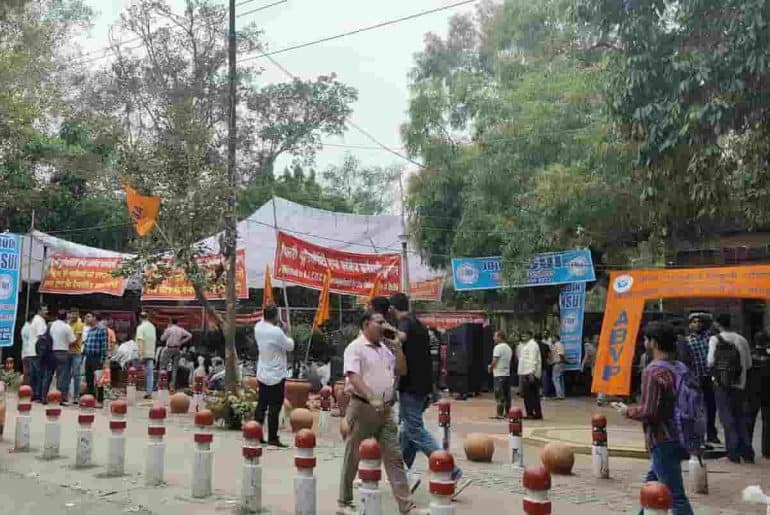
At around 10:30 on Monday morning, the roads of Delhi University’s North Campus were flooded with saffron and white flags as the Akhil Bhartiya Vidyarthi Parishad (ABVP) and National Students’ Union of India (NSUI) parties welcomed freshers to a brand-new academic year. An ABVP procession made its way through the streets as NSUI representatives attempted to attract a new following amongst the fresh faces that had emerged across campuses.

The signature saffron flag associated with the ABVP party was spotted outside several north campus colleges, including Shri Ram College of Commerce (SRCC), Daulat Ram College, and Miranda House, bearing slogans welcoming the incoming first-year students to Delhi University. The flags were accompanied by helpdesks to guide students through the process of joining the party as a volunteer. Representatives handed out brochures and flyers to passersby, as well as ABVP-branded bookmarks to interested students in addition to addressing any queries they had. A procession of ABVP members waved their flags through the Patel Chest and surrounding areas. ABVP members such as Aryan Maan, Bhoomika and Prabal Pratap Singh have been posting pictures and reels on Instagram over the last few days for the purpose of welcoming the new batch. 

NSUI was not far behind in their efforts to celebrate the arrival of new students on campus. Guidance desks were organised outside various colleges, and blue and white banners waved in and around the Faculty of Law campus. Tokens such as pens and booklets highlighting NSUI’s agenda were distributed to students who expressed interest in joining the party. When asked about the intentions behind putting up such kiosks, NSUI party representatives operating the Miranda House helpdesk conveyed that they enjoyed helping students and spreading cheer about the good work that they believe their party does. Their duties as helpdesk representatives ranged from signing up new members to the party, helping them through the registration process, and adding them to the respective communication channels thereafter. 

A student who asked to remain anonymous expressed frustration at the sudden congestion and traffic that took over the streets of North Campus in the morning, especially at a time when most students and faculty had to reach their respective colleges for classes and meetings, blaming it on both parties’ incessant campaigning.
A spectator to the ABVP procession praised Delhi University’s active and engaging political ambience, calling it impressive and an ode to the inclusive democracy that India stands for. “A true enjoyment of life,” they said. However, they pointed out the excessive wastage of paper and resources that goes into such campaigning, ultimately littering the campus and ruining its aesthetic. They also highlighted the importance of ethical campaigning, and condemned involuntary interceptions and forced registrations, which sometimes become the case. As long as all practices remain fair, they call such demonstrations a celebration of student rights. 

All in all, it is evident that both parties are gearing up for another round of relentless student activism and campaigning. As for the widespread malpractices and defacement of property observed during last year’s Delhi University Students’ Union (DUSU) elections, Delhi University Vice-Chancellor Yogesh Singh clarified that more limitations will be enforced during the next DUSU elections.”Nobody should deface walls. What happened during elections in the past: huge amounts of money and muscle power, is not expected. We don’t want to repeat these things, and next time, we will see a change,” the Vice-Chancellor told PTI. 

In addition to this, Delhi University’s official website released an advisory to prevent defacement of institutional property on 31st July. It mentions that practices condradictory to this advisory can lead to suspension, expulsion, or even debarrment from contesting elections.

Read also: Rise in Threats Amid DUSU Elections – AISA Activist Abducted and Attacked

Image credits: Manya Marwah

Manya Marwah

manya.marwah.me@gmail.com

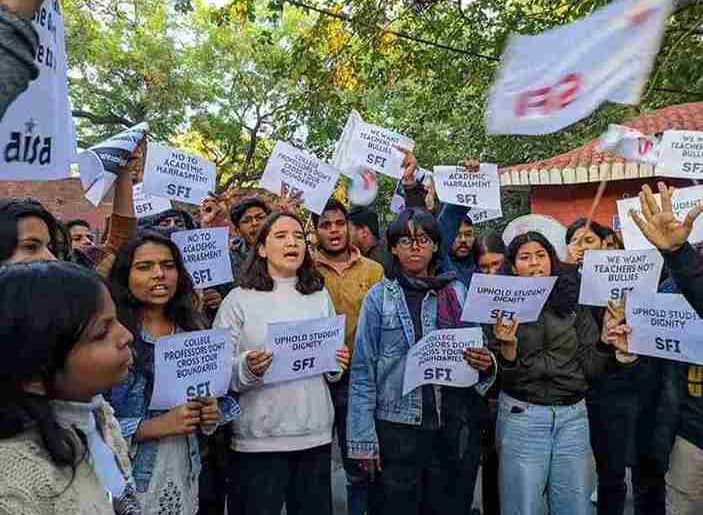
SFI staged a protest at the Arts Faculty, DU on 6th August 2025, demanding action against ABVP for its alleged role in multiple campus sexual violence cases across India.

SFI (Student Federation of India) members led by Sohan Yadav, President of SFI Central Delhi area, demonstrated a protest at the Faculty of Arts, University of Delhi on 6th August 2025. The demonstration was held in solidarity with a student from Fakir Mohan Autonomous College in Balasore, Odisha, whose tragic death in July has sparked national outrage and renewed scrutiny of the alleged misconduct and impunity associated with members of the BJP-affiliated student group, ABVP.

The 20-year-old student died after self-immolating on campus in July 2025. The victim had reportedly faced sexual harassment from a faculty member and had filed multiple complaints, which were allegedly ignored by the college administration. The case took a shocking turn when the Odisha Crime Branch arrested Subhra Sambit Nayak, the state joint secretary of ABVP, and Jyoti Prakash Biswal, a student and initial “witness” who had recorded the incident instead of intervening. Both were charged with abetment to suicide and criminal conspiracy. The arrests drew intense backlash and further highlighted the alleged impunity enjoyed by ABVP leaders across educational institutions.

Coming on the heels of the IIT-BHU rape case, this incident has fueled growing public concern over the ABVP’s repeated involvement in campus violence and sexual abuse allegations. The accused—Kunal Pandey, Saksham Patel, and Anand (alias Abhishek Chauhan)—were later identified as members of the BJP’s Varanasi IT cell, with Pandey and Patel holding convenor positions. The delayed arrests and eventual bail granted to two of them in July 2024 sparked nationwide outrage. Protests by students and civil society groups demanded institutional reforms and the implementation of gender-sensitisation mechanisms. Allegations also surfaced that ABVP even attempted to disrupt campus protests

Further, recently the Rajasthan police booked three ABVP members, who were accused of canvassing for a student leader seeking a ticket from the ABVP for students’ union elections in the university.

Sohan Kumar Yadav addressed the crowd and importantly, pointed out 

Why was there such a wilful negligence by the Chief Minister’s Office who had received all the complaints? This shows very clearly the involvement of the state government. 

Sohan Yadav further claimed in the protest that ABVP’s alleged involvement in multiple rape cases in University campuses across the country is a recurring trend, and the body must claim responsibility for the same. 

SFI Student members demanded strict action against the alleged involvement of ABVP in these rape cases and termed it a ‘rapist organisation’ which shields people who outrage the modesty of women, especially on educational campuses. 

Read also:  Minor Girl Rescued After Gang Rape Near Moolchand, Alleged Police Inaction

Featured image credits-  SFI Instagram page 

Madhav Choudhary 

madhavchaudhary1209@gmail.com

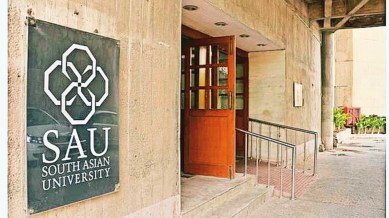
A violent altercation allegedly erupted at South Asian University (SAU) on Wednesday when members of the Akhil Bharatiya Vidyarthi Parishad (ABVP) reportedly clashed with students, including women, and mess staff over the serving of non-vegetarian food on Maha Shivratri.

According to reports, tensions had been brewing in the days leading up to Maha Shivratri as ABVP members insisted that only ‘sattvik’ food be served in the university mess, citing religious sentiments. However, the mess committee decided to provide both vegetarian and non-vegetarian options to accommodate all dietary preferences. Despite this, the issue allegedly escalated when ABVP members, led by Ratan Singh, Anshul Sharma, and Ram Sharma, entered the mess and confronted the staff and students.

They had been discussing this in WhatsApp groups for days. We ensured vegetarian food was available, so why should others be forced to follow their dietary choices?
– Yashada, the mess secretary and a master’s student 

She further alleged that Ratan Singh threw food on the floor and later turned violent, physically assaulting her.

The incident has drawn strong reactions from various student groups. The All India Students’ Association (AISA) condemned the attack, stating:

This is a strategic attempt to instill divisive hate. The ABVP-Admin-BJP nexus stands exposed as no action has been taken against the alleged perpetrators. The demand for separating non-veg food reeks of casteism.

Despite multiple complaints, SAU’s administration has yet to issue a statement on the matter. Students have accused the Dean and Proctor of allegedly shielding ABVP members from accountability. Yashada had reportedly filed a harassment complaint against Ratan Singh earlier, supported by video evidence, but no action was taken.

ABVP, however, denied the allegations, claiming that left-wing students instigated the altercation.

Students observing a fast on Maha Shivratri had requested sattvik food. 110 students had written to the administration, and their request was granted. When they were eating in a separate space, a left cadre member and mess representative allegedly brought fish curry and started arguing. When they were requested to eat elsewhere, she allegedly created a scene and threw food at them; this was intentional, just like the disruption of the Diwali celebrations at Jamia. Those who thrive on division feel threatened by cultural harmony among students.
– an ABVP representative

The Students’ Federation of India (SFI) has called for the immediate suspension of those allegedly involved and a thorough investigation into past complaints.

Students allege that the attack reflects a pattern where right-wing groups resort to violence while the administration remains unresponsive.

What happened at SAU is not an isolated incident. It is part of a broader attempt to create divisions among students in university spaces. The lack of action against those accused of violence is deeply concerning.
– An AISA representative 

Calls for an impartial investigation into the incident have intensified, with student organisations demanding that the university administration take decisive steps to address the alleged assault and ensure accountability. As of now, no official statement has been released by SAU authorities regarding the incident.

Read Also: Jamia Millia Islamia administration cracks down student-led protests; imposes arbitrary disciplinary proceedings

Featured Image Credits: The Indian Express

Ritobrita Mukherjee for DU Beat

ritobritam1@gmail.com 

Members allegedly of ABVP disrupt protest in Ramjas College on 8th January against Prof. Dhani Ram’s sexual harassment allegations. The protestors demanded that the college administration suspend the professor officially and reconstitute the ICC. The miscreants severely injured a student from the North East and threatened violence against a professor of English who intervened. Cases of sexual harassment, marking the above, continue to rise, alongside politically charged violence within academic spaces.

Dhani Ram’s history of sexual harassment charges

In December 2024, a minor and a first year undergraduate student of Ramjas College filed a case against Dhani Ram, professor of the commerce department and joint dean of Dean of Students’ Welfare, DU at the Internal Complaints Committee of the college over charges of molestation and sexual harassment. This complaint was the fourth official complaint against the commerce professor filed at the ICC of the college with several other unofficial accusations of harassment that could not be filed officially, including a 2021 letter by M. Com Students of batch 2022 written to the then Secretary of the University Grants Commission (UGC) highlighting his ‘unethical and unprofessional teaching methodology’. The negligence displayed towards the previous complaints highlight the inaction of the college authorities and the ICC regarding his conduct and his abuse of power on multiple occasions. It was only after calls of protest by the student body, AISA and SFI that Prof. Dhani Ram was temporarily suspended from the college on 24th December 2024 pending the ICC enquiry, though an official notice of his suspension has not yet been released by the college. 

ABVP’s violence and disruption of the 8th January protests

Due to the inaction of the college authorities for a duration exceeding 10 days since the filing of the complaint, Stanzin, the Vice-President of the Ramjas College Student Union, issued a call for protest on 8th January 2025. The protest demanded that the victim’s consent be taken into consideration, the reconstitution of the ICC, timely enquiry into and suspension of the accused professor, and transparency during the enquiry, including the publication of an official suspension order on the college website. However, when the students along with the members of SFI and AISA gathered in the Eco Lawns at 12:30 to make posters for the protest against sexual harassment, several students of the college and outsiders, alleged to be members of ABVP by the Left parties and the students, disrupted the protest and tore the posters. They harassed and attacked the student protestors with flower pots and sticks, particularly targeting a third year student from the North East, leading the student to suffer severe bleeding and injuries. Further, when a professor from the English department intervened to put a stop to the violence and request the group to stick to the cause rather than fight among themselves, he too was threatened by the outsider students with violence and later falsely accused of perpetrating violence himself. Despite the disruption of the protest, the student body, along with the Left parties, demanded action against the violence from the administration and issued a call for a protest against sexual harassment and the violence meted out by who they claimed to be ABVP members, outside the college in the evening. 

ABVP’s protest, Prof. Dhani Ram’s supposed resignation and the Left vs Right debate

Meanwhile, the members of ABVP locked the Dean of Students’ Welfare office and conducted a sit-in protest in the office demanding Professor Dhani Ram’s resignation. A notice released by Mitravinda  Karanwal, the secretary of DUSU, and signed by Bhanu Pratap Singh, the Vice President of DUSU, claimed:

 By the orders of the students of Delhi University and ABVP led DUSU, Dhaniram shall not be allowed to enter his office and continue as the Joint Dean of Students’ Welfare, DU, till the enquiry against him is concluded and decision made.

Later, a screenshot of a mail supposedly written by Prof. Dhani Ram was circulated over social media by ABVP Delhi which claimed that Prof. Dhani Ram resigned due to its “persistent efforts”. However, no official confirmation about the accused professor’s resignation as the Joint Dean of DSW has been received. Further, Dhani Ram’s suspension from the post of Joint Dean does not indicate his suspension or termination as a professor in Ramjas College. His suspension and termination as a professor also do not guarantee the prevention of such cases in the future, leading to the necessity of addressing the larger problem of sexual harassment in universities with particular focus on the POCSO Act.

Stanzin, the Vice President of Ramjas College, resolved to continue the movement despite the alleged violence by ABVP:

We wish to ask why the ABVP is protecting sexual harassers and perpetrators. We further ask why the administration is complicit in the organised violence against common students. What occurred in Ramjas during the protest was wholly unconstitutional and barbaric. We condemn it to the fullest terms and demand justice for both the survivor as well as the students. Further, I want to emphasise that they will not silence us and we will continue to fight resiliently. While the ABVP is publicising that Dhani Ram has resigned from the post of Joint Dean of Students’ Welfare, no formal action has been taken against him. The administration is complicit in protecting him and we demand his immediate suspension and the  reconstitution of the ICC. Since our demands have not been fulfilled, our fight continues.

A former student of the college and member of AISA added:

The attack by the goons today—it is amply clear that the people who inflicted the violence today were from ABVP—is the clearest expression of the state of democracy on our campus, in which, students cannot even gather to protest against sexual harassment on their own campus. There is a litany of regulations which is supposed to prevent sexual harrassment on campus, because sexual harassment is so fundamentally antithetical to a healthy teaching-learning environment, but all of these regulations are merely on paper. It is the students’ right to demonstrate and gather in their own college, and whenever the administration is incapable of directly suppressing these movements, it has time and again made use of goons to intimidate student organising, an example of which we also saw last year in the protests in BHU. ABVP and people aligned with it, in attacking the students today have proved that they stand with the perpetrators, the harassers, and all their claims of gender justice is a farce. The students of Ramjas College have bravely resisted all attempts at suppression, have done so today, and will continue to do so.

Rising cases of Harassment by professors and acts of violence in Ramjas; problems within the ICC

The sexual harassment case against Prof. Dhani Ram is not an isolated case in the college or the university as several students have also reported other cases of sexual harassment by professors in Ramjas College in the past few years that have either not been reported due to the influential positions of the accused or not been thoroughly investigated by the ICC. Further, the students of the college have also reported a rise in acts of physical violence during conferences, society events and auditions, and the everyday functioning of the college by students of the college, outsiders, and members of ABVP. The recent attack on student protestors by the members allegedly of the ABVP is a continuation of the acts of violence meted out to students and faculty in 2017 and 2019, and it raises grave concerns about the safety and security of students within the campus space. The college authorities must address the growing cases of sexual harassment by professors, the rise in the cases of violence, and reform and reconstitute the ICC, a body that has been reduced to inaction, complicity, shaming the victims and protecting the culprits, in accordance with the students’ demands for transparency and respect for the survivor’s consent. 

A third year student of the college who had joined the protest remarks:

The recent act of violence during the protest by ABVP members is a shameful and concerning attempt to distract attention from the sexual harassment case. I found that several members of the staff association except for one did not even do the bare minimum. Important as it is for us to condemn violence, we must also ensure that we do not reduce this case to a left vs right battle and bring our focus back to the harassment case. This is sadly not the only case we have seen in the college as professors from the English and history departments regularly harass students sexually and verbally. We have even heard some of them slutshame their own colleagues behind their backs and we see them regularly harass female professors in the department meetings. These cases highlight a growing sense of institutional amnesia in the college and university where a large majority of students and professors no longer address such cases, thereby normalising them. It is important that the survivor in this particular case gets justice, Prof. Dhani Ram is suspended, and the larger problem of sexual harassment within university spaces is addressed, bringing into light other such cases as well.

Aadrit, a former student of the college who had also joined the protest added:

I went there as a common student, not as a part of any political party. I am a part of none anyway. I went there because it was important—not because a North East student was brutally beaten—that happened later and violence of all forms must be condemned—but because, first and foremost, it was a case of sexual harassment and my experience has been one where such cases routinely are brushed under the carpet; be it Hathras, RG Kar, or the previous offenses of Dhani Ram. Against the backdrop of the present situation, as the right and the left continue their war, I urge all students, faculty and others, to come together and stand in one unwavering spirit so that justice is done, ICCs are fixed, the system is corrected, and Dhani Ram and all those like him are held accountable. The focus must not shift. We must remember what we are up against: patriarchy. And we must all stand in solidarity in this arduous struggle for gender liberation which involves the fight against all forms of injustice.

Neha, the Secretary of SFI Ramjas, highlighted a systemic problem with the ICC of the college:

There have been multiple violations of ICC guidelines. The complaint has not got any reply from the admin even after 20 days when they should have released one within 7 days. Those who are a part of this enquiry committee consist of the same people who had protected Dhani Ram 2 years back in another sexual harassment case. While UGC guidelines say that people in enquiry committees should have work on gender, these teachers don’t have that merit either.

Further, a member of the college’s student union claimed in yesterday’s protest that a member of the college’s current ICC, which is investigating the Dhani Ram case, has had an alleged case registered against himself in the ICC, a body he is now a significant part of, on which account no action has been taken by the college authorities, highlighting the supposedly corrupt and complicit nature of the body.

Anonymous

Read Also: Dalit student allegedly harassed and assaulted by Shaheed Bhagat Singh College’s principal

Picture Credits: SFI Delhi Instagram Page

 

Characteristic of DUSU elections, the DUSU elections for the session 2024–25 were also a display of money and muscle power, tearing up of nomination forms, and a rather irreverent attitude towards the Lyngdoh Committee guidelines for the elections. The emergence of identity-based parties, an SFI-AISA alliance, and the Delhi HC directive to postpone counting of votes augur major changes. Despite this, the voter turnout remained abysmally low at 35.2%, the lowest of the past 4 elections, and from what students claim, this reduction seems to be manufactured by the administration. 


Slated to start its counting post the 21st of this month after the court hearing scheduled on the same date, this year’s DUSU elections were different from all previous elections. From the alliance between the Left and the emergence of identity-based parties like Ambedkar Students’ Association (ASA) and Fraternity Movement in DUSU to the last moment introduction of special buses, the inauguration and removal of a miniature Ambedkar statue by the DUSU, and eleventh hour changes in presidential candidates of major parties, this election saw it all and was, by far, one of the most happening elections of all times. Despite these developments, it seems unlikely to have such a low voter turnout. Though the hostile nature of the campus during elections and the rather short time frame for voting discourage a lot of students, especially female students, and thus, voter turnout appeared unnaturally low. 


According to Hindustan Times, the voter turnout for this year was 35.2%. It is important to remember how the voter turnout is calculated in order to understand the trends for this election, as the figure measures the number of votes cast as a percentage of the eligible voters rather than the number of voters who come to their institutions to cast votes. It is the gap between the number of eligible voters who show up on the day of voting and the number of votes cast, reflecting the number of voters who were unable to cast their vote despite showing up on the day of elections. While this gap has emerged in the previous elections too, it seems to have widened rapidly in this election, making it seem ‘manufactured’ by the administration to decrease the number of votes cast, as per the claims of the students. This gap was exacerbated by issuing last-minute notices in several colleges that set out the eligibility criteria to vote in the elections and made students stand in long queues in administrative offices on the day of voting, to update their ID cards that took hours, leading to situations where the voters were unable to cast their vote past, despite their early arrival in college. Further, in several colleges, only a handful of polling booths were allotted for the entire institution despite the availability of more polling booths, making 1000s of eligible voters poll from a single booth. These booths were also changed at the last moment, creating confusion around the venue for voting.


A third-year student from Ramjas College notes:

I couldn’t vote because I was 2 minutes late. There was a big jam on the campus, and no auto was able to make it through, and as soon as I got to the college gate, they didn’t let us in. I waited there for a while to enter, and as soon as I did, there was so much confusion with the venue of the voting; some said the auditorium, and some said other classes. When I finally found the classroom, they didn’t let me join the line as I was 2 minutes late. The faculty was rude, and they were shouting at us without listening to a word we said. I wasn’t the only one who was left out, and there were a lot of other students as well.


Though several colleges had sent out last-minute notices about verification of fee slips and upgradation of ID cards for all voters, in stark contrast, it turns out that at several institutions, the faculty was not checking whether the ID cards of students had been upgraded. 


Another third-year student from Ramjas notes:

Though the college had notified students to verify their ID cards, several students, including me, were only asked about our courses and year of study and were allowed to vote even regardless of whether our ID cards were updated or not. The faculty members at the polling booths were not following the rules as a lot of students were in the queue to vote. While I was voting, the DUSU presidential candidate of a major political party entered our booth and was openly campaigning, and no faculty members present in the booth stopped him, despite this being a clear violation of the guidelines. They rather allowed him to speak.


Though bureaucratic mismanagement and chaos are natural in such a large election, a lot of the aforementioned incidents seem deliberate and conscious attempts to dissuade students from voting. Even while the students were verifying their ID cards, the candidates were openly campaigning and helping those in queue using their contacts in the college administration to get their ID cards verified faster to garner more votes. This ensures that only a selective and chosen crowd gets to vote in the elections, and a large crowd of students is not allowed to exercise their right to vote despite their attempts to do so.


A student from Miranda House notes the manufactured chaos in the order of voting in the elections:

Students remember the ballot numbers of each candidate, and that’s how polling booths are supposed to work. In Miranda House, in the initial phase when the elections started, the order of positions in the polling booth was informed to us as President, followed by Vice President, Secretary, and the Joint-Secretary but later on, as the elections went forward, they altered the position. The Joint-Secretary’s position was moved to the first, and the President’s position was moved to the last in the polling booth which caused a lot of confusion among students because that is not how you come memorising the numbers.


Though bureaucratic mismanagement led to a further decrease of voter turnout, the developments in this year’s elections will have a long-term impact. With the strict action taken by the Delhi High Court to ensure that counting doesn’t begin until public defacement is removed, it could potentially tamper with the results but might result in lesser defacement and a violation of rules next year. Further, the directive to ensure 50% reservation of women in DUSU would also have a positive impact. In terms of party politics, sudden changes in candidates of major parties post-nominations and the withdrawal of community support following the same might lead to a reflection about the role of caste politics in DUSU. The emergence of identity-based parties and the alliance among the Left would also ensure that the ABVP-NSUI binary is challenged in the upcoming years.


Read Also: Under the Shadow of DUSU Elections: A Stage for Sexual Harassment and Caste-based Politics


Picture Credits: Nehal for DU Beat


Vedant Nagrani

vedantnagrani12@gmail.com