Author

DU Beat

Browsing

Societies work tirelessly every year to put their best foot forward and perform at various colleges gaining a whole load of exposure and memories. But often these experiences come at the expense of one’s mental health and personal restrictions.

Even semesters at the University are jam packed with all kinds of events – dance, drama, debate and fashion, most notably college fests. And fashion events amongst them are considered the most glamorous of all – shows with extra spotlights, flawless garments and charismatic models. However, this screaming confidence on stage involves hours of practice and dedication, a fact most people tend to ignore.

What people also don’t realize is the untoward pressure, toxicity, shaming and biases that members of a fashion society deal with on a daily basis. They might be forced to follow certain diet restrictions, compromise on their personal life for the sake of endless practices and expected to deal with the toxic environments. You either adapt to this discomfort for your passion or end up leaving the society.

On the condition of anonymity, an ex-member of a renowned fashion society shares, “I was so thrilled to be a part of the fashion circuit in my first year. It seemed like the perfect start to my college life. However, it turned out to be so toxic right from the first week. The seniors who were so kind and considerate in the auditions were actually so rigid and egoistic when it came to following their instructions. One of them literally kept an eye on me to check how much time I spent having lunch. She not only scolded me for being just five minutes late to the practice but also didn’t shy away from passing personal comments. Because of their repeated misbehavior, I ended up leaving the society in the second week itself. But even after that they would talk nonsense about me and pass comments every time they saw me. I don’t know how much I have cried because of them.”

On the performing front, fashion productions often seem to be reduced to a mere display of ‘walk and entertainment’ and exquisite clothes with eve-teasing and name-calling during shows being recurrent occurrences.

DU Beat came across instances of the audience passing lewd comments from the crowd, throwing notes and papers at models on stage and clicking inappropriate pictures. This behavior is so uncalled for and affects the participating members mentally and emotionally. Societies have rightfully taken a strict stand against any such instance. However such shaming might not just be restricted to the crowd.

A member from a reputed girl’s college in South Campus talks about how fashion policing and judging is so normalized within the circuit. “You are expected to look presentable at all times, beyond the stage and practices as well. Because when it comes to shaming, even your society peers won’t leave a chance. I guess that is one reason why fashion societies are considered to be very elitist and that not everybody can afford the branded clothes and style. You are really judged on what you wear on a daily basis.”

It is usually assumed that fashion societies do not have much to do in terms of rehearsals and that it’s just about the ‘good looks and walking the ramp’. However preparing for this ramp walk involves costumes, dresses, props and lights that are designed and worked upon by the members themselves. The sequences are choreographed and repeatedly practiced. Moreover there’s a fine difference between a dance performance and a fashion walk. “Societies and judges continue to live on the tangent that drama and dancing makes a performance look good. But as a fashion society we work on our walk, props and expressions, not dancing around in carefully crafted costumes”, says Garima Satija, ex-president of Nakshatra, Hindu College.

“I went to a judge for the feedback of our performance at a competition. To my surprise the judge told me that we would have won if only we could add a bit of dance movements in the front. Most judges don’t even come from a fashion related background, they are sometimes dance choreographers or even faculty of the organizing college. While the judges’ decision is final and binding, we face problems in getting proper feedback for improvement. The true sense modelling and ramp walk seems to lack when people prefer dramatic content over pure fashion shows”, she added.

Many societies complain that the judges often end up giving vague explanations for feedback instead of valid points. With teams trying to uncover avenues of creativity in terms of themes and productions, there’s still no acknowledgement given to them for trying something out of the box because judges continue to consider the same old dramatic content to be capturing. Repetition of judges was a major concern pointed out by societies. A fashion society member from a North Campus college told DU Beat, “If a judge likes a performance at a particular college, they aren’t likely to change their views at another college and the same teams end up winning similar positions everywhere. The results get forged and the judges turn out to be explicitly biased towards certain societies. There isn’t any mechanism within the circuit as well to keep a check on this.”

Mismanagement at fest is another problem that societies put forth collectively. Events end up having logistical issues in terms of announcement of results, performing sequence, manipulation of results, untimely distribution of prize money and certificates and other malpractices. Such issues not only disheartening and difficult for the participants but also undermine the essence of performing art. With sensitive conditions in the city overlapping with the DU fest season earlier this year, many events were either cancelled or abruptly conducted. While societies did lose their chance to perform at maximum colleges, they also faced security issues while commuting and disappointment at many college doors.

A member of a South Campus society talks about a popular fest, “We faced a lot of security issues in the month of February and early-March. The gates were closed and the police were not permitting teams to enter the campus. The lack of coordination caused a lot of chaos and students were close to getting physically hurt. The organizers didn’t come to help the participants as they should have, and many had to return without performing.” He adds, “In fact after 9-11 teams clearing the prelims, they conducted their event with only 4-5 teams in the finals and eventually distributed the prizes as well. This was very unfair to teams who travel all the way to perform but cannot because of the inefficiency of the organizers.”

Addressing the show mismanagement issue, an ex-member of Poise, Institute of Home Economics, says, “Being an all-girls team we used to face security concerns due to varying show timings and late announcements of results. Shows hardly start on time and get delayed late for one another reason. With multiple shows in a day across colleges in the University, it becomes really difficult to manage it all and ends up affecting the performance of the team.”

Lack of green rooms and proper changing spaces is also an increasing concern within fashion societies. 15-20 members of a team are often clubbed into one small classroom and expected to change their costumes and assemble their props there. Sometimes the windows too are left uncovered. This leads to random people clogging outside these rooms, clicking absurd pictures and passing comments.

Talking about the rising bias and forged results in competitions, Aashna Rai, President of Galore, Maitreyi College tells DU Beat, “We’ve often witnessed judges repeatedly favoring teams which is highly demotivating for societies and the members. While every team deserves a fair judgement procedure, the scores and judgment sheets are not transparent at all events. They are often tampered by the organizers.”

She added, “At times societies copy the sequences, music track or garments of other teams causing internal feuds.”

Now building up an annual production does require extensive thinking and research. However in the process, societies often tend to forget the difference between inspiration and duplicity. Plagiarism thus leads to clashes and bad-mouthing within the circuit, thereby diluting its creative credibility.

While the internet is flooded over with body positivity content creators and inclusivity in modelling, the stereotype that a model has to have a good height and figure to enhance her looks still penetrates in the DU fashion circuit. Anushka Tyagi, the newest president of Nakshatra, Hindu College shares with DU Beat, “I have never won the ‘Best Female Model’ because I’m short and this is despite practicing my walk and expressions for hours with full dedication. In order to win an individual mention, you really need to look like a stereotypical model. It’s really hard to find judges who actually judge you on the basis of your confidence. Most of the time it comes down to looks, height and figure. With the circuit boasting flexibility in terms of body shape and height, you end up getting intimidated and insecure about yourself that you won’t ever be able to achieve something like that. I had to really push myself to come out of it and work on my sequence, energy and expressions with extra hard work.”

It’s time that the University circuits introspect its ways of functioning and develop mechanisms to deal with toxic environment, mismanagement and malpractices. Societies as a whole should come together to enable themselves to be friendly and respectful spaces that can promote collective growth and inclusivity. The true essence of any art form lies in upholding fairness with focus on performing instead of just winning.

Feature Image Credits: DU Beat

Aishwaryaa Kunwar
[email protected]
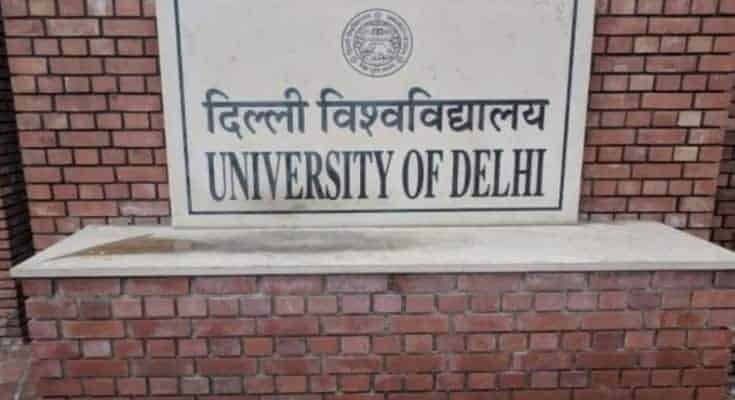
Delhi University Teachers’ Association (DUTA) has refused to comply after the University of Delhi sent colleges and institutions letters seeking details regarding the online classes conducted by teachers.

On 20th April 2020, the University of Delhi (DU) administration had sent a letter to all of the varsity’s colleges and institutions to enquire about the online classes being taken by the teachers. However, the Delhi University Teachers’ Association (DUTA) has refused to comply with these demands. DUTA said that the teachers would not be filling out this form as it feels that this form could be used to draw a conclusion that is in favour of online exams.

This seeking of information was done by the varsity after the Human Resource Development (HRD) Ministry sought details of the online classes being conducted during the pandemic by the teachers. Previously, the university had urged its teachers to remain in touch with students. They had been asked to distribute e-resources, and this was done by providing material through WhatsApp and e-mail. On Monday, 21st April, DU sent a letter to its colleges requesting information regarding the classes being conducted online.

However, DUTA wrote to the Vice Chancellor, urging him to withdraw the letter. “We express our utter dismay at the approach taken by the university in the face of the pandemic with respect to conduct of online classes and the forthcoming semester examinations,” the association wrote to the VC. “The letter does not indicate as to the purpose for which this information is being sought, that too at such short notice. We wish to point out that the format sent out to the colleges reveals extreme shortsightedness as there is no attempt whatsoever to find out how students and teachers are coping with the abrupt closure of the university due to the pandemic and subsequent lockdown announced by the government.” They also added that “The format expects teachers to answer questions in a manner that would reveal very little about the preparedness for exams or issues which they are facing.”

Earlier, DUTA had written to the administration opposing the idea of online examinations. They had urged the administration to understand the lack of resources available to various students of the varsity, as well as the fact that online classes could not compensate for in-class lectures. They, therefore, insisted that online examinations weren’t a viable option. 

“Hence, to ask colleges to submit details of online classes on the format circulated is not only grossly misplaced but also indicates the complete lack of concern on the part of the authorities towards the well-being of students and teachers,” the DUTA said.

DUTA has therefore decided to reject the letter in fear that it may be used to draw conclusions in favour of online examinations.

Feature Image Credit: DU Beat Archive

Shreya Juyal

[email protected]


The entire country will be segregated into red, orange, and green zones based on number of reported cases from each region. 

The countrywide lockdown has been extended till 3rd May. The Prime Minister in his address to the nation stated that the entire country will be divided into three zones: red, orange, and green. These zones will be formed based on number of the cases in that area. Areas with sizeable cases will be in the red zone. There will be little to no activity allowed in this zone. The status of orange zones will be given to those areas that reported positive cases in the past but saw no increase in the number of cases. Those districts where no coronavirus cases were reported will be categorized as the green zones.

Chief Ministers of multiple states proposed the opening of liquor shops as the revenue generated through them adds a considerable amount to the state revenue. In green zones, citizens will be permitted for limited movement across the zone itself. The limited movement will most likely put the green zones at risk of turning into orange zones. Many districts in Maharashtra reported cases with no travel history or close contact with anyone having a travel history. Yashvi, a student of Miranda House College opined: “The decision of categorizing regions into three different zones is going to be complex, and faulty implementation might lead to serious repercussions such as spreading of wrong information and a spike in new cases.”

India’s containment strategy is still being accurately mapped out. Hotspots or red zones will have strict travel restrictions. Many bureaucrats are apprehensive about the impacts the pandemic will have on the economy. According to the World Bank’s prediction, India will witness a growth of not more than 1.5 to 2.8 percent.

Feature Image Credits: DNA India

Suhani Malhotra

[email protected]

Read the words of our Editor-in-Chief for one last time, before she graduates, as she complains about her stolen sixth semester.

I remember last year, around this time, I was preparing for the farewell ceremony for my seniors at DU Beat- my phone would blow up with some 250 random messages on WhatsApp, endless calls discussing the venue, theme, gifts, and what not. At that time, I didn’t actually understand what the final semester meant to my seniors because I was too engrossed thinking about how life and work would be without them being around. But I also had the settling feeling that I would know when time comes.

Cut to 2020, the last semester of my college life as an undergraduate student, sitting at home, writing this article, and thinking about where my last semester went. I think of the stuff I would have been doing with my college friends and my team at this wonderful organisation.

However, I have always believed ‘expect the unexpected’ and I think that this is the only thing that is keeping me sane in such uncertain times. As kids, most of us might have experienced an unsettling feeling when somebody would snatch out a lollipop from our mouth. This is exactly what happened to our final semester.

Having said this, I would not talk only about the sad situation we are in. As a graduating student, a host of memories flash in front of me right now- the day I got admitted to the University of Delhi(DU), the day I met my college best friend, and the day I joined this organisation.

The three years of my college life have been the most challenging, yet the best years of my life. From being a student coming out of the protected cocoon of school life to graduating college with confidence and an identity, this is what these three years have made me. As college students, we are stuck with assignments, internals, submissions, deadlines, placements, societies, and endless preoccupations.

The nationwide lockdown gave me enough time to introspect and surprisingly, all that mattered to me during this difficult time were the people. I realised that my college life was not only defined by a degree or my friends, but also the security guard of my college who would wish ‘Good morning bacchon’ every morning, the canteen staff who would talk about their families, and the housekeeping staff of the college who would smile and wish me luck before every exam.

I wish I could get to relive all this one last time because I didn’t know that the chai I had on 6th March in my college canteen was the last cup I would have with my college friends while Ravi bhaiya (college canteen staff) talked about his Holi plans. You know something impacts you a great deal when you are unable to write about it without being cheesy and clichéd. It’s a faux-pas I’m willing to indulge in for the sake of honesty.

As much as I have talked about the final year students, I would also like to talk about the juniors. They are also the ones who hope to give their seniors the most memorable days of their college life. The end semester is also a reminder that they have become older, and are now themselves seniors. It’s a nostalgic time for the third-year students but what we often forget is how overwhelming it is for the juniors as well.

Dear Delhi University, the batch of 2020 will miss their last fest season, internals, college parties, night stays, bunks, submissions, and the last lectures and yes, they will miss you too- a place which gave them friendships, lessons, and lots of memories.

Feature Image Source: Anoushka Sharma for DU Beat

Anoushka Sharma

[email protected]

In her last editorial of her tenure, our Print Editor talks about the socio-political and cultural connotations of expecting productivity in the midst of a Pandemic.

The University of Delhi (DU) is a revered dream for many, with its soaring cut- offs at the top ten colleges, promises of placements (mostly for commerce- based courses), and the affordability of its fee structure which allows undergraduate students to get a degree for as low as INR 50,000. Owing to the hullabaloo and cry over privatisation, one cannot say whether the last factor will sustain much further or not, but for now it is safe to estimate that this University is not home to selectively privileged youngsters.

Therefore, in unprecedented times like these with the Covid-19 Pandemic, DU’s 12th March Press Release, which insists upon maintaining the “continuity of the online teaching-learning process” is premised upon a sweeping generalization of social, economic, cultural, and political privilege.

With over 75 colleges, having an approximate total strength of nearly 1.5 lakh regular students, it is the infrastructure and physical access to the resources (libraries, notes, Internet, classes) available in respective DU colleges that is integral to the teaching-learning process for many students. The national lockdown due to the Pandemic has confined students, like all others, and many students have had to return to their respective homes.

The foundation of the belief that it is possible to continue an education process in the illusion of normalcy is the myth that the accessibility to resources is fair-play for all. Take for instance, the Kashmiri students in the University who have difficulty downloading byte-sized PDFs due to the restricted Internet access, and one would understand that video lectures on Zoom, Hangouts, and reading on JSTOR are synonymous with a utopian fancy in many students’ homes.

This is not to say that professors and peers in colleges are entirely ignorant of the aforementioned limitations, but there is significant pressure upon students nonetheless to go about internal assessments and coursework, as if it is an extended vacation.

To be fretting over grades and submission deadlines is not a privilege available to many whose mental health gets threatened in abusive or patriarchal households. Especially for women in India, many of whom choose DU because of its affordability and residential facilities that are liberating as compared to conservative, controlling families, being forced to stay in an inevitable lockdown can be a severe trigger for anxiety and, in some cases, trauma as well. There are urban and rural households alike which put a gendered burden of housework and chores like cooking, cleaning, laundry, etc. upon the women in the family – a factor that is not only troubling in terms of its sexist and patriarchal strain, but also because it practically limits how much time women can devote to an education they fought to attain in DU.

In times like these when Instagram influencers and many others have taken the approach of selling the ideals of ‘productivity, evolution of self, finding yourself’ among other things, it is integral for teachers and administrators of an educational institution like DU to realise the exploitative and harmful burden an undeveloped, inaccessible system of ‘online teaching-learning’ puts on young minds. This needs to be considered before generalising and declaring that students can afford to be studying more, finishing course work properly, and working hard, from the apparent comfort of their homes.

In this last editorial for this paper, I thus urge the students, teachers, and administrators of this vividly diverse University to acknowledge unequal privileges, and be kinder.

Anushree Joshi

[email protected]

Medical officers, scientists, even the World Health Organisation (WHO) refers to the current pandemic as Coronavirus, but not some powerful world leaders, who have used this opportunity to stigmatize a particular disease. We still have not learnt anything from history, Have we?

 Amidst the world combatting the Coronavirus pandemic, the infamous part-time President, full-time “Twitterati” Donald Trump took to Twitter to address COVID-19 as “The Chinese Virus”. While in the same tweet he also said, that the United States of America would continue supporting the worst hit industries, like Airline and Travel Industry, where he completely ignored the dearth of funds the US healthcare system has been facing, the worst part still remains him nationalizing Coronavirus. 


Image Credits: Talk Radio Image Caption: The tweet where Trump addressed Coronavirus as Chinese Virus
Image Credits: Talk Radio
Image Caption: The tweet where Trump addressed Coronavirus as Chinese Virus


The US has been struggling to deal with the pandemic since Day 1, and Trump’s blame game has only jeopardized the situation more. Earlier, Trump blamed ex-President Barack Obama for the rise in number of cases in the States (Sounds familiar, doesn’t it?). Followed by Trump then blaming WHO, his own medical officers and ministers, and well now China. It is confirmed that the first case of Coronavirus was found in China, but does that make the virus Chinese? Trump’s own Secretary went on record to condemn Trump’s racist views as the virus is not propagated by any ethnicity or nationality, but Trump’s views do propagate Xenophobia.

While being asked to comment on his racist remarks of calling the virus Chinese, Trump refuted all accusations by saying, “The only reason I call the virus Chinese is because it originated from China. Whatever I said is not racist. Not racist at all.” Now, the question that persists is why the Coronavirus being called Chinese is extremely wrong?

There are two answers to that question, and both of which lie in power dynamics. Firstly, history has been the witness that whenever a disease or a pandemic has been stigmatized to particular ethnicity or nationality, it has led to catastrophic consequences. In the 14th Century, Jewish people were blamed for the outbreak of Black Death in Europe, and they were killed in great numbers. Again in 19th century Irish Catholic immigrants were blamed for spreading Cholera to the US, and thus were thrown in detention camps and faced mass killings. If you still don’t understand the relation of stigmatization of disease and its effect on people and national policy. In 1876, a group of Chinese people living in San Francisco became the scapegoat for smallpox outbreak which prompted the infamous Chinese Exclusion Act. 

While Trump may just be following the past narrative of naming diseases on the place of their origin, like Ebola, The Zika Virus, and more, what he doesn’t realize is that the world already has realized their mistake of stigmatizing diseases. Therefore, in 2015, WHO laid down the guidelines for naming a disease to avoid exactly what Trump is doing right now. Owing to the ideology that Trump preaches, the Asian-American, specially the Chinese-American community are facing tremendous violence, hate and daily racism. This phenomenon is also evident in India, where several harassment and racism cases have been reported against the North-Eastern citizens.

Secondly, calling the virus Chinese helps Trump to put the entire accountability of failure of the US health infrastructure on China. It also defers people from asking questions to Trump and his health policy, to hating China. Unfortunately, this has been proven true, with now the conspiracy debate around China using Coronavirus as a weapon being more surfaced than questions regarding the poor healthcare system, and how our politicians do not deem to invest in it but would spend all its budget on statues.

The Coronavirus sees no nationality, no ethnicity, no race, it just sees immediate health action plan. Whenever a disease has spread, shameful incidents of xenophobia and stigmatization have been written in history. Trump’s desperate efforts of playing the blame game, and nationalizing the suffrage of people, just shows the ideology of a capital-driven right-wing President.


Feature Image Credits: Bangalore Mirror


Chhavi Bahmba

[email protected]


Amongst all the social reformers that India has had, Ambedkar was one of the most remarkable. For a country like India, where caste system is ingrained as such, the role of Dr Bhim Rao Ambedkar cannot be forgotten.

On 12th December 1935, Bhimrao Ambedkar was asked by the Hindu reformist group, Jat-Pat Todak Mandal (Society for the Abolition of Caste System), to address their annual conference. He had been asked to speak about the horrifying and detrimental effects that the caste system brought upon the country.
However, when Ambedkar sent in his address, it was denied by the group. It had been deemed “too controversial”, and no one wanted to risk offending the higher caste groups. When they asked him to delete any provoking comments, Ambedkar had adamantly replied that he “would not change even a comma”. A year later he published this speech as the essay, “Annihilation of Caste”, which was remarked as one of the most scathing reviews of the caste system.

Inarguably, the caste system is one of the most shameful concoctions to be birthed out of archaic Indian traditions. A repressive and inhumane ideology, the caste system was one of the social constructs that many Indian reformists tried to abolish, and the contribution of Dr Bhim Rao Ambedkar was one of the most stellar.

Dr B.R Ambedkar dedicated his entire life to the abolishment of caste, and his contributions towards dismantling the system are extremely notable. Born to a Mahar family, Bhim Rao was one of the few lower-caste children to attend school. Despite the discrimination, he became the first Dalit to be enrolled into the prestigious Elphinstone High School and won the Baroda State Scholarship for three years. He finished his postgraduate education from the Columbia University in New York, and for his thesis, he wrote about the castes in India- a paper that was presented at the Columbia University.

When Ambedkar returned to India in 1924, he launched a social reform movement against untouchability. He founded the Bahishkrut Hitkaraini Sabha, an organisation with the resolve of uprooting India’s caste system. He organised various marches for Dalit rights to basic human activities that were denied to them, like drinking water from public resources, or their right to enter religious houses. As a famous symbol of struggle against injustice, Ambedkar along with other protestors, walked into public tanks and reservoirs to drink from their waters. In late 1927, Ambedkar presented in a conference and publicly condemned the religious text of Manusmriti and its inhumane justification for caste discrimination and the notion of untouchability. He then led a march later that year where he and his fellow protestors burnt copies of his text as a token of opposition.

For the rest of his years, Ambedkar continued to fight against the archaic system. His most famous contribution is the construction of the Indian constitution under his guidance as the Chairman of the Drafting Committee. The Constitution of India, applauded as one of the most progressive documents of its time, abolished untouchability every form.

It has been over sixty years since Ambedkar’s reformations, and though caste still remains an evil that taints the society, it is only fair to recognise the immense struggle and development Dr B.R. Ambedkar contributed towards dismantling the caste system.
In 1936, Annihilation of Caste, Ambedkar had said, “Political tyranny is nothing compared to the social tyranny and a reformer who defies society is a more courageous man than a politician who defies Government.” The life of B.R. Ambedkar is that of a courageous and brave man working passionately to reform the Indian society and rid it of one of its worst evils. His legacy is one of great example and precedent which we cannot afford to forget.

Feature Image Credits: Britannica

Shreya Juyal

[email protected]

On the occasion of World Heritage Day, we take some time out to point the spotlight on lesser known monuments which are rapidly headed towards disintegration due to constant neglect.

Long queues neatly separated by steel railings. Constables stationed outside and inside the premises. A two digit price ticket for Indians and a three digit price ticket for foreigners. Tour guides who speak better English than you, seated in anticipation just after the air-conditioned ticket counter. Spick and span washrooms. Expensive audio guides. Well-manicured gardens. Informative placards stationed after every five metres. The Qutub Minar, a UNESCO World Heritage Site is lavishly groomed as a tourist spot, and meticulously well preserved as a monument. One could almost call it “pampered”. And why shouldn’t it be? Having towered over the capital’s skyline for nine centuries, it is a reminder of the country’s architectural supremacy and the city’s rich cultural heritage, aweing every single person seeing it for the first time.

A couple of minutes’ walk from the Minar along a secluded, peaceful road dotted with some posh nightclubs, designer boutiques and leafy canopies suddenly opens up to the bustling cacophony of a messy mini metropolis, Mehrauli. On the Mehrauli roundabout, opposite a noisy bus depot, lies a domed structure, visible to every passer-by courtesy its huge size, but acknowledged by none, except for some adventure-seeking tourists. There are no constables, long queues, tickets or ticket counters, tour guides, manicured gardens and most importantly, tourists.

The monument itself is run-down. A few vagabonds sleep inside the circular corridor. Four children play cricket in the courtyard. Some tobacco and paan hawkers have set shop inside the premises. If you look closely at the dirt stained informative placard at the entrance, it reads “Adham Khan’s Tomb”. Locals refer to it as “Bhool Bhulaiya” and it is well known only as a landmark, helpful perhaps while giving directions to delivery boys, and certainly not as an important heritage site, in spite of being built by one of the greatest rulers of the subcontinent, Mughal emperor Akbar.

Despite being in close proximity to the Qutub Minar, the treatment that most of the monuments and heritage sites in the Mehrauli and Hauz Khas area receive is a far cry from the one received by the Minar. Some have it worse than Adham Khan’s Tomb. Rai Pithora, the once grand citadel of the Rajputs lies in shambles and some of its boundaries are even used as garbage dumps. Most of the Sultanate era baolis or stepwells reek with stinking green water and are a breeding ground for mosquitoes.

There are hundreds of historical sites peppered across the city, in Old Delhi, Zamrudpur, South Extension, North Delhi, Central Delhi, Tughlukabad, Palam to name a few. Many of them are recognized by the Archaeological Survey Of India, but still find themselves in miserable conditions. Some are not recognized and remain unidentified even by the locals. Apart from being uncared for, they also fall prey to two menacing issues – vandalism and encroachment.

“X was here”. “Y loves Z”. “Long live the X party”. Acknowledgements of romance and pledges of loyalty to political candidates scribbled on the walls or pillars greet the beleaguered tourist who visits the monument once in a blue moon. Besides this, climbing atop delicate structures as well as sticking advertisement posters on the monument’s walls also count among the rampant acts of vandalism undertaken by irresponsible citizens.

In areas like Mehrauli, Chandni Chowk and South Extension where heritage sites exist simultaneously with residential areas, encroachment into the monument premises is common. Homeless people use them as shelter. Children use them as playgrounds. Residents use them as garbage dumps. According to ASI rules, construction within 100 metres of a monument protected by ASI is prohibited. But it is hard to implement the rule in a populous city like Delhi where unauthorized constructions are prevalent. In fact in a recent report by ASI in response to a Right to Information (RTI) application, Delhi ranks first in the country in terms of monument encroachments with the number crossing 300.

One might attribute this to the domino effect. Once a person vandalises or encroaches, and is not reprimanded, others follow suit and soon the number rises. “Doing the same in heavily guarded and respected sites like the Humayun’s Tomb and Red Fort would be unthinkable for even the most desperate of vagabonds and mischief mongers. So why aren’t the rest of the sites as heavily guarded?”, said a professor of sociology at the University Of Delhi on the condition of anonymity, questioning the unequitable treatment of monuments by authorities. These issues would have been nipped in the bud had there been stricter measures and punishments against them when they started coming up initially. The goal now should be to limit any further damage and if possible, allot funds for the refurbishment of the damaged sites.

Why should lesser known heritage sites be refurbished if they don’t attract any footfall? Well the very reason these sites don’t attract people is because they aren’t refurbished. With nothing worthwhile to see, nothing worthwhile to read, nothing to transport them back to the past, there is no incentive for them to visit. Add to the fact that many decrepit monuments are located in secluded and unguarded areas, thus making them unattractive to potential tourists. And even if they do not attract as much tourists as other well-known monuments, they need to be well maintained and well preserved for the sake of historical and cultural integrity. India’s rich culture and heritage is what makes it so unique, admirable, respectable, and the neglect of historical sites sabotages this reputation.

Nevertheless, the ASI has done credible work in handling an extremely long list of heritage structures. In fact, even the meticulously handled affairs at well-known historical sites is something that they need to be lauded for. Non-governmental organizations like INTACH and the Aga Khan Trust have done well in complimenting the work done by the government and have helped fill up loopholes. As citizens, it is our duty to provide constructive criticism and awareness so that the ones who wield the power and authority to take action know that their job isn’t done yet.

Feature Image Credits: Panasonic 4K Imaging Club

Araba Kongbam

[email protected]

The Students’ Federation of India (SFI) released a statement about the need for financial support for students facing problems during the COVID-19 pandemic and released a set of demands regarding the same.

In a statement dated for 17th April 2020, SFI released a press comment regarding the triangular problems being faced by students during the Coronavirus lockdown and urged the government to provide financial support for the same.

The SFI condemned the BJP-led government’s abrupt announcement of the lockdown without any prior notification for the students to prepare for the situation. They commented that though necessary, the statement for a lockdown came upon every citizen “like a bomb”, and though the lockdown is set for 3rd May, it is likely to extend further.

“The wage labourers and unorganised sector workers who live from hand to mouth are the ones who are facing the worst repercussions of the lockdown. But the brunt of the lockdown is felt by all sections of the population, and by all industries. While a huge portion of the Indian population is facing dire livelihood issues, with the unemployment rate touching a 1/4th of the population, it is futile to expect families to support their children in schools, colleges and universities. many families can’t afford it. If this is left unchecked, it could lead to a great increase in drop-out rates.

Many students are stranded in universities and college in various cities across the country in hostels. They are stranded not only because we were all told to remain where we were and not travel, but also because the lockdown announcement gave no time for students (or anyone) to make preparatory decisions. The government had demanded the students to remain as they are, thereby we demand the government to provide financial assistance to these students. Moreover, students are from disparate economic backgrounds and given the present economic condition, to expect their families to financially support these students is irresponsible”, as stated by SFI’s Delhi State Committee.

SFI has, as a result, released a set of demands for the government to help the students being affected by this pandemic. These include:

  • Provision of a minimum amount of sum to students’ bank accounts
  • Disbursing Fellowships/Scholarships and Grants for Bachelors to PhD
  • Waiving college fee of two months
  • No hostel fee to be charged during the lockdown
  • Government to pay the rent for students staying on rent
  • Necessary steps to be taken to ensure that students’ basic needs are met.

Feature Image Credits: The Sentinel

Shreya Juyal

[email protected]

Due to the COVID-19 outbreak, the University of Delhi (DU) admission process for the year 2020-21 is likely to go fully online.

In these tough times, one of the group which is suffering significantly is the present batch of 2021-2022. Considering the difficult situation and attempting to avoid any losses to them, the Delhi University is planning to make its entire admission process online for this year. Unlike, last time when students had to visit their respective colleges for document verification, this time they will rather be asked to upload the soft copies during the filling of forms, and get them verified later in July when the session commences.

The admission department also suggested of reducing the cut-offs but the final decision is yet to be declared. Shobha Bagai, the admission department head said, “Earlier, students had to go to college and get their original documents verified, but since we are in this situation we will ask them to upload their documents on the website.” However Rajesh Jha, executive council member expressing his disapproval towards the suggested process said, “Delhi University has a large number of colleges and courses. If students do a lot of reshuffling in the process of admission, then it will be cumbersome. Also, there are a large number who don’t have internet facilities.”

Harsh Malik, a student of Ahlcon International School, of the present batch said,” It would be really helpful if the process is made online. With everything happening we have already encountered enough academic strains and difficulties. Making the admission process online will make the application process easier or rather possible for everyone.” However, another student of the same school said,”It would be easier only for those students who have a stable internet connection at their homes, for all the others it would be unfair and would not ensure equal opportunity.” There is also a suggestion of creating help centres in colleges, for the aid of students facing an internet crisis and network issues, for better accessibility.

Feature Image Credits – Education After 12th

Kriti Gupta

[email protected]