Author

DU Beat

Browsing

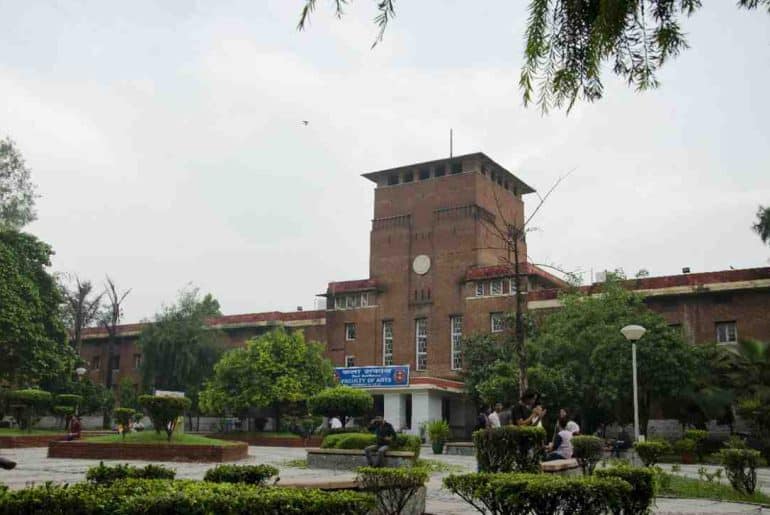
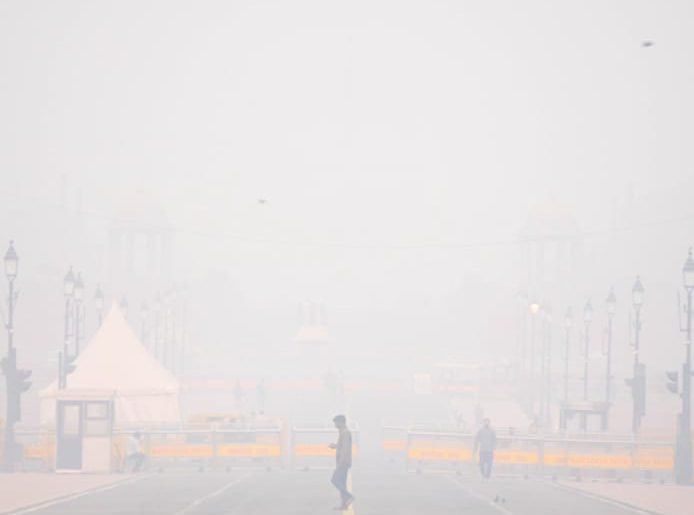
As the capital is once again swept under smog this year, students are compelled to worry about their health, class attendance, constant coughing and semester-end exams simultaneously.

Every year, as the AQI in Delhi reaches new heights, students studying in the city must attempt to normalise hazardous environmental conditions.

In conversation with DU Beat, Jigisha Sharma, a second-year student from Miranda House, said, “For a university that has a whole course about Fit India, they aren’t very keen on keeping their students fit and away from the pollution of Delhi. Instead of taking any action to tackle the situation, the government is blatantly trying to hide it from the masses, further worsening the situation for both the city and her residents.” 

Himanshi Singh, another Miranda House student, said, “Having lived my entire life in another city, I was aware that Delhi had pollution problems, but actually experiencing it is something else entirely. The air feels heavy and almost unbreathable, and stepping outside for even a few minutes leaves you coughing or with a sore throat. It’s scary how normal this has become for everyone here. What really bothers me is how we’re all expected to just carry on with our routines, like attending classes and travelling long distances, as if this level of air toxicity is something we can simply adjust to.

Colleges and the university administration seem indifferent, which feels unfair to students who are genuinely struggling with the health impact of this air. Especially for those of us who’ve just moved to Delhi, it’s physically and mentally draining to adapt to this environment. Because right now, it feels like we’re being forced to breathe poison and pretend it’s fine. Every year, the AQI spikes, people complain, and then everyone moves on until it happens again.”

Last year, the University had declared a transition to online classes when the AQI had reached alarmingly high levels. However, despite GRAP Stage 3 being implemented this year and the AQI reportedly touching 764 in Delhi-NCR, which can be officially categorised as “hazardous”, there has been no official notification from the administration regarding any relief to be provided to the students in the form of breaks, transition to the online mode, or leniency in the attendance policy. 

Read Also: The Trade-off Between Half Dust and Half Deity

Image credits: Ayushmaan for DU Beat

Manya Marwah
[email protected]

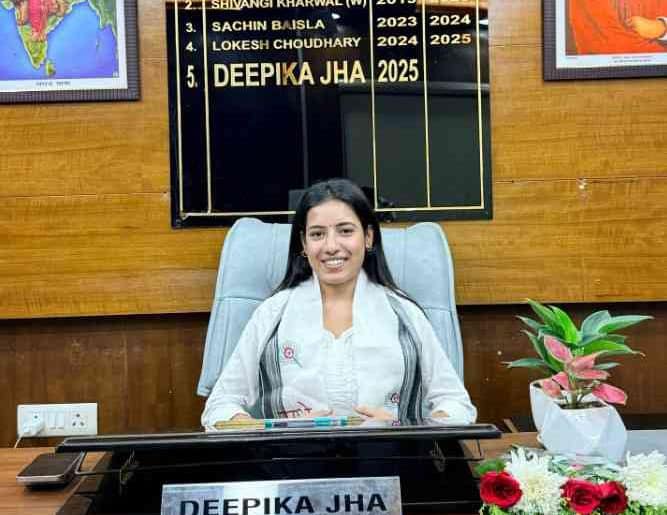
DUSU Joint Secretary and ABVP member Deepika Jha has been suspended from her post for two months after the assault that took place in B.R. Ambedkar College on Professor Sujit Kumar. 

DUSU Joint Secretary, Deepika Jha, a member of Akhil Bharatiya Vidyarthi Parishad (ABVP)  has been suspended for two months following the assault on Dr. B.R. Ambedkar College Professor Sujit Kumar. The order, issued by the Office of the Proctor, prohibits Jha from entering the premises of any Delhi University affiliated college during the suspension period. The decision comes nearly a month after the incident, which took place on October 16th, 2025.

According to the order, the suspension will take immediate effect. Jha has also been directed to submit a written apology to Prof. Kumar and an undertaking of good conduct. While her entry into DU-affiliated colleges is prohibited, she will be permitted to attend her academic classes and appear for examinations. The order mentions that her conduct will be reviewed by an Enquiry Committee after the two-month period before revoking the suspension. However, the initial inquiry panel recommended a three-month suspension period. A senior DU official said, 

She will remain suspended for two months and cannot enter any DU campus in her capacity as a DUSU office-bearer. She is permitted to attend only her academic classes.”

An inquiry committee was constituted after CCTV footage of Jha slapping Prof. Kumar inside the Principal’s Office of Dr. B.R. Ambedkar College surfaced. The incident occurred during talks between ABVP members and teachers regarding a physical attack on the college’s elected Student Union President. Prof. Kumar, who was the then acting convener of the college’s Disciplinary Committee, had been looking into the matter.

Prof. Kumar stated that a student affiliated with ABVP, who was under suspension, assaulted the elected president, a member of NSUI, in front of him during the oath-taking ceremony in the college that day. Following this, ABVP members including Jha came to the college. Prof. Kumar stated that he was asked to resign as convener, which he did. 

The incident sparked uproar on the ‘unacceptable’ breach of decorum. It particularly triggered condemnation from teachers’ groups, including DUTA (Delhi University Teachers’ Association) and DTF (Democratic Teachers’ Front), both of which demanded immediate action for what they termed a serious breach of institutional decorum.  Calling the episode “mobocracy and hooliganism,” the DTF warned that such unchecked behaviour could escalate violence across campuses. The Dr. Bhim Rao Ambedkar College Staff Association (BRACSA) also held a protest in October, calling for stringent disciplinary measures, which saw participation from DUTA office-bearers and others.

In a statement to the Hindustan Times, Jha said, “I regret the incident and apologise to the teachers’ community.” She claimed that Prof. Kumar had been “staring” and “smirking” at her, which she said prompted her reaction. “I felt angry and raised my hand,” she added. 

Some have criticised the punishment as greatly disproportionate to Jha’s actions. “This has confirmed the apprehensions held by most teachers: that the DU administration will ensure a safe passage for the culprit,” said Rudrashish Chakraborty, Associate Professor at Kirori Mal College and former DUTA Executive.

This travesty of justice has sent a message loud and clear that the teachers, students, and non-teaching staff of DU have no security in their workplace. The University administration has abandoned everyone in order to protect the goons of the ruling party,” he continued.

Dr. Mirthuraaj Dhusiya, an elected member of the Executive Council, echoed similar sentiments, stating: “The quantum of punishment does not seem to inspire confidence to act as a strong deterrent to prevent such incidents of physical assault against teachers in the future.”

Read Also: DU Staff Criticise Admin, Demand Expulsion of DUSU Activist Over Assault on Professor

Image Credits: @deepika.jhaa

Anjali Paruvu

[email protected]


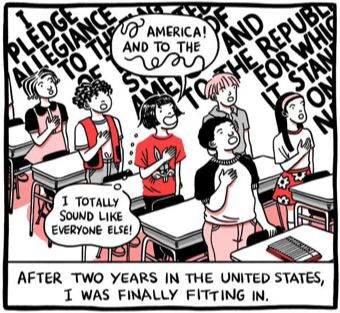
We are slowly becoming children of fragmented intermediaries, the political nature of our feeling of “belonging” consequently revolutionising against the self. What is then the fate of the culturally displaced? 

To be so brave as to consider yourself to “belong to a city” is to rely on a notion whose existence oscillates between a spectrum of aggressive spiritual sentiment and almost complete non-existence. 


Cultural identities, after all, are themselves functions of constantly reforming institutions, in addition to the very unit of time. I do not generally endorse that the self be subject to the atrocities of socio-cultural servility, except in the case of “belonging”, which both demands it and, quite often, penetrates into the individual that asks for it . 


There have been times when I longed for any answer to the preliminary question that enquires after the place affiliated with the self, to a personal or ancestral memory of the lives that led up to ours. The tangibility of this feeling is, unfortunately, unavailable to those who have been taught to live on the margins of cultural plurality, suspended on a line that indulges in its normative nature and constantly tears us away from it at the same time.


I talk of such a paradox because there is no doubt that it is a widely experienced one; the very characteristic of life is such that it craves connection aggressively, and the reality of experiencing it is that it is almost never fulfilled. 


Delhi, as an example, may be considered as a refuge for many such seekers of connection. It rescues the ones stuck in the limbo of cultural overwhelm, or the lack thereof, and offers a new schema to which a sense of belonging can be associated. The subjectivity of this rarely derived relationship must not be forgotten, for there are any number of objects or places or people—your family, an old journal—that can act as its source.


We “belong to a city” the same way that lions and tigers identify their territories. The land we exist on is a stolen geographical unit which becomes “home” when we recognise the value of the experiences contained within it. 


For the perpetually displaced- culturally, linguistically, geographically, metaphysically- “to belong” is contingent upon a performative assimilation into localities, the ability to ignore the dissonance between inherited memory and the manner of present existence. This liminal experience is therefore, the phenomenological reality that inhabits multiple symbolic universes, without a complete citizenship in any. The cultural limbo that is thus born is not neutral, it’s a perpetual psychic effort to translate our own fragmented identities calibrated to a contextual actuality. 


The fear, in my opinion, is not that we may never exit this cultural limbo, but that the epistemic space to narrate ourselves without distortion is ultimately taken away. We ask, in this context, whether we—the ones who have lived with such disjunction—possess legibility in our complexity.

We call the act of belonging “political” because it is never a static achievement. For most, it is a demand to be seen in their own nuanced sense, as a legitimate node in the social fabric, complete with the complexity that is born of fragmentation.

Perhaps the solution is that the goal must shift from “belonging to a city” or to tangible entities, to something more achievable in the larger sense of multiplicity. The conventional relation is thus a gesture of yearning for solidarity—a radical act of hospitality that simultaneously indicates an exclusion of the culturally displaced.

We must, as a species, “belong”. The question remains what we decide to aim this relationship toward. The recognition of this fact is perhaps the ultimate liberator of those stuck in this ill-fated limbo.

Read Also: On Belonging

Image Source: Excerpt from “‘Are You American?’: The Question I Couldn’t Answer,” by Rumi Hara

Manya Marwah

[email protected] 

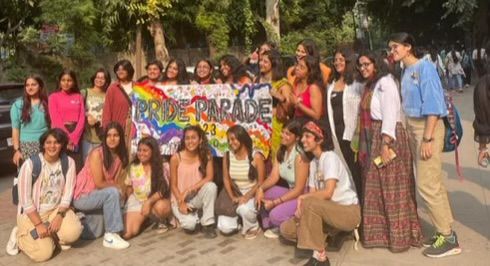
The White Rose Club, Gargi’s queer-straight alliance, celebrates pride through campus-wide march, flash mob and zine launch

The White Rose Club (WRC), Gargi College’s official queer-straight alliance operating under the Centre for Diversity and Inclusion, organised its annual Pride Parade on 29 October 2025. Established in 2017 and formally recognised in 2020, the WRC aims to make Gargi College a safe, inclusive, and informed environment for LGBTQIA+ students by fostering dialogue through its programs and initiatives.

The parade, held from 12:30 PM to 1:30 PM, began at the Arts Quad and moved across the Auditorium, Main Arch, and academic blocks of the South Campus College. The event witnessed enthusiastic participation by students, faculty, and allies. Slogans such as “Hey hey, ho ho, homophobia has to go!”, “We resist, we persist, we exist!” and “Desh ke rang anek hai, pride unme se ek hai” echoed through the halls, encapsulating the primary resolve for inclusivity and dignity for the LGBTQ + community..

A highlight of this year’s parade was an interactive flash mob by Team WRC, which drew widespread engagement. Additionally, the face and hand painting stall, a WRC tradition, remained one of the most popular attractions before and after the parade.

The White Rose Club also released its second zine, “What Queerness Looks Like in Gargi”, featuring contributions in the form of poems, illustrations, and personal reflections from students across the college. 

Reflecting on the event, Disha Barwal, the WRC convenor, shared with us, “..I felt just as electric and vibrant, if not more. It is an incredible feeling to see people from all corners of our college come together to celebrate this community. I wouldn’t change it for the world.” Anjum Kaushal, Design Head for WRC, added, “Attending my first pride parade made me feel a sense of belonging, and seeing others experience that now is truly phenomenal.”

Other members of the club spoke on what the parade meant for a queer student who has been isolated for much of their life: “Being queer as an Indian is quite isolating sometimes, and this parade is just one of WRC’s efforts to help the students feel like they belong here just as anyone else does. It’s showing up that matters, and WRC shows up each year.”

Read Also: Rainbows on Chhatra Marg: Fourth Campus Pride Parade Takes Place in Full Force

Image Credits : gargicollege.in

Anjali Paruvu

[email protected]

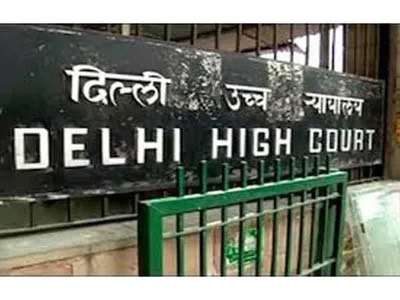
Delhi High Court questions delays in appeals challenging the order on disclosing Prime Minister Narendra Modi’s Delhi University degree details, directing the university to respond within three weeks. It has listed the matter for hearing on January 16, 2026.

A Bench comprising Chief Justice Devendra Kumar Upadhyaya and Justice Tushar Rao Gedela directed Delhi University to submit its reply within three weeks to the applications explaining the delay in filing the appeals. The matter has been listed for the next hearing on January 16, 2026.

The appeals were filed by Right to Information (RTI) activist Neeraj, Aam Aadmi Party (AAP) leader Sanjay Singh, and advocate Mohd Irshad. They challenged the August 25 order of a single judge, which had quashed a Central Information Commission (CIC) directive that required Delhi University to disclose details of Mr. Modi’s 1978 Bachelor of Arts degree.

During Wednesday’s proceedings, the petitioners’ counsel argued that the single judge’s order contained fundamental errors and required judicial reconsideration. However, the Bench noted the delay in filing the appeals and emphasized that the issue of condonation of delay must be addressed before proceeding with the case.

Solicitor General Tushar Mehta, representing Delhi University, was asked by the court to file objections to the applications seeking condonation of delay. “We need to condone the delay first. File your objections,” the Bench directed.

The controversy stems from a 2016 RTI application filed by activist Neeraj, seeking inspection of records of students who completed their B.A. degree in 1978—the year Prime Minister Modi is said to have graduated. The CIC had, on December 21, 2016, allowed the inspection of these records. However, the decision was later challenged by Delhi University.

On August 25, the single judge had ruled that merely holding public office did not make all aspects of an individual’s personal information subject to public disclosure. The order emphasized the right to privacy, stating that such information could not be demanded simply because the person occupied a high position.

The issue continues to attract public and political attention, as it sits at the intersection of transparency and privacy—testing the limits of the Right to Information Act in relation to public figures. The court’s next hearing in January 2026 is expected to determine whether the petitioners’ appeals will proceed on merit.

Read Also: Delay in Examination Form filling: students report Missing Enrolment Numbers and Subject-Selection Glitches

FeaturedImageSource:  The Tribune

Richa Choudhary

[email protected]

When the time comes for the deity of the Earth to redeem its dues, the dust flows and concedes into spaces of the capital, halting the economy to a stop.

This city has become a rousing tale of being a debonair con artist—the black and white of society and politics extends to perpetual pitch-black darkness with economic sense, hitting rock bottom. Our tears come way before any words—thanks to the divine air quality after Diwali, and the richness in our voices has been lost to the excruciating agony of credit card bills, shopping lists, and destitute bank accounts, topped off with the smoke that fills our lungs—especially with the post-Diwali festivities of smog-covered skies and the antics of mitigation. 

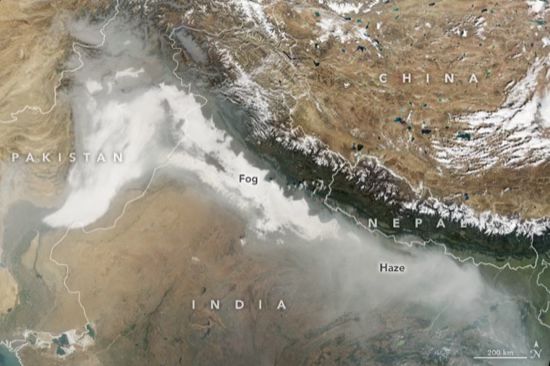
Delhi, very recently, successfully achieved its aim of becoming one of the top cities in the world, but on a different scale. It is now the most polluted city in the world according to the IQAir rating, which was sadly a long-foreseen event. The major contributor to this fate is our favourite post-Diwali concoction—vehicle emissions, industrial pollutants, stubble burning and an endless conversation about these issues, but to no redemption. All of this is supplemented by the onset of winters and the harsh cold air, making Delhi a smog-covered chamber. Recent images by NASA show how potent this smog looks from space, and that should be enough to scare our hats off. 

The government boasts its goal of achieving Net Zero Emissions by 2070, announced at the COP26 summit, yet the progress can only be described as largely superficial. Recent estimates show that pollution hits India’s collective GDP hard, with the effective percentage ranging from 3% to 9% annually. This is a substantial loss compared to the pollution levels in other metropolitan cities and their relative impact. The primary drivers are, of course, increased health care expenses, reduced worker productivity and premature deaths. 

The economic-environmental trade-off is catching on as the whole country suffers because of its capital’s ‘tragedy of the commons’. Clean air—a classic example of a public good—no longer remains publicly available, and economic inequality persists in our society more than we allow ourselves to believe. With the affluent being able to afford clean air through expensive air purifiers and work-from-home lifestyles or as an escape from the city for a post-Diwali getaway, the free air costs the common people their lives. There are hundreds and thousands of unorganised workers, especially in India, who cannot afford to leave the outdoors, let alone find clean air indoors. 

“Everyone has a thousand wishes before a tragedy, but just one afterwards,” said Fredrik Beckman—completely unaware of its relevance today. The tragedy today originates not only from self-interest that drives us towards it, but also from the total lack of accountability, as the proximity of oneself to this issue remains undefined. It’s a testament to how the core economic concept of efficiency is what causes the greatest economic losses; stubble burning might be efficient for the farmers in Haryana and Punjab to clear the fields, but its impact can be seen on the book vendor on the streets of Delhi, who are unable to breathe. 


Sustained implementation of regulatory measures is a far cry; the best we can hope for is at least a few pre-emptive measures that control this rise. All the reactive, quick-fix solutions right now act as a bandage on a bullet wound. Recently, new efforts were made to try cloud-seeding to induce artificial rain to clear the smog that covers Delhi. The government spent crores just to get a drizzle of rain, notably with a technique which can only be used in very specific conditions, which are extremely rare to coexist at the same time. On top of that, its effects are small, almost unnoticeable, and it does not help solve the root cause of the issue. Yet these pollution mitigation efforts, which cost a huge chunk of the GDP, are set into place, and it’s the same story every year. Guess we never fail to find a head that fits the crown. 


In a world where trading carbon credits has now become a core business function, the soul of Delhi cannot be cured with a mere promise on paper. We need actionable steps taken as precautions, and soon. The AQI has crossed the 400 mark, stepping into the severe category, and it is affecting not only India’s economic position in the global market but has also started to serve as a long-term foreign investment deterrent for Delhi; a characteristic that is currently driving the Indian markets to high growth is becoming a cautionary tale for its capital. 


The poor air quality has caused a death rate of 15% in 2023 due to respiratory diseases; that is, 17,188 people in Delhi who died just because of the toxic air that we’re all breathing. It means 1 in every 7 deaths is due to the largest health risk of pollution levels in Delhi. This not only leads to a loss of human capital and productivity but is just one of the tangible measures due to which foreign investors have started hesitating before investing here. The economic instability caused by the sudden imposition of GRAP every year is another cause, combined with increased spearhead costs and problems with talent attraction and retention. 


Colloquially, our cultural worship practices disregard the environmental degeneration due to them with “traditional incumbency”, and Delhi was fain to follow—until now. Today, future progress lies at the feet of Delhi’s air quality. So, until we start honouring the air we breathe, prosperity will remain an illusion—half built, half alive, half dust, half deity. 


Read Also: Protesters Detained at Kartavya Path as Delhi’s Air Pollution Crisis Deepens 

Image Credits: NASA Earth Observatory

[email protected] 

Shreya Bhushan


The University of Delhi’s examination portal has left students distressed as enrolment numbers remain missing and subject-selection errors persist. Despite the portal being active since August, no official clarification has been issued, leaving thousands uncertain about form submissions ahead of the upcoming examination deadlines.

The University of Delhi’s examination form portal, which has been open for this session since August, has once again sparked student frustration. This time, a wave of technical glitches has left first-year students unable to access their enrolment numbers, while many across batches report issues with subject selection — raising concerns as form submission deadlines approach.

The University’s website outlines a multi-step process for filling the exam form: Firstly, logging in using enrolment credentials. Then, selecting the active examination session, choosing papers via the course-selection menu, and finally, paying the fee online, and waiting for college verification. While this digital system was intended to streamline work for the university’s 7-lakh-plus student body, it has also introduced new layers of technical dependency that are proving unreliable during peak usage periods.

For several first-year students, the problem begins at the very first step. The enrolment number field on their dashboard remains blank, which prevents them from completing the rest of the form. Without an enrolment number, the students in no capacity are now able to complete the submission process, pay their fees, or receive their confirmation slip, and ultimately, this would lead to a delay in releasing their admit card.

The portal of the University explicitly states that fresh students (“fresh/new student” category) may need to wait until their college/department forwards verification before their exam roll number is generated. In practical terms, this means first-years often find themselves waiting — yet many say the wait is already unreasonably long.

Aanya, a first-year B.A. (Hons.) student openly expressed her frustration, saying:

“It’s been over two months since the portal opened, but my enrolment number is still not visible. Our college told us to keep checking the portal, but nothing has changed. I’m worried that I won’t be able to fill out the form before the deadline.”

The problem, however, does not stop there. Many second and third-year students have reported errors in the subject-selection section, which either fails to load entirely or displays incorrect paper combinations. In some cases, the subjects listed on the portal don’t match those actually opted for during the semester.

Many students anonymously expressed their dissatisfaction, saying:

“When I finally logged in, the subjects shown were from last semester. I tried multiple browsers, even visited the computer lab, but nothing worked. The university hasn’t issued any clarification, and that’s what frustrates us the most.”

While deadlines for examination form submission have already been extended multiple times this semester, no official statement has been released by the Examination Branch addressing the technical lapses. Students say the silence from authorities has left them anxious, especially as colleges begin internal assessments and pre-exam preparations.

People are also worried about possible late fees, wrong exam entries, or missing admit cards if mistakes keep happening close to the exam date. For first-year students who are still getting used to the university’s online systems, the lack of clear communication has been particularly stressful.

The Examination Branch has not yet released an official statement explaining the cause of these technical issues or offering a timeline for their resolution, despite multiple student complaints and the delayed deadlines in previous cycles.

In previous years, the University issued advice to submit well before the last date to avoid any last-minute technical issues. But for this year’s batch, many feel that the system has already fallen behind. Some students have shared screenshots of the portal with blank enrolment fields, subject codes not appearing, and submission blocked.

Despite repeated attempts by students to seek answers from their respective colleges and the university’s Exam Branch, no fix or timeline has been announced. For now, the only message circulating is to “keep checking” — advice that does little to reassure students as exam deadlines draw near.

Thousands of students are still in limbo, waiting, refreshing, and hoping that their exam forms won’t be another victim of DU’s digital problems until the university sends out an official update or fixes the problems.

Read Also: Final Year of College & Still No College ID Cards

Image Credits: Devesh for DU Beat

Naincy
[email protected]


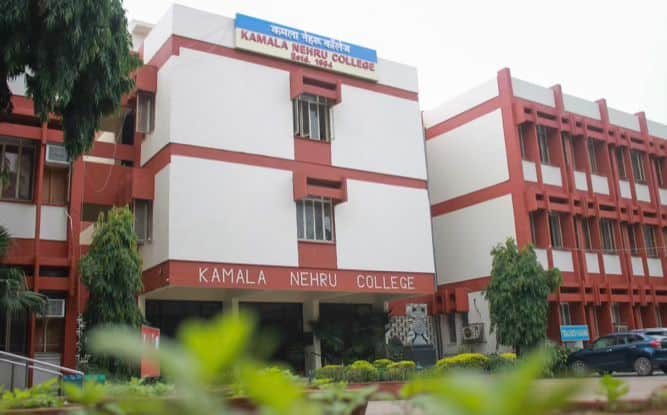
Third-year Journalism students at Kamala Nehru College continue to face administrative delays, remaining without their college ID cards since admission.

In a surprising case of administrative neglect, the entire batch of third-year Journalism students at Delhi University’s Kamala Nehru College (KNC) continues to remain without college ID cards, more than two-and-a-half years after their admission. While their juniors in the same department have already received their cards, around 45–50 students from the 2022 Journalism batch are still waiting.

As per the usual college process, students receive their ID cards within the first semester of their first year of study. However, this batch claimed to have never received any, despite repeatedly approaching the administration. “We have gone to the admin office at least a hundred times”, said a third-year student. “Every time, we are told it’s some system or data issue. The excuse has remained the same for three years.”

According to the students, the administration initially cited a “technical issue” with student records, saying that names and roll numbers had been mismatched in the database. “We were told that because of wrong information flow, like father’s name or roll number mix-ups, the cards couldn’t be printed”, one student said. “But that was in the first year. It’s third year now, and nothing has changed.”

Students allege that this delay has caused multiple inconveniences. During events such as the Diwali Mela and college fests, campus entry is restricted to those carrying valid ID cards. “We weren’t allowed entry even with our library cards”, said the student. 

When the matter was raised in a student-principal meeting a few months ago, the principal reportedly downplayed the issue, saying that everyone had received their ID cards and that students could get them printed from the college machine. However, the administration did not act even after that.


Students claim that, despite the principal’s attempts to communicate with the administrative office, no concrete action has been taken. They continue to be informed about system issues or mismatched details with no proper follow-up.

Journalism department students have begun documenting their complaints collectively, hoping that the administration will finally address the issue before they graduate.  Currently, there is no clear timeline for when or whether the college administration will resolve the ID card delay, leaving nearly an entire graduating batch without a basic document of identification from their own institution.

Read Also: Protesters Detained at Kartavya Path as Delhi’s Air Pollution Crisis Deepens

Image Credit: Anshika for DU Beat

Anjali Kumari Jha

[email protected]

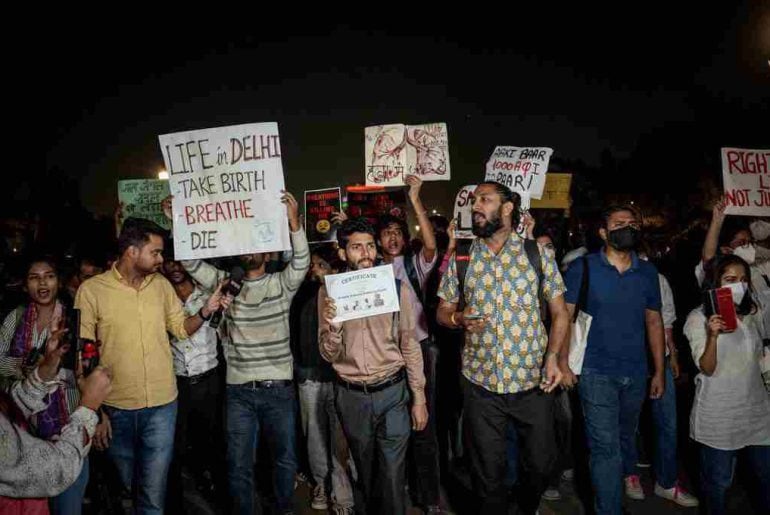
Citizens and students protesting Delhi’s hazardous air quality were detained at Kartavya Path after police blocked a march at India Gate, raising concerns over civil liberties.

On 9 November, around 5 p.m., students, citizens, and environmental activists gathered at Kartavya Path to protest the worsening air quality in Delhi. The demonstration, announced as an open call by individual organisers, drew support from groups such as the All India Students’ Association (AISA), Himakhand, and several other collectives.

The protest came amid a sharp spike in air pollution across Delhi, with AQI levels crossing 400 in several areas, categorised as severe by SAFAR. This rise has been accompanied by a surge in respiratory illnesses, particularly among children and the elderly. Protesters demanded greater accountability from the Delhi government and urgent measures to address the public health crisis.

Organisers said police prevented the demonstration from being held at India Gate, citing the absence of official permission. Protesters then moved to Kartavya Path. According to a report by Scroll, one organiser alleged that they had been warned days earlier that an FIR might be filed against them if they proceeded without a permit.

Police detained several people, including women, minors, and media personnel. Protesters reported being “thrashed around and dragged”, and many were injured. While female constables were present at the site, protesters claimed they were not present in the buses during detention—even when women were being transported.

Those detained described being driven around in buses before being taken to a police station, where they were allegedly kept in an open area resembling a “baseball court”. They said they were repeatedly asked for identification, which they refused to provide, and were threatened with legal consequences. Detainees were released around 11:30 p.m. after police recorded their names.

Even after the initial detentions, protesters regrouped for a second demonstration demanding the release of those held. These protesters were also detained, and, according to one account, later released near the Delhi border. Some participants noted that another protest,  for stray dogs, was taking place at the same time and location, yet saw no comparable police action.

Meanwhile, ANI quoted DCP Devesh Kumar Mahla as saying that Jantar Mantar is the designated site for protests, not India Gate. Protesters contested this, arguing that the designated site is heavily barricaded, inaccessible to the public, and that permission to protest there is routinely denied.

The events of 9 November underscore growing public anger over Delhi’s hazardous air, malfunctioning pollution monitors, and the perceived inaction of authorities. With respiratory illnesses rising and protective measures out of reach for many, the city’s toxic air continues to raise serious concerns about public health and quality of life.

Read More: NEP’s Three-Language Formula for Schools

Photo credits:  Muhammad Shahamath, Maktoob

Reva Rawat

[email protected]


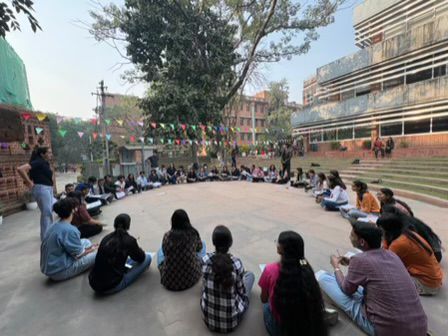
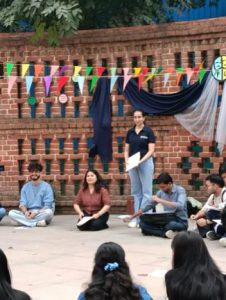
Friends’ Corner, the Mental Health and Counseling Cell of Hindu College, hosted one of its flagship annual events Persona on Saturday, November 8. Blending science, creativity, and self-expression, the one-day event delivered a meaningful experience that struck the perfect balance between learning and relaxation, especially right before exams.  

The day began with a thought-provoking speaker session on Understanding Schizophrenia and Cannabis Addiction  led by Consultant Neuropsychiatrist Dr. Aakanksha Malhotra. Her session opened with a lively quiz that instantly set the tone for interaction and curiosity. Students participated enthusiastically, asking insightful questions and engaging deeply with the themes of mental health and substance use. Dr. Malhotra’s clarity and warmth made the complex subject accessible and left the audience with lasting takeaways.  


Image Credits: Friends’ Corner

The event then moved to the college Amphitheatre for an Art Therapy session with psychotherapist Ms. Kritika Makkar and artist-advocate Ms. Aalijah Ali. Through lighthearted games, painting, and guided reflection, the duo led participants to explore themes of self-acceptance, letting go, and holding on to what truly matters. The session’s relaxed, joyful energy created a safe space for expression where color and creativity became tools for introspection.  


Next came a deeply engaging Drama Therapy session facilitated by Creative Arts Psychotherapist Ms. Kritija Saxena. Using storytelling and movement, she encouraged participants to uncover different layers within themselves. The session was equal parts thought-provoking and liberating, beautifully showcasing the power of theatre in emotional exploration.  

Image Credits: Friends’ Corner

The final session of the day was Dance Therapy with Ms. Jyotsna Ramachandran, who guided participants through movement and rhythm to release stress and reconnect with themselves. What started as simple motions soon turned into a collective wave of energy and freedom. The amphitheatre echoed with laughter, music, and joy as participants embraced the therapeutic power of dance.  


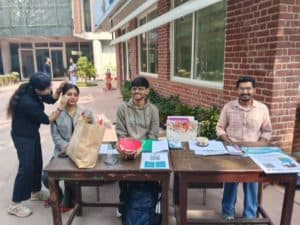
Adding a touch of creativity to the celebration, Friends’ Corner also put up a lively face-painting and sticker stall ,  while Youth for Mental Health (YMH)  hosted an interactive installation that drew students in throughout the day. 

Image Credits: Friends’ Corner

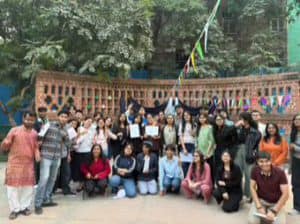
Every session radiated warmth and openness, filled with laughter, moments of quiet reflection, and a few bursts of delightful chaos. With exams around the corner, Persona 2025 arrived as the perfect pause students needed. Many attendees called it “the perfect de-stress before exams” and thanked the Friends’ Corner team for creating a space that was both healing and heartfelt. 

Image Credits: Friend’s Corner (Hindu College)

DU Beat