
The Met Gala 2026 positioned fashion as art, and inherently power, with Indian craftsmanship and cultural identity finding itself widely embodied, while simultaneously exposing tensions around elitism, Western dominance, and the limits of celebrating art within exclusive global spaces.
The Met Gala, with all its consistent A-listers’ attendance, best and worst dressed lists, and never-before-and-after-seen outfits, also functions as a charity event and fundraiser for The Metropolitan Museum of Art’s Costume Institute. It prides itself in being one of the biggest fundraisers for art in the world, raising unparalleled sums of 8 figures every year with an increment in collections every year. This year, it was co-chaired by Beyoncé, Nicole Kidman, Venus Williams, and Anna Wintour, with a theme of “Costume Art”.
The theme, like each passing year, becomes a focal point of discussion primarily as a test of whether the said attendees adhered to it or not, but also how far they were successful in elevating it. These themes ‘attempt’ to explore different niches of the fashion world, from last year’s “Superfine: Tailoring Black Style” to the iconic and fan favourite “Heavenly Bodies: Fashion and the Catholic Imagination”. The dress code, ‘fashion is art’, is, like other themes, extremely open-ended and broad, which then results in showcasing the vibrancy of garments as the brainchild of plethora of designers at the red carpet.
This year’s exhibition, “Costume Art”, is paired with the dress code “Fashion is Art”. Current curator Andrew Bolton says, “The ‘Costume Art’ exhibition explores ‘the centrality of the dressed body’ by pairing garments with paintings, sculptures and objects spanning 5,000 years of art.”
He adds that
what connects every curatorial department … is fashion, or the dressed body; even the nude is never naked. It’s always inscribed with cultural values and ideas.”
Amidst this exploration of culture and ideas, the presence of Indian celebrities at the Met, like always remains crucial; all hopeful eyeballs are on them, which means that they have the pressure to meet the high standards that not only fans but even an average Indian internet lurker has on them. This certain way is generally associated with a prideful representation of Indian culture. In recent years, we have become more vocal on how the fashion world of the West takes inspiration from Indian ornaments and designs and yet chooses to ignorantly not acknowledge or give credit to it and make it their own, what we often term as cultural appropriation.
With the advent of increasing acceptance we have come to recognise that fashion is not just clothes or accessories but represents power structures and thereby is equally political. The only way then is to make the world our stage and own and preserve our art.
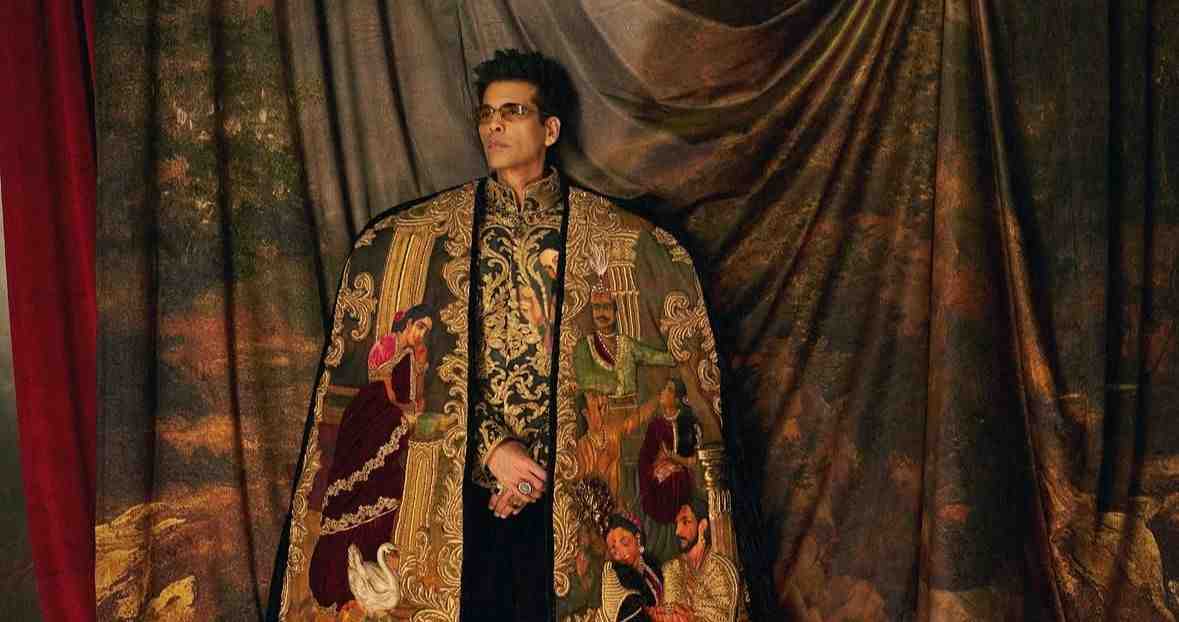
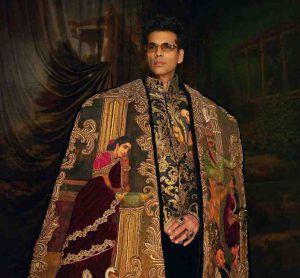
This Met Gala saw the attendance of various Indian celebrities, with the likes of Karan Johar, Isha Ambani, Ananya Birla, Sudha Reddy, and Manish Malhotra, among others; it is appreciative that all of them chose to pay homage to the artisans of India: Karan Johar’s outfit was designed by Manish Malhotra and styled by Eka Lakhani; it carries Raja Ravi Varma’s imagery across a hand-painted ensemble, with zardozi borders, three-dimensional pillars, lotuses and swans, and a hand-painted jacket lining. Johar, while praising the artist, said, “Raja Ravi Varma gave India its most enduring images of itself.”
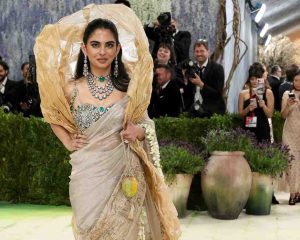
Isha Ambani, who has now become a global figure with her frequent presence in events like the Academy Awards and the Vogue Fashion Fund Awards coupled with the publicity of the Ambani family events, wore a custom-made sari which brings together historical references from ancient Indian frescoes, with the sari border featuring hand-painted Pichwai-inspired motifs. The blouse of her outfit was embedded with her mother’s jewellery inventory. Representing realism in art, she wore a mango sculpture created by an Indian artist, Subodh Gupta, 20 years ago.
Gauravi Kumari, the princess of Jaipur, was also seen wearing her family heirloom, the chiffon sari of the then fashion icon and her great-grandmother Maharani Gayatri Devi. Emphasising the regionalistic sentiments, Kumari wore a pink sari to represent the colour of her city. The same was also carried by her brother Sawai Padmanabh Singh, who stated, “The idea was to bring Rajasthani craftsmanship to the forefront in a way that felt authentic to me.”
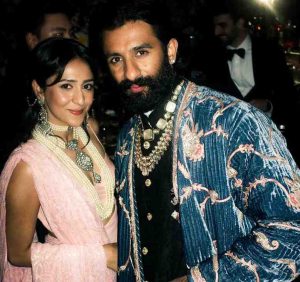
Manish Malhotra, in a move that is getting wide appraisal, wore a garment representing Mumbai with a special ode to all his craftsmen. The outfit features renowned Mumbai locations, such as Chhatrapati Shivaji Maharaj Terminus, Gateway of India, and so on. The garment features many forms of embroidery-zardozi, chikankari, and kasab to name a few, which were endered in white and ivory.
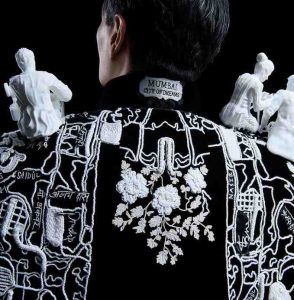
This representation is targeted at getting much-needed discourse on authentic Indian craftsmanship. This pride is newfound because we as Indians carry with us a deeply entrenched colonial baggage and have been at the receiving end of the ‘West is Best’ narrative. India has in the recent past seen vast westernisation of its elite, possibly beginning from the creation of the bhadralok identity, where the upper-class upper-caste elite exclusively associated themselves with European and later on American brands, as they were seen as the epitome of artistry during its time as a colony but was unable to overcome it even after independence.
One association that puts a question mark on the event’s genuineness of promoting “art” is Jeff Bezos, along with his wife Lauren Sanchez, being the primary sponsors of the event with around 10 million dollars in donations. This collaboration is questionable because it lays a doubt on whether they are unfeigned patrons of art or doing this just because they have the means to do so, in order to gain social capital in the world of art and fashion, which tends to be gatekept, especially given the worldwide protests surrounding exploitation of workers and increasing wealth inequality. At the centre of this conversation is situated the costume embodied by Lauren Sanchez, which critics have likened to an “average American prom dress”.

However, in between this elitism and “fashion for the rich” are ongoing efforts to challenge this elitism and exclusionism, particularly by the Mayor of New York City, Zohran Mamdani who chose not to attend the event highlighting the question of “affordability”—why there is an us v. them attitude of the privileged in terms of access to fashion.
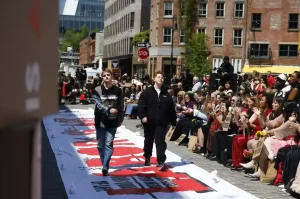
When the preparations for the Met Gala were underway, labour unions from across the USA staged an anti-Met Gala fashion show in the Meatpacking District of Manhattan. “The Met Gala tells a story about who matters, who gets celebrated,” said April Verrett, president of the Service Employees International Union. “And we decided to make ourselves the protagonists.” Amazon delivery drivers, warehouse workers and former Washington Post staffers walked down the runway, flexing in outfits by local designers while the audience held up cards that read “You Can’t Buy Cool” and “Labour Is Art”.
Whenever I, through my computer screen, examine the looks of the Met Gala by channelling my inner Miranda Priestly. I always ask, do we really need a Met Gala once every year to take pride in our art and then forget about it? Why can’t we have our own? Shouldn’t this celebration not be restricted to only those artisans that manage to reach the clientele of celebrities but also those local uncles and bhaiyas that we see at our local bazaars? Is being cool and endearing restricted to only a few billionaires and celebrities?
Read Also: Unclean Spaces and Neoliberal Urbanism: Graffiti as “Counterliteracy”
Image Credits: Instagram
Divyanshi Dusad




Comments are closed.