
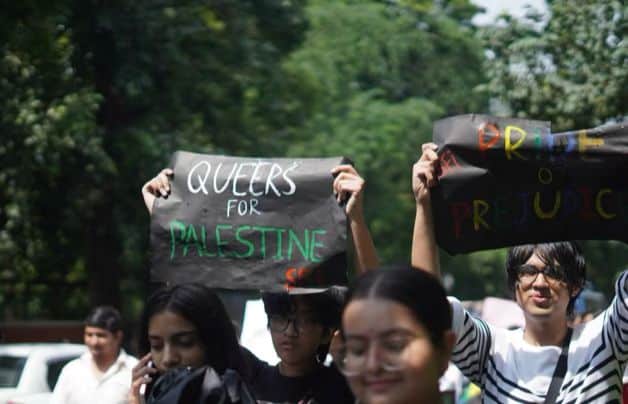
Indian students’ solidarity on Palestine can make a difference. But when does our solidarity matter less than what side of the line we’re speaking from?
From the pouring of fake ‘blood’ on the steps of Kamla Nagar’s Starbucks to chants of “Free Palestine” at protest marches, Delhi’s student body has been at the forefront of protest in support of Palestine. With estimated death tolls crossing sixty thousand in Gaza and a collapsing health and food situation, keeping the Palestinian issue alive through active engagement is critical. However the entire narrative around a Free Palestine has become more and more politicised. One cannot shirk the feeling that the term ‘Free Palestine’ is at risk of becoming a buzzword.
Today, a watermelon emoji next to your social media account is not just a symbol of solidarity. It also connotes a political identity, often linked to left or centre-left student groups. This is evident in the actions of outfits like AISA and SFI, which have consistently organised marches and protests supporting Palestinian rights. In May 2024, AISA held a candlelight march in Delhi condemning Israeli airstrikes and demanding an end to the siege of Gaza. Similarly, IPSP coordinated protests on Global Action Days, to highlight the humanitarian crisis and support the Boycott, Divestment, Sanctions (BDS) movement. The SFI-organised Campus Pride Parade last week also echoed “From the River to the Sea, Palestine Will be Free.” These efforts certainly succeed in bringing people together in support of Palestine but tend to do so under a coloured banner.
The pushback from right-wing student groups has been no less. In April this year, ABVP members at Jawaharlal Nehru University burnt the Palestinian flag during student election vote counts, deeming Palestine activism anti-national. Even more recently, ABVP activists vandalised a Palestinian flag mural at the University of Hyderabad, sparking widespread condemnation from other student bodies.
In this backdrop, an Indian student finds their opinion on the issue a mark of their political affiliation. It isn’t feasible to be an active Palestine supporter in DU without finding yourself associated with the left or losing affiliation with the right. For those keeping distance from both camps, it isn’t easy to join the movement strictly on humanitarian grounds without being questioned on their political standing.
What should be a humanitarian cause gets caught in the conditionality of what beliefs entitle you to be a true supporter—and which ones you are now required to unsubscribe from.These watertight compartments, at some level, inhibit any real collaboration on global issues.
Palestine is undoubtedly political, but it is a politics far more important than any other politics we are fighting. A politics that needs solidarity.
Anjali Paruvu
Image Source: Mahin for DU Beat



Comments are closed.