
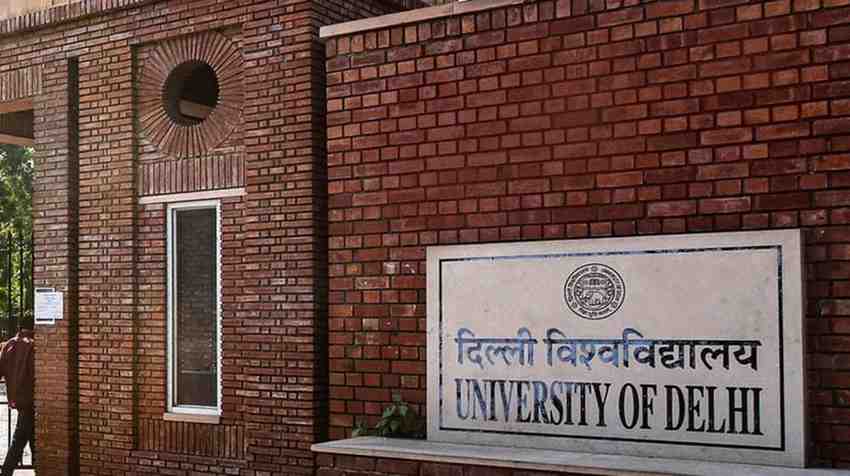
Will off-campus colleges ever witness a dawn? This article addresses the irregularities, myths, and implications of the recent reforms, as well as the need for a fundamental and judicious approach to address this bias effectively.
St. Stephen’s, SRCC and Miranda are the first colleges that find a place in every CUET aspirant’s preference. It’s more of an elite biasness of a child who thinks of serving this country only as an IAS, IPS or an IFS. Other professions are just manifestations of disillusioned power and a mere internal pomposity on their nameplate for them. Because, ideally, these elite services are the only way to penetrate into the biggest, most viable network in the world.
This same superficially embedded mentality a 17-year-old pertains to when they apply for DU colleges. But then these are also the same people who mostly come from the ‘liberal arts’ courses who hem and haw when it comes to mingling with the students of off-campus college: exceptions include members of debating, quizzing and theatre societies, who feel obliged enough to maintain a certain ‘network’ with these people. This is a paradox of hypocrisy in the most unfeigned way possible.
The only differential factor that determines a college as an “off-campus” is their proximity to their administrative office. This becomes a slightly complex idea for students to distance themselves from the idea of getting into an off-campus college, considering it as a sabotage to the life that has not even begun.
In the recent reforms introduced by the DU Admission Dean, Ms Haneet Gandhi (refer also to reading), the DU administration is still not able to fill in the vacancy; primarily affected are colleges like Bhagini Nivedita and Aditi Mahavidyalaya, where the enrolment capacity has just touched a meagre 60-70% even in courses like Political Science. This has forced these colleges to create an outreach programme for students in government schools and a constant persuasion to the university for filling these gaps.
Colleges which are situated around villages like Aditi Mahavidyalaya emphasise that girls usually are unaware of CUET and other provisions for college studies.
Delhi University, in order to fix the high vacancy problem, has announced mop-up admission rounds for undergraduate programmes from Sept 4 to fill vacant seats for which admissions will be based on Class XII marks, not CUET scores.
The university said it will release a college-and course-wise list of vacant seats on its admission portal. According to the guidelines, already registered candidates who are not admitted anywhere can apply for the mop-up round by logging into their CSAS dashboard. Fresh applicants can also register by paying a one-time non-refundable mop-up fee of Rs 1,000, in addition to the registration fee of Rs 250 for UR/OBC-NCL/EWS and Rs 100 for SC/ST/PwBD categories. Colleges will shortlist candidates based on Class XII marks and available vacancies from Sept 8 onwards. Candidates may receive multiple allocations and will have two days to accept an offer. Students already admitted through CUET will not be eligible to participate. The mop-up will be processed only through the university’s official portal.
The only solution that looks promising and surviving shall not be pushed by the university but by the student community themselves. This is a red line for these colleges to survive in the long run. However, a brutal and non-forgiving emphasis should also be given on the development of the faculty and other infrastructure pertaining to the regularities of this college.
Kinjal Sharma
Read Also: The Dawn of Off-Campus Colleges
Image Credits – DU squad


Comments are closed.