
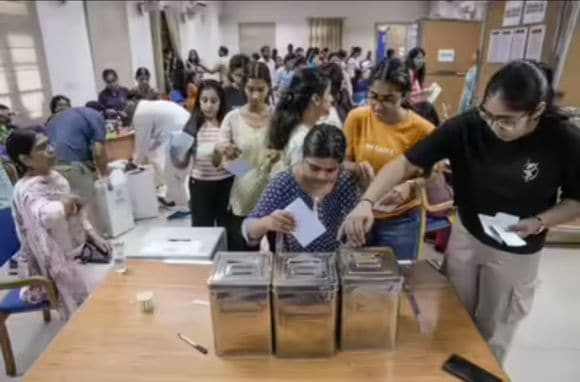
The Delhi University Students’ Union (DUSU) elections in September 2025 saw turnout climb to around 39–39.5 per cent, a notable increase from last year’s 29.7 per cent. While this rise suggests some renewed engagement, it also means that more than 60% of students either could not or did not vote. The paradox raises a deeper question: why does a union with such visibility fail to attract the majority of its student body?
Part of the answer is structural. Many colleges, such as St Stephen’s, Lady Irwin and DCAC are not affiliated with DUSU, excluding large sections of the university. Students in these institutions do not see the elections as relevant to their daily academic lives. Even within affiliated colleges, however, participation is often shaped by what political scientists would call a cost–benefit calculation: the perceived risks and burdens of voting outweigh the likely impact of a single ballot.
For many, the costs are immediate and physical. One undergraduate recalled, “There was a huge turnout this year, and our colleges do not have the infrastructure to support the same. Many of my friends stood there for three to four hours to cast one vote. Another described the atmosphere starkly, “For the lack of a better word, I would say the main reason why I personally don’t go to vote is the sense of gundagardi that surrounds the campus.” Another student who skipped voting admitted, “There was so much stress and fear around the campus that I thought there is no point in risking my safety for one vote.”
Even when students did turn up, the presence of candidates near polling areas created unease. “A friend said that at times so many candidates were around the polling booths that it created a sense of fear amongst the students,” one student reported. Several students also mocked the dramatics of campaign appeals. Students allege that Aryan Maan was near the Miranda House campus and kept approaching students by saying, “aap sabhi behene ho meri isliye bol raha hu votes ke liye.” These accounts suggest that what is framed as democratic engagement often feels like pressure, even surveillance.
Credibility further erodes incentives to participate. “It’s a waste of time for me to put my safety and security at risk, travel for two hours, and wait for another three hours, to cast one vote when I know no tangible change will come out of it,” one student complained. Another added: “Har saal wohi posters, promises, rallies; result toh pehle se decided lagta hai.” Ongoing legal challenges to the election process, including petitions around EVM integrity, reinforce these doubts.
If students perceive the institution as structurally exclusionary, procedurally unsafe, and substantively captured by dominant parties, their withdrawal is not apathy but a rational response. Turnout rose this year, likely due to mobilisation by major political outfits rather than restored trust.
Until questions of safety, accessibility, and credibility are addressed, DUSU’s symbolic prominence will remain unmatched by genuine representativeness.
Image Credits: Times of India
Image Caption: Who does the DUSU really represent?
Sakshi Singh