
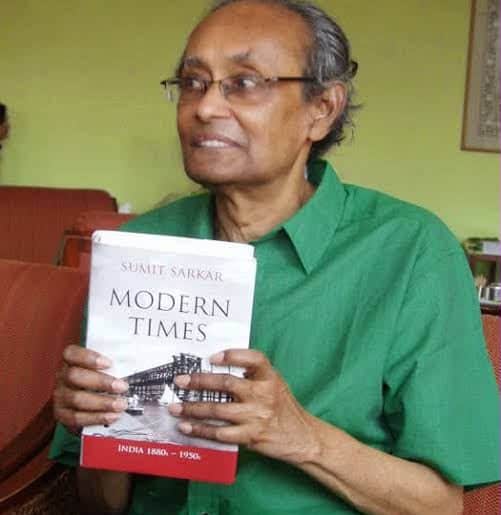
The death of Sumit Sarkar at 87 marks the loss of a major historian of modern India, remembered for his scholarship, teaching and influence on generations of students.
Renowned Marxist historian and scholar of modern Indian history Sumit Sarkar died at a private hospital in New Delhi on Thursday, August 13, 2026. He was 87.
Sarkar was known for his extensive scholarship on modern Indian history, particularly nationalism, social history, caste, gender and political movements. He spent several years teaching History at the University of Delhi and was also a Fellow of Wolfson College, Oxford. He served as a visiting professor at several universities in the United States and Europe.
Born in 1939, Sumit Sarkar completed his BA (Honours) in History at Presidency College, Kolkata, before pursuing his Master’s and PhD at the University of Calcutta.
His scholarship included Swadeshi Movement in Bengal, 1903-1908 (1973); Modern India (1989); and Writing Social History (1998). He also co-edited Women and Social Reform in Modern India (2007) and Caste in Modern India (2013) with his wife and fellow historian, Tanika Sarkar.
Beyond his written scholarship, Sarkar was remembered for his distinctive approach to teaching. Journalist Ravish Kumar, who studied History under him in the mid-1990s, recalled attending his classes, which were often packed with students.
“He never entered like a professor. He always came into the class like a shy student surrounded by questions,” Kumar recalled.
He described Sarkar as a teacher whose “range of knowledge stretched like the Himalayas,” while noting that he “never imposed himself” on his students.
Kumar also remembered Sarkar’s use of humour in the classroom, saying that “amid the flow of scholarship, he would suddenly check through little stops of sarcasm” to see whether students were paying attention.
Reflecting on Sarkar’s influence on generations of scholars, Kumar said, “Being Sumit’s student was medal-worthy in itself.” He described his teaching style as “Gandhian” and “Democratic,” adding that many students who passed through his classes later became prominent historians.
His former students and colleagues also remembered him for his warmth and accessibility. Ravikant, a professor at the Centre for the Study of Developing Societies and Sarkar’s student from 1988 to 1991, recalled his “scintillating” lectures and said Sarkar could look at “one word and speak a full paragraph at one go,” reflecting the concision of his summaries.
Historian Anirban Bandyopadhyay described Sarkar as “one of the rare Marxist historians to delve deeply into culture and emotions as opposed to the economy”. He also recalled Sarkar’s contribution to the study of Bengal, saying, “With regard to 19th and 20th-century Bengal, there was nothing that he did not write about.”
For Bandyopadhyay, Sarkar’s death was both a personal loss and a loss for students of history. He remembered how Sarkar “always listened to younger people, and always had a smile”.
He leaves behind an extensive body of scholarship and generations of students and historians influenced by his work. The death of Sumit Sarkar at 87 marks the loss of a major figure in Indian historiography, as well as a teacher remembered for bringing intellectual depth and humility into the classroom.
Read Also: The Republic of Restless Youth
Aarushi Chaubey