

Tag

SC

Browsing

Amid rising dog-bite and rabies cases, Delhi-NCR’s stray dogs face mass relocation by Supreme Court order. Residents welcome it, but activists warn of cruelty and ecological risks—who truly bears responsibility, and can safety coexist with compassion?

On August 11, 2025, the Supreme Court of India ordered the relocation of all stray dogs in Delhi-NCR to shelters within eight weeks, citing a rise in dog-bite and rabies cases and prioritising public safety over sentiment. The bench of Justices J.B. Pardiwala and R. Mahadevan acted suo motu after media reports highlighted the growing menace. The case was taken up after a Times of India report, “Delhi Hounded By Strays, Kids Pay Price,” detailed incidents, including six-year-old Chavi Sharma, who suffered multiple bites despite repeated complaints, and four-year-old Abhishek Rai, attacked on July 23, 2025, in Alipur, leaving facial injuries and forcing parents to keep children indoors.

The bench announced it would hear arguments only from the Centre, excluding petitions from dog lovers or other parties: 

We are not doing this for us; it is for the public interest. So, no sentiments of any nature should be involved. Action should be taken at the earliest.

The amicus curiae Gaurav Agarwal urged permanent relocation of all stray dogs to shelters, citing over 37 lakh dog bites in 2024, including 25,000 in Delhi, and a sharp rise in early 2025. He proposed shelters for 5,000 dogs within 6–8 weeks and adoption drives via welfare groups. Solicitor General Tushar Mehta noted a Delhi relocation site was stalled by an activist-led stay order, which the bench criticised, stressing the need to clear streets entirely. Warning that adoptions could lead to dogs being released again, the court ruled out adoption and ordered all strays to be moved to shelters without exception.

The Supreme Court has ordered Delhi-NCR authorities to build dog shelters immediately, relocate all stray dogs, and report progress. Shelters must have trained staff for sterilisation, immunisation, and containment, with CCTV to prevent escapes. Authorities must also set up a dog-bite helpline and prioritise vulnerable areas, rounding up all strays, sterilised or not. Civic bodies may use any method, including a dedicated force, with contempt penalties for obstruction. The bench called the situation “grim” and directed NCT Delhi, MCD, and NDMC to make clearing localities of stray dogs their top priority.

Residents’ welfare associations (RWAs) have welcomed the Supreme Court’s directive to shift stray dogs in Delhi-NCR to shelters within eight weeks, calling it a long-awaited relief amid rising dog bite cases. Atul Goyal, president of United Resident Joint Action (URJA), said the move would ease the growing menace and urged similar action against stray cattle: 

Along with stray dogs, cattle on the roads have also started attacking people and causing traffic jams. The authorities should take similar action for such animals as well.

Animal rights groups condemned the Supreme Court’s order, calling the mass removal of community dogs inhumane and ineffective. PETA India’s Dr Mini Aravindan noted that Delhi has around 10 lakh community dogs, less than half sterilised, and that forced relocation would cause suffering, public uproar, and fail to control population, rabies, or bites. She blamed poor implementation of the 2001 sterilisation and vaccination mandate and urged focus on comprehensive sterilisation, shutting illegal breeders, and promoting adoption instead of displacement drives:

Communities think of neighbourhood dogs as family, and the displacement and jailing of dogs is not scientific and has NEVER worked.

Congress leader Rahul Gandhi criticised the Supreme Court’s directive as a reversal of humane, science-backed policy, arguing on X that shelters, sterilisation, vaccination, and community care can keep streets safe without cruelty. Former minister and animal rights activist Maneka Gandhi called the order “impractical,” warning that it could upset the ecological balance, citing the 1880s in Paris, where mass dog removals allegedly led to a rat infestation. 

Mass appeals urge the Supreme Court to revoke its Delhi-NCR stray confinement order, calling it cruel and impractical. Petitioners advocate sterilisation, vaccination, waste control, and community care instead.

An LSR student says,

I’ve cared for strays since childhood and never felt unsafe. Rabies deaths are rare; the Bombay HC says vaccinate, sterilise, and let them live freely. This city is theirs too—they’ve even protected women at night. We have no right to decide how they live.

The protests have also faced criticism from some individuals who view them as selective in focus. According to these voices, many participants come from privileged backgrounds and have not been equally vocal on other human rights issues, such as the treatment of Bangladeshi migrants.

The Supreme Court’s order to relocate all Delhi-NCR stray dogs spotlights a clash between public safety and animal welfare. The debate leaves key questions unresolved: Can humane, science-backed measures protect people without mass displacement? Who is truly responsible for the city’s stray population—the authorities, the community, or the animals? And in striving for safety, can compassion be preserved?

Read Also: Daily Commute to DCAC in Crisis

Image Credits: Hindustan Times

Neeraja Unnikrishnan 
[email protected]

In order to fill up the vacant seats in the reserved categories, DU’s Special Drive will consider cases of those who were left out, after the fourth cut-off.

While admissions to the unreserved seats in the University of Delhi (DU) fast drawing to an end after the release of the fourth cut-offs on July 13th 2019, the varsity has decided to conduct a Special Drive of admissions to fill up the seats in the Scheduled Caste (SC), Scheduled Tribe (ST), and Economically Weaker Section (EWS) categories of the reserved seats. 


One of the most prestigious academic institutions of the country, DU has received a total of 2.6 Lakh applications to its undergraduate courses for the 2019-2020 academic intake. Of these, around 1.5 Lakh applicants are from the unreserved category and the number of aspirants in the SC, ST, and EWS categories are around 34000, 7000, and 9000 respectively. 


Academic Council Member Rasal Singh told the New Indian Express that during the Special Drive, the University will consider cases of those reserved applicants who were left out, “For someone who met the criteria in the first list but didn’t come up for admissions, the University will reopen the window. This particularly benefits outstation candidates, who are at times, unaware and miss the opportunity,” he said. Albeit, the University rules say that those who meet the criteria in the initial lists and don’t come for admission are not eligible in the subsequent lists. 


“If seats go vacant, we go for such drives. We announce the number of seats available. If you have applied and are still interested, we call a list solely for the reserved categories. There are special cut-offs for the colleges and courses available,” Sukanta Dutta, Officer on Special Duty- Admissions, said in an interview to the leading daily. 


Since the new academic session is all set to begin on July 20th 2019, the University is all set to finish admissions to vacant seats well in advance. 


Image Credits: Livemint 


Bhavya Pandey 


[email protected]

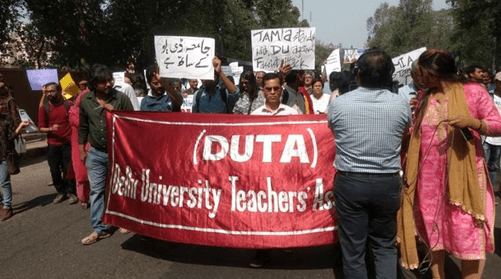
As the Supreme Court ruling further attenuates the Reservation Rights of Scheduled Castes (SC), Scheduled Tribes (ST) and Other Backward Classes (OBC), DUTA pushes out a letter to question the state of incompetence and wrongdoings.

The Supreme Court in the latest ruling on the reservation rights of SC, ST, and OBC for the appointment of faculty to college and university, has decided to water down from the 200-point system to the 13-point system. The latter system considers the department or subject (taught) as a unit, whereas the earlier system considered the university or college as a unit.

This decision has in turn simply stated made it so that OBC’s would be given every 4th position available in the unit, SC’s every 7th position and ST’s every 14th position, also in the case of small units or departments that don’t have for example 7 or 14 positions, no reservations will be created. The decision as expected has come to anger and agitate those working and prospective workers and has moved the hands of DUTA (Delhi University Teachers’ Association) who have written an open letter explaining how this ruling is absurd and harmful to the ‘Dalit Bahujans’ and is a step back into granting equal rights something that is taken to be the duty of the pillars of our nation. The letter in question was addressed to the Minister of Human Resource Development Prakash Javadekar asking him to bring in a Bill/ Ordinance to restore the 200-point reservation roster on the basis of college/university as a unit.

The final steps that members of DUTA have decided to undertake is to organise a march on the 31st of January from the Mandi house metro station to the Parliament street, for what they call a step necessary to ensure deliverance of basic human rights.

Feature Image Credits- Hindustan Times

Haris Khan
[email protected]

Graphic Credits :- Sahil Jain

Every passing year, securing admission in good colleges is getting tougher and tougher. Not for everyone though. If you happen to belong to any of the numerous communities deemed to be underprivileged (SC, OBC etc), all the skill that you’ll require is that of correctly filing a form.

The reservation system has received fervent criticism from all corners but can a country which has historically discriminated against certain minority groups afford not to provide them with opportunities for bettering their status? Or is it that reservations are the wrong way to go about uplifting minorities.

This week, Juxtapose sets the jury out on whether the reservation system is good for the country as a whole. So what are you waiting for? Scroll down and voice your opinions.

Juxtapose: Are reservations in colleges justified?
Show of Hands:
Justified: 2
Not Justified: 8
The Arguments:

1. Thangchungnung Mangte, Not Justified
I do have a great respect for the founding fathers of our constitution and their empathy towards the underprivileged sections of our society who were discriminated and exploited for hundreds of years. However, if we want to help those people to be able to grow and improve their condition, the very basis of granting reservation should be on the basis of a person’s economic condition. Giving reservation to a caste, tribe etc. will only help those, who are already doing well. A poor dalit or a tribal hardly gets to use the benefit of reservation granted to his/her tribe or caste and instead it is used more by the sons & daughters of, let’s say for example, an IAS officer.

2. Vikas Jaipuria, Not Justified
The ideal situation should have been: Merit alone triumphs! Having sat on a hunger strike when I was in class 8 in AIIMS when this debate broke out in 2006, I have seen the agitation from close quarters. This is a paralytic policy decision, which is far from the principles of equality espoused by our constitution. Sure the weaker sections and minority should be uplifted, but providing reservation in higher education is not the correct means. The government should have created better infrastructure in primary/higher secondary schools in small towns/backward areas. It should have extended the benefit of its social schemes by bringing more OBC’s/SC’S/ST’s under its net. The true effects of this paralytic decision is more evident in DU – OBC’s/SC’s/ST’s from well of families are sitting in top colleges with less than qualifying marks, while hard working students of General category who slogged their ass in class XII are precluded admission (even if they fall short of cutoff by a small whisker!). And we all know in a country like ours where bribing public officials is a cakewalk, no wonder you can get yourself made a fake SC/ST/OBC certificate.

3. Ankita Mukhopadhyay (LSR), Justified
When Dr. B.R Ambedkar formulated the Constitution, little did he foresee the uproar that his policy of reservation for minorities would create once education and literacy became a prime concern for most households in India. I think reservation for minorities is justified, provided there is an income bracket to justify their need for reservation. Reservation has come into the limelight today because of the UPA government’s policy to give preference to the minorities in order to garner more votes. The issue of reservation shouldn’t be a politically contentious issue; it should be more of a moral issue.
People belonging to the Scheduled castes and tribes are still discriminated against today in the villages, and even if a person belonging to the SC/ST or OBC category manages to break the mould and succeed in the corporate segment or any other sector, he/she is always looked down upon by the general candidates as an academically weaker peer. I agree that there are many general category candidates out there who lose out on a seat because of reservation, and economically backward general candidates face a bleak future due to no government support for them, but we should also look into the historical origins of this caste problem. The government should change its policy, and instead of demarcating lower cut offs or marks for SC/ST and OBC candidates, they should evaluate them on an equal level, barring only the fact that they have a quota for themselves. One should look for a solution to the problem, not ponder over it needlessly. We should learn from our forefathers and not continue repeating the mistakes that they committed hundreds of years back.

4. Riddhi Dayal (Sri Venkatswara College), Justified
I think reservation was a justifiable means to be used in the scenario of the caste-system in India, and many people have actually benefited from the same. Therefore, to completely write-off reservation is unjustified. Many students had a problem with the fact that General Category seats would be reduced in number due to reservation, however, that was taken care of by the court order that stated that the total number of seats would be increased to incorporate reserved seats while keeping General category seats constant. Thus, I don’t think its really a big deal.
However, I’d like to clarify that I don’t believe reservation should be continued indefinitely. As with all policies, it should be in practice till one reaches the stage of emancipation of the downtrodden and then be discontinued.
The Verdict: Reservations are neither justified nor beneficial.

According to a Supreme Court judgment the College Freshers’ party has to take place by the first week of August. Preparations have started all over. All colleges are hustling with activity and this week is all about fun and celebration.

It’s considered to be the first opportunity to socialize and take a peek at college life.  It’s also supposed to be the first party of sorts that they have in college and they can be seen preparing for it. In fact this is the time they get to interact with their seniors for a prolonged period of time.

This event sees a lot of participation from the juniors who are usually highly enthused about it. It includes a hunt for the Mr. and Ms. Fresher, including impromptu performances and games. Every college’s Student Union is usually digging into its contacts list to come up with the best Freshers’ party. Some even have media coverage to popularize the event. Most colleges have both the college freshers’ and the department freshers’. So for the juniors, it’s double the fun.

Last year, SRCC had a rain dance party with the theme ‘Western’. It was quite a hit, more so as SRCC is generally lenient with the timings. Speaking of rain dance, at KMC the rain was ‘created’ with the help of pipes and buckets.  At JMC, food from Mc. Donald’s is the big catch!

At Hans Raj there is a College Freshers’, department formal Freshers’ (where the staff is also present in the beginning) and the various informal Freshers’ that are organised by the seniors. The Hans Raj College Freshers’ party takes place in the LP (Lovers’ Point) and badminton court. Its organized by the student union that arranges for a DJ and live music.  The college canteen or nearby eating joints are approached to organize food stalls as well.

You can actually witness some union brawls in the middle of this whole function so police security is actually a must even in an event like the Freshers’. This caught quite a few eyeballs last year.

At Hans Raj, if you want to keep the fun going beyond 5 p.m., college is not the place for it. Stephen’s has both a college and department Freshers’. It’s based on themes yet again. There is a brief introduction after which the lecturers of the respective departments leave and that’s when the actual party starts…For example, a few years back it was on “School Uniforms” and last year it was “The Great Indian Epic” ,where everyone had to dress up according to the characters in the Mahabharata or the Ramayana and introduce themselves as those characters and do silly things. The prospective themes for this year are ‘Pirates’, ‘Las Vegas’ or ‘Cartoon Characters and Super Heroes’ .The music society organizes a gig for the Freshers’. Later, there is a concert by the freshers who join the society.

As for the department freshers’ , they are a proof of the hard work put in by different societies. The department freshers’ helps you to know seniors from your department better. The announcement of the theme is followed by a lot of looking around or borrowing which actually becomes a must when you have themes like LSR’s ‘aliens’, Hans Raj’s ‘Cartoon Network’ and IP’s ‘Fairy Tale’.  Most freshers take the theme of the party very seriously and dress for their part perfectly. Sometimes wrong or over interpretations of themes can lead to awkward scenes such as going out of their way to look like a beggar at the Hindu Freshers’  where the theme was ‘Beggars’.

At many other colleges the societies contribute a lot to the freshers’. Music, choreography and western dance societies welcome the juniors through their performances.

This year too, fachchas are geared up and waiting in anticipation for this year’s Freshers’ and are hoping for some positive changes and longer hours.