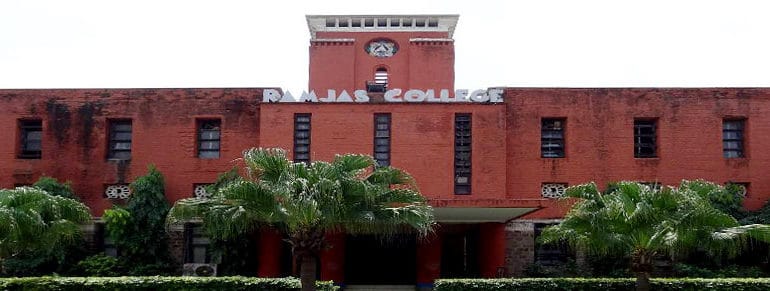
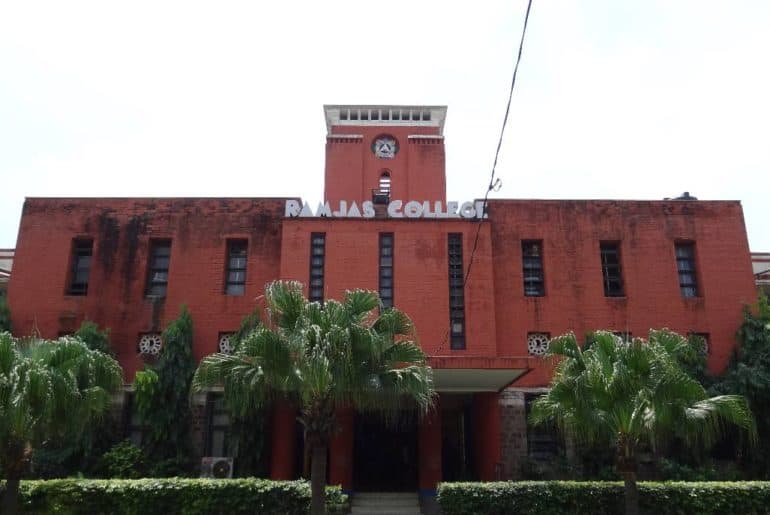
A 25% increase in fees at Ramjas College will be effective from the 2017-2018 academic session. Such a hike will require every student from across courses to pay an additional amount of Rs. 2500 each. The decision was made in a staff council meeting of the College, held on Friday. Acting principle, P.C. Tulsian maintained that the fee hike was necessary in light of the developmental work taking place in the college. Moreover, he said that the University does not give funds for the same.
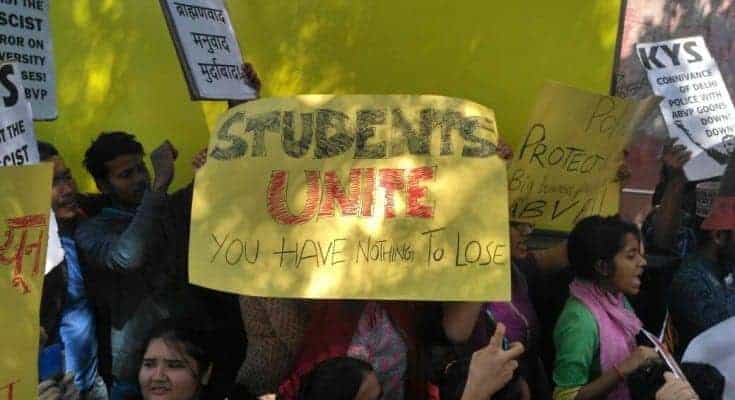
However, the move has not gone down well with the faculty and students of the college. Students view it as a clear movement towards privatisation of the college. They’ve also criticised the fee hike as going against the public-funded nature of government colleges and a sheer attempt to dismantle it. For years, the University of Delhi has invited students from various economic backgrounds. However, due to such a move, students from lower income groups are bound to be burdened by the added expenses.
This decision by Ramjas College comes shortly after the move to inflate hostel fees at the DS Kothari hostel. In a statement to the New Indian Express, a group of DU students remarked:
“If all colleges and hostels will slowly hike their fees, even when the varsity is central and public funded, then where will the poor students go? It clearly states that the varsity is moving towards autonomy and privatisation of education.”
Following the controversy to make St. Stephen’s College autonomous and the recent NAAC appraisal, many have begun to view such moves as part of an agenda to privatise higher education.
Please write to us, expressing your thoughts on the same.
With inputs from The Statesman and The New Indian Express
Feature Image Credits: Ramjas College Swareena Gurung [email protected]
Every Academic Year, the University of Delhi witnesses a multitude of events, including those that add glory to its name through the students’ or educators’ outstanding achievements, and those, that probably lead us to question the existing status. Having their own significance, here are the Proud and Dark moments of Delhi University, which added stars to the University’s glory, and brought our focus to the issues that urgently need to be addressed.
Proud Moments of Delhi University 2016-2017
DU ALUMNUS ANKIT KAWATRA, SLECETED AS ONE OF THE 17TH “UN YOUNG LEADERS” IN THE WORLD
Ankit Kawatra, an alumnus of DU’s Keshav Mahavidyalaya College, also the founder of the NGO, Feeding India was selected by the United Nations (UN) as one of the “UN Young Leaders” at the Social Good Summit. Ankit quit his corporate job at the age of 22 to lay the foundation of his NGO, which has now expanded to feed over 1 million people across the country.
DU’S HIMADRISH SUWAN HONOURED WITH SWACHHTA WARRIORS AWARD – 2016
Delhi University’s Himadrish Suwan, was honored by Shri Narendra Modi on the succesful completion of two years of the Swachh Bharat Abhiyaan. Suwan is the convener of Mission-E-Safai, an initiative by students for the Swachh Bharat Abhiyaan through which he connected universities & their student’s group under one umbrella to function as clusters to spread awareness about cleanliness.
DELHI UNIVERSITY STUDENT WINS DOUBLE GOLD AT WORLD UNIVERSITY CHAMPIONSHIPS
Akhil Sheoran, a graduate of Delhi University brought laurels for the nation at the sixth International University Sports Federation’s (FISU) World University Shooting Championships, held at Bydgoszcz, Poland. A part of the 34 member contingent from India, Sheoran bagged two medals in Men’s Air Rifle Events and made the country proud.
An enterprising group of Delhi University students made headlines by creating a new world record of making the Largest plastic cup pyramid by using 5 7,000 plastic cups at Thyagraj Sports complex on September 21st, 2016 . The contingent of 22 students led by Kushagra Tayal, an Economics Hons student of Hansraj College, took 3 days to accomplish the feat. The group broke the existing world record from Mexico, where 42,935 plastic cups were used for creating the pyramid.
The largest plastic cups pyramid made by DU students
DU SHINES AT PARALYMPICS TOO
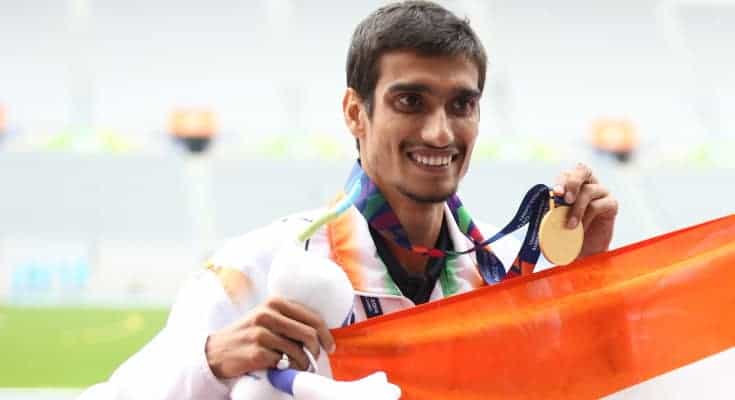
Apart from representing India in Olympics, a student of Kirori Mal College, Delhi University, also represented India at the Rio Paraolympics 2017. Sharad also broke a 12 year old record in the men’s high jump category and joined the league of Apurvi Chandela, Lalit Mathur in representing the country at the international level.
MIRANDA HOUSE STUDENT SEXUALLY HARASSED AT SRCC’S FEST
A student of Miranda House faced sexual harassment during KK’s concert at SRCC’s Crossroads. Identifying herself as Meghna, the victim described the event of a man masturbating on her while she was attending the concert, through a Facebook post. She, however, had to face mockery at a public platform due to the audience’s dismissal of the post as an attempt to seek attention.
DU TENSE WITH STIFLED PROTESTS; PROTESTORS ASSAULTED AND DETAINED
Tension arose in the north campus due to violent protests between members of Ramjas College’s
English Literary Society and ABVP activists on February 22. The tension arose due to the violent intervention of ABVP activists in a conference organised by the college’s LitSoc where JNU’s Umar Khalid was invited to present a paper. A large number of protestors were assaulted and detained during the tussle.
A DAULAT RAM COLLEGE STUDENT SEXUALLY ASSAULTED BY BANK EMPLOYEE
A student of Daulat Ram College was sexually assaulted by a male employee of the Indian Overseas Bank branch inside the college on January 18, 2017. The victim lodged a complaint against the accused at Maurice Nagar Police Station where the latter confessed to molesting the student.
Enactus, the global non-profit community which seeks to inspire action, has transformed communities in more than thirty-six countries with the help of visionary minds. Emphasising on the monumental impact of entrepreneurial action, the Enactus community has been working towards manifesting an independent world by generating employability through its unique projects. Colleges under the University of Delhi have established their presence through relentless efforts and have emerged successful in catering to the plethora of social issues plaguing thousands of lives. Here is a compilation of the events, projects, and achievements of the prominent Enactus societies of the University of Delhi.
Enactus Ramjas
The Ramjas chapter of this social venture commenced in 2011 and has successfully catered to three models of business since its inception. These include the Enactus Store, Project Bawarchi, and Project Transcreation. Enactus Store is an online platform which specifically caters to the products and services of Enactus teams all around the country. Project Transcreations seeks to help the transgender community to sustain their lives through providing them with entrepreneurial avenues such as cab driving, jewellery making, etc. They have also launched their very own beauty parlour in Saket solely run by transgenders. Project Bawarchi is a canteen exclusively being run by victims of drug and substance abuse near North Campus and is accompanied by food carts and tiffin delivery. The society has also conducted myriad events to serve the community this year. Under the umbrella of its Project Transcreations, Enactus Ramjas organised a transgender fashion show along with an LGBT pride march. It also conducted the biggest Enactus Festival in February of this year and saw a successful participation. Semi-finalists of Enactus Nationals 2016, the society has carried out more than 30 sensitisation campaigns related to drug abuse since the launch of the project.
Enactus Hindu
Conceptualised in 2014, Enactus Hindu launched its Project Veerangana in this academic session. The social endeavour aims to propagate safety ideals for all by transforming young, unemployed women into self-defence instructors. The previous social campaigns of the society include Project Shreshth and Project Oorja. Their pilot project, Shresth, transformed a group of financially dependent women from the Badli Industrial Area, Rohini into self-sufficient entrepreneurs who manufacture and market incense sticks under the brand name ‘Aanchal Aggarbatis’. Project Oorja strives to preserve environmental balance by providing clean solar lighting solutions to tackle the menace of rising carbon footprints. Under its current project, the society introduced a campaign titled ‘Be A Veerangana,’ and witnessed two months of intensive offline and online promotions, encouraging women to share instances of harassment and breaking the taboo around crimes. At Mecca 2017, the annual cultural festival of Hindu College, their team conducted ‘Road to Safety,’ a unique? simulation of the streets of Delhi, with the objective of raising awareness about simple safety measures which can come in handy in our day-to-day lives. The animal community was also served with its ‘Warmth for Paws’ initiative to provide clothes to street dogs with sweaters made from discarded woollens in the bitter cold months of December and January.
Enactus Khalsa
One of the youngest members of the Enactus community, the Khalsa chapter of the non-profit endeavour germinated in August of last year. While their pilot project is currently under development, they successfully organised an awareness campaign within the college. Titled #LetsMakeGodTalk, the students of the college were induced to deliberate upon the social sphere. On Daan Utsav, the society also organised a visit to a girls’ shelter home and spent a day there with the kids playing games and interacting with them.
Enactus Ramjas College
Enactus Hindu College
Enactus SGTB Khalsa College
Enactus Miranda House
An active member of the social community, Enactus Miranda House has been the launching pad of four successful initiatives since its inception in 2011. Namely Project Zaffran, Project Jazba, Project Tarang, and Project Daryaft, the society aims to boost the issues of financial dependency amongst the women community, strengthening the standing of acid-attack survivors, developing environmentally complementing products, and enhancing the tourism sector, respectively. This year, the society organised a seminar – ‘Astitva’ in relation to Project Jazba, along with a seminar with Mr. Vikramjit Singh Rooprai on the occasion of Heritage Day under Project Daryaft. The annual festival of Enactus Miranda House – Impressa 2017, was organised with the theme ‘Breaking Stereotypes,’ and witnessed events such as open mics and movie screenings. In addition to organising a waste collection drive, the society has also conceptualised an internship programme ranging from the Campus Ambassador Program to Synergy, the Winter Internship Program to propagate ideals of entrepreneurship and initiative.
Enactus SRCC
Perhaps the oldest member of the Enactus community, Enactus SRCC has been doing pertinent projects for a decade now. Some of their recent projects are as follows. Project Life On Wheels facilitates micro-credit for rickshaw pullers by enabling them to own their rickshaws. Project Aahaar is an initiative to rehabilitate underprivileged women by providing them with culinary training. Project Azmat was an endeavour to liberate manual scavengers by providing them with a sustainable source of livelihood through a development of a micro-enterprise and to facilitate construction of proper toilet systems. Project Sattva was an initiative to bring efficiency in India’s dairy sector by the rearing of high yielding cattle and value addition to milk through a mutually beneficial relationship. Project Asbah aimed at providing clean drinking water to rural households through the development and marketing of clay-based water filters produced by a community of potters. With projects like these, Enactus SRCC secured the second runners-up position at the Enactus Nationals 2016. They have received the prestigious KPMG grant and Walmart grant in recognition of the progress made by their projects.
Enactus Shaheed Bhagat Singh College
Since its formation in 2014, Enactus SBSC has come a long way with three socially relevant and inspiring initiatives. Their first project, Project Karva aimed at the upliftment of women. Under Project Roshni, visually impaired people were taught how to make candles as an attempt to become independent as well as self-sustaining. Inspired by the United Nations Sustainable Development Goals, they conceptualised their third project, Project Aahar, which seeks to provide affordable as well as hygienic food to people in need. Other than the projects, two fundraising campaigns were conducted this year. From 5th-7th October 2016, Campaign Umeed took place where members sold bookmarks and notebooks made by the specially challenged children of Deepalaya School. On the 109th birth anniversary of Bhagat Singh under Campaign Anghaar, candles made by the visually impaired to the students of Shaheed Bhagat Singh College were sold. Campaign Sparsh addressed the women residing at Anand Parbat and introduced them to NGO GOONJ’s ‘My Pad’ – a kit that contains undergarments, sanitary pads, and a manual on menstrual health. They also addressed the issue of child sexual abuse as it is one of the major evils surrounding Anand Parbat through organising interactive activities for the children and showing videos that demonstrated the difference between appropriate and inappropriate touching.
Enactus Miranda House
Enactus SRCC
Enactus SBSC
Enactus Maitreyi College
Established in 2014, Enactus Maitreyi is currently working in collaboration with the National Coalition of People Living with HIV on their third project – Project Samya. True to its name, Project Samya aims at bringing equality to women affected with HIV who are evidently socially excluded and are often forced to quit their jobs. Enactus Maitreyi’s first project, Unnayan, helped the women of Mayur Vihar to make and market a liquid dishwasher, ‘Clean Ninja’ for them to become self-reliant. They launched their second project, Swadhin in 2016, with the aim of helping the physically impaired community by equipping them with entrepreneurial skills. This year the society started its own plantation drive. Other than this, Enactus Maitreyi purchased stationery items for the specially-abled students of Anukriti School, with its own funds by keeping aside INR 2 from the sale of every product. To raise funds, Enactus Maitreyi launched a fundraising campaign called,#IDidMyBit, which was conducted over a period of 2 months. A photo booth in Connaught Place was also created to raise money.
Enactus Sri Venkateswara College
Conceived in 2015, Enactus Sri Venkateswara College has been appreciated for its innovation and uniqueness of projects. The society has successfully churned out three projects, namely Project Captain Compost, Project Aushadhi, and Project CiggB. Project Captain Compost aims to provide a solution to the garbage menace in the city while uplifting the social and economic status of ragpickers at the same time, and Project Aushadhi merged the two issues of homelessness and medicinal waste. Winner of the Blue Dart Grant worth INR 40,000, the society launched Project CiggB this year which focuses on the disposal and recycle of used cigarette butts. To establish a communal outreach, they organised stalls in the fests of Hindu College, Indraprastha College for Women, Kamala Nehru College among others, along with stalls and exhibitions under ‘Heartist,’ where they provided a platform for street artists to showcase their skills and sell their products. In association with ‘People for Animals’ and Enactus SRCC, Enactus SVC also set up a winter cloth collection drive in December 2016. They have also collaborated with ‘Parivartan’, the social service society of Sri Venkateswara College for interaction and skill development of slum children and organised a special event for them to celebrate Children’s Day.
Enactus Hans Raj
A cognizant member of the Enactus community, Hansraj College’s Enactus has been running four projects since its commencement in 2011. Project Lekhni has been successful in helping five women from Jhandewalan to rise from the status of victims to the masters of their lives, Project Boond seeks to solve the problem of clean drinking water for the underprivileged masses by providing them with low-cost water purifiers that run without electricity, and Project Mithaas is an endeavour aimed towards providing a stable source of income to farmers in India by encouraging them to adopt beekeeping as a practice. Enactus HRC conceptualised Project Aaangan this year to provide day-care facilities to working women of lower income strata. Winner of the Best Project for showcasing the spirit of VEER at Enactus Nationals 2016, Enactus HRC has, in addition, conducted a donation drive for Project Aangan. Aashayein’16 was an initiative for the kids of an NGO Navjyoti to help them experience the dream they wished to live. It was a small drive by Enactus Hans Raj to fulfill wishes and spark a fire in them by overcoming challenges.
A notice issued on Thursday by the acting principal of Ramjas College says that there will be no DJs or music streamed through speakers at freshers’ welcome parties, farewells or other functions. All functions must also end by 4 pm, and at least two teachers, one of whom should “preferably” be a woman, must be present till the function ends.
The principal said that the notice was passed so as to make sure that there is no noise pollution or complaints in and around the campus.
“It is appalling what the students do. We have received many complaints in the past. I will not go into the details but there have been instances where people have complained of misbehavior. Why are DJs or loud music needed? This is a college, not a club. Even I was a student of this college. We didn’t need to make noise to throw farewell parties. People have to maintain decorum. Also, examinations are starting soon and there should be no noise. Students in hostels need peace and quiet to study. Practical exams have already started and theory exams will start on May 9,” said Principal PC Tulsian.
The notice has received criticism from both students and teachers.
One of the students who did not want to be named said “This is bizarre! Why can’t we play music during our functions? And why must a function end by 4 pm? These rules make no sense for college students. The college itself uses speakers for the functions it holds. Why should the students not be allowed? If the music is too loud or disturbing anyone, the authorities can always tell us to lower the volume. But why the blanket ban?”
The teachers as well criticized the clause regarding the mandatory presence of teachers calling it regressive. “The rules are regressive. Students should be able to hold functions in their own college. Why is the presence of teachers necessary? The notice smacks of unnecessary moral policing,” said a teacher on condition of anonymity.”
Mukhatib 2017, the annual streetplay festival organised by Shunya-the theatre society of Ramjas College on 31st March 2017 saw four plays being censored by the authorities to avoid any type of unrest in the campus. The organisers of the event were reportedly asked for the scripts of the plays which were to be performed in the festival just before the event. This was followed by the cancellation of four plays which had elements of nationalism in them. The students replied to this attempt of the administration by sealing their lips with black tapes and tying black bands around their arms.
There were seven plays scheduled to be performed in the event out of which only three were allowed. The plays of the colleges which were cancelled were SGTB Khalsa college’s play ‘Trump Card‘, Dyal Singh Evening college’s ‘Jokistaan’, Sri Guru Gobind Singh College of Commerce’s ‘sawal to uthega’ and Gargi College’s ‘Main Kashmir, aur aap? Main Manipur’.
Out of the three teams that were allowed to perform, Lady Shri Ram College did not perform as a mark of protest while Miranda House and Kirori Mal College went ahead with their performances “Hadsa-e-Paidaish” and “The Accidental Death of an Anarchist” respectively.
However, the authorities refuted the claims of censorship and said that it was the students who themselves decided to scrap the plays. The acting Principal P.C. Tulsiyan said “The administration did not cancel the plays but Ramjas students who are members of the drama society did it themselves. We had just advised them to not include anything which may hamper the peaceful atmosphere at the college.”
However, speaking to DU Beat on the condition of anonymity, a student organiser said “We were made to sign an undertaking by the authorities who refused to give us permission otherwise. We have been organising Mukhatib for years but never before we have seen this type of censorship and silencing of voices on the pretext of safety.”
The college saw violent protests last month by ABVP against a seminar which featured ‘Umar Khalid’ and ‘Sheila Rashid’ as two of the speakers.
A few prestigious institutions under the University of Delhi, namely, St. Stephen’s College, Hindu College, Ramjas College, Shri Ram College of Commerce and colleges run by theDelhi Sikh Gurudwara Management Committee, have expressed the desire of achieving a deemed university status. The proposals are at very initial stages, but if granted, these colleges will have the power to formulate their own rules and fee structures which will not adhere to the functioning of Delhi University.
The matter was raised in the governing body meeting of Hindu college, and it was declared that in later stages if a college wants a deemed university status, they must have an ‘A grade’ accreditation under NAAC for 3 consecutive years. A senior university official stated, “Few colleges like SRCC, Stephen’s, Ramjas, Hindu and the ones run by the Delhi Sikh Gurudwara Management Committee want deemed university status. The Union Human Resource Development Ministry has also formulated some norms for providing more autonomy to colleges but deemed status will give them complete freedom of functioning on their own”. It has been speculated that if this status is granted to any of these colleges, they will not be bound by any of the rules and regulations of Delhi University, and thus there will be no need to seek sanctions from the University for any decision. Despite of all these proposals, it has also been speculated that the Student Unions of these colleges might oppose this move because the college will then have a liberty of deciding their own fee structure, and thus there might be a price hike in the fee which would make affordability a great reason of concern for many students.
St. Stephen’s College has already been in a tussle with the University of Delhi for the past couple of years regarding an autonomous status. Attempts to reach out to the Student Union of the college for their comments were unsuccessful.
The north campus of the University of Delhi was tense on February 22 with violence breaking out inside the Ramjas College campus, outside the college, and later in the evening in front of the Maurice Nagar police station. After the violent intervention by the ABVP of an academic conference in Ramjas College on February 21, a common students and teachers protest was set to take place the next day, on February 22, against the intervention. ABVP’s reason for obstructing the conference was the presence of Umar Khalid and Shehla Rashid, JNU students, who were amongst the speakers at the conference. Umar Khalid was arrested on sedition charges in 2016, however no charge sheet has been filed in the case yet.
February 22, 2017:
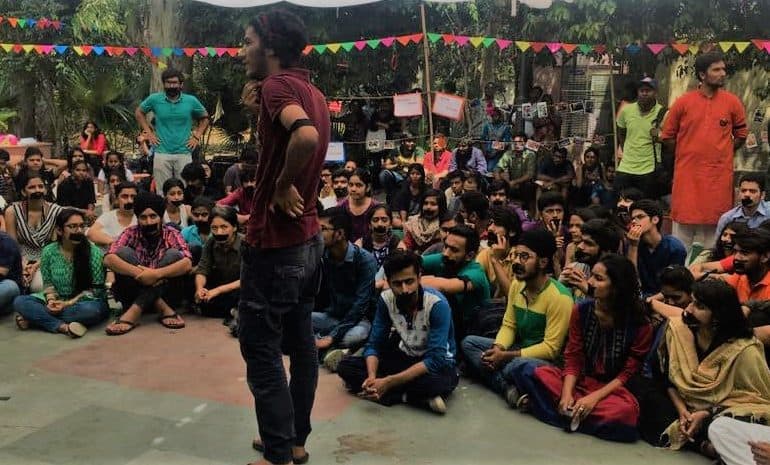
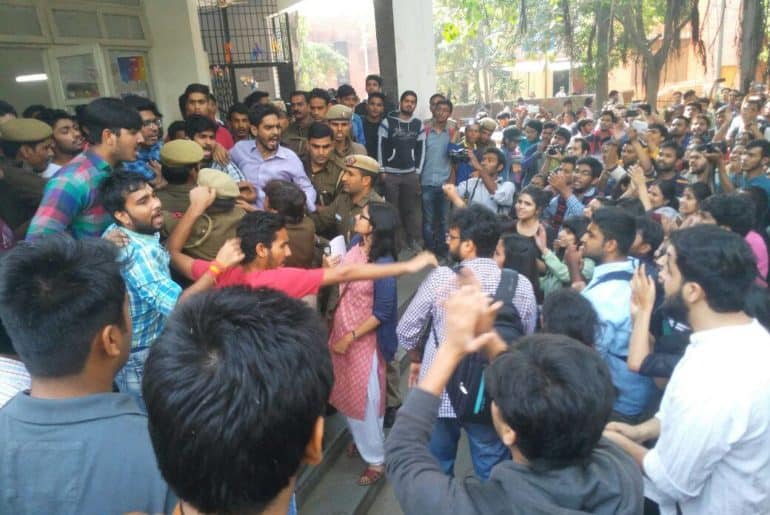
The common students teachers march was scheduled to start at 1 p.m. but was blocked by he ABVP. Before the march, as an extra security measure, guards at Ramjas College checked ID cards to ensure that only students of the college were allowed to enter. What was supposed to be a peaceful march around the campus was cut off by the ABVP as they began shouting slogans like “Bharat Maata ki jai” and ” Vande Mataram” in the sutta lane within the Ramjas College campus. In response, the student and teacher protestors sat down and began their own chants of “Hum honge kaamyaab ek din” on a lawn adjacent to the ABVP gathering. Within a few minutes of this standoff, members of ABVP were seen entering into the lawn space where the students were gathered. There are eyewitness accounts and videos floating on social media of the ABVP activists beating, shoving, and grabbing the students gathered. The police intervened immediately and the students shifted towards the canteen premises.
The protest march being blocked by ABVP activists and supporters
A large gathering of students sat down in front of the canteen and under the conference hall. Reports came in of a large number of protesters consisting of students, teachers and activists gathered outside the college gates. Students and teachers who were inside the college sat down in silent protest. The police tried to form a barrier between the two groups. The ABVP activists repeatedly tried to break the barrier and attack the students. Fearing escalating violence, the police escorted the students out through the back gate where they were transported to the metro station in Civil Lines.
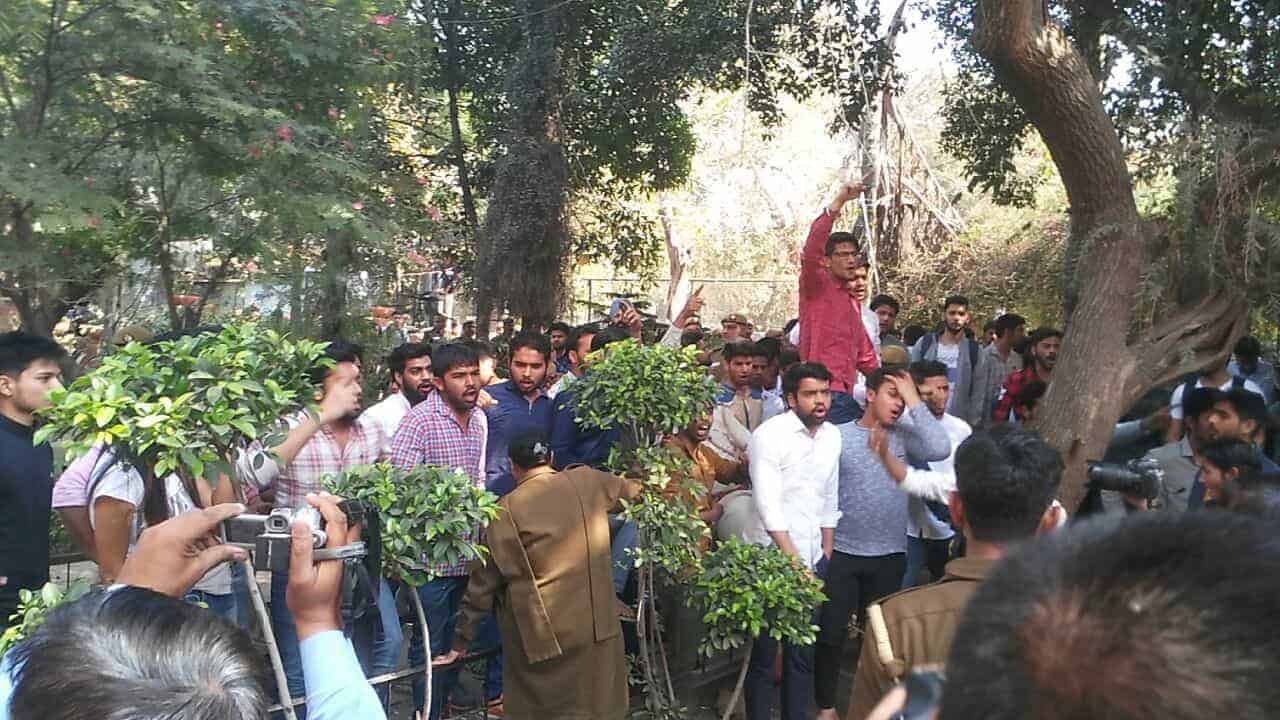
Meanwhile, outside the college, students and teachers who had congregated for the protest march, and journalists covering the issue, encountered ABVP activists. There are videos and evidence of students and faculty members being injured during this encounter. Around this time, roads leading to the Maurice Nagar police station were blocked by the police and shopkeepers around Patel Chest area were asked to bring down their shutters. The protest reached the Maurice Nagar police station area after 3 p.m., where police had been deployed to keep the violence from escalating and forming a barrier between the two sides. The protesters placed themselves outside the police station, demanding that an FIR be lodged against the violence committed by the ABVP. Slogans like “Aar ho ya paar ho, aaj FIR ho” were heard from the protesters’ sides.
Protestors in front of Maurice Nagar police station on February 22
At around 6.30 p.m., just after protesters were speaking to the police about their demands, a commotion broke out as the police surrounding the protesters started absconding them, in some cases with unnecessary force. The protesters were rounded up in police buses and taken to different corners of the city in an attempt to break up the protest on campus. They were dropped off later in the evening. There were reports and rumours of a potential ‘witch-hunt’ by ABVP members around the campus in search of people at the protests. No such incidents were confirmed.
February 23, 2017:
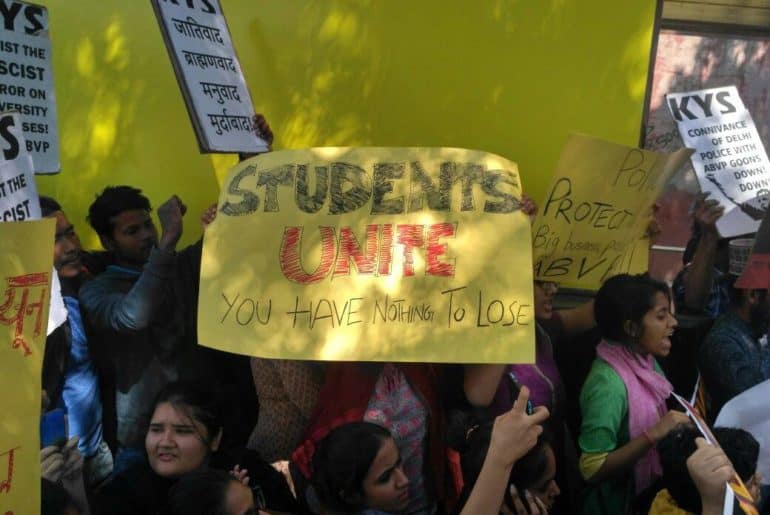
Another peaceful protest was organised today by the students and teachers at the Delhi Police Headquarters in ITO with heavy police presence around the area. Hundreds of students attended the protest, where sloganeering was heard and protest signs could be seen condemning the police brutality against student protesters yesterday. An exit gate at the ITO metro station was closed around noon. The protesters pushed for an FIR to be lodged and for a meeting with the police officials. After meeting with the students, who wanted separate FIRs to be lodged against the ABVP members who engaged in violence, the police informed them that separate FIRs cannot be lodged and they would need to be clubbed under one FIR. The student protesters then took the decision to have affected students write down testimonies of violence committed against them, with which they’ll approach other authorities given the contention between their demands and the police’s stance.
The police has admitted to the use of excessive force against students on February 22nd. The case related to the entire incident has been transferred to the Crime Branch. They also invited students to submit their complaints to the police which can then be clubbed together.
The student protesters are reportedly upset about the incident being branded an ABVP-AISA clash and the protesters being clubbed together as AISA members. They have called these protests movements by the students and teachers of Delhi University, and not a political party. The protesters comprised of students from across Delhi University, Jawaharlal Nehru University, and other institutions across Delhi, with supporters of various movements and parties, and many with no political affiliations.
There were other protests in North Campus as well, with NSUI carrying out their peace march from the Arts Faculty to the Maurice Nagar police station, and the ABVP continuing their stance of protesting against ‘anti-national’ activities and elements. There were reports of considerable police presence around the campus.
A two day seminar on Cultures of Protest, organised by Wordcraft, the Ramjas literary society and the English department of Ramjas college, was disrupted when members of the ABVP protested against Umar Khalid speaking at the conference. Khalid is a PhD scholar from Jawaharlal Nehru University and a student activist who was slapped with sedition charges last year. The two day seminar was set to explore the representations of dissent in literary productions, and Umar Khalid was invited to speak on the theme ‘The war in Adivasi areas’.
ABVP protested against Khalid’s presence inside the college campus. They went to the Principal’s office claiming that the majority of the students were against his speaking at the conference as well, and therefore the conference should be cancelled. “Majority of the students were against Umar Khalid speaking and they were calling us up, asking us to stop the event from taking place. Moreover, the organisers had no approval from the faculty. So we marched inside and managed to stop the conference from taking place,” said Priyanka Chawri, the Vice President of the Delhi University Student Union.
We spoke to one of the teachers-in-charge of the event, Vinita Chandra, who said, “We had approval of the principal and we had been planning this event for months now. We have official proof of the invitations as well. The Principal expressly said, ‘I believe in tolerance and I believe in freedom of speech’. I have always assured my students that when teachers are there, nothing is going to happen to the students. In my 30 years of teaching here, for the first time I feel no confidence at all in being a teacher.”
Apparently, the faculty was aware prior to the event that there could be some form of protests but the college union president assured that all protests would be peaceful in nature. Moreover, the police had said that they would not be able to provide protection to Khalid or the members of the organising team if any major disruption takes place. Apprehensive of any violent outbursts, members of the literary society decided to cancel Khalid’s talk and proceed with the conference. Before beginning, the teachers and students organised a short march around the campus, protesting against the disruption in the day’s events.
After the session was about to resume, the ABVP protesters turned violent and started throwing bricks and stones at the windows. Groups with lathis and rods were seen rioting around the area and the police had to resort to the necessary means to quell the violence. Students and teachers attending the conference inside the conference hall were locked in and the power was cut. The police had to barricade the entrance to the conference hall to stop the protestors from getting inside. After an hour of struggle, the police formed a human chain and helped the students trapped inside to exit safely through the backgate of the college. A student present in chaos said, “The protesters abused and threatened even the teachers of the college. Goondagardi hai yeh toh.’’
In the entire process, a few students were injured and one had to be taken to the hospital for immediate treatment. Umar Khalid in response to these events, posted on Facebook, “ Such open brazenness is only possible because of the institutional impunity ABVP goons enjoy in universities’’.
A glimpse is obviously not enough to gorge on the rich history of the college, but Ramjas College’s Grand Centennial Celebration is right around the corner as they complete a hundred years in 2017 and we decided to take a look at the past.
Located in the heart of North Campus, surrounded by an air of political sway and a hundred years’ worth of dignified history as its foundation, stands Ramjas College – known for a lot more than just its education. With the college completing a century with abundant achievements and alumni in its list, let’s look at what makes Ramjas College exceptional:
1. The college was founded by Rai Kedarnath, a philanthropist, who created the college for the lower middle class students who couldn’t afford the education in other colleges. Admission of students was solely on the basis of merit and no student was discriminated or denied admission on the basis of caste. All you needed to be at Ramjas was a will to study.
At first, the college was run by the Ramjas Foundation, that was meant for schools and educational institutions, but later, it got affiliated to the University of Delhi . Ramjas College is one of first three colleges that were established in Delhi University.
2. Ramjas was the first college to run their classes in shifts. This started due to Partition and the morning classes were affiliated by the University of Delhi and the evening classes were affiliated by the University of Lahore. The college provided accommodation for many refugees from Pakistan, however students were having troubles in commuting to the college. So, Rai Kedarnath went to ask for donations from people in places like Chandani Chowk and made sure that every student had one bicycle for commuting.
3. The provision of bicycles led to the start of another trend. In order to earn money, students from Ramjas delivered door-to-door newspaper service on the cycles. This was the first time that something like this happened in Delhi.
4. The students of the college were actively involved the freedom movement and a group of students were arrested for their involvement in the struggle. A plaque with their names inscribed on it has been put up near the college auditorium gate in memory of the brave students. Two students, Ram Bihari Mathur and Saxena, were sentenced to life imprisonment and shipped off to Andaman.
5. Ramjas College’s involvement with the freedom struggle is extremely memorable. Chandra Shekhar Azad hid in the hostel of the college, pretending to be a Sikh student from Pakistan, when he was evading the British Government.
6. Ramjas College location was shifted from the Anant Parbat location in 1950, when the previous building was ceded to the Allied Forces of the World War II. The first President of India, Dr Rajendra Prasad, inaugurated the college’s new location.
7. This is the only college in Delhi to have Dr. BR Ambedkar as the Chairman of the Governing Body of Ramjas College. After the death of Rai Kedarnath, the father of our constitution took over and honoured the college.
Ramjas not only has a rich past, but a very exciting present. With alumni including film-maker Prakash Jha, actor Manoj Bajpai and singer-musician Papon, the college is a place for budding artists, politicians and activists.
A huge congratulations to the college for its glorious 100 Years!
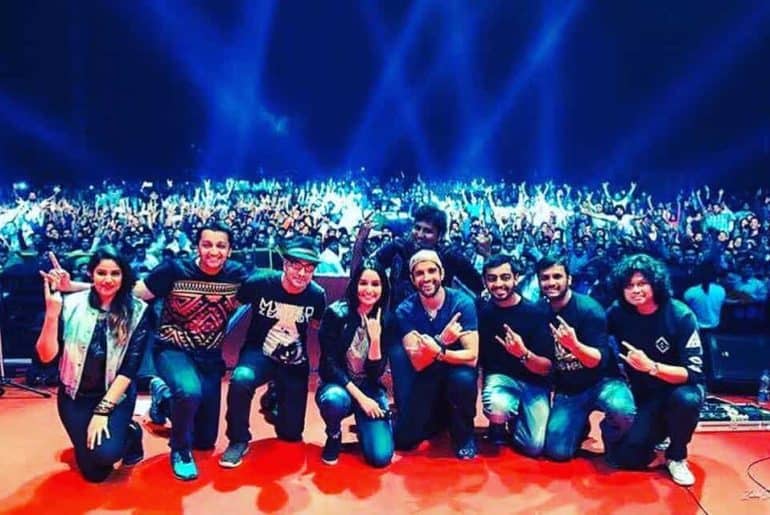
With Ramjas College celebrating its centennial year, it has seen quite a few musical nights. Starting from Papon and Astitva performing around late January this year to now, the star-studded cast of the upcoming film Rock On 2, a sequel to its hit musical predecessor, Rock On, which is all set to release on November 11.
The ‘Magik’ entourage brought to life their own on-screen roles as singers and musicians of the grunge-rock band, comprising of Farhan Akhtar, Arjun Rampal and Shraddha Kapoor. Singing along to the tunes were scores of students, enjoying the much welcomed respite from the drudgery of oncoming exams. Farhan Akhtar also sang his old popular hits from the much beloved Zindagi Na Milegi Dobara and the song Main Aisa Kyun Hu, which were definite crowd pleaser.
Shraddha, being the new entrant in the sequel, plays Jiah who is a rich girl who deviates from the beaten path in pursuit of becoming a singer, while Farhan and Arjun play the lead singer and lead guitarist respectively, the roles which they took on in its prequel.
It was quite the sensational night as college students from all over the University thronged the Ramjas grounds, most snapchatting away as the crowd hooted and cheered at the sight of the celebrities. Ramjas College has had a wonderfully eventful year when it comes to concerts, events, academic seminars, etc. as part of their grand year long celebration of it entering its 100th year on January 17th 2016, a feat to be immensely proud of. Farhan Akhtar said, “I am very happy to be here this evening. We know that the weather here was a little bit suspect but we can see all the people standing in the back. We are here to have fun with you all.”
At the end of the night, the trio wrapped up the concert, thanked the students for their overwhelming support and turnout. In sum, it was a promotion well executed.
Feature Image Credits: Ramjas College Facebook Page