Tag

Politics

Browsing

Politics has played a major role in the Indian frame for a long time, and we explore its obsession branching out in the student arena as well.

Election season is over but the hype, controversy and the obsession with student politics brims over hot brews of coffee debating and general angst.

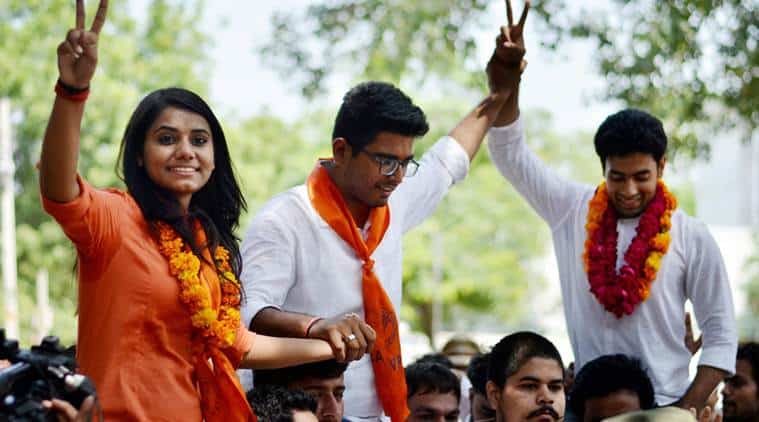
The past few years have noticed a consistent increase in the role the student bodies play in the circuit of Delhi University. Delhi University’s Students Union [DUSU] is the representative body for most of the faculties and colleges. The hierarchy also includes the internal students union in every college, with elections being held every year for office-bearing positions. Ever since 1954, the Delhi University’s Students Union [DUSU] has peaked prominence in the university. One of the key factors being is the expanse of the varsity. Being one of India’s largest universities, it serves as a great plethora for younger generations to express their viewpoints in a different light. These bodies are backed by different political parties.

Campus activism in the words of T.K. Oomen in his book Asian Survey, “is one of the pet areas in the research in contemporary social science. However, the nature of student politics and government is rarely studied”. The DU campus is blessed with serenity until the election season hits in. there is chaos and loyalty battles wrung out, with roads synonymous with lying pamphlets and college walls echoing with slogans. The case of Indian students’ union politics or student parliaments is quite different compared to its western contemporaries.

While the major touch-point for being actively involved in a student’s union means the adequacy for a good and experienced political career in the future, a lot of the nuisance created here is not prevalent there. While student bodies have a variety of tasks enrolled within, there is a big difference in the varsity student unions abroad and here. For starters, the students union elected has representative halls, like the George Sherman Union in Boston University or the up and coming promising members of the Yale College Council. Compared to the American and Western counterpart, our student unions are still emerging but are we convalescing in the shackles of unclear domains when it comes to politics? Are our student unions a reflection of the un-impressive struggle Indian politics has faced coming into the purview of the world?

The obsession of student politics can be traced to the source of power and authority, a pre-requisite to self-sufficiency in a now emerging Indian youth. While politics still stands as an attractive career option in the Indian domain, there are certain criticisms attached to the political situation and the trend of familial politics which has been extending an arm ever since the British Raj.  In a recent article in the Sydney Morning Herald, an interesting view-point of Indian politics was given notice stating, “In India politics is not a vocation, but a family business.” Continuing with his argument, Amrit Dhillon also comments that Whichever party you look at, in every part of India, nepotism is rampant. Merit, a record in public life, knowledge, skills, character, are all irrelevant. If you have the right surname, you will get a ticket.”

While just politics in a global scenario is still long miles away, it is safe to say that there are pros and cons both attached to the increasing importance to the student bodies in India. While it still is ushering up in other universities, the Delhi University scenario places a good observation and argument as to where we stand when it comes to student parliament bodies, and their role in the overall national hierarchy of democracy.

Sources cited:

https://www.smh.com.au/opinion/nepotism-the-way-they-do-politics-in-india-20140327-zqnpg.html

https://www.jstor.org/stable/2642743?seq=1#page_scan_tab_contents

Feature Image Credits:  DU Beat 

Avnika Chhikara

[email protected]


For a long time, Hindu College has had the distinction of having its own Parliament, a rare feature in any DU college. So, as the campus gets awakened in the wake of the DUSU elections, Hindu College becomes a political world in its own.

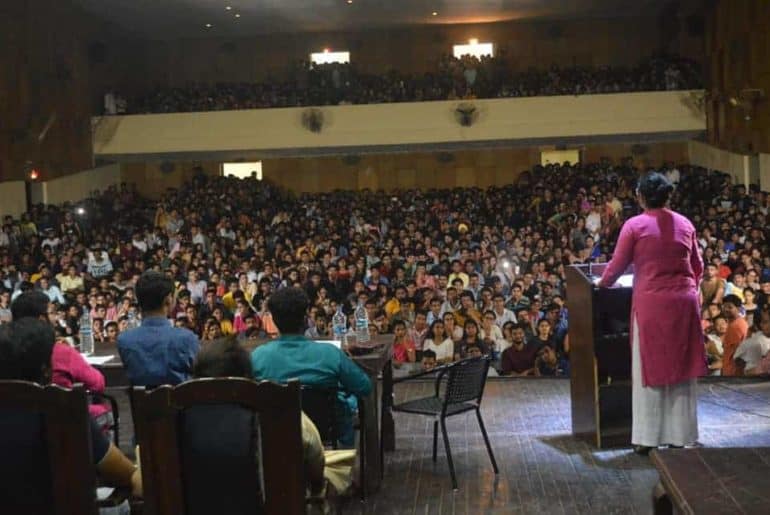
On the eve of the college Students’ Union elections, a major event that takes place in Hindu College is the Annual PM debate. This year, the same took place on the 10th of September 2018. Apart from fiery speeches and questioning, it also felt like a session when the democratic audience of the Hindu College auditorium got to know their candidates in a better manner. There were obviously a few hoots, cheers and naarebaazi. But this year’s edition was pretty different in the sense that there were five contestants for the PM’s chair (one of them being a woman leader which, again, is a rare phenomenon in the Parliament). Each one was from a different course with different aspirations and agendas. After the clock struck twelve, the auditorium started to get jam-packed. Members of the ‘Symposium’, the society involved in hosting this mega event, were trying their best to handle the unruly crowd, cheering for their candidate and finding the spots where the other members of their society were seated. The energy and the whole aura of the setting felt as if a music concert is about to start.

After a few minutes, all the five candidates got up on the stage, each one displaying a mix of confidence and confusion on their faces, their notes clutched tightly in their hands. Round one witnessed each leader presenting his or her vision, his or her arguments, and his or her expectations. Ananya Bhardwaj started out by explaining how the politics in the college has hardly been inclusive for women and the debates and discussions are mostly “concentrated within the boys’ hostel”. She questioned, “If the women of the institution don’t get an adequate space to voice their opinion, then how is this parliament democratic?”

Next in line was Divit Yadav who again highlighted how he too wants to promote gender equality and at the same time, would want to improve the infrastructure of the college. He also mentioned how he and his supporters had successfully conducted ‘Mecca’, the college fest which was hailed as ‘the big daddy of college fests’ in several publications of Delhi. The ‘Mecca achievement’ was again highlighted by the third candidate, Naveen Kumar. He added how he had been disillusioned with the ruling panel of the Parliament the year before and this led to the creation of his own front ‘Team Naveen’. Kumar also took an indirect jab at a few other instigators in the student politics when he said he does not believe in using surname or caste to attract votes. Infrastructure and student welfare issues were also elaborated by Shreyas Mishra. His speech might have sounded dull but it was factually correct and straight to the point. His agenda included strengthening the Wi-Fi signals, setting up a lunch break for the convenience of science students, introducing more books in Braille and so on. The last speech was by Vivek Reddy who seemed very timid and calm while he was seated. But as soon as he got to the podium, he took control of the stage. His was a speech driven by a lot of aggression as he yelled out his thoughts on how the parliament needs to be more equivalent in nature and accommodate people of all social and economic backgrounds. Even though this was mentioned by other candidates too, Reddy’s passion truly seemed unique and personal.

What followed was a session when the candidates could question each other and answer a few questions asked by the audience. In all these rounds of arguing, the main themes that were common to all were student welfare, representation for students of all backgrounds, and of course, ‘Mecca’. Some glorified how Mecca is ‘Hindu College ki Shaan’ (the glory of Hindu College) while a few others said that conducting the college fest is not the only responsibility of a PM and many other issues need to be given more attention.

Some points in the candidates’ agendas seemed like they are much needed to enhance Hindu College while some other points seemed like unrealistic electoral promises which will hardly be realised once the elections get over.

Who will win? Who will lose? The answer to that is totally dependent on the students who make Hindu College what it is. The answer will be revealed on the 12th of September.Till then, the students can ponder over yesterday’s debate and try making the right choice.


Feature Image Credits: Vivre

Shaurya Singh Thapa

[email protected]


The AISA-CYSS alliance unveiled their candidates today in a rally that started from the Faculty of Arts, North Campus.

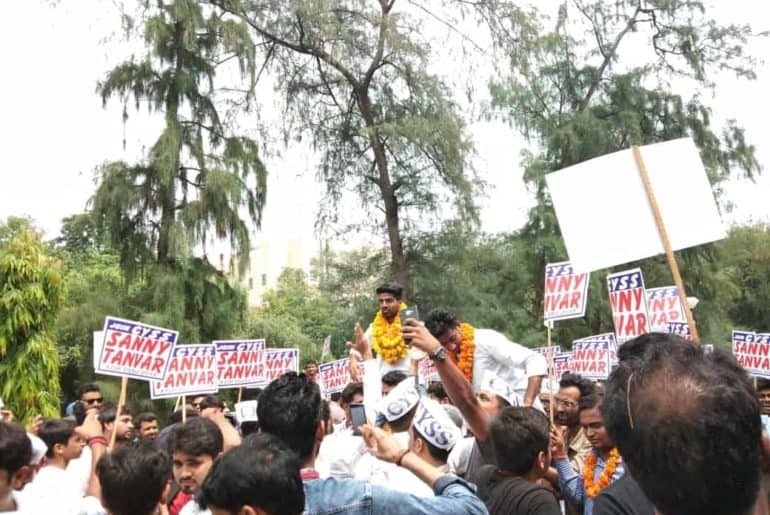
In a huge show of strength, the alliance of the All India Students Association (AISA) and Chhatra Yuva Sangharsh Samiti (CYSS), declared their candidates for the upcoming Delhi University Students Union (DUSU) elections on 12th September 2018, in a rally that started from the Faculty of Arts at 1 p.m.

Abhigyan, a first-year student pursuing B.A. Programme from Ramjas College would be contesting for the post of President while Anshika Singh, a student from Dayal Singh College would be contesting for Vice President. Both are from the AISA. Chandramani Dev, a student from Law Centre II and Sunny Tanwar, a student of Pannalal Girdharlal Dayanand Anglo Vedic College will be contesting for the posts of Secretary and Joint Secretary respectively. Notably, both candidates are from the CYSS.

In a press release, the joint alliance promised to challenge the politics of hooliganism around the campus and to establish an ‘alternative model’ of DUSU which will be student-friendly. They have based their campaigning on issues like better student transportation and accommodation facilities, ensuring a Gender Sensitisation Committee Against Sexual Harassment (GSCASH) which would encompass the entire University, better placement facilities for students, student clinics in DU colleges and so on.

The rally of around 300 people moved from the Faculty of Arts in North Campus to Ramjas College, Kirorimal College, Hansraj College, Hindu College, Law Faculty and returned to the Faculty of. When asked why students should vote for AISA-CYSS, Abhigyan told DU Beat, “We’re trying to change the narrative that has been existing around here. We want to change the scenario of people coming with garlands in their necks and trying to portray themselves on a pedestal that is above the students. We’re trying to break that. We’re trying to communicate better with the students and we are fighting every day while understanding that students are also fighting every day.”

Having said that, it was considered ironical that the CYSS panel members started to climb the statue of Swami Vivekananda in the middle of the Faculty of Arts, with garlands in their necks. On the insistence of some AISA members, they descended from the statue and proceeded for the rally on foot.

Feature Image Credits: DU Beat

Sara Sohail

[email protected]

From Arun Jaitley to Alka Lamba, student politics in DUSU has revolutionised the lives of many we deem influential today. The slogans, policies, campaigns, and polling hooliganism in DUSU elections form a microcosm for the national politics.

When Franklin Roosevelt spoke about ‘building the youth’ for an uncertain future, he definitely did not have the hullabaloo of the Delhi University Students’ Union (DUSU) in his mind. Today, with over 65 years of elections under its belt, the DUSU elections serve as an apt materialisation of Mr. Roosevelt’s words.

Being a central University in a nation of over 1.3 billion people, the University of Delhi (DU) has over 1.5 lakh students enrolled in it as of 2018. When it comes to politics, a majority of the diverse student population belongs to the eligible age for exercising its voting rights. Thus, the nationally popular political parties like the Indian National Congress, Bharatiya Janata Party, and Aam Aadmi Party influence the ideologies and the politics of the youngsters through their respective youth wings, namely- National Students’ Union of India, Akhil Bharatiya Vidyarthi Parishad, and

Chhatra Yuva Sangharsh Samiti (CYSS). Though there are provisions recognised by the Election Commission for the DUSU elections, the national political influence on student politics is evident even on the materialistic level as well. NDTV reported the controversies raised on the presence of the then Chief Minister (CM) of Delhi, Arvind Kejriwal, as a celebrity figure for a concert organised by CYSS in 2015. Several reports revealed the dissatisfaction of other party leaders, like Mr. Ajay Maken, who were vehemently against the endorsement and promises of a CM in student-
oriented elections.

The other aspects of this deep-rooted politics of pragmatism are manifested in the trajectory of the professional futures the representatives and members of these student wings go on to lead. Past DUSU Presidents, including famous names like Arun Jaitley, Alka Lamba, Vijay Jolly, and many others, went on to hold esteemed positions in the same parties whose student wings they represented at the student level.

It is not unusual to associate the national party’s larger ideologies and policies with their student wings. This can be attributed to account for the fact that the ruling party in Delhi finds its student wing winning majority in the DUSU elections as well. For instance, for the duration between 2000 and 2013, the Congress was ruling at the centre and in Delhi, and NSUI won 10 out of the 13 terms of University elections. The sway of ABVP and BJP in the student politics and the central politics of the nation went hand-in-hand from 2013 as well.

There is no element of surprise when one connects the pomp and show, bribery culture, caste-centric, and non- inclusive traits of the national political front to the student elections. Like their national counterparts, political ambitions drive a certain strata of the society, with funds and resources, to invest in the campaigning process. There has been an undeniable disparity between representatives in terms of campaigning and lobbying votes for the election day.

Barack Obama urged the world to wonder- “Do we participate in a politics of cynicism or a politics of hope?” As students, it then becomes imperative for all of us to ask the bigger questions-if there is an inevitable influence, must it be from the established gamut of privileged, unrepresentative power? Should student politics feed off the flaws and negativity of our developing democracy’s politics? Or should there be a movement of change that sets precedent for the broader realm of politics?

Feature Image Credits: Adithya Khanna for DU Beat

Anushree Joshi
[email protected]

The DUSU we recognise today has its roots in the power tussles, falls, and revolutions of the past. How much has it changed? Read on to find out.
As the capital of this democracy, Delhi has always experienced the uprising of revolutionary, sometimes unsettling, but always a realistic picture of the national politics. The student population of the University of Delhi (DU) comprises of 1.5 lakh diverse individuals today. But back in the time when the University was in its inception stages, the issues faced by the country were still concrete and significant although they were not enormous in number. It is not an unexpected predicament that the Delhi University Students’ Union has been addressing and even reflecting the politics of a much larger realm since 1954, when the first polls of the DUSU elections were held.
Paving a path for prominent positions in the national political parties of India, DUSU has had a history of producing leaders who proved their motivation. During the Emergency in the nation, the then General Secretary of DUSU was allegedly jailed and subjected to torture for raising a voice against the advent of fascism. Moulding, adjusting, and
treading the tightrope of similar ideals, the present day parties contesting in the DUSU elections draw a lot of
their narrative, structure, policies, and campaigning methodologies from their older counterparts.

Mirroring the hyped affairs of the contrasting politics of the two most popular political factions today- the Rashtriya Swayamsevak Sangh and the Bharatiya Janata Party on one hand and the Indian National Congress on the other- the DUSU elections of 2018 might create an illusion of a power struggle only between the student units of the said political bodies, namely the Akhil Bharatiya Vidyarthi Parishad and the National Students’ Union of India, respectively. The truth is – like a national democracy cripples without the existence of real choice in its representatives, student governance too suffers a downfall. This is why, choices and political parties have come, gone, and changed through the course of DUSU’s journey.

For instance, the Indian National Students’ Organisation stemmed as the student wing of the Indian National Lok Dal and enjoys strong favorability in the state of Haryana at present. In the year 2008, INSO contributed to a seemingly radical initiative for that time by reportedly being the first party to field a male candidate from the Sikh community for one of the four office bearers in the central panel at the DUSU elections. This report published in The Hindu provides a clarity of thought to the understanding of numerous parties’ participation in bringing the University’s politics to the forefront.

Aam Aadmi Party’s student wing Chhatra Yuva Sangharsh Samiti, a relatively nascent organisation, joining forces with the left-wing All India Students’ Association, may seem like an unprecedented move, for the politics at DU, but the very foundation of the much notable NSUI was laid by the then Prime Minister, Mrs. Indira Gandhi. Saimon Farooqui, the National Secretary at NSUI, told DU Beat that the 2013 DUSU elections were a crutial determinant of the Vidhan Sabha and the Lok Sabha political upheaval and outcome. He believes that the Lok Sabha elections of 2019 too find a significant sway with the DUSU politics for this term.

Almost six decades later, DUSU has seen a plethora of political tussle, and a vision for the future of this University and the capital must not be forgetful of the history that changed its course in every way.

Feature Image Credits: The Hindu

Anushree Joshi

[email protected]


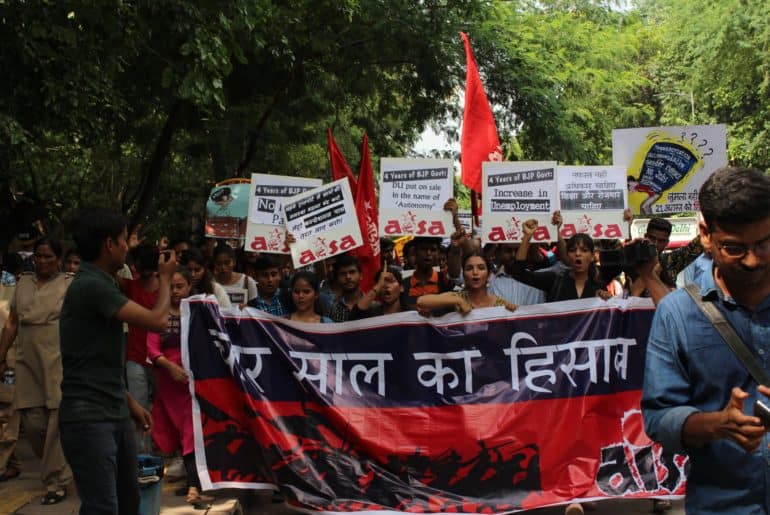
The All India Students’ Association has released a ‘report card’ on the conditions of the University of Delhi (DU) in four years of the Modi-led government. Culled from a common survey form distributed across various colleges of DU, the report claims that the University has “rejected the Modi government” and that it has “failed”.

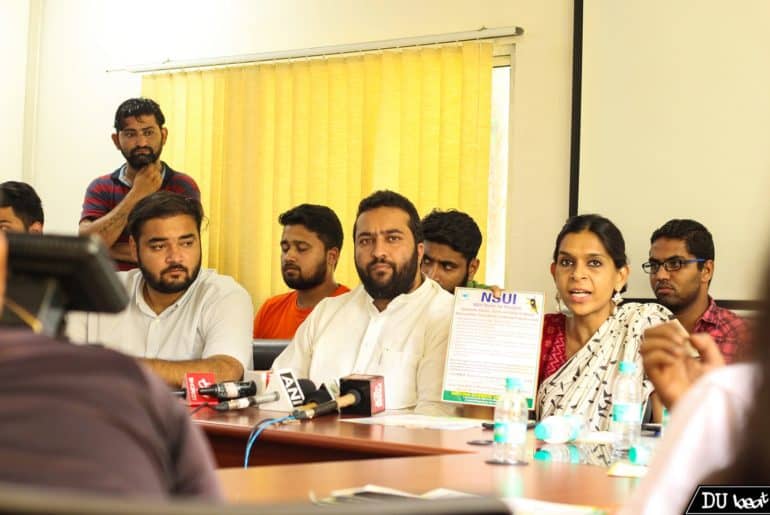
In a ceremony attended by President of the DU unit of the All India Student’s Association (AISA) Kawalpreet Kaur, former President of the Delhi University Teacher’s Association (DUTA) Nandita Narain, and almost two hundred AISA members, Ms. Narain unveiled the report along with Ms. Kaur. The survey form which featured questions on the state of hostels on campus, issues of transportation, gender violence, infrastructure development and academic freedom among others was reportedly distributed to 21,456 students. AISA claims in its press release that only 19% (4056) of the respondents had said that they were satisfied with the Modi government.

Ms. Narain raised several issues in her speech such as the cuts in JNU research seats in 2017-18 by the Academic Council, the loan-granting system of Higher Education Funding Agency (HEFA) and the debate on autonomy and privatisation and the recent assault on Assistant Professor Sanjay Kumar at Mahatma Gandhi Central University. “Wherever you students have any movement or any programme, the teachers will always try to extend their support to you…all for one, and one for all will be our motto. Only then can we save this country,” Ms. Narain added.

Later, members of the AISA also launched a rally across the various colleges of North Campus and entered Ramjas College, Hindu College and the Faculty of Law with heavy sloganeering such as, “Arre Dekho Kaise Jhoom Ke Aya, AISA! AISA!” (See how we come dancing now, AISA! AISA!).

Through an official press release, Kawalpreet Kaur said, “It is clear that DU students believe that this regime has been the worst and should be ousted from both the centre as well as DUSU…We appeal to all anti-ABVP forces to come together to give a strong message against the anti-student Modi government and defeat the ABVP in the DUSU elections.”

A Different Kind of Question  

Priyanka Chawri, former Vice President of DUSU talked to DU Beat about the rally taken out by AISA. In a telephonic conversation, she categorically denied that the ABVP was linked to the BJP and stressed that in many instances, the ABVP has criticised BJP’s policies. Regarding AISA’s jab at gathering “anti-ABVP forces” to “defeat the ABVP”, she said, “The DUSU elections is about the students and the students of DU vote in these elections. So there are no ABVP forces. There are only normal students who will vote for you based on what agenda you have. So I think AISA should work on its agenda and enlighten the students about what they would do if they came to power instead of leading an anti-ABVP campaign.”

“As far as the work of ABVP-led DUSU is concerned, everyone is aware of how ABVP was instrumental in getting the sanitary napkin pad nationwide campaign in process…We have already started our campaign and we are getting very positive and immense support from students,” Ms. Chawri added.

According to several sources, however, the questions in the survey contained statistics that favoured certain kinds of answers. One source at Ramjas College, on the condition of anonymity, said, “The survey put facts before each question. I didn’t have time to go through each number and verify the legitimacy of each question, but it did come to me as a surprise, given AISA’s liberal reputation…that they did not truly cater to the true essence of conducting a survey.” An instance of such questions can be: In the last four years, metro fares have been hiked by 100%, thereby forcing students to pay more than INR 100 per day on transportation. Are you satisfied with this state of transportation facility? (Yes/No). An anonymous source at Miranda House said “The survey sheet had already declared what is right and what is wrong. So, a lot of people had to tick mark only one option. I think they could have raised the issue and left it on the people to judge what was correct.” However, Navneet Khubber, a student at Miranda House, said, “I think that the survey form prompted the respondents towards a certain direction but I think that the questions were well-chosen.”

Another source said, “Even if I could clearly see the questions in their questionnaire leading to certain conclusions, I don’t think those conclusions were based on wrong principles. Since the purpose of this survey, unlike an academic survey, is not neutral, it wanting you to arrive at certain conclusions is not essentially problematic in itself. Also, AISA is doing amazing work in the case of metro passes which the ABVP is trying to pass off as their own work.”A few other sources also mentioned how they could not relate to questions regarding transportation and infrastructure since the levels of such costs differed widely across the student community of the University.

AISA’s questionnaire, therefore, seemed to have raised a lot more questions than answers and these answers need to be sought in the future.


Feature Image Credits: Adithya Khanna

Sara Sohail

[email protected]


The student community in the University of Delhi (DU) transcends state borders and every year welcomes lacs of students from all over the country. This dynamism has over time allowed rampant exploitation of students by political parties.

In one of the premier universities of India, every discipline teaches us to be more aware, opinionated and accepting. What no discipline teaches us is political correctness. Politics in DU is a facade of Red Ford Mustangs and bribery; an avenue for the rich. Money is power. If you are a returning wanderer to this political front of DU, well and good. But if you are another impulsive fresher, you need to be wary. For our sake of safety, I shall endeavor to advise you about the complexities of politics in DU.

Politics conventionally is supposed to represent concerns of the general public. But in recent times, politics has been attached with a more morbid connotation consisting of blame game and dark plays. In DU, the election season is around the corner. While the campaigns are yet to gain the requisite fervor, more apparent are the posters on Wall(s) of Democracy in North Campus. The misspelled names convey the message of the mystery related to the candidacy. As per the section in the Delhi Prevention of Defacement of Property Act 2007, such posters are unacceptable. Not only that, they are also punishable with imprisonment for a term which may extend to one year or with fine which may amount to INR 50,000, or both. But laws are bothersome, why fret?

Expressing alarm over the momentum gained by caste politics, an Indian news and media website had stated, “The Political front is increasingly becoming the battle of Jats versus the Gujjars.” While the success of a student-party is attributed to the money it spends on polls, Independent candidates are generally beaten and downtrodden. According to the Lyngdoh Committee guidelines, a candidate can spend up to INR 5,000 during polls. But it is known that during election campaigns, lavish parties and visits to water parks are funded while free movie tickets, pizzas, cosmetics, and alcohol are distributed to buy favors of the student voters. More desperate measures are not unheard of, as bribery takes the front seat. Justice is promised, not delivered. A platform for simulation becomes one that is stigmatised.

The Ramjas College incident of last year offers us lessons. Here are some ideas to guide you through the election season:

  • Stay cautious. Do not hesitate with your interactions, but be on your guard.
  • Do not fall for fancy promises. Judge the candidacy wisely.
  • Stay well-informed about the events happening around.
  • Practice diplomacy. Since your views are your own, express them. But learn to hold them back too (if need be).

Protests and campaigns will begin soon with the hurling of stones, soap-bars and blame on each other. Remain true to yourself. If you are intrigued by politics, seek some reliable guidance before you enter it. The ideas of sedition, nationalism and patriotism cannot be set for you by anyone. This independence day, break free from the unnecessary indulgence. Your will is your own, so long as you are true to yourself.


Feature Image Credits: The Indian Express


Kartik Chauhan

[email protected]
 

A rational approach would suggest that liberalism is directly proportional to the progression in time but in today’s scenario, all means of sound judgment seem to be clouded by the veil of pseudo-patriotism. While patriotism is an emotion that requires inward reflection of our duties as national citizens of the country, pseudo-patriotism necessitates the exhibition of the same, disregarding consensual willingness. As is incessantly debated, the many folds and crevices of patriotism seem to have acquired a false sense of affinity towards jingoism, and in the grand scheme of things, if this ulterior wave persists, the essence of patriotism will soon get drowned in the battle cry for nationalistic fervor.

In a recent case in Madhya Pradesh, School Education Minister, Vijay Shah instructed the government schools in Satna District to answer their roll calls by enunciating, ‘Jai Hind’ from October 1. His insistence stems from the martial chants of ‘Jai Hind’ as a greeting and suggests that repeated intonation of the same will foster the love for the country, in the youth, as is deemed necessary by certain political segments. Another bizarre implication of instilling committed patriotism in the people is the order passed by the Supreme Court to play the national anthem in cinema halls across India before the feature film begins and all present in the hall are mandated to stand up for the same as a part of their “sacred obligation”.

The bench referred to Article 51(A) (a) of the Constitution, which states that “it shall be the duty of every citizen of India to abide by the Constitution and respect its ideals and institutions, the National Flag and the National Anthem”, in the processing of this order.However, it seems that the lawmakers are conflicted among themselves because until now, the law precisely stated that it has been left “to the good sense of the people” not to indulge in indiscriminate singing or playing of the national anthem. The playing of the national anthem prior to a film is not only unnecessary but also a blatant contravention of an existing law altered and modified to suit the convenient propagation of a flawed nationalistic outlook.

As is popularly preached, there is a time and a place for everything. There is a certain kind of mood that complements the recitation of the national anthem and the unfurling of the national flag. An atmosphere as nonchalant as that of a cinema hall, reveling in the undertones of humour, sarcasm and wit fail terribly at incorporating the anthem and garnering reverence for the same. The theatre audience consists of a majority, who view it solely as a means of entertainment and exercise their involvement as dormant participants. Instilling patriotic sentiments in a crowd that is only casually aligned to the cause and predominantly treats it as an unnecessary precursor, in itself defeats the purpose for which it is so crudely being materialised.

Both, nationalism and patriotism reek of honor and esteem and rise way beyond the modern day construct of ethnocentricity. It is high time that the learned minds are set free to explore and redefine their allegiance.

Image Credits: The Indian Express


Lakshita Arora

[email protected] 


What are the factors affecting college elections and how they put the average student with political aspirations at a disadvantage?

It is important to keep in mind that student life and the functioning of a college is largely influenced by the elected student representatives.  These members wield immense power over the day-to-day functioning of the college. They have an essential say in everything ranging from the cultural events to be organized, the fests, facilities offered to students and more. For a lot of students, this is an opportunity to actively participate in student governance, and have a say in how the administration runs. It is important to keep into account that in politics, the beam always tilts heavily towards the side that has money, muscle power and influence at its disposal.

And while it would have been naïve to assume that college elections in the University of Delhi (DU) are free from these influences, the extent of power these factors exert is shocking.

1) Hostellers vs Day scholars                                                                               

It seems that in the College union elections, the beam always tilts heavily towards hostellers. Student’s studying in DU College’s that have both a hostel and elected students union know that in most cases, as far as elections are concerned, hostellers are at an added advantage. They have the benefit of not just being physically present on the campus at all times which allows them to contribute effectively and easily for the college welfare but also gain traction over scholars over the same. The fact that they are present in college at all times allows them to participate more actively in college activities. Hosteller’s also had a closely knit network and support group which opens up more avenues for them. The relevance of being a hosteller is particularly more in college’s that are not affiliated to DUSU, since this reduces the influence of political groups. Sanchita from the Daulat Ram College Hostel says “ day scholars are at a disadvantage because they can’t be present on campus 24*7. Hostellers are more available during fest season and other events which puts them at an advantage”

2) Student political groups

Another major factor influencing college elections is the association with parent parties and organizations that help create background support. Recently Chattra Yuva Sangharsh Samiti, Aam Aadmi Party’s student wing won 25 seats out of the 28 seats it fielded its candidates on, across DU. ABVP and NSUI are key players in these elections. A lot of support from parent parties is covert and goes into the background. Building traction, getting contacts, organizational support during the campaigning period are all ways in which these parties contribute and influence college elections. While this kind of backing may not be very public and may seem irrelevant, it ends up influencing elections in a major way. It is especially relevant in Delhi University Student’s Union (DUSU) affiliated colleges, where student political groups help leaders in their campaign to win college elections and subsequently these students help them in DUSU elections. It is a symbiotic relationship that benefits both the parties into gaining supporters.

3) Regional sentiment

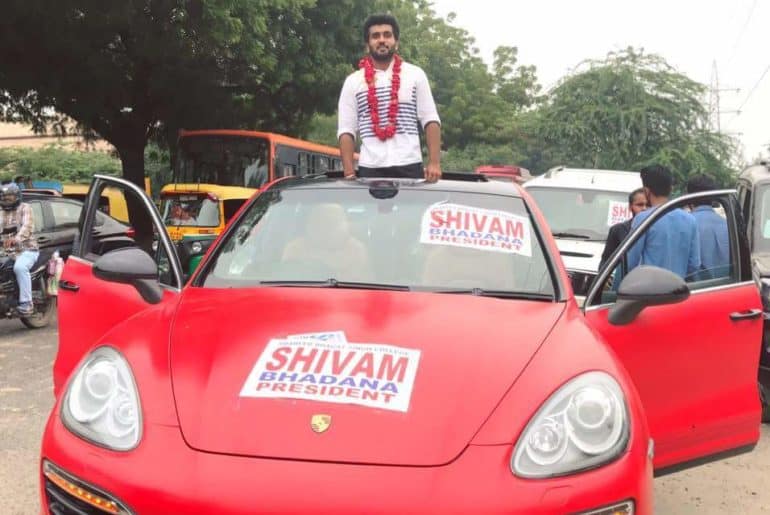
Regional sentiment plays a significant role in these elections. A student belonging to a particular region is more likely to support a candidate from the same place.  Not just that the idea of community and regional pride runs deep in the conscience of the majority. Recently a video was seen on social media which showed the celebrations post the victory of Shivam Bhadana as the President of Shaheed Bhagat Singh College Morning. The victory was seen as not just the candidate’s but also his community’s, it seemed. Statements like #GurjarPower and “Gurjar is king “could be seen in the comments section, which showed how relevant community lines are for a lot of voters. Student politics does not exist in isolation and the kind of regional sentiment that is central in all aspects of national politics, cannot miraculously be absent from universities. A source from KMC that chose to stay anonymous says “This regional idea is very internal, it’s not really broadcasted with people saying things like- we are from Haryana or we are from UP, but it’s there and it has a big role to play”.

4) Wealth 

A bevy of SUVs, music, crackers to celebrate victory and the occasional brightly coloured sports car is a frequent sight at off-campus colleges during election season. Candidates charm voters by their army of loyal supporters, their flashy automobiles and the slogans, drums, and claps that accompany them, each attesting to their popularity and influence. These shiny toys come with a shock value and they provide the student body all the more reasons to talk about the candidate. It is an effective way to generate interest and grab eyeballs. To add to that election costs include the cost of posters, hoardings, pamphlets and more. These banners and hoardings are ripped out and damaged by rival candidates and their supporters and need to be replaced regularly. These additional costs that come with contesting and winning elections acts as a barrier that filters out the majority of students. It is a primary reason why student unions’ are not as effective as they ideally should be. These candidates, with wealth and resources at their disposal, may not always be able to comprehend and relate to the struggles of the average student, which makes them ineffective as leaders. Students with an active interest in politics and a desire to contribute to change are dissuaded from pursuing it because more often than not, these factors passively work against them. A lot of debate has been going about around the idea that student politics has somehow lost its relevance. Student politics has not and will not lose its relevance but it has become ineffective and the marginal benefits gained from it are continuously decreasing. The first step to making it more effective would be realising how it has become an elite institution which heavily favours a small group of students, where everybody does not stand an equal chance. Once this insight is present in the student body at large, they will be less likely to fall prey to tried-and-tested election campaigning tricks and this would allow more dedicated students with political aspirations to pursue their goals.


Feature image credits: Facebook page of Shivam Bhadana

Kinjal Pandey

[email protected]


In  a world where there are 5 steps for everything, be it flying to the sun, we come up with three, even lesser than 5,  infallible ways to win our elections.

Being the proud denizens of the great republic of India, we have had the unequal privilege of enjoying the unpredictability of the vibrant Indian democracy for almost 70 years. Our pious elections are won by the virtue of a candidate’s flawless track record, unquestionable honesty and  knack for development and public welfare, a manifesto which caters aspirations of the people and numerous other paradigms of dharma; so were you told by the political science textbook of class 10th.

Now these are difficult boxes to tick and hence results generally used to be a surprise.

But not anymore. Here we come with 3 foolproof tricks which are 100% guaranteed to make a party rise above the rest and come up with flying (saffron, preferably) colours in a general election.


  1.   The Time Factor.

You must have heard the saying that early bird catches the worm. So here is the trick- Hijack the social media and you have hijacked the minds. If you are ruling currently, start projecting your achievements, scarce they may be. If you are on the other side of the table, fret not. Start with bashing the ruling party. Next run to a poet and come up with some jumlas or some cool acronyms. The most important part, start selling dreams and other lures. Hesitate to nothing, even sky is not the limit anymore. (Need a hint- How about making petrol completely free? ). Fake data, false stats, or illegit allegations, all is fair.


  1.   The Mr. X. factor

Not having a very good candidate, worry not. Find a superstar campaigner. Or else hire one. Works magic if you have the prime minister campaigning for you.


  1. Vote Management.

Now that you are done with campaigns and false claims, it’s time for the finishing move a.k.a polarisation. But you don’t have to do the dirty work, just make an air of it. Media will instantly go gaga. Your opponents will consequently voice minority, hence irate majority and lo! your mission is accomplished. To hell with social fabrics, only winning counts.


Picture credits- rediff.com


Nikhil Kumar

[email protected]