
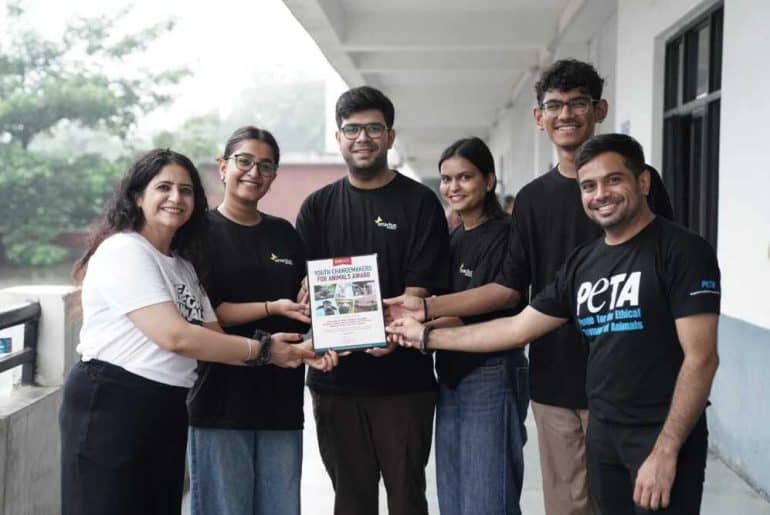
Five Ramjas College students have won PETA India’s Youth Changemakers for Animals Award for developing an eco-friendly vegan leather from discarded banana peels.
Five students of Ramjas College, University of Delhi — Kanishka Yadav, Naman Rajpal, Aryan Mittal, Daksha Lohani, and Vrinda Gupta — have been honoured with the Youth Changemakers for Animals Award by People for the Ethical Treatment of Animals (PETA) India for developing “Sehar,” an innovative eco-friendly vegan leather made from discarded banana peels. Developed for nearly a year, this durable and flexible material gives food waste a second life while offering a sustainable alternative to animal-derived leather.
The students are members of Enactus Ramjas, a student-led group committed to creating a more sustainable world and uplifting communities through entrepreneurial action. The group focuses on developing innovative solutions to social and environmental challenges while promoting sustainable practices.
Kanishka Yadav, President of Enactus Ramjas, explained the motivation behind the innovation, stating, “The poor conditions endured by cows and buffaloes during transport and in slaughterhouses deeply affected us and inspired us to look for a compassionate alternative to animal leather. At the same time, through our work in waste management, we saw the environmental challenges posed by discarded fruit peels.”
PETA India Director of Corporate Affairs, Ashima Kukreja, praised the students’ innovation, stating, “By creating an innovative material from food waste, these students have shown that young people know future businesses must incorporate animal and environmental protection.”
In PETA India’s statement on the need for such innovations, it raised concerns regarding both the treatment of animals in the leather industry and the environmental impact of leather production. The organisation states that animals transported for leather in India may be subjected to overcrowded conditions, resulting in severe injuries and, in some cases, death during transit before being taken to slaughterhouses. It also highlights the environmental concerns associated with leather tanning, which uses toxic chemicals and can generate waste that contaminates local waterways.
At the same time, the organisation points to the growing availability of vegan and animal-free leather alternatives made from materials such as pineapple leaves, cork, fruit waste, recycled plastics, mushrooms, mulberry leaves, teak leaves, coconut waste, and tomato composites. These alternatives can reduce reliance on animal-derived leather while also creating opportunities for agricultural and waste-based enterprises. It also cited Meghalaya’s consideration of pineapple-leather production as an example of how plant-based leather alternatives could benefit both sustainability and local farmers.
Read Also: Delhi Cabinet Approves Private University Bill, Proposes 25% Quota for Delhi Students
Image Source: PETA India Official Website
Bishakha Gogoi