
Tag

Op-ed

Browsing

Five stages shape a student’s journey through India’s competitive examination system. But when the system fails them, what remains of the future they spent years sacrificing everything to reach?


Denial

There exists an undeniable comfort in telling yourself that your life is not actually on hold. The same repetitive routine is not holding you back; it is preparing you for the ultimate test. You wake up right as the alarm starts to go off; you brush your teeth, staring into the abyss of your own eyes in the mirror; you eat your food, mentally preparing yourself for yet another ordinary day to come, which somehow finds a way to seize your heart. You convince yourself you are doing this by choice; you will get far ahead in life if you make this one last sacrifice. There is a future waiting for you.

Yet the reassurance bleeds you dry.

You’re not postponing living in the present; you are waiting for the right time. Most Indian students fall prey to this predatory education system where one competitive exam after the other forces your hand and breaks your will. No amount of coaching, classes, or revision prepares you for what is yet to come, but you still somehow believe that your sacrifice has a purpose. One day you’ll wake up, and all you need will be yours, as long as you stay put.

Your plans will wait for you, friends will wait for you, opportunities will wait for you, the world will wait for you as long as you clear the next attempt. Unfortunately, life doesn’t wait, and that future you keep wishing for is always just far enough to justify sacrificing the present.

This is the first sign: you believe the life you are postponing is still waiting for you exactly where you left it.

The classroom eventually empties, sacrifice often does not.

Anger

Then someday the system fails you. A dagger is plunged right into your gut, and as you lie bleeding, you realise.

A paper is leaked, an examination is cancelled, a result is delayed. You are yet again forced to wait just a little longer and accommodate someone else’s failure as if time must be an administrative inconvenience and not something that has already been taken from you.

Over the past decade, India has seen nearly 90 reported paper leaks across multiple states, affecting crores of students and job aspirants. From recruitment exams to board exams, NEET, and UGC-NET. The numbers are so high that they don’t even feel human.

People seem to forget that every single one of those numbers was a student who spent months or years preparing. A student who woke up early, paid for coaching, declined opportunities, rescheduled plans, all for one exam. They promised their families that this time would be different, and it was, in the most gut-wrenching way possible.

The founder of Shiksha Nation, Saurabh Kumar, said, “Students prepare for years. The system must prepare with equal seriousness.” That is not a demand. It is the least students should be able to expect from the system.

A paper leak is not just an administrative failure; it is a disruption of a student’s timeline. The anger does not simply lie in taking the paper again but in the time that feels wasted. They did everything right, and yet the future they had readily waited for was snatched away right in front of their eyes.

But anger does not always make you leave. Sometimes, it makes you hold on tighter.

Preparation leaves few visible traces beyond worn books and borrowed time.

Bargaining

As it slips through your fingers while you weakly try to grasp it, you know you don’t want to give up. No, you can’t give up, not after everything. You can’t leave, but you can compromise; you can negotiate. You can bargain with your own life.

One push harder, one more attempt, one more strategy, one more schedule. After this, you would never have to sit down to cram for hours again. The people in your life will stop being distractions; their company will become a celebration. Opportunities will envelop you as a family’s arms on result declaration; you will touch the horizon, and this time you won’t fall back down again.

The problem with “one more year” is that it seems redundant by the fourth time you say it. Preparation stops being a period of life and becomes the organising principle of life itself. There is a logic to it: after investing so much, stopping feels more frightening than continuing would. The years of effort you’ve poured into it would only be justified if you clear the next attempt.

The future keeps moving, and you keep following it; chasing the next, the next, and the next.

But eventually, the promise of the next attempt begins to lose its shine. You look around and realise that the years you were promised would come later have already passed.

Depression

This is perhaps where the waiting begins to reveal its cost. As it kicks in, you sink.

You notice how the people in your life moved on to bigger things; they graduate, find jobs, get married, all the while you were making decisions dependent on an examination calendar.

Your future leaves you behind.

It’s not that you aren’t working hard. What makes it so difficult is that you are relentlessly doing exactly what you should’ve been doing. Everything that is required of you, you deliver, and yet nothing in your life seems to have moved forward. Your everlasting dream of success fails you; that strange emotional experience of prolonged preparation breaks you not only physically but mentally. It eats away at your hope, at your faith till the time you cannot imagine breaking out of this cycle controlled by an exam.

You cannot imagine a free day without guilt; you feel wasted, abused. Every conversation revolves around your examination. Your life is not yours anymore. It has been taken from you, and now you’re devastated. Utterly helpless.

Days often begin and end at the same desk.

Acceptance

Suddenly it sets in: acceptance doesn’t have to mean accepting failure; it is something more.

Imagine telling every student that they have to give up their careers and that an exam does not matter when it so clearly does. To many students, it matters enormously.

Reality occurs much later for these students; degrees don’t guarantee employment, and employment may not guarantee security. For them, competitive examinations continue to represent one of the few reliable routes to stability. For a system to fail these students is a complete breakdown of trust. How can you tell students to move on after making them depend on these examinations in the first place? How does mismanagement on the system’s part become the fault of a helpless student? The acceptance must be of something else.

The future is not guaranteed simply because you have sacrificed your present for it.

That’s it. Hard work is not a contract with the universe; preparation does not ensure the examination is conducted fairly, and eventual success cannot return to you the years that have passed.

But what happens when you do continue? What happens when you do exactly what the system asks of you?

The Aftermath

Ayushman Singh did what the system asked of him. He continued. But that doesn’t mean nothing was taken from him.

He had bought a guitar in Class IX. By the time he began preparing for NEET, it had become, in his words, “just a piece of furniture” in his house. After the examination, he finally had the chance to sign up for guitar classes. Two days after learning that he would have to sit for the examination again, the guitar, which would finally be strung with life again, sank back into the darkness, camouflaged.

He had to postpone the life he had already started imagining.

Now, one would assume that his greatest loss after this experience would be time. Perhaps confidence. But, what he lost was the trust in his own nation. “Broken systems don’t just leak papers; they destroy trust,” he said.

And perhaps that is the problem with resilience. We see a student continue and assume that nothing was taken from them. We see them return to the classroom, the coaching centre, the examination hall, and assume that they have moved on.

They have not necessarily moved on. They may just have had nowhere else to go.


Image Credit: Ayushman Singh

Read Also: The Ghosts of Indian Small Towns: What Changes, What Stays


Ahana Dey

[email protected]


Why are we so quick to dismiss “performative” learning? An exploration of intellectual aesthetics, social media, and the democratization of knowledge. 

To be “disgustingly educated” online today is less about what you’ve understood than about what you’ve successfully signalled. What started as a compulsion to learn has, somewhere along the line, been quietly replaced by a compulsion to look like you’re learning. You have probably seen more copies of The Bell Jar and more quotes by Franz Kafka and Susan Sontag on Instagram than you ever will elsewhere. I’m not above falling victim to the algorithm’s insistent recommendations myself. At some point, the aesthetic overtook the actual appetite for the thing.

Yet it seems unkind, even a little myopic, to mock someone for trying to claw their way out of the hole we are all collectively stuck in – the same brainrot, the same forty-second attention span, the same three-hour scroll that ends nowhere. If the education system has failed us as thoroughly as it has, then what exactly is the harm in a trend that fills even a fraction of that gap? There are plenty of cases where performative gestures lead to real engagement. People begin by posting reading lists or reviews to keep up appearances, only to find themselves drawn into the conversations that follow and gradually craving a deeper understanding. Sometimes the performance is simply the nudge that turns display into curiosity.

There’s a moral purism that likes to insist learning should exist in pursuit of some untouched, capital-T Truth – that the moment money or aesthetics enter the room, the whole enterprise is corrupted. I find this a little precious, mostly because it isn’t how the actual production of knowledge works, and never has been. A university professor isn’t teaching solely out of love for Kant; they are also, notably, drawing a salary. The YouTube essayist breaking down existentialism in fifteen minutes wants your watch-time as much as your enlightenment. Passion and payment have always sat in the same room together – the difference now is that the room has better lighting and a ring light.

Underneath the eye-rolling is something less charming than taste. Access threatens hierarchy. That hierarchy limits, quietly and very deliberately, who gets to be legible as intelligent, and there is a particular kind of person who benefits from that limitation staying intact.

The internet flattened the gatekeeping without flattening the desire for distinction. If everyone can buy the same Penguin Classics edition or watch the same lecture online, distinction simply migrates elsewhere – to annotations, aesthetics, carefully curated reading lists, and performance. The gate never really disappeared; it just moved.

Pierre Bourdieu saw this coming from several decades away. In Distinction, his study of how cultural preference maps almost exactly onto class position, he wrote that “taste classifies, and it classifies the classifier.” Which is to say: what you read, and how visibly you’re seen reading it, has never really been about the book. It’s a badge. It tells everyone else where you stand. The discomfort around “performative” intellectualism, I’d argue, isn’t discomfort at the performance at all; it’s discomfort that the badge is now available to people who weren’t supposed to have access to the shop.

One explanation, I think, is that someone already accepted as an intellectual can casually mention Simone de Beauvoir and be taken at face value, while @lifeofpuja, sitting down on Instagram to talk through the same book, still strikes some people as surprising. People still struggle to reconcile the idea that intelligence – or the performance of it – might exist somewhere outside the postcode it was assigned.

Whether any of this actually democratizes knowledge, or just redraws who’s allowed to perform it, is a fair question, and I don’t think the honest answer is a clean one. More people are almost certainly reading Fanon because creators like @lifeofpuja exist than would have otherwise. But the culture increasingly rewards reading that is public, photogenic, and consistently visible, as though it only counts once it’s been documented. Access undoubtedly widened, but a new kind of audition got added on top of it.

Perhaps the only way to resist that pressure is to become comfortable with being unfinished in public. Share questions instead of conclusions. Admit confusion. Let conversations matter more than performances. The point isn’t to disappear from the internet, but to stop treating every interaction as an audition.

And yet. There is undoubtedly an elitism baked into all of this too, one that’s harder to defend, because nothing escapes commodification, least of all the appearance of being knowledgeable. There are Instagram businesses that will coffee stain, dog-ear, and annotate a book for a fee, engineering exactly the right amount of visible love. Etsy sellers do the same: margin notes, underlining, and a highlighter’s careful, deliberate mess are sold as a finished aesthetic object rather than the residue of someone’s actual thinking. It’s the second-hand bookshop, gutted and resold to you as content.

People rush to fulfil the visual component because it’s faster than the real thing. Actually engaging with a text is slow, the learning curve is humiliating, and it demands a persistence that doesn’t photograph well.

Performance isn’t always vanity. Sometimes it’s accountability. Sometimes it’s aspiration. Sometimes people perform the version of themselves they’re trying to become. The internet has always blurred the line between identity and ambition; reading publicly is often less about claiming expertise than rehearsing it.

If there’s any way out of this particular loop, it’s almost insultingly unglamorous. Buy the second-hand book that got dog-eared by accident, not by design. Mark it up badly, honestly, and for no one. For what it’s worth, the times I’ve learned the most have rarely looked impressive: getting lost in a book so dense I filled the margins with question marks, pages bent at the bottom of my bag, whole paragraphs underlined out of confusion rather than confidence. Keep reading past the point where it stops being cute and starts being boring and a little confusing, because that’s usually where the actual thinking begins. Let your annotations reflect your actual thoughts, even if they aren’t particularly eloquent, instead of leaving them there as decoration. None of this might fill your phone storage with aesthetic pictures, which is more or less the point. The goal isn’t to reject aesthetics. It’s to make sure they remain evidence of learning rather than a substitute for it. Resistance to a market built entirely on visibility tends to look like doing the thing when the camera isn’t out.

Something tells me 2015 StudyTube didn’t lead anywhere by accident. It goes from colour-coded notes to dark academia to thought daughter, each stage borrowing the last one’s costume while insisting it’s finally, this time, about the substance. With every iteration, intelligence became a little more aesthetic and a little less private. Maybe, for some people, the curriculum gets built and actually read. Maybe the annotations happen before the coffee stain does. I’m not entirely willing to write the whole trend off as vanity, if only because the alternative – a generation genuinely giving up on curiosity altogether – feels considerably worse to me than one mildly insufferable enough to caption their reading list.

For what it’s worth, I don’t think the line sits between the person who reads at home and the person who reads at a café with good lighting, which is kind of where most of the mockery assumes it does. It sits between chasing an aesthetic and public validation that replaces the reading and the aesthetic that simply survives it. A mood board is not a crime. A “personal curriculum” is actually a great thing. The trouble starts only when the styling becomes the entire transaction – like sitting with an AI chatbot to generate your opinions and summaries because working through the text feels like too much to ask.

Learning has always been social, and it has always been performative to some degree. The question isn’t whether we’re performing it; it’s whether there’s still something real beneath the performance.

Aamna Rehman 

[email protected] 

Image Source: Patrick Tomasso – Unsplash.com 

Read Also: The Ghosts of Indian Small Towns: What Changes, What Stays 

India’s 2026 Election verdict signals generational change, ideological fatigue, and the rise of new political alternatives.

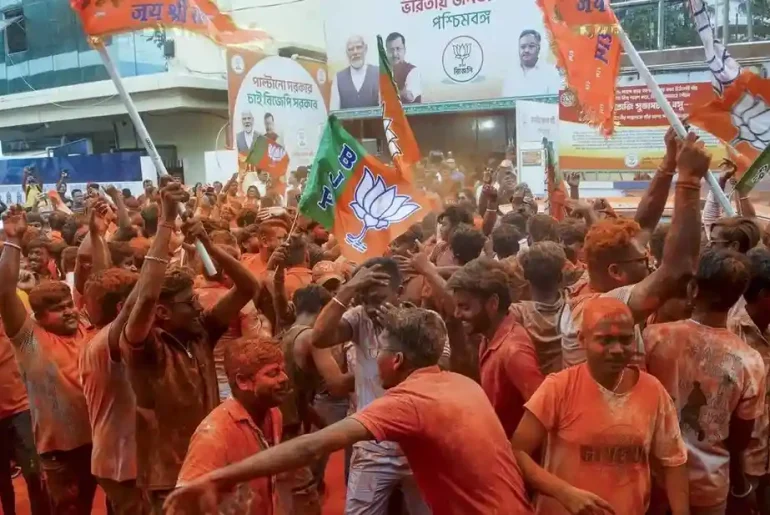
Tamil Nadu, West Bengal, Assam and Kerala in 2026 were no ordinary poll-bound states. These assembly elections jolted pollsters, unsettled analysts, and challenged some of the most entrenched assumptions of Indian politics. While several states broadly conformed to expectations, the outcomes in the West Bengal and Tamil Nadu election marked something closer to a tectonic shift. The meteoric rise of TVK in Tamil Nadu resembled a political “first-day, first-show” blockbuster, while what was projected as a close contest between TMC and BJP in West Bengal culminated instead in a decisively one-sided verdict. 

As Prannoy Roy once observed, elections in India are fought as much in the mind as on the ground. Any post-poll analysis, therefore, must grapple with multiple and often competing interpretations. Even so, certain patterns offer valuable insight into a rapidly evolving political landscape stretching from the North-East to the South. These, however, must be approached with caution: there is no singular “Indian voter,” and no single explanatory framework can fully capture the complexity of these outcomes. 

One of the clearest signals from this election is the quiet but decisive consolidation of the youth vote. In West Bengal, this was not visible in rallies or rhetoric, but in mood. As a voter from Asansol and student of Delhi University noted, “the shift from Durga Pujo to polling day was stark”—deserted TMC offices, guarded conversations, and a single refrain cutting across communities: “Poriborton toh chai chai.” 

The silence was strategic. Beneath it lay accumulated grievances—stalled government recruitment, corruption, concerns over women’s safety, and the political aftershocks of cases like RG Kar. When it finally spoke, the student vote did so not in fragments, but as a bloc.

Tamil Nadu reflected a very different, yet equally generational churn. The rise of TVK is less a conventional political story and more a cultural mobilisation. For a Gen-Z electorate raised on cinema and immediacy, TVK offered disruption without ideological baggage. It broke the fatigue of the DMK–AIADMK binary not through policy depth, but through identification and momentum. In the Kerala election, the shift was sharper in ideological terms—sections of young voters appear to have turned away from the Left, driven by a growing discomfort with centralised authority. As one student put it rather bluntly, “the authoritarian CM had to lose; his Left was not right.”

Alongside this generational shift is a quieter rejection of political inheritance. Across states, familiar surnames no longer guaranteed electoral comfort. The message is not the end of dynasties, but the erosion of their immunity. Voters are no longer willing to underwrite legacy without performance. The disruption in Tamil Nadu’s entrenched bipolarity only reinforces this trend—new entrants are no longer fringe experiments; they are viable vessels of aspiration.

For the Congress, the picture is deceptively flat. On paper, there is little immediate gain—Kerala’s victory comes in a space where the BJP is not a primary contender. But politics rarely moves in straight lines. The party’s position today resembles the early, incremental phases once seen in states like West Bengal—small footholds preceding larger relevance. With limited downside, Congress has room to manoeuvre: deepen its Kerala base, negotiate more assertively within a potential TVK alignment in Tamil Nadu, and cautiously expand in Bengal where the search for alternatives is clearly underway. The opportunity is narrow, but real.

What ties these strands together is not a uniform swing, but a pattern of voter impatience—with stagnation, with entitlement, and with unpredictability. Indian elections, as Yogendra Yadav reminds us, have a way of defying both political calculation and analytical certainty: “Indian voters are wiser than the politicians who seek to manipulate them—and often wiser than the analysts who try to predict them.”


Read Also: The oppressed as oppressor: notes on caste

Image Credits: Frontline


Madhav Choudhary 

[email protected]