Tag

NSUI

Browsing

In a press release dated January 3, 2018, several students’ organisations have mutually agreed upon a student resolution that was passed in Youthquake. The resolution deals with recommendations of electoral reforms, Students’ Right Act, the age of contesting elections, and unemployment allowance.

In a resolution passed by the students’ organisations in Youthquake on January 3, 2018, the rationalisation of the student elections and the formation of an independent Election Commission were seen as legitimate demands in the light of the arbitrary decision-making procedures of college administrations. The implementation of Lyngdoh Committee guidelines by the Ministry of Human Resource Development on an order of the Supreme Court adds weight to the demand for a separate legislation to deal with student elections in the country.

The students’ organisations have raised the demand for a separate institution under the Election Commission for conducting student elections and a complaint redressing mechanism. Such an independent Election Commission should be headed by a retired Chief Election Commissioner and should consist of retired members from the judiciary and administration, who possess impeccable records. Calls were made for compulsory and direct elections, revision of election expenditure especially the social media expenditure limit to be set in, the online voting system to restrict violence on students during elections, and reservation of seats for women candidates.

The Charter for Students’ Rights Act, comprising of the Fundamental Rights of Students and Directive Principles for universities and colleges was also laid down, which should be complied with by the university administration at all times. Additionally, a demand for a three-tier enforcement mechanism was also made, and the students’ organisations wanted the age of contesting elections to be brought down to 18 years.

“The Narendra Modi Government promised 2 crore jobs at the time of elections and made promises for unemployment allowances as well. But today, what we can see is that the credibility of universities is decreasing and democratic spaces for dissent are also being curbed by the institutions. Thereby, we have raised demands for the creation of an organisation/body along the lines of the National Commission for Women (NCW) or National Commission for Backward Classes (NCBC) to address the specific concerns of students- National Students’ Commission,” said Neeraj Mishra, National Media In-Charge of National Students’ Union of India (NSUI).

Several Students’ Organisations like the AISF, SFI, Samajwadi Chhatra Sabha, Naga Students’ Union, PUSU, Jharkhand Chhatra Sangh, Joint Action Commission-BHU, Swaraj Abhiyan, Panjab Students’ Union, Telangana Students’ Union etc. have mutually agreed upon the resolution. The Action Commission of the resolution consisted of J&K Students’ Union, YSR Students’ Union, All India Students’ Association (AISA), DUSU (Delhi University Students’ Union), AMU, SOPU, DURU etc.


Feature Image Credits: New Indian Express

Oorja Tapan
oorjat@dubeat.com


The elected president of DUSU has been barred for now from entering the office. On Thursday, he was told that the university will have to take legal opinion before he can take charge as DUSU president after a criminal case against him came to light. The case dates back to a complaint made on August 6, 2014, by a final-year student of Shivaji College, Bhagat Singh, who alleged that he was beaten with a “wooden stick” by Tuseed and his three associates. The varsity, however, asked the other three office-bearers to collect the keys for their respective offices.

Tuseed, along with his supporters protested at proctor’s office and attempted convincing that the court order does not mention that he should be withheld from taking over as the president.
The proctor’s office maintained they will not act till there are consultations with the university’s legal team. The arguments on framing of charges in the 2014 case against Tuseed will take place on October 16.
The 2014 complaint, filed at the Rajouri Garden police station, alleged that Singh had been “present in his college during the presidential election and some students were conducting a meeting”. According to the complaint, when Singh was leaving his college “he was stopped at the red light outside Shivaji College” by one of Tuseed’s associates.
It added that “minutes after stopping him”, three other men, including Tuseed, “reached the spot and hit him with a wooden stick”. Singh alleged that he had “received multiple injuries on his body and head”. “Police was informed and the man was taken to DDU hospital, where he was discharged after first-aid.
Police also arrived and recorded Singh’s statement. On the basis of Singh’s complaint, a case was registered under sections 308 (attempt to commit culpable homicide), 323 (causing hurt), 341 (wrongful restraint) and 34 of the IPC,” a senior police officer said. Tuseed was arrested and sent to a 14-day judicial custody in Tihar before he got out on a bail.
Speaking to Indian Express Delhi Police officials said after that day, the complainant has been absent and no further contact has been made with him.
Meanwhile, the Vice-president Kunal Sherawat had assumed the office while the secretary, Mahamedhaa Nagar, and joint secretary, Uma Shankar, were yet to collect office keys from the proctor’s office.


Image Credits: DU Beat Archives


Sandeep Samal

sandeeps@dubeat.com

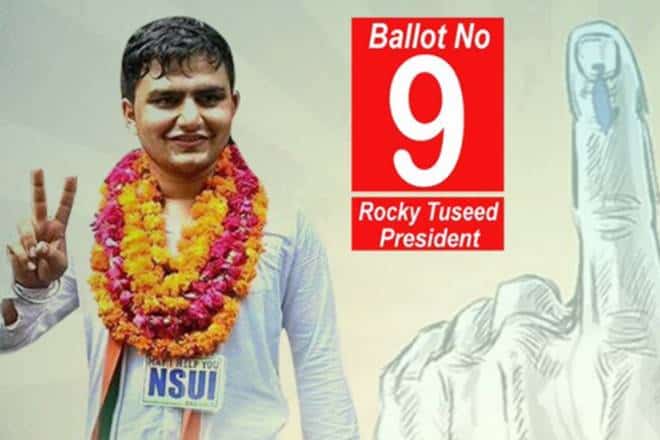
Be it hiccups like the election officials cancelling his nominations, or reliefs like the High Court allowing him to contest the elections, or moments of ecstasy at finally winning the elections, Rocky Tuseed of the National Students’ Union of India (NSUI), the newly elected President of the Delhi University Students’ Union (DUSU) who is currently pursuing a Master’s degree in Buddhist Studies, has seen it all in just a week’s time. In an exclusive interview with DU Beat, he discusses his ideas for the betterment of the University.


Q: You have been considerably active in politics this past year. From where did you start your venture into the field?

Ans: I joined Shivaji College in 2013; in my first year, I encountered several small problems like the non-functionality of the water-cooler, unavailability of Girls Common Room, etc. On being persuaded by my classmates, I contested and won the election for Executive Committee of DUSU, and that’s how it all started.


Q: Now that you are the DUSU President, what are the key areas you would like to personally focus on?

Ans: There are several areas that I am going to work on for the betterment of the students. Alongside working on every issue that has been mentioned in our manifesto, I will try to ensure that University students are entitled to metro passes because many students travel daily from far-off places.


Q: Providing affordable accommodation to students was one of the main agendas of NSUI this time. Given the fact that DUSU doesn’t have any power to construct hostels, how do you plan to see this promise fulfilled?

Ans: Although DUSU doesn’t have the authority and budget to construct hostels for students, we can certainly pressurise the University of Delhi (DU) administration to construct more hostels. The University returned nearly Rs 150 crore meant for infrastructure development to the Ministry of Human Resource Development (MHRD) despite the fact that it has more than 95 acres of vacant land where it could have constructed new hostels. We will also take up the issue of implementation of the Room Rent Control Act with the Delhi government.


Q: Your campaign focused on ensuring transparency in the DUSU budget. How do you plan to turn these words into action?

Ans: We are planning to ensure maximum transparency in our budget allocation. We will try to upload all our bills that are sanctioned by the Union on the DU website if allowed. Or else, every bill will be uploaded on the NSUI website.


Q: How do you plan to ensure a violence-free campus wherein our academic spaces remain free from intimidation and political interference?

Ans: We will try to restrict outsiders entry into the University. No type of violence in the shadow of fake nationalism will be allowed under our leadership of the Union.


Q: With several hiccups, your campaign must have been hectic. What is that one moment that you recall as being particularly unique in the course of your entire campaign?

Ans: There was this moment of disappointment after my nomination was cancelled by the University authorities. But, as the High Court reinstated my candidature and allowed me to contest the polls, the whole team just cheered and we all shouted in joy. I will cherish that moment of small victory forever.


Q: In one line, what would be your motto as the DUSU President for the year 2017-18?

Ans: Ho gayi peer parvat si bighalni chahiye, is baar DU se nayi dhara nikalni chahiye. Ye buniad ab parde ki tarah hilne lage, maksad hamari hai ki ye buniyaad badalni chahiye.

(The University has encouraged new voices and ideas. These very foundations are shaking now due to a new wave of change.)


Srivedant Kar

srivedantk@dubeat.com

Newly elected Delhi University Students Union (DUSU) President, Rocky Tuseed now faces a setback to his victory run. On Wednesday, the Delhi High Court issued a notice to him after an intervening application held him guilty of concealing personal facts, including his arrest on criminal charges. The application was filed by Suman Chauhan and Jivesh Tiwari, counsel for Rajat Choudhary, the Presidental candidate of the Akhil Bharatiya Vidhya Parishad (ABVP). This September, Tuseed broke a five-year spell when he was elected as the first President of the DUSU from the National Students Union of India (NSUI) since 2012. The controversial candidate won the election with 16,299 votes, beating Choudhary who gained 14,709 votes.

The Allegation

The ABVP has played the Lyngdoh trump card; a recurring move in University elections across the country. The Lyngdoh committee guidelines which were implemented in May 2006 are to be followed in the Students’ Union elections in order to establish accountability, transparency, and discipline. The complainants have claimed that Tuseed hasn’t abided by these guidelines in his run for President.

Firstly, the application claims that Tuseed did not disclose that an FIR had been registered against him in Rajouri Garden on August 6, 2014, under Indian Penal Code (IPC) sections 308 (attempt to commit culpable homicide), 323 (punishment for voluntarily causing hurt) and 341 (punishment for wrongful restraint). It also mentions that he was sent to judicial custody on August 28, 2014, to September 15, 2014.In this respect, the Lyngdoh Committee guidelines state: The candidate shall not have a previous criminal record, that is to say, he should not have been tried and/or convicted of any criminal offence or misdemeanour. The candidate shall also not have been subject to any disciplinary action by the University authorities.

Secondly, the application alleges that Tuseed had been given ‘essential repeat’ in two semesters while pursuing a Masters in Buddhist Studies in the academic session 2016- 2017. The Lyngdoh committee states that “the candidate should in no event have any academic arrears in the year of contesting election”.

The NSUI stance

The NSUI has defended Tuseed by refuting charges in a press release earlier today. It accuses Choudhary of approaching the Delhi High Court on the basis of a false FIR which was registered by the Bharatiya Janta Party (BJP) government in August 2014 against a group of students, during the 2014 DUSU elections. According to the NSUI, the complainant had withdrawn the case against Tuseed within a month. They’ve also pointed out the fact that the newly elected ABVP DUSU Secretary, Mahameda Nagar is also being investigated in a criminal case filed by the Dean of Faculty of Law.

A bumpy presidential run

This is the third time that Tuseed has been accused of disciplinary charges. When the Delhi University’s Chief Election Officer’s (CEO) office released their list of candidates on 5 September, the NSUI candidate, Tuseed’s name had not been mentioned on “disciplinary grounds”. The NSUI had then sought to campaign for an independent candidate, Alka, until the High Court acquitted him of charges on 9 September, two days before the DUSU elections. This arbitrariness had also dogged his presidential run in the Department of Buddhist Studies last year. The election commission had cleared him to contest the election which he subsequently went on to win.

In the running for this year’s DUSU election, ABVP candidate, Choudhary had also been caught up in controversy. Independent candidate Raja Choudhary had been given police protection following his complaint to the police and the chief election commissioner, in which he alleged that he had been beaten up and threatened by the ABVP candidate. According to Raja, the ABVP candidate had feared that the students would get confused between the two names- Raja Choudhary and Rajat Choudhary, and would mistakenly vote for the other candidate rather than the candidate of their choice.

What now?

Justice Indermeet Kaur has sought a reply from Tuseed on November 15. The High Court has termed the alleged concealment on his part as “very serious”.

Keeping in mind the fact that the Lyngdoh Committee guidelines are more often flouted than not, students wonder whether any strong action will be taken against Tuseed. The same guidelines also mandate that candidates should not be affiliated with any national political party and that the campaigning expenditure per candidate should amount to ?5000. Yet, DUSU elections have been more about contesting parties than individual candidates. The expenditure requirement has also become a joke, so much so that when Tuseed cheekily announced in a discussion on national television that his total expenditure amounted to ?4800, every speaker laughed it off.

With inputs from The Indian Express

Image Credits: Financial Express

Swareena Gurung
swareenag@dubeat.com

The University of Delhi has rejected Congress-backed National Students’ Union of India (NSUI) plea for recounting of votes in the recently concluded Delhi University Students’ Union (DUSU) elections. Even though a recount of votes will not take place, the grievance redressal committee has permitted Meenakshi Meena and Avinash Yadav, NSUI candidates for Secretary and Joint Secretary respectively to view EVM-wise data.


NSUI claimed it won three not two posts in the DUSU panel post elections and alleged that the results were tampered due to intervention by Prime Minister Narendra Modi and BJP President Amit Shah. NSUI’s National Media In-Charge told Scroll.in., “The CCTVs were not working properly, and many officials from the ABVP and the Rashtriya Swayamsevak Sangh were present in the counting centre.” NSUI asked the Election Commissioner to recount the votes and also submitted an official complaint to the grievance redressal committee. It had also threatened to move to the Delhi High Court soon.


Avinash Yadav, NSUI’s candidate for Joint Secretary of DUSU lost to RSS affiliated Akhil Bharatiya Vidyarthi Paridhad’s (ABVP) candidate by 342 votes. NSUI’s candidates for the positions of President and Vice-President, Rocky Tuseed and Kunal Sehrawat bagged the seats by 1590 and 175 votes respectively.


Image Credits: Hindustan Times


Vijeata Balani

vijeatab@dubeat.com

After weeks of campaigning, the Delhi University Students’ Union Elections 2017 were held on Tuesday, 12th September in colleges across the University of Delhi. At the end of the day, the voter turnout was said to be 42.8%, which was a huge improvement from last year’s turnout of 34.3%. The results for the same were announced on the afternoon of 13th September.

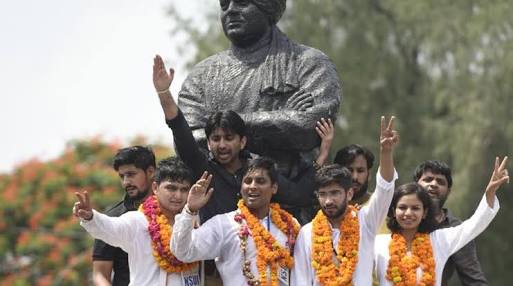
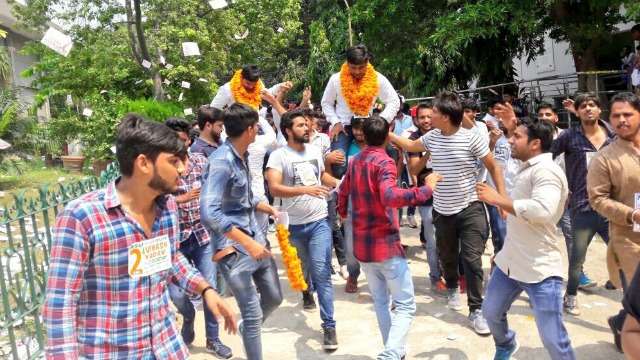
Rocky Tusheed and Kunal Sehrawat from the National Students’ Union of India (NSUI), affiliated to the Indian National Congress, won the posts of President and Vice President respectively. This was an enormous leap for NSUI, as they emerged victorious over Rajat Choudhary and Paarth Rana from Akhil Bharatiya Vidyarthi Parishad (ABVP), affiliated to the Rashtriya Sawayamsevak Sangh (RSS). ABVP has maintained monopoly over these 2 posts for the past 4 years in DUSU. The post of Secretary and Joint Secretary has been won by Mahamedha Nagar and Uma Shankar from ABVP.

However, in a recent turn of events, the counting of votes for the post of Joint Secretary is being taken to the Delhi High Court by NSUI. Neeraj Mishra, the National Communications In charge of NSUI, said, “The average NOTA vote count for the post of Joint Secretary had been declared as 5000, however ABVP claims the NOTA vote count to be 9000. Due to the discrepancies in these numbers, the matter of the final vote count will be moved to the High Court by NSUI”. The final tally of votes were, President: NSUI (16299), ABVP (14709). Vice-president: NSUI (16431), ABVP (16256). Secretary: ABVP (17156), NSUI (14532). The post of Joint Secretary has been won by Uma Shankar from ABVP as of now, however the final decision will be declared by the Delhi High Court.


Feature Image Credits: DNA India

Joyee Bhattacharya

(joyeeb@dubeat.com)

The Ministry of Human Resource Development had recently issued a direction to nearly 40,000 higher education institutions to tune into Prime Minister Narendra Modi’s speech, to be delivered on 11 September, in commemoration of the 125th anniversary of Swami Vivekananda’s famous address at the World Parliament of Religions in Chicago.

The National Students’ Union of India (NSUI), which is the student wing of the Indian National Congress, has specifically condemned these actions taken by the University Grants Commission (UGC) to promote and telecast the speech in every Delhi University college just a day before the DUSU elections are scheduled.

In a press release today, the NSUI Media In-Charge, Neeraj Mishra, said, “Forcing this in Delhi University will be a flagrant violation of the moral code on conduct since the elections for the DUSU are scheduled on September 12, day after PM’s address. ABVP, one of the organisations contesting the DUSU elections is closely linked to the ruling party, the BJP.” (sic). Midrash Mathew, Media Department, NSUI, said, “It is well known that the UGC and the government are linked since the UGC works under the government directives. By telecasting the speech of our Prime Minister in all colleges of DU, it will only help further ABVP’s agenda since the speech is on Swami Vivekananda and it will actively reflect and propagate the ideologies followed by ABVP. This will be a clear violation of the moral code of conduct set by the Lyngdoh Committee, and ABVP will greatly benefit from it. Hence, the speech should not be streamed in Delhi University as it is unfair.”

NSUI issued another press release today in which they requested the Chief Election Officer (CEO) of DUSU to extend the campaigning time and election day by four days, while restricting other candidates to campaign during this time. The presidential candidate of NSUI, Rocky Tuseed, received his ballot number yesterday evening after the High Court directed the CEO. The Officer had prohibited Tuseed from campaigning for two days while the other candidates were actively campaigning. Neeraj Mishra pointed out that since the University is closed over the weekend, and the campaigning officially has to stop at 8:30 a.m. on Monday morning, Tuseed will get no time to campaign.

The CEO rejected the request put forth by the NSUI by stating that the office was constrained by the Lyngdoh Committee guidelines which directed the University to conduct the elections within 56 days. On this matter, Midrash Mathew said, “A bigger mandate of the Lyngdoh Committee is to conduct free and fair elections. If the elections are not postponed, our presidential candidate will get no time to go to students and make them aware about his views and campaign. Because of the accusations put on us, we were left in the dark when the ballot number was taken away. However, the High Court’s decision came in our favour. Hence the CEO should take our request into account.”

the-hindu-rocky-tuseed
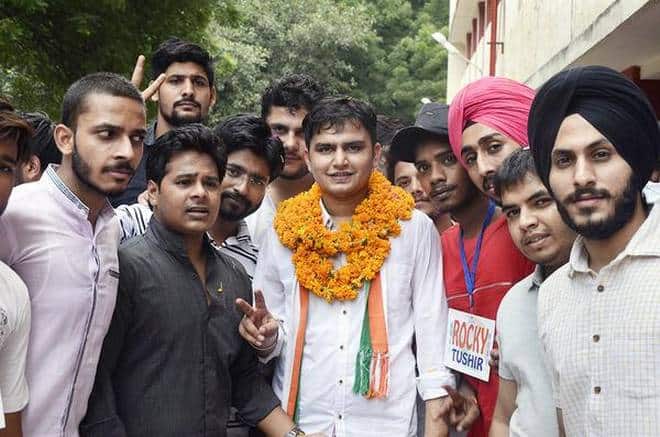
Rocky Tuseed after being cleared to contest for DUSU elections. Image Credits: The Hindu


DU Beat reached out to multiple official representatives of the Akhil Bharatiya Vidyarthi Parishad (ABVP), but none were available for comment.


Feature Image Credits: The Indian Express

Bhavya Banerjee
bhavyaba@dubeat.com

The National Students Union of India(NSUI), the student wing of the Indian National Congress(INC) got a rude shock when it discovered that its presidential candidate for DUSU Elections, Rocky Tuseed was missing from the final list of candidates released by the Cheif Election Office(CEO) office. Rocky Tuseed’s name was missing from the list released by CEO’s office which comprised of six other presidential candidates including Rajat Choudhary of ABVP and Parul Chauhan of AISA.
The cancellation of nomination was on the grounds of “disciplinary actions” based on an incident that happened during Tuseed’s time at Shivaji College.
NSUI called for a press conference this afternoon at Arts faculty to express resentment about the scenario. Ruchi Gupta, National In-charge of NSUI alleges that no certain definition of ‘disciplinary action’ has been defined by the Election Commission of DU. She further adds “ Without a clear definition, there is bound to be arbitrary applications of a standard which are bad in law.” Tuseed has contested and won as president in departmental elections (also under DUSU) last year. Ruchi Gupta told DU beat that “DU election commission can’t apply differential standards in two separate academic years.”
Mr Tuseed showed a copy of his character certificate issued to him by his college to DU beat. The principal of Shivaji college, however, denied that they had issued a good conduct certificate to him, while also refusing to comment on the actual details of the incident.
Mr Tuseed alleges ABVP for pressurizing the authorities for cancellation of his candidature. He informed that a case has been filed in this regard and he will be going on a hunger strike until justice is delivered.
Meanwhile, the party has convinced an independent candidate, Alka of Shaheed Bhagat Singh College (evening), to contest on their behalf.
DUSU Polls are scheduled for September 12.

Image credits: Sandeep Samal for DU Beat

Sandeep Samal

sandeeps@dubeat.com

Are there certain patterns that DUSU elections follow? How much of a role does ones caste, gender and socio-economic background play? With election season round the corner, we try to answer these questions.

Winning the students’ union elections in the University of Delhi is an immense feat. Major national political student parties like Akhil Bharatiya Vidyarthi Parishad (ABVP), National Students Union of India (NSUI), and All India Students Association (AISA) amongst others are the key players in the Delhi University Student’s Union (DUSU) elections.  Along with muscle-power and extensive campaigning, a lot of strategy goes into the DUSU elections. Are people from a community, gender, or political party more likely to win this election? We try to answer these questions through an analysis of past election data.

1) The rise of ABVP -The last time NSUI won all four DUSU posts was in 2007, some ten years ago. In the last ten years, ABVP has won the DUSU elections seven times (the criterion being winning three or more seats). Out of these seven times, in 2009 the ABVP won one seat. Howsoever the President (independent) and Joint Secretary (Samajwadi Chattra Sabha) publicly credited ABVP for their victory. Only twice was NSUI able to win majority seats in the panel. In 2012, both ABVP and NSUI won two seats each. In the last ten years, Delhi University has seen six ABVP, one independent (credits ABVP) and three NSUI Presidents. This shift in voting patterns is unconventional since DUSU had a NSUI stronghold for a long time.  From 1996 to 2008, NSUI maintained its position as the key player in DUSU politics, winning the majority of seats.

Source: @nupursharmabjp on  Twitter
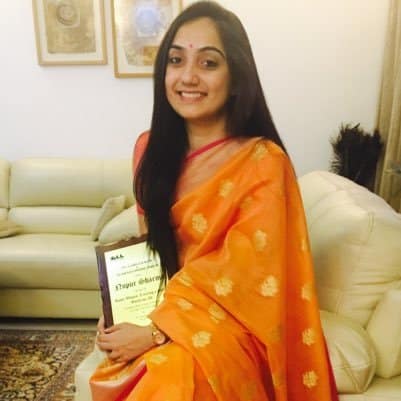
Nupur Sharma was the DUSU President in 2008. She won the Presidential seat for ABVP ending a long NSUI stronghold, surprising many. There has been no female DUSU President after her. Source: @nupursharmabjp on Twitter

2) Fall in the participation of women – Between 2011 and 2017, out of the twenty-four candidates that became a part of the DUSU panel, only five were women. The role of women in the last six years has been limited to the positions of General Secretary and Joint Secretary, with ABVP’s Priyanka Chhawri (Vice President) being the only exception. It would be strange perhaps to find out that women were not always relegated to the role of a token in DUSU politics. In fact between 2001 and 2010 women won twelve seats in DUSU overall with five of them being President and two being Vice President. Where there should have been an improvement in the position of women, there has been a decline. This fall in the number of female candidates winning and the lack of female DUSU Presidents is strange. In fact, while the awareness about gender-equality and feminism is greater than ever. While DUSU President of 2008, Nupur Sharma, believes this is because posters with faces were no more allowed; Ragini Nayak, DUSU President of 2005, believed it is so because the number of days of campaigning has been shortened to four or five days, and this kind of aggressive campaigning is easier for men to accomplish. (Source: Hindustan Times)

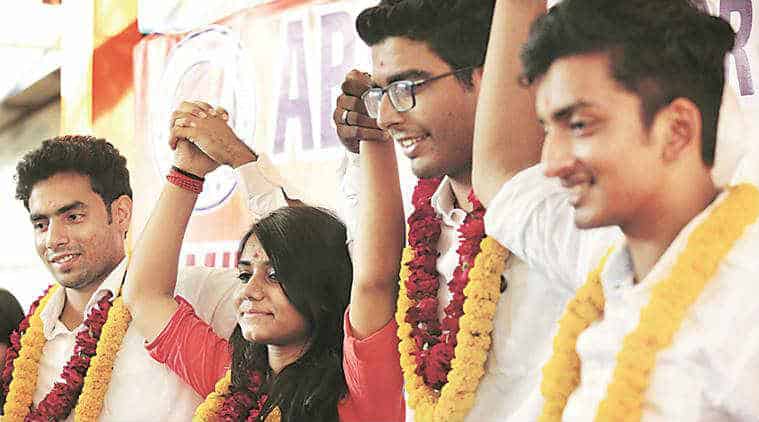
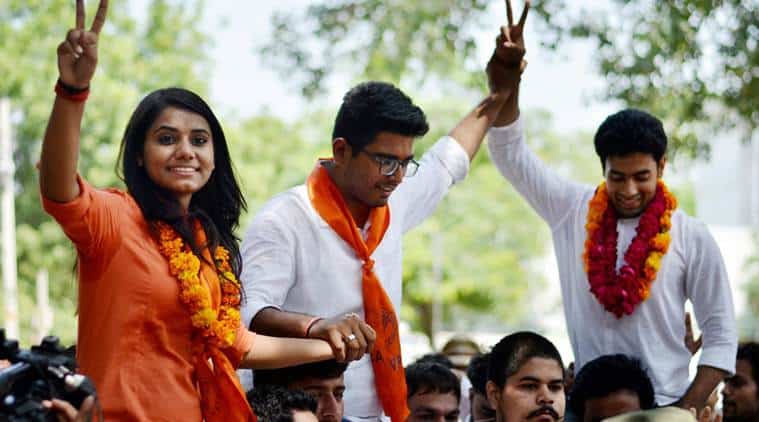
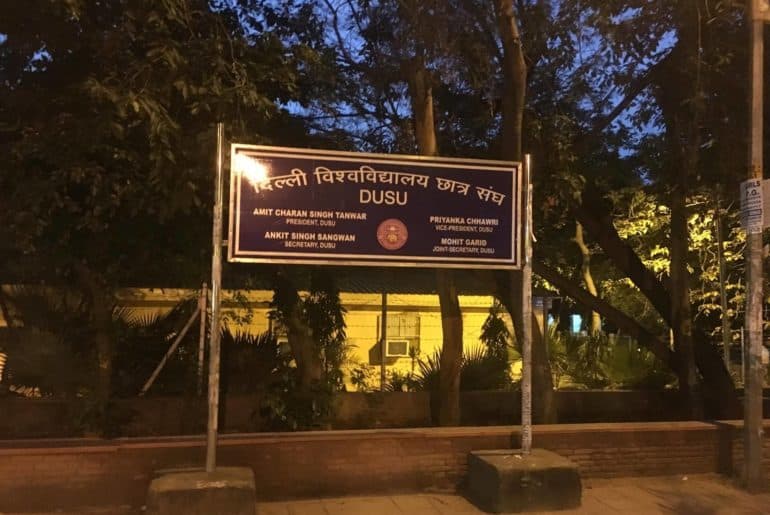
L-R:  Priyanka Chhawri, Ankit Singh and Amit Tanvar after winning the 2016 DUSU elections. All four post holders in the 2016-17 DUSU union are from either the Jat or Gurjar community.
L-R: Priyanka Chhawri, Ankit Singh and Amit Tanvar after winning the 2016 DUSU elections. All four post holders in the 2016-17 DUSU union are from either the Jat or Gurjar community. Source: The Indian Express

3) The dominance of the Jat and Gurjar community – From 2011 to 2017, every DUSU President has been from either the Jat or the Gurjar community. The last four DUSU Presidents belonged to the Gujjar community while the two before them from the Gurjar community. In fact not just Presidents, but often the entire panel hails from these two communities. For instance, in 2016-17 all four post holders hailed from the Jat or Gurjar community. This dominance of certain communities in DUSU is recent but it clearly shows how major student parties are not shy of fielding candidates hailing from influential communities who have immense social capital at their disposal, in order to win.  

4) Emerging alternatives to ABVP and NSUI – Parties like AISA and the Students’ Federation of India (SFI) have continuously been gaining relevance in DUSU politics. In the 2016 elections, on almost all posts, AISA candidates managed to secure the third highest vote share, thus securing its position as the third party in the DUSU political scene. It managed to secure a total of 30,000 seats. It also managed to secure an increase in its vote share for each post.


Feature Image Credits: The Indian Express

Kinjal Pandey

kinjalp@dubeat.com


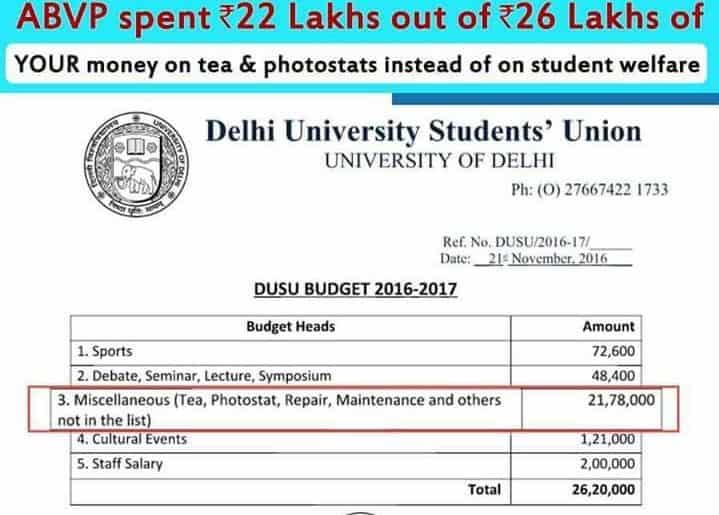
Right before elections, a photo uploaded by the National Students’ Union of India (NSUI) had started making rounds on the internet. The picture alleged the Akhil Bharatiya Vidyarthi Parishad (ABVP) of spending Rs. 22 lakhs out of the assigned 26 lakhs for the Delhi University Students’ Union (DUSU) budget on tea.

Soon, there was an outrage in the student community regarding the blatant misappropriation of expenses. NSUI officials claimed that Mr. Mohit Garid, the Joint Secretary of DUSU, provided the information as he has got access to all DUSU official records.

20914196_110099089717513_600105314418395050_n

But when DU Beat reached out to ABVP, the other side of the story was unfolded. Mr. Amit Tanwar, president of DUSU, explained that the document making rounds is the budget of DUSU and not the expenditure. He further told DU Beat that many other events were conducted which didn’t fall in any of the other categories, hence, were included in miscellaneous sections.

Mr. Saket Bahugana, the national media convenor of ABVP, shared with us the original complete document, which clearly reflects the signature of Mr. Mohit Garid on the document.

img-20170822-wa0013
Image Credits: DUSU office


Mr. Bahugana adds, “Why didn’t the Joint Secretary object to the budget while it was being proposed?” He also alleged that Mr. Garid had taken more than Rs. 5 lakhs from the DUSU fund but failed to utilise the money towards an event with the money.


Feature Image Credits: NSUI Twitter Handle 


Sandeep Samal

sandeeps@dubeat.com