Tag

nep 2020

Browsing

The Democratic Teachers’ Front comes forward with criticism and highlights hasty decision-making with regard to the implementation of Integrated Teacher Education Programme by the DU Academic Council.

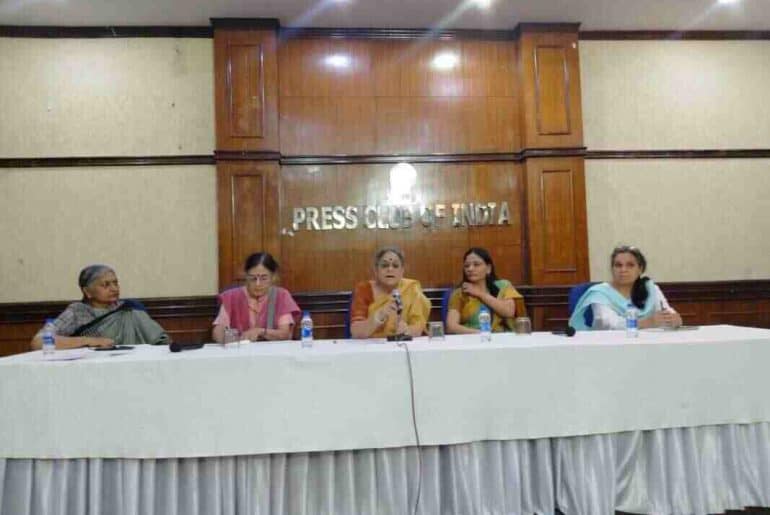
A press conference was organised on 24th May 2023 at the Press Club by the Democratic Teachers’ Front to highlight concerns and discuss the impact of Integrated Teacher Education Programme (ITEP) by the varsity. This conference comes ahead of the Delhi University Academic Council’s meeting to be held on Friday, 26th May 2023 regarding the implementation of ITEP.

ITEP is a flagship four-year “dual-major holistic undergraduate degree” of the National Council for Teacher Education (NCTE) under NEP 2020. ITEP will be replacing DU’s Bachelor of Elementary Education (B.El.Ed) programme which was introduced in 1994. Currently, only eight colleges offer this programme which is unique to the varsity – Shyama Prasad Mukherji College for Women, Jesus and Mary College, Mata Sundari College, Aditi Mahavidyalaya, Gargi College, Miranda House, Institute of Home Economics, and Lady Shri Ram College for Women. Out of these, the former three institutions have been granted permission by NCTE to offer ITEP in the upcoming 2023-24 academic year. Admissions to the same will be done through an entrance exam conducted by NTA instead of the Common University Entrance Test (CUET).

The design of the ITEP is based on the design of teacher preparation stated in the NEP 2020. It combines rigorous educational understanding, disciplinary depth and a strong focus on school practice while taking into account existing ground realities.

Reads the Agenda for the Academic Council’s meeting.

This proposal has met scathing criticism from educators who question the legitimacy, lack of syllabus and hasty decision making behind the programme. Key addressors at the press conference included Prof. Poonam Batra (former Faculty member, CIE, DU), Prof Anita Rampal (former Dean Faculty of Education, CIE, DU) and faculties from the eight colleges currently offering B.El.Ed.

The ITEP differs from the existing programme in two key areas – minimum Faculty qualification and programme structure. Teacher groups have alleged that the B.El.Ed is ‘internationally-recognised’ and ‘has successfully trained close to 10,000 teachers’. The ITEP curriculum on the other hand will follow three years of general education followed by one year of rigorous professional training. Educators have also come forward with criticism about the declining qualification standards for teaching the new programme.

This dilution of faculty qualification and a standardised homogenised curriculum indicates a deep dilution of the standards required to prepare school teachers. A common curriculum to educate teachers across diverse cultures, communities and languages of India will not prepare them to teach in diverse classrooms and hence will make them ineffective.

– Dr. S.Ram, a teacher at Jesus and Mary College, University of Delhi.

Questions have also been raised on the impact of this programme on the ongoing ad-hoc crisis and other temporary faculty in the varsity. With strict NCTE norms about the curriculum and exit options, the University’s autonomy about such decisions also comes under fire.

Closing down a well reputed programme such as the BElEd is not only illegal, it is also, academically and professionally irrational. The University should come clear on why it is coercing colleges to replace the BElEd with ITEP?

– reads the Official Press Release of DTF dated 24th May 2023.

Several independent educators and other teacher groups, both within Delhi University and outside have come forward with their disapproval of the programme.

By comparison with the B.El.Ed. program at Delhi University, ITEP thus represents a significant dumbing down. It reflects a conception of the teacher as a mere conduit for delivering pre-approved subject content, rather than as a socially responsible and autonomous professional capable of interpreting and adapting the curriculum and inspiring her pupils.

– a letter addressed to DU Vice Chancellor, Prof. Yogesh Singh by Edward Vickers, UNESCO chair professor on Education for Peace, Social Justice and Global Citizenship, Kyushu University, Japan dated 25th May 2023.


Read Also –https://dubeat.com/2023/05/15/du-scraps-existing-be-el-ed-programme/

Featured Image Credits – DTF

 Bhavya Nayak

[email protected]

NEP 2020 is envisioned towards creating an inclusive education to all by bridging the abiding spaces in the society. Yet, it seems to just be a façade of progression. The policy is ought to introduce the much needed practicality into the mainstream education but what is the correct way to go about it? Is it going to be an actual consideration of voices of all the stakeholders or will it be a theoretical approach to a ‘practical solution’?


The National Education Policy (NEP) 2020 has a vision towards transforming the Indian education system into a global knowledge superpower. It lays down the veracious purpose of the education system, to develop virtuous human beings having rational and critical ability, empathy and solicitude, creativity and the power to go beyond but what is the cost to implement this? Will this be uniform for each child living under the same sky or a question of ‘subjectivity’ would arise?

NEP address to the practical knowledge and skills like carpentry etc but see now the things is that our government schools do not even have quality teachers how can you equip them all in such a small time frame, so first government should be focusing on ground development rather than looking on to the entire nations prosperity.

-Malvika Choudhary, Delhi School of Journalism

The irony of this policy is such that it is a step towards changing the theoretical approach into practicality but the policy itself sounds too theoretical than pragmatic. While observing the NEP 2021, inclusivity is a major factor of the entire policy. Yet, there are provisions that might look like encompassing all the sections of the society. However, in the actuality of this realm, it is only pushing the way towards widening the gaps of disparity. It is as if a kid falls down, gets hurt on the knee and starts wailing; rather than using a bandage to heal the wound, they are being given licorice in pursuit of ceasing the tears. The question is not about if these provisions are good or bad but about the “tomorrow” that the nation is trying to build.

The problem in NEP is that it scarcely mentions of affirmative action in the form of reservation for the socially oppressed anywhere in the document moreover it also talks about financial autonomy for the government which will lead to rise in fees and so more exclusion of the students.

-Aman, Ramjas College, member of Students’ Federation of India (SFI)

The NEP emphasizes on the sitch of inclusivity and universal education. However, granting the status of autonomy is only going to widen the gaps. Autonomous colleges and universities can introduce independent rules and regulations and curtail the transparent admission processes which guarantee the seats to the marginalised sections. Further, they can enjoy the liberty of introducing expensive self-financed courses. This step does not speak inclusion, instead, is screaming omission.

The National Education Policy (NEP), 2020 is a policy aimed at commercialization, privatization, centralisation and saffronisation of the education system in the country. In the garb of granting ‘autonomy’ to educational institutions, the NEP gives unbridled power to the institutions to implement fee hikes as per their will. It turns education from a responsibility of the state and a social service, into a profit making enterprise. This will further lead to education being inaccessible and a debt trap for the coming generations and the present.

-Prabudh Singh, graduate from Zakir Hussain Evening College, member of SFI

Adding to this, the policy emphasizes on the need to set up a ‘Gender-Inclusion fund’. On the surface it seems to be bringing an end to the unjust practices against the girls and transgender but as a matter of fact what is in it for them? Will it bring solace to the wronged genders or will it welcome even more adversities than it is already present?

This fund will be set- up to provide equitable quality education to the transgender students and girls, especially belonging to the socio-economically disadvantaged groups. However, this step would require the transgender students to come out and identify themselves in the public eye. We are living in a progressive country but not progressive enough to even provide security to this section through penal laws. From a classroom to the roadside tea stall, slurs are normalized against trans people then how are we supposed to believe that a fund is going to solve these deep-rooted problems? Are we supposed to turn a blind eye towards the underlying issues and focus on the surface?

A trans student dressed up as a boy for every single day until he finished his final school examination and secured a seat in a foreign land. It was then that he recognized himself as she/her. It took her nearly twelve to fourteen years to come out in the public eye since she has the sense of security of leaving the country so how are we supposed to accept the fact that by introducing a fund, by providing bicycles, provisions of sanitation and quality education, the long-lived stigma will come to an end? Is this enough to turn the thorns into roses when the country finds it normal to laugh them out?

Certain aspects of the NEP might have long term detrimental effects, after lapsing the short-lived happiness. It is a good decision but not a thoughtful one. The gender inclusivity fund is a good start per say, but at some point these students will be exposed to the vulnerability that our society hides. A system has to be incorporated that would not throw these students under the bus and would provide them from basic needs to quality education.

-Sanya Gupta, a student of Kamala Nehru College

Furthermore, the policy talks about introducing similar inclusion funds for other marginalised sections. These funds are in the talks for their holistic wellbeing in addition to equitable and quality education. These steps look good on paper but are they a promise to a long-term happiness or just a fantasy of seventh heaven? Not to mention, how are we supposed to address the issue of ‘roti, kapda aur makaan’ on the pile of discriminatory laughter and societal stigma. On top of all these, the perplexing situation arises about the source of the funds, given that we live in a country with quite a number of marginalised groups. Even if they are introduced, how is the question of transparency in terms of usage of the funds is going to be answered? These funds seem to be a wolf in a sheep’s skin. From exposing to a greater vulnerability to a possibility of widening the societal gap, this policy needs to be rethought from the perspective of the wronged ones.

The NEP-2020 is set to be implemented completely by 2030. Given that India has the second largest population in the entire world, not only is it a strenuous task but also mapping the various tangibles for over 250 million students, next ten years seem to be quite a less number.

NEP 2020 is very promising in theory, but its implementation is way difficult, especially in a country like India which ranks second in population. Surely, there’s a long way ahead for the Indian education system to grow and develop under the NEP, 2020. There is a need to shift from mugging up facts and figures to encourage creativity and practical experiences.

-A Professor of University of Delhi in conversation with DU Beat

Besides a problematic implementation, it needs to account for all the tangibles that come along with it. The most quintessential stakeholders of this policy, the students, believe that the demerits of the policy might overpower the actual vision which in turn could lead to a massive failure if not addressed. Nevertheless, this policy might be the much needed change to one the largest education systems of the world but which lines are we ready to blur in order to achieve the top rank?

Featured Image Credits: itstimetomeditate.org 

Ankita Baidya

[email protected]