
Tag

Mukherjee Nagar

Browsing

Following the collapse of a private student accommodation in Satya Niketan that killed seven, Delhi University has announced plans to expand hostel capacity to 12,754 seats, including a new women’s residential facility.

On September 10, Delhi University announced plans to add more than 5,500 new hostel seats, including 1,000 reserved for women. This comes days after a five-storey private accommodation collapsed in Satya Niketan on September 6, killing seven students.

At the university level, seat capacity is set to rise from 3,422 to 7,344; an addition of 3,922 seats. DU-affiliated colleges currently offer around 3,788 hostel seats and are expected to add another 1,622, taking combined capacity to 5,410. The university stated that these projects would increase total hostel capacity across DU and its colleges to 12,754, nearly doubling existing provision.

Among the new projects is a 1,000-seat facility for women called the Nirbhaya Residential Accommodation, as well as a 1,050-seat studio apartment complex. A 1,450-seat hostel at the Dhaka Complex in Mukherjee Nagar, which comes under the Institution of Eminence scheme, is also nearing completion. 

Vice-Chancellor Yogesh Singh convened a meeting of college principals earlier this week to discuss the Satya Niketan collapse, at which a two-minute silence was observed for the students who passed away due to the tragedy. He asked principals to review existing residential facilities and expedite hostel projects already under construction. The university is also expected to submit fresh hostel proposals to the government. The university also said that this expansion reflects efforts undertaken over the past four to five years, amid renewed scrutiny of the shortage of affordable student housing around DU’s campuses.

Delhi University has over 2.5 lakh students enrolled, with existing hostel capacity accommodating only a fraction of them. This leaves many outstation students dependent on private paying guest accommodation similar to the kind that collapsed in Satya Niketan.

Separately, the National Human Rights Commission has directed the Delhi government and the University Grants Commission to draw up a time-bound plan addressing the shortage of affordable hostel accommodation for outstation students, days after the collapse.

Read Also: UGC-NET Re-examination: NTA Warns Delhi Candidates of Traffic Delays Ahead of BRICS Summit

Image Caption: Rajiv Gandhi Hostel for Girls (RGHG) at DU’s Dhaka Hostel Complex, an existing  postgraduate hostel in Mukherjee Nagar. 

Image Source: Delhi University

Vidhi Ramchandani
[email protected]

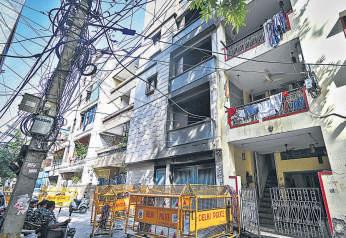
Days after a fire broke out in a PG at Mukherjee Nagar, leaving 35 lives in danger, the question arises: are the PGs following the normative procedure of establishing such an institution for living?

Following the massive fire breakout in a PG at Mukherjee Nagar, a senior municipal official was put to the task of conducting a survey to determine whether the PGs were following the correct procedure to be established. A door-to-door survey was conducted and revealed that 104 PG units have been earmarked. The buildings are operating in violation of building bylaws, the survey concluded.

The officials from civic bodies said that notices are being served to 104 PG units for alleged violations of laws. The notices have been issued to the owners, asking why the premises must not be sealed.

After the four-day survey concluded, the official remarked in conversation with Hindustan Times,

We have photographed these units. If a satisfactory answer is not provided to the show cause notice, it will be followed by a sealing drive.

It has been noted that the MCD is focusing on PG accommodations operating in buildings that are more than 9 metres tall and have more than 20 people staying in them. Hindustan Times noted that the higher authorities from MCD are focusing on these accommodations, particularly those that are more than 9 metres in height and have an occupancy of more than 20 people.

Interestingly, the fire broke out at the PG a day after a sealing drive for 20 coaching centres was conducted in the same area after a fire broke out in June.

The official further added,

According to the Master Plan of Delhi regulations and Unified Building Byelaws that came into effect after 2007, such units with more than 20 students and above 9m buildings cannot operate without a fire NOC. Only one unit was found operating with fire NOC issued by the Delhi Fire Services (DFS). We will also submit these findings in our action-taken report on the coaching centre fire safety case.

It is expected that the Delhi High Court shall hear the matter related to the fire safety for coaching centres and the consequent actions taken by the higher authorities of the civic body on October 10.

After the thorough investigation was completed, the MCD officials added that so far, most of the PG’s out of the 44 have been sealed since they are operating in the basement and mezzanine floors. Such activity is strictly prohibited in the basement area since it is a clear fire hazard. 24 out of these 44 units were coaching centres, while the rest were spaces like libraries and reading rooms. A second official associated with the drive commented,

We have also issued notices to units running on the first to the third floor and a hearing has been sought by them. We will have to wait for them to present their documents.

However, according to the Hindustan Times, the owners of such accommodations and coaching centres have shown their frustration as no clear regulations have been defined for them.

Coaching institutes were allowed to operate in commercial areas, mixed land areas, and residential areas by being included in ‘Other Activities’ Section 15.7 of the MPD 2021 subject to following the norms of ROW of road. The amendment regarding 20 people in one unit and the need for fire NOC was unjustly added in 2020 whereby coaching centres with 20 or more people were clubbed under the category of ‘educational building.

– Keshav Aggarwal, President, Educators’ Society, a union of coaching centres.

He further remarked that the clubbing had been done in a hurry, and the stringent regulations under the educational building were a consequence of the same.

But in such cases, there are too many grey areas, and the MCD needs to formulate fire safety policies. Indeed, such precautionary measures are crucial for the safety of an area, whether its residential or commercial in nature.

Read Also: Dead Cockroaches to Lizards: Hindu College’s Canteen Has It All!

Featured Image Source: Magzter.com

Aanya Mehta
[email protected]