
Tag

ILLL

Browsing

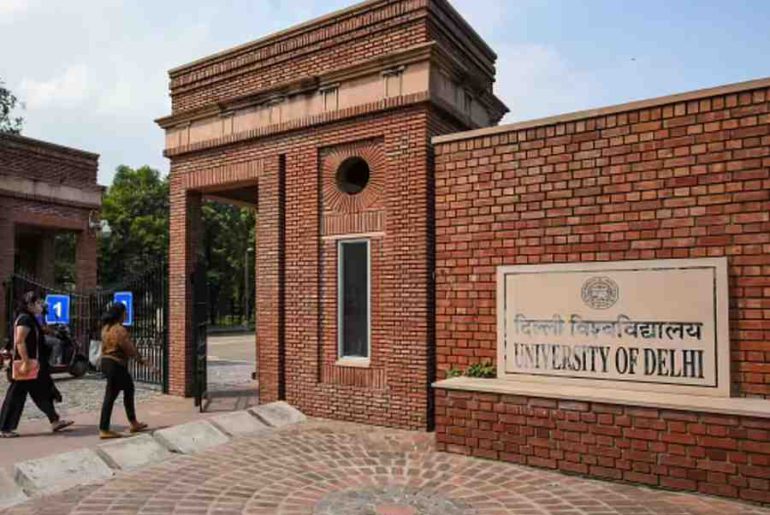
Delhi University has opened applications for its Competence Enhancement Scheme (CES) for the 2026 odd semester, allowing candidates to enroll in individual papers offered by university departments and colleges, per the official CES portal.

The University of Delhi opened applications for its Competence Enhancement Scheme (CES) for the 2026 odd semester on September 2, allowing candidates to register for individual papers offered by university departments and colleges without enrolling in a full degree programme, according to the official CES portal.

According to the portal, an applicant may register for a maximum of two papers or eight credits in a semester, whichever is reached earlier, and must pay a fee of Rs 6,000 per paper once the application is verified. Working professionals are required to upload a No-Objection Certificate (NOC) from their employer, while candidates already enrolled in a regular DU programme are not eligible to apply. Applicants are directed to consult the DU Syllabi portal to identify the programme, semester, course name, course code, and credits before submitting their form for departmental scrutiny.

Once a form is verified, candidates must pay the course fee through DU’s Miscellaneous Fee payment system and submit a copy of the receipt to the concerned office to confirm admission. Seats allotted under CES are treated as supernumerary and do not affect the intake of regular students, with selection dependent on availability in the relevant department or college.

CES was rolled out in DU’s centenary year in line with the National Education Policy (NEP) 2020, with the Institute of Lifelong Learning (ILLL) serving as the nodal agency for the scheme. The ILLL describes its mandate as supporting learners for whom education is “neither age-bound nor classroom-bound.”


Image Credits: thecsrjournal.in

Read Also: Delhi HC issues notice on PIL seeking 50% Women’s Reservation in DUSU Polls

Vidhi Ramchandani

[email protected]


With a deadline of December this year, Delhi University’s Institute of Life long learning is preparing to make lectures and some of the best course content available online.
The Human Resource development Ministry has awarded ILLL a 2 crore pilot project to develop e content for 14 papers of seven discipline. The list includes mathematics, botany, chemistry, economics, history and commerce.
The project is a step in the direction of ILLL’s Rs 100 crore proposal to set up a national centre for e-content development for the undergraduate and postgraduate courses under the University Grants Commission’s Model Curricula.
If the plan is successfully implemented, it would bring about a significant change in the field of higher learning as the best content and lectures would be accessible to eligible students throughout the country. Furthermore undergraduate and post -graduate studies would be available under the same roof.
E learning would also enable students of any college to access lectures on different topics. In addition to providing information about a particular topic , the e portal would include video lectures, online quizzes, animations, simulations to help students achieve a better level of understanding.
The e-learning material would include certain value additions to the traditional content such as a glossary of difficult terms, common misconceptions, pop-ups, points to ponder, web links etc
The major concern regarding the implementation of this measure has been that there might be a compromise in the quality of education provided. The varsity is however planning to set up an internal quality assurance cell to assess, monitor and enhance quality standards.
According to Vice -Chancellor, DU, Deepak Pental, “We are not even in the top 10 Asian Universities despite having all the programmes, faculty and infrastructure. There’s need for enhancing quality on all fronts and we’d like to have an internal mechanism for this. We would like to compare our university with global standards for which we may even consider inviting an international agency. The academic council would be consulted for its opinion before we proceed on this.”