There has always been an ideological conflict in the Indian political environment, which has inevitably trickled down to student politics. Understanding national sentiment and its future is thus impossible without first understanding how the youth perceives it.
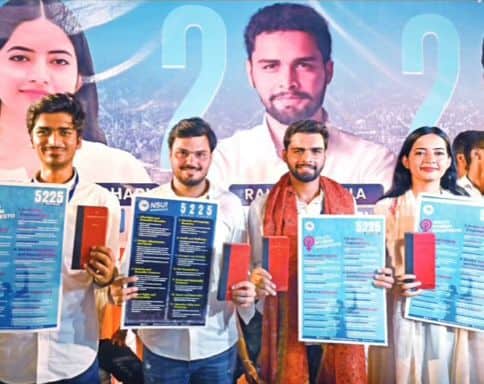
The Delhi University student election season has come and gone yet again, with another set of representatives coming into office. This year, we saw an ABVP majority within the four central panel posts, namely Aryan Maan from ABVP as DUSU president, Rahul Jhansla from NSUI as vice president, and Kunal Choudhary and Deepika Jha, both from ABVP, as secretary and joint secretary respectively. While all candidates who contested for these posts expressed concern over student welfare, different approaches were taken to this endeavour by candidates affiliated with the different parties.
ABVP reportedly consulted over 5000 students to construct its campaign manifesto, which included largely infrastructural reforms, along with pan-DU college integration, a section on gender sensitisation, (where “Pink Booths” for female police officers would be set up around girls’ colleges) subsidised health insurance for students, while also mentioning students with disabilities, metro concessions and concerns regarding ECA admissions. Since the ABVP is the student wing of the RSS and a consequent affiliate of the present ruling government, it was noticed that many of the points brought up in their manifesto actually represent a student-centric translation of the issues talked about by the present government, such as the sanitation of stray dogs, for which it faced controversy earlier in the year due to a perceived extreme stance.
On the other hand, even though the campaign manifesto released by NSUI voiced many of these same concerns, some said that the issues raised were indicative of Rahul Gandhi’s idea of opening a “Mohabbat Ki Dukan”. While addressing infrastructural, accessibility, and inclusivity issues similar to the ABVP, the party also promised the abolition of the Higher Education Financing Agency (HEFA) and its consequent fee hikes, in addition to demanding the rolling back of the National Education Policy (NEP), 2020, on the grounds that it commercialises education. The party also released a distinct “NSUI’s Women Manifesto” under which 12 days of menstrual leave per semester would be granted, in addition to pledging a zero-tolerance policy on harassment, medical and counselling sessions, a functional Internal Complaints Committee (ICC) in every college and bhaagidari or equal representation at all levels.
While some have said that the issues targeted by ABVP and NSUI and the solutions provided by them are “practical” in nature, students have been known to widely identify with the left-aligned organisations as well.
While these organisations, also contesting in the DUSU elections, were not able to secure any of the four central positions, they had their own distinct approach of expressing student issues and campaigning. SFI and AISA had dominated Delhi University student politics for years before losing popularity in recent years, and moved on to contest DUSU polls as the SFI-AISA alliance, largely representing the left-aligned groups. Much of the alliance’s popularity remains with students who recognise the money-muscle power approach of the other mainstream parties. This year, they raised demands for affordable education and hostel facilities for all students according to UGC norms, assistance with CUET admissions, and the removal of the, what they called, “bogus” SEC and VAC courses. They have also advocated for the strict execution of the Rent Control Act, especially in university and student areas, as well as for the provision of menstrual leaves through protests and highlighting the everyday struggles of queer individuals in the university space and celebrating their resistance through a campus pride parade organised recently. They have also been known to ask for the inclusion of girls’ colleges that are not affiliated with DUSU, such as Lady Sri Ram College, Daulat Ram College, and Gargi College, in the union.
In addition to SFI-AISA, the manifesto released by the Disha Students’ Organisation, who put forward Yogesh Meena as their presidential candidate, where they called themselves an “independent revolutionary alternative”, put across some similar points, which were aimed at fighting the “fascist agenda” and committed to “reject[ing] the politics of hooliganism and opportunism”.
While every party is ultimately advocating for issues voiced by the students, it is interesting to note how the approach towards this goal differs among them, and is ultimately both a reflection and rehearsal of national sentiments from the point of view of the youth. Not only are the DUSU elections indicative of the ideological battles fought at the national level, but are also a testing ground for party strategies, messaging, and campaign strategies utilised at a larger level.
Image Caption: DUSU candidates’ manifestos indicative of a larger ideology
Image Source: Daily Pioneer
Manya Marwah