

Tag

guidelines

Browsing

Delhi University tells the Delhi High Court it is scrapping the ₹1 lakh bond rule for DUSU poll candidates. Students now only submit an affidavit and security bond after petitions argued that the clause was arbitrary, exclusionary, and unconstitutional.

The Delhi University on Friday informed the Delhi High Court that candidates contesting the Delhi University Students’ Union (DUSU) elections will no longer be required to deposit ₹1 lakh bond, as earlier mandated by an 8 August notification. The university said that the provision was withdrawn following widespread criticism and legal challenges.

Representing the University, counsel Rupal Mohinder submitted before Justice Mini Pushkarna that election candidates will now only need to provide an affidavit and a security bond at the time of filing nominations. The clarification came during the hearing of a petition filed by two students, Anjali and Abhishek Kumar, challenging the 8 August notification that introduced the ₹1 lakh deposit rule.

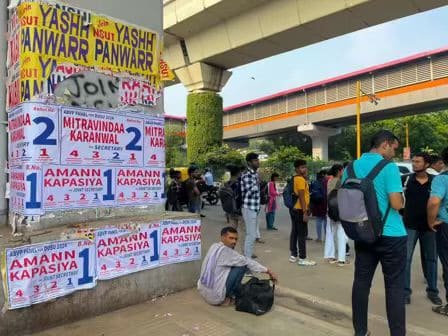
The contested notification was issued with the stated objective of preventing university defacement and public property during elections scheduled for 18 September. The university argued that the hefty bond was intended to avoid a repeat of last year’s incidents, when widespread defacement forced the High Court to delay the counting and declaration of results by nearly two months after the September 2024 polls.

However, petitioners, represented by advocate Raja Choudhary, contended that the rule was arbitrary, discriminatory, and unconstitutional under Article 14 of the Indian Constitution. They argued that the provision disproportionately affected students from middle class and rural backgrounds, effectively excluding them from the electoral process. The plea further pointed out that the rule contradicted the Lyngdoh Committee recommendations, which assign joint liability to candidates for defacement rather than imposing individual financial burdens.

“The impugned clause subverts the democratic ethos of student unions, turning elections into an elitist arena, contrary to judicial mandates for inclusivity,” the petition stated. It was also alleged that the registrar lacked the authority to introduce such a condition.

The 8 August notification drew sharp criticism from several students’ groups. The Akhil Bharatiya Vidyarthi Parishad (ABVP) earlier this month submitted a memorandum to the university administration opposing the deposit requirement. The group demanded immediate withdrawal of the provision and warned of large-scale campus agitation if it was not revoked.

Student leaders argued that the rule went against the spirit of campus democracy by restricting participation to those who could afford the steep bond. Many have also questioned the practicality of such a measure, claiming that it would not address the root causes of poster wars and graffiti.

Taking note of the university’s submission, the High Court disposed the petition filed by the two students. The court’s acknowledgement effectively removes this contentious requirement, allowing the electoral process to continue without financial hurdles for candidates.

The DUSU elections, scheduled for 18 September are a significant event in Delhi University’s political calendar and are often seen as a reflection of broader student politics across the country. With the withdrawal of the bond requirement, the focus is expected to return to key campus issues such as affordability of education, hostel facilities, and the quality of academic programs.

The university administration has yet to clarify which alternative steps, if any, will be taken to curb defacement during elections. For now, candidates will contest under the revised rules, with only one affidavit and security bond required at the time of nomination filing.

Read Also – DU Not Bound to Share PM Modi’s Degree Records, Says Delhi HC

Featured Image source – Hindustan Times

Richa Choudhary
[email protected]

Delhi University’s new DUSU poll guidelines mandate a ₹1 lakh bond to curb defacement, sparking backlash over affordability and fairness from various student organisations.

Delhi University on 8th August issued a new set of guidelines that direct DUSU (Delhi University Student’s Union) poll candidates to endow a bond of Rs. 1 lakh at the time of filing nominations for any defacement or poll code violation. This comes amidst the advent of DUSU elections for the new session, which is expected in September. 

This amount will be liable for forfeiture if the candidate or their supporters are found violating defacement norms,” the advisory issued by DU Registrar Vikas Gupta stated.

This move was met with significant backlash from various student organisations on grounds of being uneconomic for the common folk, especially candidates from relatively underprivileged backgrounds, and being “exclusionist” in nature. 

Someone from a lower-income background may not be able to afford the Rs 1 lakh bond required for nomination, which could prevent them from participating despite their willingness,” Ronak Khatri, the incumbent president of DUSU, told PTI.

 He urged the university authorities to hold candidates individually accountable in case of any violation by lodging direct fines instead of mandating them for all candidates in general. 

We welcome the guidelines, but we oppose the provision that requires students to submit a ₹1 lakh bond. It is not convenient for students to pay such a huge amount. We will soon release our own guideline in response to this,” said ABVP National Secretary Sarthak Sharma.

All India Student’s Union (AISA) President Nitish Kumar supported the motive of curbing electoral malpractices; however, he raised questions about the monetary constraints that the guideline imposed. 

We welcome rules that aim to ensure transparency and reduce malpractice. However, merely depositing a bond of one lakh rupees cannot prevent the misuse of money power. In campuses like JNU, elections are conducted without the use of money,” he said. “The volume of money power used in DUSU can only be curbed by placing stakeholders in a more informed position,” he further added.

 He highlighted that during the Joint Proctor’s meeting, he proposed to democratise the election process through presidential debates, but he was met with no response from the authorities. 

The directive included a range of guidelines with adherence to court orders and the Lyngdoh Committee, such as an anti-defacement affidavit at the time of admission and barring the use of loudspeakers, rallies, and roadshows outside designated “walls of democracy”. Violations may attract a fine of Rs 25,000, suspension, rustication, or even disqualification.

The results of DUSU elections 2024 were delayed by two months due to outrage over rampant vandalism committed during election campaigning by various student outfits and Delhi High Court intervention directing student organisations to restore defaced property.


Read-DUSU 2024: An Election in Waiting

Image Credits – Nabeera for DU Beat

Divyanshi Dusad

[email protected]

The School of Open Learning (SOL), Delhi University (DU) is all set to introduce its online teaching programme to aid students from 1st November.

The University Grants Commission (UGC) has requested SOL  to upload Massive Online Open Courses (MOOC) for B.A. Programme, B.Com (Honours), B.Com Programme and B.A English (Honours) for the first semester.

This comes after the Governing Body made this decision in a prior meeting. The faculty of DU had been requested to submit the proposal for the same. It was earlier approved by the Executive Council of DU.

The motion of online courses was put forward by 22 universities, but UGC gave consent to only four which includes DU.

A “four-quadrant approach” has been suggested under UGC guidelines. This includes video and audio tutorials, open access web content, self-assessment techniques like MCQs, among others. Availability of reading material, in the form of e-books or PDFs, has also been suggested.

The University website provided instructions on making these modules on Tuesday, abiding with the guidelines which state to incorporate video lectures, classroom presentations, small movies, documentaries, fieldwork, virtual experimental learning, gaming, and short question and answers.

It also states that these must be in accordance with the government’s SWAYAM guidelines.

“We have developed a special system, which includes live streaming of lectures. Our teachers have already developed the lectures. We have also hired special tutors and interns,” said Mr CS Dubey, Director of SOL, as reported by Jagran Josh.

SOL is also planning to partially conduct its examination online. The institution had applied for approval to offer online courses in January this year, after the UGC Gazette Notification dated 4th July 2018, prescribing the regulations that shall apply to a university conducting open learning classes.


Feature Image credits: College Duniya


 Stephen Mathew

s[email protected]