
N.B.- I owe my theorisations and links heavily to the ideas disseminated by the lectures and work of Dr Sanchita Khurana, Asst. Prof., MSCFW, DU.
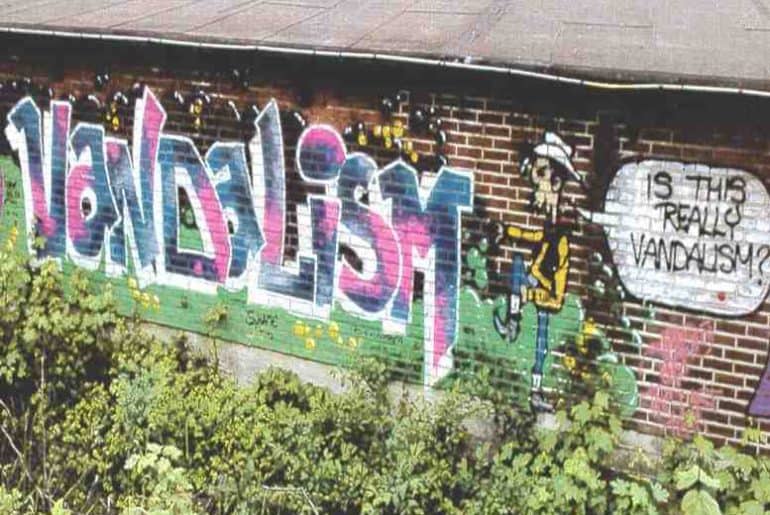
Graffiti haunts the liminal space between the abject and central, the impure and pure, the legal and the illegal. Post-graffiti in Delhi has seen a significant change in its ideological affiliations and creations when compared to the genesis of the art form in Philadelphia in 1967.
By the 1980s, the industrial economy of America had been voraciously replaced by the service economy characterised by its turning of “culture into resource” (phrase borrowed from George Yúdice). The “creative economy” was born, and along with it, the global narrative of the “creative city”. The creative city is always in competition with other global “world cities”, viewed as dedicated drivers of social growth and economic change through the capital generated by cultural productions as opposed to tangible “products” of the industry. Delhi was not immune to this shift. Dr. Khurana remarks, “Gautam Bhan (2009) notes that contemporary India has been shaped by the transformation to liberal market economies, a focus on developing world class cities and increasingly aspirational attitudes of the middle classes.” She further argues that we may, in this neoliberalisation of the Indian market economy, incipient in the 90s, locate the “emergence of the urban in Indian political economy.”
This inchoate neoliberal urbanism came with the need to aestheticise and beautify urban spaces. While this meant state-sanctioned projects of wall art and street murals to “decorate” urban space, it also meant the cleansing of the abject and marginal from the same space, i.e. political graffiti in direct contestation with the semiotics of urban arrangement. The contrast between state-sanctioned and/or internationally funded citizen–artist group collaborations flourishing within the neoliberalist state and Jadavpur University facing scathing allegations for its Pro-Palestine and “Azaad Kashmir” graffiti reveals this duality, repeating JNU’s history with the same. The need to co-opt the politics of graffiti is made clear in its signification as lying outside the semiotic and symbolic order of the state. The symbolic order refers to the patriarchal construction of a law, power, state and language that excludes the filthy feminine and its rhythmic, disordered imagination. Alistair Pennycook summarises this well; he argues that graffiti is an act of counterliteracy that “challenges, mimics, and carnivalizes the relations between text, private ownership, and the control of public space.” The Kristevan “abject” and its refusal to be purified is echoed here. For Kristeva, the abject constitutes the boundaries of the inner consciousness that always threatens to break in and disrupt the self as constructed within the symbolic order. The abject becomes the haunting peripheral presence, or absence—“something rejected from which one does not part”, as Kristeva describes. One recalls also the Freudian unheimliche, or the uncanny. The word unheimliche literally translates to “unhomely”. Peter Brooks writes about the unheimliche: “a monstrous potentiality so close to us—so close to home—that we have repressed its possibility and assigned an un as the mark of censorship on what is indeed too heimisch(homely) for comfort.” The abject, or the unheimliche, then becomes an irrepressible fragment of the consciousness and identity, or, within our context, the purified urban space; always contesting, haunting and resisting purification.
The aesthetic categories of “beauty” and “dirt” within the context of the Indian neoliberal “revanchist” state reveal strong associations with nationalist and classicist narratives of “upper-class hygiene and middle-class civility”(quoting Dr Khurana). Neil Smith identifies this revanchism as rooted in an exclusionary attitude towards minorities within an urban space and in urban discourses reflecting the interests of the hegemonic state.
While the street art popular during this time—a part of the “cultural economy” of the newly born “creative city” of Delhi—was situated intellectually in its apparent reclaiming of urban space and a critique of the commercialised and elitist “gallery artist”, a close look at the class biases and the ideologically and investment driven state-sanctions of these projects deconstructs this spurious claim. Nancy Adajania observes, “Art that uses the public domain as site and resource does not automatically become radical because it is made outside the hallowed confines of a gallery or because it sidesteps the commodity nature of art. It requires constant negotiations with the authorities and diverse publics it comes into contact with.” This illusion of citizen-agency and autonomy as granted by the state is a device through which to subtly govern them from within. It utilises the neoliberal citizen’s capacity for self-governance. Slater and Illes explain, “…in Foucauldian terms, governmentality uses aesthetics to penetrate the subject more deeply, to tap into our capacity for self-government. If power has become life-like, it has also become art-like.” The Foucauldian “neoliberal subject” represents a government that exists through the psychologies of individuals and societies. To conclude, I quote Foucault:
“An enabling state that will govern without governing ‘society’—governing by acting on the
choices and self-steering properties of individuals, families, communities, organisations. This entails a twin process of autonomisation plus responsibilisation—opening free space for the choices of individual actors whilst enwrapping these autonomised actors within new forms of control (italics mine).”
Read Also: Banality of Evil
Image Credits: Vandalism by Goon and Chick, 1985
Aayudh Pramanik
