
Author

Aayudh Pramanik

Browsing

N.B.- I owe my theorisations and links heavily to the ideas disseminated by the lectures and work of Dr Sanchita Khurana, Asst. Prof., MSCFW, DU.


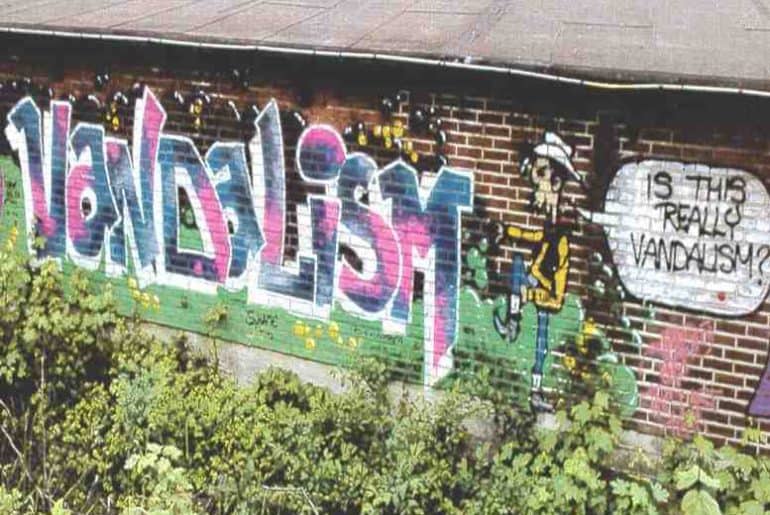
Graffiti haunts the liminal space between the abject and central, the impure and pure, the legal and the illegal. Post-graffiti in Delhi has seen a significant change in its ideological affiliations and creations when compared to the genesis of the art form in Philadelphia in 1967.


By the 1980s, the industrial economy of America had been voraciously replaced by the service economy characterised by its turning of “culture into resource” (phrase borrowed from George Yúdice). The “creative economy” was born, and along with it, the global narrative of the “creative city”. The creative city is always in competition with other global “world cities”, viewed as dedicated drivers of social growth and economic change through the capital generated by cultural productions as opposed to tangible “products” of the industry. Delhi was not immune to this shift. Dr. Khurana remarks, “Gautam Bhan (2009) notes that contemporary India has been shaped by the transformation to liberal market economies, a focus on developing world class cities and increasingly aspirational attitudes of the middle classes.” She further argues that we may, in this neoliberalisation of the Indian market economy, incipient in the 90s, locate the “emergence of the urban in Indian political economy.”


This inchoate neoliberal urbanism came with the need to aestheticise and beautify urban spaces. While this meant state-sanctioned projects of wall art and street murals to “decorate” urban space, it also meant the cleansing of the abject and marginal from the same space, i.e. political graffiti in direct contestation with the semiotics of urban arrangement. The contrast between state-sanctioned and/or internationally funded citizen–artist group collaborations flourishing within the neoliberalist state and Jadavpur University facing scathing allegations for its Pro-Palestine and “Azaad Kashmir” graffiti reveals this duality, repeating JNU’s history with the same. The need to co-opt the politics of graffiti is made clear in its signification as lying outside the semiotic and symbolic order of the state. The symbolic order refers to the patriarchal construction of a law, power, state and language that excludes the filthy feminine and its rhythmic, disordered imagination. Alistair Pennycook summarises this well; he argues that graffiti is an act of counterliteracy that “challenges, mimics, and carnivalizes the relations between text, private ownership, and the control of public space.” The Kristevan “abject” and its refusal to be purified is echoed here. For Kristeva, the abject constitutes the boundaries of the inner consciousness that always threatens to break in and disrupt the self as constructed within the symbolic order. The abject becomes the haunting peripheral presence, or absence—“something rejected from which one does not part”, as Kristeva describes. One recalls also the Freudian unheimliche, or the uncanny. The word unheimliche literally translates to “unhomely”. Peter Brooks writes about the unheimliche: “a monstrous potentiality so close to us—so close to home—that we have repressed its possibility and assigned an un as the mark of censorship on what is indeed too heimisch(homely) for comfort.” The abject, or the unheimliche, then becomes an irrepressible fragment of the consciousness and identity, or, within our context, the purified urban space; always contesting, haunting and resisting purification.  


 The aesthetic categories of “beauty” and “dirt” within the context of the Indian neoliberal “revanchist” state reveal strong associations with nationalist and classicist narratives of “upper-class hygiene and middle-class civility”(quoting Dr Khurana). Neil Smith identifies this revanchism as rooted in an exclusionary attitude towards minorities within an urban space and in urban discourses reflecting the interests of the hegemonic state. 


While the street art popular during this time—a part of the “cultural economy” of the newly born “creative city” of Delhi—was situated intellectually in its apparent reclaiming of urban space and a critique of the commercialised and elitist “gallery artist”, a close look at the class biases and the ideologically and investment driven state-sanctions of these projects deconstructs this spurious claim. Nancy Adajania observes, “Art that uses the public domain as site and resource does not automatically become radical because it is made outside the hallowed confines of a gallery or because it sidesteps the commodity nature of art. It requires constant negotiations with the authorities and diverse publics it comes into contact with.” This illusion of citizen-agency and autonomy as granted by the state is a device through which to subtly govern them from within. It utilises the neoliberal citizen’s capacity for self-governance. Slater and Illes explain, “…in Foucauldian terms, governmentality uses aesthetics to penetrate the subject more deeply, to tap into our capacity for self-government. If power has become life-like, it has also become art-like.” The Foucauldian “neoliberal subject” represents a government that exists through the psychologies of individuals and societies. To conclude, I quote Foucault:


“An enabling state that will govern without governing ‘society’—governing by acting on the

choices and self-steering properties of individuals, families, communities, organisations. This entails a twin process of autonomisation plus responsibilisation—opening free space for the choices of individual actors whilst enwrapping these autonomised actors within new forms of control (italics mine).”

Read Also: Banality of Evil

Image Credits: Vandalism by Goon and Chick, 1985

Aayudh Pramanik
[email protected]

A lesson in the other of visuality, narrative desire, and body politics, Joyland revels in a deconstructive tune. Combining metaphors of emancipation, murder, and desolation, it is a masterclass in queer filmography and instructive in scripting the body and inscribing jouissance into celluloid.


Sadiq’s Joyland (2022) is at times blasphemous and at times gorgeous, and, indeed, overwhelmingly both. The film bears an unimaginable density of truth, longing and grim premonitions. The vision is immense, distilled masterfully into delicate symbolism. The lights are equally brilliant, dispersed, a little out of reach, as happiness always is; the film does well to teach us. Haider’s (Ali Junejo) fragile frame, Biba’s (Alina Khan) ferocity, Mumtaz’s (Rasti Farooq) intrepid and boundless sense of self, and Nucchi’s (Sarwat Gilani) finally shattered feminine reserve, shelter abrasive and tender acts of resistance within themselves. The film is hardly an embittered tirade against a maiming and smothering patriarch (Salmaan Peerzada)—and it might as well have been a nifty jab at the phallo-monarchic imperial image that the throne he sits on is a wheelchair, himself limp as his enterprise. Rather, it locates its inexorable moment in the agonised body writhing for desire. That desire could and does possess the ability to simultaneously root and uproot patriarchal machinery; that desire wields a fearsome transformative aspect, altering societies and the bodies that inhabit networks of social relations, extraordinarily informs the narrative’s creative purpose.


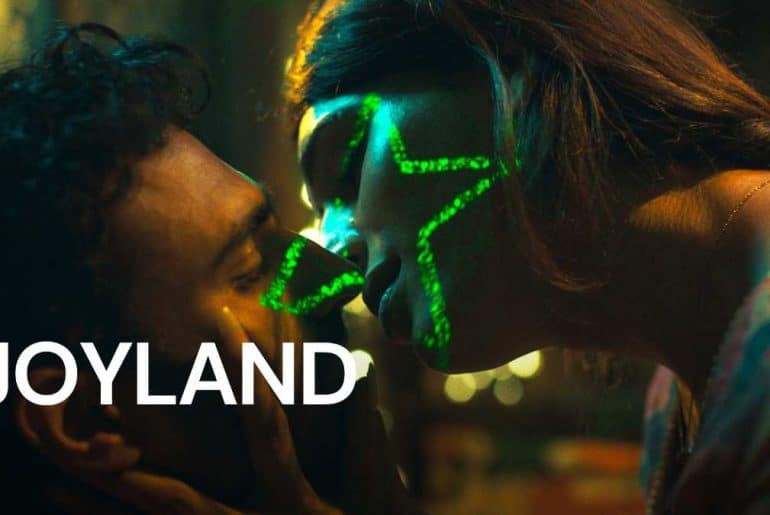
Sadiq and his cast communicate in images. The wheelchair that inverts the patrilineal image; the blood pooling on the floor from the goat sacrificed by Mumtaz and not Haider that perverts the role of ‘the male in violence’, of ‘the male of violence’; the garish neon stars resting on the face of Haider and Biba, speaking, as if to the deeply moved voyeur, “Here are star-struck lovers”, quite literally; the eponymous Joyland itself that acts as a tether between the two bereft women as they lament the last time they ‘came’—came into orgasm, came into love, came into the privilege of expression encoding homoerotic desire. The most prodigious of images is set aside for the end, for it carries the full force of the film’s vision: the enormity of the ocean that Haider offers himself to—a distinct maritime metaphor of liberation. Mumtaz, like Antigone (her brick-prison the marriage), frees herself in death. Nucchi frees herself in snapping back at her husband and silencing him. Haider frees himself continually throughout the film: in joining Biba’s troupe as a dancer, allowing himself to be clad in a femininity that he had hitherto inhumed deep underneath a blistering masculinity that was not his own; in turning, in naked dance, and offering himself up to Biba so that he could be “had”; in undressing as he floats into the ocean, a final act of self-emancipation. The path of desire is not tread alone, the film emphasises repeatedly in the relationships that overtly or clandestinely unfurl before the audience. Haider’s queer, alternative desire finds company in Biba. Mumtaz’s barren, burning body finds company in the silhouette of a self-pleasuring stranger, the patriarch’s loneliness is balmed by the company of the neighbouring widow. They all want desperately to breathe, to maul the facade they force upon themselves. Normative codes of socialised and embodied desire stand utterly dismantled in the face of the altered bodies that come alive in the company of other desires, not at the cost of them. 


The deconstructive attempt does not stop at questions of desire. Gendered structures are threatened in the womb itself. The grotesque images and suggestions of Mumtaz’s partially conscious and unconscious attempts to kill the male baby in her womb on the patriarch’s birthday produce resistance at the level of the genome and by cumulative affective force, gendered civilisational organisation. It is as if she declares that she would not allow another one to replace the patriarch, to smith the murderous shackles of the household onto another woman, or man, for that matter. 


The film’s genius does not rest here. It manages to portray a complicated queerness in Haider that manifests in both his relationship with Mumtaz and his relationship with Biba. While the latter is quite glaringly obvious, albeit rocky, the former is not to be understood as a relationship that stifles Haider’s queerness. If anything, it helps construct who Haider is and what he means to himself and the world around him. The only person that Mumtaz feels a semblance of desire with is Haider, a desire to explore herself and to dwell outside of herself. There is a subversive ripeness in their relationship that we are allowed to view through the memory of Haider’s proposal to Mumtaz—her consent is of paramount importance to him. It is a ripeness that exists in their conversations, in their friendship, and in Mumtaz’s defending his implicit femininity. When Haider falls apart, Mumtaz collects him. When Mumtaz despairs, Haider, in his capacity, comforts her. They hold each other in the film till they are wedged apart by the expectation of a child, and thereafter the child itself. It is not Haider who kills Mumtaz; it is clear by the end.


A devastating ode to the desiring body and the body in desire, Joyland wields the peculiar ability to draw out the rage, the love, the lust and the fear in both the performer and the performed upon, the performance and the performed for. Working with vastly ambiguous affections, Joyland lures out, and sometimes wrenches free, a raw humanity that waltzes constantly at the precipice of danger, at the peril of its own self, and perhaps it is this reckless audacity that finally speaks to the audience. 

Read Also: Bodies as Battlegrounds: Regimes, Reproduction, and Resistance

Image Credits: Still from Joyland (2022)

Aayudh Pramanik

[email protected]