Tag

DU

Browsing

Meet the band, When Chai Met Toast , that embodies happiness and performs it in their music.

Kartik: The band name is a very creative fusion of Indian roots meeting western elements, so what kind of musicians or bands from India and abroad influence your music?
Ashwin: Actually, a lot of them! I mean, there is a lot of inspiration from English folk, but we are experimenting with a lot of other stuff as well, which includes English and European folk.
Achyuth: Not really folk, more like pop.
Ashwin: We do not want to really define ourselves into a category or genre, as such.
Achyuth: Some of the artists that we have been listening include The 1975, Coldplay; Coldplay is an all-time favourite.
Ashwin: There is Sufjan Stevens as well. There is a bunch of artists we listen to, and are inspired by.


Kartik:What qualifies as good music for you?
Achyuth: Anything that sounds good, I guess.
Ashwin: Very difficult question!
Achyuth: Anything that is true, actually. Anything that comes from the people, whatever genre it is. Something that comes from within.
Ashwin: I will be very honest. More than what qualifies as good music to me, what my ears hear as good music is what I like. For instance, you cannot really ‘name’ good music or music that you like. You are not very fond of something at one point, and other times you love something. You cannot really classify or clarify what good music is, and we have not really given it a thought, so I think there is no generic or specific category of good music.
Achyuth: For me, it is anything that has some soul to it, in whatever way. It can be any artist, but as long as there is passion, there is good music.


Kartik: Your songs are multilingual. Notably, the transitions in the languages are very smooth in the songs, which make the composition very cohesive. How do you think the audience reacts to this aspect of your music?
Achyuth: First of all, we are glad you think so!
Ashwin: We have heard positive reviews till now, thankfully. Nobody has as yet, thrown anything negative at us. We try not to force the elements into a song just because the song has to carry out something which is multilingual or some meaning that has to be conveyed. We try to keep whatever we write as what it is.
Achyuth: The fact that we all speak multiple languages helps. So, we are not really restricting ourselves. If we want to convey something through a song in Tamil, we have the freedom to do that, because Ashwin knows how to speak Tamil. It gives us many options, as a band.


Kartik:I was just listening to your latest song, “Nee aara”, and I loved it! This is your first Malayalam single, please tell your listeners about the song and what it means.
Achyuth: Thank you very much! It starts off with self-introspection, and then it moves into the ideas of new beginnings, in various metaphorical forms.
Ashwin: In one sentence, it is like understanding your mistakes and then trying to rectify them, and finding what is wrong with you. It’s about finding the new you, to some extent.


Kartik: Do you guys have any just-the-band or personal rituals to do before performing on stage?
Ashwin: We definitely pump each other up!
Achyuth: There is like a band-huddle before the performance.


Kartik: How many shows have you done in the last one year? Which show has been the best in terms of audience and the derivative artistic gratification?
Achyuth: Around 80-90 shows. All of them were great shows.
Ashwin: As for the latter part of the question, I think both of us might have differing answers, let’s see.
Achyuth: Weekender Pune 2018 was a great one.
Ashwin: Oh, then it is the same. We played our 70s set for the second time at Weekender Pune.
Achyuth: We were still learning our parts for that, but we managed to do well, I guess.
Ashwin: Narayan on violin, Prashant on bass, along with trumpets, we had a proper ball of a time. It was great to see five thousand people in front of you, while Joe Satriani was playing on the other stage. The sound was amazing, thanks to Yogi for mixing that day, Guru did an amazing job with lights as well. It was a crazy good day for us, altogether.


Kartik: Can you describe what do you feel when you’re performing on stage and a massive crowd jams to your songs along with you?
Achyuth: I think that’s what we live for.
Ashwin: Yes, we dance with them. And live the moment, that’s it.


Kartik: So how would you describe this feeling in one word?
Ashwin: D-E-D, DED, a very millennial term. (laughs)


Kartik: What are your views on failures and/or criticism? And what do you think stays with the audience, the artist or the art?
Achyuth: The art definitely.
Ashwin: I think both. Like when the artist feels the art is when the people feel the art.


Image Credits: Adithya Khanna for DU Beat


Kartik: All the band members have had professional training in Indian classical music. In times of rap and hip-hop, and pop rock, where do you think Indian Classical music is leading to?
Ashwin: It’s leading to world music, buddy. Bands like Agam, and Shadow and Light and so many other independent artists are working on Carnatic and Hindustani music. There are a lot of jazz singers who are blending Carnatic music with jazz. Carnatic music is in a completely different scale altogether than what we think is Indie.
Achyuth: There is immense potential in the genre. It’s already massive.
Ashwin: Totally, I mean a Carnatic music show in Singapore selling more than 2500 tickets that is the substance of the genre.


Kartik: In a lot of your music videos, there is a running metaphor of creative and artistic blockade, and coming out of it. One of these videos that has stayed with me is that of the song “Believe“. What are your views on creative expression and its ability to transgress social obligations or expectations?
Ashwin: That’s too tough for me, man! (laughs)
I have been doing music for ten years now (professionally), and I have been learning from almost twenty years. It is definitely a very difficult task coming from a state like Kerala, to build up something what we are trying to do. There is always this hurdle, always this blockade that hits you, and you don’t know what you have to do. You have to find out the right door to move across. It’s not like you sign with a label and you are there. It gets very difficult when you are independent, when you are doing everything by yourself. Within the band, all of us have certain roles, and it becomes this division of creative people, coming together and doing so much together. Everybody’s struggle to get out there speaks for freedom of creativity. We have also come from different social backgrounds. My father worked in a bank, and later retired as an architect. So, we have to tackle all that when we are doing something like curating music on a full-time basis.
Even though our parents and families support us in whatever ways they can, there’s always this element of social obligation that comes to the fore.
Achyuth: Our listeners also relate to it. (the struggle)
Ashwin: At the end of the day, whatever you are doing, you need to be happy with it.


Kartik: Which conveniently brings me to my next question. When Chai Met Toast identifies itself with ‘The Happy Project’, it focuses on creating music that makes the listener happy. How do you think it impacts your credibility and influence as a band in a Rockstar-world obsessed with romanticising sadness?
Ashwin: Funny, funny part! (laughs)
See once you are broken, hope for one day that you will be happy. Life is all about it, is it not? I mean if there are songwriters who are writing about this state of being broken, we are trying to get out of it.
Achyuth: I think you can call our music being on the ‘positive’ line. We are looking at the brighter side, even when we are talking about a break-up, for instance.
Ashwin: There are a lot of other factors that get into you in the form of anxiety and depression, now that is entirely different. There is another thing. Generally, in music, we do not wish to depend on emotions too much, right? Every emotion has its own set of feelings that it gives out. But think of this: somebody for instance, thought that she would die of cancer, but having worked hard, she comes out of it. She has definitely channelised her positivity in that fight. She discovered herself, and fought it back. So, it’s always greener on the other side, we just have to look at the green from our side, and just go for it.


Image Credits: Saubhagya Saxena or DU Beat

Kartik: In an interview you talked about a school in Kashmir (Haji Public School) wherein your song “Firefly” is now sung by the students in assembly. What was your reaction to this discovery and how great of an achievement do you think it is for you?
Achyuth: I think, things like these make what we do, all the more worthwhile. I cannot give it a word, for sure, but the spontaneous reaction to the news was: immensely gratifying. To see our art reaching out and being accepted and loved by people who are like miles away. There have been multiple schools across the country like Patna and Kerala, where students have sung our songs. This is another part that makes our music meaningful. There are no age barriers, our listeners’ ages range from six-year-olds to seventy-year-olds.

Kartik: Please tell us about your upcoming album, tours, and shows.
Ashwin: We are working on the album. Pre-production is going on, song-writing is going on. We are trying to figure out when we are going to release it. We are also trying out different things, and experimenting with new elements and instruments.
Achyuth: We do not know, as yet, when exactly it will be ready, but it is definitely on the cards.
Ashwin: One thing that we know for sure is that we are all very stoked and looking forward to the fun that the process is going to be.
Achyuth: As for the shows, we will be playing at three shows in North India this month. We have not played in North India in a while. We have performances in Delhi, Chandigarh, and Jaipur. Tours are still being planned out.


Kartik: How do you like performing in the North Indian states?
Ashwin: There is no barrier such as North Indian states. We love performing everywhere. People accept our music, they come and dance, they have a happy time, we have a happy time. Everybody has their own share of happiness, and we just enjoy that whole ground of people singing and dancing. There is no differentiation as such.
Achyuth: For us, we are equally happy when we are playing in any part of the country. Anybody who loves music is loved by us.


Kartik: Now that you have a huge following as a band, where do you see yourself in another five years?
Achyuth: Hopefully playing outside India as well, I don’t know.
Ashwin: To be honest, would love to win a Grammy, but that might be too much to ask for. We would love to play at international festivals, that would be great.
Achyuth: Yes, spreading our vibe, now that we have reached many people in the country, and making difference in whatsoever way we can in the larger community.


Kartik: Will we be seeing you anytime soon in some University of Delhi fest?
Achyuth: You should be telling us! (laughs)
Kartik: We would love to have you!
Ashwin: Oh, we would love to play there, as well! It is very mutual.


Feature Image Credits: When Chai Met Toast via Facebook

Kartik Chauhan
[email protected]


With Zomato delivery executives in Bengal protesting against the delivery of beef by Hindus and pork by Muslims, we see solidarity against the food delivery giant which finds itself in turmoil.

Another day in our secular country, another attempt made to communalise food on the religious grounds while the entire narrative on twitter shifts into countless debates on eating beef or pork.

However, for the students of the University of Delhi (DU), this opens up an interesting arena of speculation.

The majority of the student body considered animal cruelty as the reason for not eating beef/pork and very few considered religion to be behind this. A student stated, “I am against any sort of animal slaughter done for the sake of greed, taste or nutrition. They are sentient beings that deserve to live and we can survive without eating them.”

To further elaborate this point another student added, “I belong from a rural background, I am aware of the significance of livestock and cattle in shaping the life of village folks. Right from the agricultural activities, with the dung cakes used as fuel to cook food, to the dairy products used in everyday life, cattle form an essential part of their lives. I don’t consider religion to be the reason behind my choice.”

When religion comes into this narrative, the views are conflicting. Most of the students consider it as a matter of personal choice. However, it seems evident that family and upbringing plays an important role in influencing and strengthening one’s views. Some of them term it as a “disgraceful sin”, while others don’t associate themselves with this debate.

Another student came forward with a separate angle on this debate. She said, “It would be good if people try to understand why their religion tells them not to eat beef or pork, the idea behind it might still be relevant.” She further added that eating or not eating any kind of meat is a personal choice as long as one is not enforcing their opinions on others. According to her, if some religious institutions have certain rules about the consumption of meat then it should be followed while one is within the premises of that institution out of respect.

On the other hand, a part of the DU student body is much in the favour of consumption of beef and pork. “If it appeases the taste buds, it goes on top of the favourite food list” says a History student. The consensus either leans towards exploring the various delicacies that meat has to offer or rebelling against the societal diktats. As one student puts it, “I eat pork even though nobody in my family does. It’s my life and nobody can force me to not do something if I want to. I don’t eat beef because I never felt like trying it.”

Growing up it was hard to acknowledge the idea that beef can be eaten and God won’t smite you if you indulge in this practice. It was even harder to understand that people consume beef and it is perfectly normal for them as they are not indoctrinated into the belief that cow is a holy animal, the way I was from the age when my senses were not even fully developed. However, your beliefs and practices cannot be imposed on another person.

Like a rusty coin, with two alternative sides, this debate is going to be here for a long time much to the delight of the debating circuit of the varsity. Till then, I am here with my double-decker beef burger with a side of bacon to see how this whole debate moves forward.

Feature Image credits: WSLM radio

Antriksha Pathania


[email protected]  

The Executive Council of the University of Delhi (DU) has approved the semester system for the School of Open Learning (SOL) and  Non-Collegiate Women Education Board (NCWEB) starting from the current academic session.

The Executive Council of DU was called on Saturday to discuss the introduction of semester system in the SOL and NCWEB, and it has decided to introduce the semester system from this academic session.

The SOL and NCWEB are currently following the aannual system in which the exams are conducted in the month of May. 

It was decided in an earlier meeting that the Choice Based Semester System (CBCS) would be introduced in these two institutions from the academic session of 2019-2020.

The semester system would enable these two verticals to be identical to regular colleges.

Some officials expressed dissent, as they felt that this move has been taken in a hurry and would affect the students who have enrolled on an annual basis as classes have begun and the study material has also been handed over.

Akansha, who is a B.Com. student in SOL, seemed disappointed and had this to say-  ”There are mainly three reasons for choosing correspondence, those who choose it for convenience and do not have time for regular classes would be pissed as this defeats the purpose and who cannot afford regular education or do not have enough marks to get onto a regular college. I am pissed.”

SOL enables the students to enrol themselves in various courses and programs without being physically present to attend classes unlike other colleges in DU.

This means that students enrolled in undergraduate honours courses will have their examinations under the Central Examination Centre, since SOL offers very few honours courses. Notifications for the schedule of examinations and filing of forms for the students of NCWEB shall be along with regular semester students. Whereas  semester exams for non-honours students would be undertaken by SOL.

The annual system only has one examination whereas the semester system has two examinations during the months of December and May.

The fee structure also varies as semester system requires fee payment to be done in two instalments unlike the annual system with single payment.

The SOL, which was founded in 1962, is one of the largest distance education institute in the country with over five lakh students in its fold, and around one and a half lakh students enrolled annually.

NCWEB, which is exclusive to women, provides weekend to females residing in the national capital.

Feature Image Credits: DU Beat

Stephen Mathew

[email protected]


On Wednesday, 14th August, 2019, a 19-year-old young adult was arrested for killing a University of Delhi (DU) student, Shubham Srivastav, during a confrontation between them in a park at Patel Nagar, New Delhi.

The two had been fighting over the girlfriend of the accused.

The childish banter turned into gruesome murder as was revealed by Aman Soni in his police investigation. Soni got infuriated with the victim, also aged 19, had thrashed him, and then in an attempt to exact revenge, had stabbed him.

Shubham Srivastav, the victim, is a B.A. student in University of Delhi. He was reportedly in a romantic relationship with a girl from his tuition class, and both were not talking due to an argument between the two earlier, resulting in Srivastav not meeting the girl.

The dispute started when on Monday, a classmate saw Srivastav’s former girlfriend with Soni outside the tuition class, and informed him about it.  When Soni was investigated, he gave a chronological order of what motivated him to take such a dire step. He said that Srivastav came to him outside the tuition, along with his friends, and intimidated him. He showed Soni a photograph of himself and the girl, and warned him to stay away from her. This statement by the victim led to a quarrel between the two and later Shubham Srivastav and his friends, Shubham Gupta and Lokesh Aggarwal had allegedly thrashed him (Soni).

This brought up a sense of vengeance in Soni, and he was looking for an opportunity to take revenge. The next day, on Tuesday, Srivastav also confronted the girl with the photograph followed by an argument between both. This aggravated Soni more, when the girl informed him about how Srivastav had been acting with her.

It was then and there, that Soni made up his mind to end the dispute completely, unfortunately with the murder of Shubham Srivastav.

Aman Soni and his friends deceived Shubham Srivastav into coming to the Rock Garden park in Patel Nagar in the name of “resolving and sorting the issue”, for once and for all.

Victim’s friend, Shubham Gupta told the police that on Wednesday, the victim received a call from Aman Soni to meet him to resolve the issue, and Srivastav even asked Shubham Gupta and Lokesh Agarwal to accompany him. The trio found some people waiting for them in the park.

When Soni confronted Srivastav, they got into an argument during which Soni pulled out a knife and stabbed Srivastav in the chest. Soni’s friends then tried to intervene to save their  friend, however , they were also hindered by Aman’s friends, resulting in injuries being inflicted on them as well.

The victim fell unconscious on the floor of the park as the assailants left the park.

Lokesh Agarwal managed to drag his friends Gupta and Srivastav from the park onto an E-rickshaw and took them to BLK Hospital. While Srivastav died a few hours later, his injured friends are now being treated in Ram Manohar Lohiya hospital.

According to a senior officer, police received information about the scuffle around 9 pm on Tuesday, following which a team was dispatched to the spot.

“Srivastav was taken to a nearby hospital where he was declared brought dead. A case has been registered under relevant sections of the Indian Penal Code and police are trying to nab the accused, who are absconding. The body has been sent to RML Hospital for autopsy,” the officer said.

On Wednesday night, cops traced the accused after Srivastav’s friends recorded their statements, blaming him for the attack. Police also recovered the CCTV footage from the area near the park, in which Soni can be seen fleeing with his friends. A search has been launched to nab Soni’s friends too. However, the police have found the murder weapon, the knife, used to stab Shubham Srivastav.

The grieved family is under shock and the father says that he wasn’t aware of any relationship that Shubham had.

With inputs from Times of India, India Today, and Press Trust of India.

Feature Image Credits: DU Beat Archives


Chhavi Bahmba

[email protected]


Discussing the absolute belief with which we, at times, think we are right, providing no space for any sort of discussion. 

As college students, who are always being bombarded with new ideas and often one-sided news on social media and other platforms, we are, at times, too quick to form certain opinions, which we then start treating as absolute truths of the universe. More often than not, we also get influenced by the talks and views of our professors and friends. Some people, on the other hand, enter college with already fixed notions which they then are ready to defend in the face of opposition and at times even reason. 

Irrespective of how our believes and opinions are developed, for they are a result of our social and personal environment, most of us very strongly believe that we are situated in the moral and ethical corner at all times. Often, this hampers our understanding of why those who are in opposition to our views are so. Many of us who consider ourselves open-minded make statements like “everyone has a right to their own opinions”, but how often do we believe that or not belittler someone, when they hold, beliefs opposite to ours?

As students of the University for Delhi (DU), many of us consider ourselves as politically and socially conscious beings. We attend political rallies and go for protests and some students even join political organizations like the Akhil Bharatiya Vidyarthi Parishad (ABVP) or the National Students’ Union of India (NSUI). However, most of us live in complete denial of even wanting to understand the other side of the argument, leading to a lack of empathy on all sides. Many times we also associate a particular policy with a party. A person who believes in right-wing politics will more often than not believe that all actions of a right-wing political organization are correct and a person who believes in left-wing politics will more often than not believe that all actions of a left-wing political organization are correct, leaving no room for doubt. Incidents of physical and social media bullying or social ostracizing of people because of their political or social believes is a global issue, from which our University corridors are infected as well. 

In conclusion, with partial or complete information, opinionated or neutral media platforms and associates, many of us rush into making concrete judgments, completely oblivious to the fact that the other side must have their reason for their views, irrespective of whether we agree or disagree with them. Dismissing the other side of an argument does not make us victorious on an imaginary debating platform. Perhaps then, at times we can agree to disagree, for discussion is not to win, but to understand and perhaps at times even empathize with those we do not agree with, in a patient and peaceful environment.  

For instance, you may be inclined to follow my line of personal thought and agree with the beliefs behind this article, or disagree with it very strongly; you have a right to do so. I cannot admit to knowing it all but so can’t any of us. 

Feature Image Credits: Aaron Mead 

Juhi Bhargava   

[email protected] 


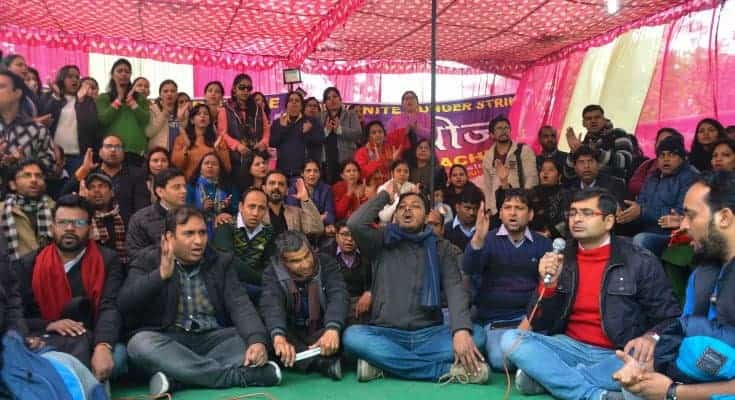
The party members of Chathra Yuva Sangharsh Samithi (CYSS) protested in front of the Arts Faculty today. They demanded a reduction of fees and, hostel facilities for the he OBC and EWS category students.

CYSS, the student wing of Aam Aadmi Party, held a protest in the Arts Faculty. The protest began at 11:30 in the morning continued till three in the afternoon. The protest saw many party workers with banners and posters, shouting various kinds of slogans. 

The march was being led by, Delhi-region State President, Mr. Sumit Yadav. The protest was organised against the fee hike in various colleges and the lack of admissions of students of OBC students postgraduate hostels. It aldo focused on the provision of admissions to OBC and EWS category students in law and other postgraduate courses.

The University had recently increased the fee in various colleges like Mata Sundari. The lack of reservations has been an issue in the University of Delhi (DU) hostels where students are given seats on rank and vacancy basis making it impossible for students of reserved categories to secure admissions in hostels.

However, other than these issues, the issue of a young Muslim girl wanting to seek admission was also raised. 

Afshan, a postgraduate aspirant, wanted to seek admission in DU after completing her graduation from Zakhir Hussain College. She believes that she was prohibited from giving her entrance because of her name which indicated she was a Muslim. 

In addressing the gathering and DU Beat, Afshan said in her speech, translated from Hindi here- “I graduated a year back in 2018 from the University, people here say things like ‘Beti Padhao, Beti Bachao’ yet I have been struggling for two years now for getting my admission done. There was a girl in Unnao who was silenced for asking justice and that’s what they are doing to me. I wanted justice for my education and my leg shivers stating what they’ve done to me. I’ve been blackmailed and told they will ruin my documents as well. I filed a complaint, yet there is no investigation. They say they’ll abduct me. I feel shivers down my spine.” 

She later tried to get in the conference hall of the University, yet she was stopped. There were policewomen ready to tackle her. After a long quarrel, she was finally admitted in the conference hall.  

Later, DU Beat interviewed Mr. Sumit Yadav, Delhi-region State President. He stated, “DU is considered one of the best institutions in the country. All the students across the country even people from rural places of Delhi like Najafgarh choose DU because they get a great education at lower price. Now due to privatisation, they’ve increased the prizes. Our party has always been against privatisation and we’ve been raising our voices for the same.”

The various slogans shouted out were “Chhatro par ab reham, karo fees hamari kam karo ( Have some mercy on the students, reduce fees now)” and “Rehne ko awas chahiye humko Chathrawas chahiye (We need shelter to stay, we need students to have homes)”. They also had slogans critiquing the Vice Chancellor’s inability to provide adequate hostel facilities.

The Party members marched towards gate number four but were stopped by the guards and were not permitted to cross. The situation turned hostile when members tried to climb the gates and cross it over. The guards were forced to push them back. 

“We are protesting here against the fee hike in various colleges which has been implemented this year, that is from ten thousand to twenty-five thousand rupees. It deters students from poor backgrounds from courses diversity courses  as they cannot afford such high fees. We are also protesting again courses as of hostel facilities because of which students are exploited by PG owners to pay very high fees,” said Mr. Hariom Prabhakar who is the General Secretary of CYSS, while in conversation with DU Beat.

Feature Image Credits: Stephen Mathew for DU Beat

Stephen Mathew

[email protected]

Chhavi Bahmba 

[email protected]

How many times have we rendezvoused at Rajiv Chowk with our opposite campus friends or clicked ourselves in the picturesque lanes of Connaught Place (CP)? Here is a story of appreciation for Central Delhi.

There have been more than a few instances of my friends and I wanting to go out together and have fun, and ending up at CP, which some of my friends call the ‘heart of Delhi’. This British architectural marketplace is a student’s favourite with cheap first-copy goods of Palika Bazaar, clothing and the accessory haven of Janpath, and fancy café lanes, there is a place for everyone to belong here. 

The complex-and-crowded-10-gate-Metro-Station of Rajiv Chowk lies centrally on the map of Delhi. It is an intersection between the two most crowded and heavily connected lines of the Delhi Metro – the Blue and Yellow lines. Hence, this becomes a perfect location to rendezvous with friends from different corners of Delhi. Shubhi Gupta, a student at Lady Shri Ram College, shares that meeting her friend from St. Stephen’s in the North Campus becomes easier at CP because it is equal travel for both of them.

The Central Park in CP sees several young couples venturing out and enjoying a simple yet romantic picnic date. In the evening, ice-cream vendors line up and bhelpuri sellers with balloon vendors create the vibe of a fair. Families come together to enjoy a peaceful evening here, and recently CP has even become a spot for extravagant wedding shoots.

Himanika Agarwal, a student at Gargi College calls CP wholesome in its appeal. She says, “It has fancy brands and top-notch expensive Italian cafes like H&M and Cafe Tonino along with the roadside chaat and rolls and cheap tops, denim, and bags from Janpath. You find the real Maybelline being sold at high prices on the ground and fake first copies being sold underground in Palika. Rajiv Chowk is a place for every mood.” 

Although, many complain of the crowd at Rajiv Chowk Metro Station and many even call CP a by-product of elitist and capitalistic tendencies of the society where Janpath and Palika become home to the struggling crowd while the lanes of CP remain pristine with its upper-class crowd. The seclusion becomes apparent despite it not being deliberate.

Feature Image Credits: Rishabh Chauhan for DU Beat

Sakshi Arora

[email protected] 

A year in this space has made me question my personal notions- what kind of diversity do we have? And is the presence of diversity the same as accepting it- those who bring it to the University of Delhi (DU)- with open arms? Read a take on the culture of shaming in a space meant for diversity.

For a University situated in the Capital of a nation that sells itself to globalisation with the tagline ‘Unity in Diversity’, cultural, economic, and social diversity is always a good self-promotional point. However, if you have been in DU for even a semester, the rose-tinted lenses wear off soon enough. We may have students from all over the country and beyond, but our academic and cultural spaces have not learnt the rhetoric of respecting the history that comes with different family and socio-economic backgrounds.

An average day in an English literature classroom in a  college considered ‘intellectual’- like Lady Shri Ram College- involves professors coming in class, throwing names of critics (mostly foreigners, usually white), and expecting students to have read them. An academic space is meant to challenge you, and to inform you about things you were formerly ignorant of. But the sighs of disappointment, ‘how do you call yourself educated’, and steely eyes filled with judgement when one is unaware of what the professor is speaking of; all are methods of shaming that do more damage than the promised ‘good’. 

It is unfairly ignorant to only speak of professors and classrooms as the harbingers of this attitude, since our own friend circles play a significant role in this process. We, as young-adults stepping outside the comfort of our homes, seek a sense of self-worth and validation from our friends. When belittled for listening to a certain kind of music, or for not having watched or read a movie or book considered ‘high art’, it is inevitable to lose faith in our intellectual capabilities. To be told that you need to have done specific, mostly privileged, and expensive things in order to fit in, is not only elitist, but also a form of childish bullying that all of us have been subjected to.

Most of us have not grown up with our fathers playing vinyl records of Bob Dylan or The Beatles to us as kids. The tag of a Grammar Nazi (wrong on every level), that we wear as a badge of honour will never encourage somebody to learn better English, but will be a reminder of the inefficiencies in their background. It says something about their history, over which they did not have active control, but it defines you as a person- an elitist who does not wish to be kinder and more empathetic.

To recognise that there are conditionings different than your own is a significant aspect of mental maturity that DU colleges fail to instil in us. Challenging us academically or giving us a plethora of resources to learn from is the thing one seeks, but DU’s rather popular culture of shaming us into learning is psychologically flawed, and ethically problematic in a time when we are learning and unlearning the caste, class, and cultural privileges and meritocracy. It is true that DU is not the only place where the culture of shaming is prominent and propagated, but when I think of DU, I think of diversity. To have diversity comes with the need to accept it, and I know our classrooms can change for the better. Arundhati Roy said, “To love. To be loved… To try and understand… And never, never to forget.” (If you have not read her, it’s okay. Take this as my recommendation, if you were looking for one?) I hope, DU does not forget its role and duty to diversity- intellectual and of all kinds- and understands that we are all learning, and we can do with a little kindness.

Anushree Joshi 

[email protected]

Members of the Academic Council (AC) have written to the Vice Chancellor (VC) to put the approval of the revised syllabus on hold.

The controversy in the University of Delhi (DU) surrounding syllabus of certain undergraduate courses looks far from over. In a recent turn of events, eight members of the University’s AC belonging to the National Democratic Teachers’ Front (NDTF), have asked the VC to not approve the controversial syllabus of the four undergraduate courses immediately.

Emphasizing the need for a “comprehensive” deliberations on the syllabus, the members of the AC have also demanded that an “independent inquiry committee be constituted to expose the persons behind the conspiracy against academics, Indian culture and the Indian state.”

Controversy over DU’s revised syllabus erupted over the inclusion of study materials in the English course related to the role of the Rashtriya Swayamsevak Sangh (RSS) in the infamous 2002 Gujarat riots, and use of Hindu deities in the reading of Queer literature. Such additions have invited the wrath of right-wing forces who find this “unfortunate”.

The Varsity has since then witnessed a bunch of protests by the Akhil Bharatiya Vidyarthi Parishad (ABVP), the AC, and invited counter-protests by organisations like the Students’ Federation of India (SFI), All India Students’ Association (AISA),  Krantikari Yuva Sangathan (KYS), Pinjra Tod, Delhi University Teacher’s Association (DUTA) among others over the proposed syllabus in what has become an ideological battle.

Barring the syllabus of the first semester which has already been passed, the AC has asked the VC to keep the rest on hold.

A copy of the letter has also been sent to M K Pandit, Chairman of the Oversight Committee, to whom the approved syllabus has been sent for further action.

In his statement to The Indian Express, Pandit said, “It’s not individuals who decide; there is a process and a committee will decide after due deliberations.”


Featured Image Credits: Niharika Dabral for DU Beat

Shreya Agrawal

[email protected]


On 31st July, over 100 students of Delhi School of Journalism (DSJ) staged a protest outside the Vice Chancellor lounge. The students were protesting against the frivolous action and discriminatory treatment of Prakash Ranjan, who is one of the Journalism students in his third-year.

The students who participated in the protest expressed their solidarity with him and raised many key contentious issues. Ranjan was framed in a fake Unfair Means (UFM) case. He is not the first student to be framed in such a manner and the same has happened previously also, reads the WhatsApp text message that was circulated.

It was alleged that he tried to manhandle and abuse the teacher during an examination. However, as per the message, it was a simple argument which turned into a serious UFM case. The complaint filed by Ranjan against the concerned teacher has also been ignored.

Prakash Ranjan said, “I was simply asking for a pen around 8:45 a.m. when the exam had not even started. It was at this time that I got picked on by the teacher who made some derogatory remarks.”

According to Suman Shekhar, one of the classmates of Prakash, the teacher was downright obnoxious and derogatory. When they approached him, he abused and mocked them and said, “Agar voh yahan sey chooth gaya, tab bhi mein usko tangwa dunga.” (Even if he is relieved in this case, still I will teach him a lesson).
To Mohammed Ali, who is another classmate, he was not only derogatory but also communal and was quoted to have said, “Ali tumhari bhi bali hogi.” (Ali, even you will be sacrificed).

There is a delay in the enquiry of Ranjan’s complaint letter. Due to this, his attendance is not being recorded and his result has been withheld. If the enquiry is delayed further he won’t be able to approach the courts for a fair trial and his case will be dismissed as immature.
However, Ranjan has filed a Right To Information complaint to get the copy of his case and is adamant to go to court even if the decision turns out to be against his favour. He further said, “I am falsely implicated in this case by Manishvini Yogi as I am an activist. A simple act of asking for a pen has been turned into a grave UFM case which can have severe consequences but I am not deterred as I will seek proper legal actions.”

According to the sources, several other students have alleged that they were targeted in the fourth exam and also being singled out due to their participation in the protest. They were allegedly failed in internals despite submitting all their assignments. It was also noted that a student who received a zero in his  Media and Culture Studies internal assessment was reporting a fake caste allegation made by another faculty member on the teacher, who has resigned due to unfair appointments.

Last year, students protested against the lack of basic amenities in DSJ. They went on a hunger strike and were able to procure basic infrastructure and facilities. Some students also got a hostel seat and everyone can now avail a bus pass.

The students further demand a centralised evaluation and external invigilation during examinations to ensure complete fairness.


Feature Image Credits: Delhi School of Journalism


Antriksha Pathania
[email protected]