
Tag

Delhi University

Browsing

The University of Delhi has released the fifth cut-off list today on the official website.

The admission under the DU 4th cut-off list ended ended on June 17th. The DU 5th cut-off list will be all about filling the seats in the reserved category in most colleges.

So far, the University has filled 67,419 seats out of the total 62,000. After the release of DU 5th cut-off, the admissions will take place from July 20, which will also be the first day for those who have already completed the admission process.

The candidates should note that this year, the university will notify just five cut-off lists.

Check this space for the latest updates on the fifth cut-off.

Click here to check the fifth cut-off list P.G.D.A.V. (E) College.

Click here to check the fifth cut-off list for Gargi College.

Click here to check the fifth cut-off list for Satyawati College.

Click here to check the fifth cut-off list for Shyam Lal College.

Click below to check the comprehensive fifth cut-off lists:

Arts & Commerce

Science

B.A. Programme

With the start of a new semester for some a new exciting college life for others, the University of Delhi (DU) session begins during monsoon.

The energy is generally high and full of high hopes and expectations. The students can be seen milling around trying out auditions for various societies, attending classes with a new-found vigour, and doing their best to make most out of the day.

However, all this energy still cannot dispel the little low you feel at the prospect of another year and all the challenges it will bring forth. It is a little daunting task for freshers coming from various parts of the country and finding their whole world turned upside down. It is hard to find your niche, your group of people, and a place in which you feel safe and most comfortable to be in. When you finally do, the rest of the journey is far more easier and smooth.

Speaking from experience, a student elaborates, “My first year was rough. My society took considerable amount of my time and in the beginning I was scared about managing both my classes and society. The most tough part was that I was not able to connect with my classmates as I was able to do with my society people.”  

At such point of time, classes become boring and you don’t even feel like attending lectures without any friendly faces in it. 

In girls’ colleges, the whole experience is different. If you are coming from co-ed schools, the whole environment feels alien. You have doubts about settling in and whether you will be able to survive the three years. However, trust me on this- no other college is as empowering and as enriching in experience as girls’ colleges turns out to be. 

A student from Kamala Nehru College says, “Initially, I was scared to be in this city. It was huge and fast. I thought people would be way smarter than me. I underestimated my own self and worth. With time, my confidence grew and I felt comfortable to such an extent that I was no longer intimidated by anyone. I realized my potential and all my initial fears and misconceptions disappeared.” 

There are also some very confusion-filled days when you feel like migrating. You are still confused about your course or college. The best way to cope with it would be to analyse what you want best thoroughly before making any long-term decision. The journey makes the destination more beautiful. So, have complete faith in your journey. 

The dreary weather can feel a little overbearing when combined with the feeling of not belonging but every dark cloud will dispel to let the sunshine pour forth. With time, you will create the best memories. Your initial fear will seem inconsequential and, with each passing day, your fears will abate. 

Apparently, monsoon in Delhi brings bouts of self-doubt and also a lot of mosquitoes. Don’t let the moody weather pull you under and also don’t let these mosquitoes bite. Both of them are not exactly recommended for a happy disposition required to make most of your days in DU!

Feature Image Source: Facebook

Antriksha Pathania
[email protected]

The Ministry of Human Resource Development (MHRD) has directed all higher educational institutes (HEIs) to link the social media accounts of students with the institute and the HRD ministry, inviting displeasure owing to privacy concerns.

MHRD, in its move to “connect the students”, has issued a notification to all HEIs to link the students’ Twitter, Facebook, and Instagram accounts with those of the institute and of the Ministry.

In addition to this, the HEIs have been directed to appoint a “Social Media Champion” (SMC) from their institute who will have access to the institute’s social media profiles and act as a medium of communication between the HRD Ministry and other institutions.

These SMCs will be further responsible to “publicize at least one positive story/event by their institution every week and retweet the positive stories by other HEIs so that their students and stakeholders can learn from the success stories of other institutions”, according to the official release by MHRD.

The deadline to submit the details of the SMC candidate is 31 July, as stated by R. Subrahmanyam, Secretary of the Department of Higher Education, in the letter addressed to the heads of HEIs.

This move to track the social media handles has sparked debates among the students and the institutions and has invited displeasure due to privacy concerns.

Ayesha Kidwai, Professor at Jawaharlal Nehru University, condemning the move said, “This is ridiculous, and it is a clear attempt by the Government at implementing surveillance on even the personal spaces of students.”

“If your intention is to facilitate communication, all stakeholders of institutions should have been made a part of it. Why should only students’ accounts be linked?” questioned N. Raghuram, faculty member at Guru Gobind Singh Indraprastha University.

Responding to the criticism and outrage coming out from various institutions and students, the HRD Ministry has clarified that the move is not mandatory and students needn’t share their account handles if they don’t want to.

Dismissing claims of privacy breach, the Ministry said, “Anyone who understands how social media works would know that sharing of Twitter handles would not enable accessing the accounts. This is elementary knowledge. It is to share good practices and motivate each other by best performances.”


Feature Image Credits: News Nation


Shreya Agrawal

[email protected]


The continuing problems related to admissions in the varsity have raised several questions on the functionality of the administration.

Student organisations Akhil Bhartiya Vidyarthi Parishad (ABVP) and National Students Union of India (NSUI) of the University of Delhi (DU) have voiced their concerns and demonstrated against the DU Vice Chancellor regarding the difficulties faced by students during the time of admissions. The demonstation also sought to question the fee hike that has taken place for almost all courses in the University.

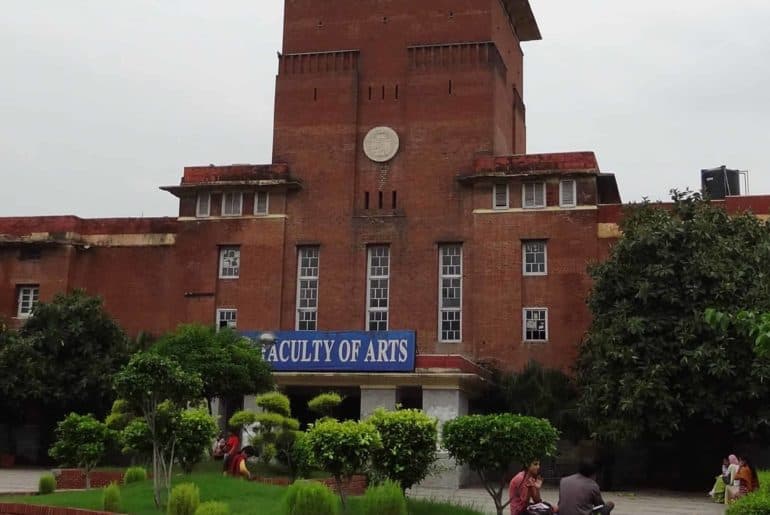
ABVP has voiced the concerns of the students by protesting at the Arts Faculty, addressing various issues related to admissions. The increment in college fees has been challenged along with irregularity in Sports Category admissions. Provision of admission by accepting undertaking, and introduction of EWS category in M. Phil/ PhD admissions has been requested. Importantly, inadequate arrangement in colleges for parents at the time of the admission process are some of the issues amongst other key issues that have been raised by the ABVP.

They (ABVP) has brought into the limelight how the admission staff in colleges who were admitting students to the first cut-off were not aware of the rules prescribed by the University. This caused problems in the smooth functioning during the admissions process. Admissions of students were also cancelled due to loopholes in the admission process.

Siddharth Yadav, the State Secretary of ABVP Delhi, said that if the demands are not met within the time period of ten days, then there will be more resolute protests against the administration.

DUSU President Shakti Singh also highlighted the issue of fee hike by saying, “There has been an arbitrary unaccounted fee increase in many DU colleges.” The issue Ramjas College’s fee hike has been previously reported on by DU Beat.

A memorandum to the Dean of Students Welfare had been submitted after the protest ended by the the ABVP delegation.

Attempts have been made by the student organisations so that the DU admission process does not become tedious and burdensome for the students. The true effects of the protests remain to be seen.

Feature Image Credits: Prateek Pankaj for DU Beat

Amrashree Mishra

[email protected]


The aspirants at were taken aback by the mismanagement, which led to several parents and students waiting till midnight to get their admission done. 

On 1st July 2019, the second day of admissions for the first cut-off list saw over-crowding and unprofessionalism by the authorities which led to a number of students suffer till midnight. 

A source who had gone to get admission in B.A. (Programme) during the first cut-off list revealed that there was only one counter for all the courses which caused the ruckus.  He said “They collected applications from all the students and then announced their names for eligibility. It took nearly four hours to get the eligibility slip.” According to him, many parents waited till midnight and even beyond that to complete the admission process. 

Another applicant’s sister who accompanied him for admission to Shaheed Bhagat Singh College (Evening) also stated that there was major inconsistency in administrations during admissions. She revealed that she had to go there twice to complete the process, first on 30th June and then on 1st July. She said, “There was no systematic process for admissions, no proper counters or queues which created immense chaos. The students from National Cadet Corps of the college were on duty and worked diligently but I couldn’t see any teacher-in-charge supervising them or helping them resolve the chaos.” 

We contacted Mr. Sunil Kumar, Secretary, Staff Council at Shaheed Bhagat Singh College Evening who himself stayed till 11 a.m. in the College to get the admissions done. He touted over admissions as a cause for this prolongation. He revealed that despite having a capacity of 814 seats, the college has taken in 1013 admissions, wherein even now, the admissions are open for courses like B.Com (Programme), B.Com (Hons.) and some combinations of B.A. Programme. While in other colleges, a combination of Commerce and Economics in B.A Programme has 15 seats ideally, the college has admitted around 100 students. He added  “Unlike other colleges l, we did not close the admissions at 6 p.m. We cooperated and admitted all the students who were eligible. My non-teaching staff stayed back till 4 a.m. in the morning to complete procedures for everyone who had come.” He also stated that around 8 p.m. the administration announced that parents can submit their documents and leave, the authorities would complete formalities and give them their fee slips in the morning the next day, but there were many who had come from different cities and wanted to take slips with them, so they stayed in the campus grounds till late.

He also added that there was no mismanagement per se, it just took a lot of time because of the intake of students. He stated  “We have admitted 106 students against the EWS quota which only has 37 seats, 438 against Unreserved category which had 373 seats, 308 admissions were done against 219 seats from the OBC quota and 141 against 121 for ST seats. We didn’t deny admission to any student who was eligible and hence, it took a lot of time”

Feature Image Credits: Anonymous 

Sakshi Arora

[email protected] 

We help you debunk one of the most important yet fussy process of withdrawal during the University of Delhi (DU) admissions. 

  • It is extremely important to hold a seat in any one of the colleges: With the cut-off trends on a rise, we can never rely on the previous year’s lists, our marks, or any other factors. It becomes important to have a water-tight plan and a back-up. Students must always have a plan-B ready for their course or college. The first two cut-off lists will always be cruel but remember to apply with each list wherever you see your course or college of choice or back-up and secure a seat. With each list, as the cut-offs fall, you can move up on your priority list by withdrawing from the previous college and applying to the new one. Securing a seat also gives us a sense of relief and security.
  • Keep an eye on the cut-off lists and tally your best of four: If the college you took admission in after the first cut-off list is not near to what desired, keep a close eye on the successive lists that are released. As soon as the next list is out, analyse the next best option you have as per your preferences based on the course or college. Ensure your Best of Four (BoF) is properly calculated and the correct subjects from the subject list have been included. Make sure that you cross check the cut-off and other pre-requisites for your course by visiting the college or the DU website.
  • Be clear and swift with the cancellation procedure and refund:  Once certain of fulfilling the criteria, go to the web portal and cancel the admission from the dashboard. With this you will now have access to take admission, in accordance with the new cut-off list. Print the new form along with its copies to take admission in the new college. The refund will be updated in the ‘wallet’ section. A cancellation fee of INR 1000 will be deducted and this will be reflected in the ‘wallet’ section. It is important to note that only one cancellation is allowed per cut-off list. Ensure that you qualify for the cut-off in the college you wish to shift to by checking in person before you cancel your admission. Once cancelled, you cannot be re-admitted in the eventuality that you do not secure admission in the next college.
  • Collect original documents and head to the new college for admission: First, go to the college you are already admitted in and collect your original documents by showing the cancellation form and the new admission form. After this, head towards the new college and repeat the admission procedure with your application, original documents, photocopies, and three recent passport sized photographs. The admission fee will be automatically adjusted from the ‘wallet’ and you will only be required to pay the balance. If some amount is left, it will be refunded to the applicant’s account.

A step by step summary of the process:

1.Take admission in a college of preference from the cut off list. Eg. B.A. (Honours) Psychology, College C

2.When new cut-off list is released, choose a course and college and ensure you fulfill the criteria (calculation and subjects in BoF) before going to take admission. Eg. Visit College B to check cut-off and eligibility.

3.At home, cancel the previous admission and fill new form. Eg. For B.A. (Honours) Psychology at College B.

4.The fee will be adjusted on the Wallet and INR 1000 will be deducted.

5.Collect original documents from College C and head over to College B and repeat the admission procedure. The total number of cancellations allowed will be (n-1) where ‘n’ is the number of cut-off lists.

Feature Image Credits: DU Beat archives

Shivani Dadhwal

[email protected]

The Delhi High Court says that rule may be reconsidered if petitioner succeeds in petition.

The Delhi High Court has issued a notice with respect to a matter presented to it on 26th June 2019 regarding a plea challenging the rule mandating deduction of 2.5% from the total percentage of a candidate in best four subjects in case of change of stream while securing admission in the University of Delhi (DU).

The rule mentioned in section 2.2 of the Undergraduate Bulletin of Information 2019-20 states that if a student is changing streams and aspiring for admission to the University in a subject that they did not study at the senior secondary level, a deduction of 2.5% from their Best of Four percentage would be considered as their score for making it to the cut-offs; a notion that puts many students at a disadvantage keeping in view the high scores required to secure a seat in the University.

Petitioner Muskan Aggarwal, a student from the science stream, has achieved a score of 96% in the class 12th CBSE Board Examinations and wants to pursue B.A. (Hons.) Political Science from DU.

It is her case that the rule mandating deduction in the percentage of marks in case of a change in the stream is “arbitrary, discriminatory and baseless”. She cites the rationale to support her argument that if a student is scoring well then they should have the opportunity to study any subject of their choice. The Court had directed the University to file a response to the plea within a week’s time.

The University maintains that this rule has been clarified in the earlier ruling of the High Court with respect to admissions criteria for this academic year (W.P. C No.6751/2019 passed on June 14th. 2019). Keeping in view the petitioner’s vehement dispute regarding this claim, the Vacation Bench of Honorable Justice Jyoti Singh has issued the notice regarding further hearing of this matter on 5th July 2019 before the Regular Bench of the High Court.

The High Court has also clarified that the petitioner, if successful in her petition, would be granted admission as per her final marks and corresponding ranking in the merit list.

Feature Image Credits: New Indian Express

Bhavya Pandey

[email protected]

After a row on the interview panel, another controversy surrounding discrimination in admissions has come up against St. Stephen’s College.

St. Stephens College released its cut-offs on 24th June 2019. Since then, there has been uproar amongst the Naga Students’ Union of Delhi regarding higher cut-offs for students from Christian Scheduled Tribe (CST), as compared to Christians from Other than Church of North India (COTH).

In a letter to the Principal, the Union said, “It is evident that there is high discrimination against students falling under CST category, where the cut-off marks have been kept much higher than the COTH”, as told in a report in The Hindu. The Union also added, “There is no rationality on how CST and COTH differ as far as the teaching of Christianity is concerned.” They called this difference a violation of their Constitutional Rights.

Comparing this year’s cut-offs to the last year’s, one can easily see that there has been a drastic change because last year the cut-offs for these quotas were either similar, or were lower for Christian ST’s in almost all courses.

In the list of 2018-19, the cut-off for B.A. Programme for COTH was at 88% (Commerce and Science) and at 85.5% (Humanities), while for CST, it was at 86% (Commerce and Science) and at 83.5% (Humanities). In this year’s list, the cut-off for COTH is at 88% (Commerce and Science) and at 86.5% (Humanities), while for CST it is set drastically higher at 96% (Commerce and Science) and at 94.5% (Humanities).

Similarly, this change in cut-off has also been observed in the B.Sc. Mathematics Course where, in 2018-19 for COTH, the cut-off was at 90.5% (Commerce and Science) and at 89.5% (Humanities), while for CST, it was at 82.5% (Commerce and Science) and at 81.5% (Humanities). In this year’s list, the cut-off for COTH is at 82.5% (Commerce and Science) and at 81.75% (Humanities), while for CST it is again set higher at 92.5% (Commerce), at 92.75% (Science) and at 91.75% (Humanities).

On contacting the Governing Body of St. Stephen’s College, we received no response regarding this matter.


Image Credits: Surbhit Rastogi for DU Beat


Sakshi Arora

s[email protected]

The University of Delhi (DU) has taken a step further to enhance the range of discussion and opportunities available for students, proving that it has the ability to respond to changing needs.

In a welcome decision taken by the University’s Academic Council, DU is now preparing to set up a center for research on Public Policy and Governance. The proposal for the establishment of such a center had been longstanding and was finally passed during the meeting held on 21st June 2019.

The minutes of the meeting revealed that the centre would be named ‘Delhi School of Public Policy & Governance’ or ‘DSP&G’. The minute added,” The School is the University’s endeavour to contribute to the quality of policymaking and governance in an increasingly complex and challenging world. It will provide a platform wherein a wider community of academics and practitioners will come together to initiate, develop and share ideas to address various emerging domestic and international public policy challenges.”

The subjects that the school intends to focus on are so vast that it presents an opportunity for researches and teachers from various departments and colleges to pursue projects at the centre. A member of the Academic Council, while speaking to Hindustan Times mentioned, “They (researchers) may continue working in their respective departments and colleges, and at the same time, carry out their research project in the School and participate in its programmes.”

The centre will, however, not limit itself to research scholars and plans on providing short term courses to practitioners such as lawmakers and policymakers working with the Government.

As per the proposal, the school will be governed by a Governing Body, an Advisory Council, and Area Coordinators. The Governing Body will have the Vice Chancellor or his nominee as the Chairperson. It will also have representatives from leading institutions in the field of Public Policy and Governance.

Further details about the functioning of the centre and the kind of courses and specialisations it would provide would be publicly available as its establishment takes shape.


Feature Image Credits: University of Delhi


Pragati Thapa

[email protected]

Music is for the soul; it is the oldest language of feeling and passion that transcends barriers like language, religion, region, etc. It unites people from all walks of life. It beguiles the senses, sets your mind free from the innate practicalities of life and creates a little space of escape where you can let the music empower, inspire and relax your mind.

For generations, people have used this medium to not only express themselves, but also to reach out to millions of other people. From the elusive folk music passed down from generations, to the emerging underground hip-hop music—it is dynamic and constantly evolving.

The recent trend of remixing old classic songs has garnered a lot of criticism for being lazy, showcasing lack of imagination, and being an easy alternative to earning quick money rather than by producing original music. However, India is not short of music or ideas. This diverse country has countless genres, instruments, and musicians with their unique music style still holding the power to enthrall the senses.

In a candid conversation, Sayani Rakshit, a member of Sangeetika, the Indian music society of Kamala Nehru College elaborates on classical music. She considers classical music to be permutations and combinations of ragas. These ragas are based on fixed set of seven notes which are combined in various ways to create countless melodies and compositions.

She further says, “Classical music is the deepest form of music that exists. There is no end to it, it has countless ragas. You have the most amount of scope here for creativity. For example, if am singing a composition, a bandish, I cannot tamper with the boundaries—but within the boundaries set by the raga, there is a lot of scope for creativity.”

Sayani mentions,“Beauty of classical music is in its routine. Ragas are sung at a particular time of the day. This is done because the notes have certain moods associated with them, which when sung at the right time are more impactful.”

She also adds, “I used to hate classical music when I first started out, but with a lot of practice and understanding, I am now an admirer of classical music. You need to understand the music in its various nuances and subtleties to appreciate it fully. This is why it is not very popular, because a person needs to understand various intricacies involved with this music to truly appreciate it.”

The underground hip-hop scene is rife with music that is politically and socially impactful. It is inspired and imaginative, hitting their audience with clean precision. Mcfreezak, a Delhi-based artist who is part of the Khirkee collective considers commercial hip-hop to be scripted. It feels artificial, highly constructed and fake, which loses the appeal of everything that real hip-hop aspires to be. Since it is not real, it is not able to connect with the real masses. Whereas their rap is grounded with the people and connects with their issues.

Mahima Dayal, famously known as Bawari Basanti, is a Hindustani classical and folk singer with a debut album “Underwater”. In a conversation with her, she shares her thoughts on folk music and considers it to be all about story telling and sharing wisdom. It’s one of the few art forms that cannot be taught, but is gained through osmosis.

She elaborates, “When I listen to manganihars, I can feel the sand falling through my fingers. Similarly, listening to bhangra and gidda music instantly puts an ecstatic smile on my face. This happens because folk music is a rustic reflection of our society and listening to it makes us feel more real. There is no pretence in the sound.”

Murshidabadi Project collaborates with musicians from all across the globe and specialises in simple yet peaceful Sufi music. He says, “Sufism talks about love and knowing the self to meet the divine. Its music is ideally raw and doesn’t require much accompaniment.”

According to him, Sufism is relevant in the present socio-political situation as it talks about love, peace and harmony. However, the mainstream audience is not in touch with it, as they do not have any choice as to the content that they choose to consume. The internet and television is so overpowered by the filmy music, that other genres do not get a platform.

As various classical genres of music struggle to gain ground in the contemporary demand trends of the music industry, a certain shift in the tastes and preferences of the audiences also can be easily observed in the subcontinent. Independent pop-rock band The Local Train or Indie artist Prateek Kuhad’s rise to fame is a testament to the previously mentioned shift in consumption. As new genres are on the rise, the idea of striking a balance between the contemporary and classical demands acknowledgement in the music industry.

Feature Image Credits: Vaibhav Tekchandani for DU Beat

Antriksha Pathania
[email protected]