Tag

Dalits

Browsing

Lessons from the Elective Course explores the Delhi University paper’s continued relevance today, demonstrating how Ambedkar’s ideas on caste, democracy, feminism, and social justice continue to challenge and inform contemporary debates.

In a moment when Ambedkar’s legacy is being relentlessly appropriated across the political spectrum, Delhi University’s paper Understanding Ambedkar acquires an uneasy relevance. The contemporary debate surrounding UGC guidelines on caste equity has further heightened this urgency: caste politics and Ambedkarian thought are inextricably linked, regardless of institutional attempts to sanitise one from the other. My engagement with the paper was intellectually uneven, characterised by stimulating readings and conceptual breakthroughs, yet weakened by pedagogical fragility–a classroom experience that nonetheless yielded powerful theoretical insights. This contradiction mirrors Ambedkar himself: complex, difficult to contain, and resistant to being flattened into ideological comfort. To “understand Ambedkar” is not to canonise him, but to confront the discomfort his ideas generate— regarding caste, power, nationhood, gender, and democracy. It is this discomfort, rather than consensus, that truly defines his relevance.

Critically Reading Understanding Ambedkar

The paper offers scope for genuine critical engagement precisely because of its reliance on primary sources—Ambedkar’s own books, essays, Constituent Assembly debates, and speeches. This direct encounter with his voice enables students to engage with his thinking on society, economy, history, politics, and democracy without excessive mediation or interpretive filtering. One of the paper’s most valuable intellectual interventions is its decisive dismantling of the myth of Ambedkar as a demi-god. He emerges instead as a rigorous, evolving thinker—brilliant, yet not infallible; transformative, yet marked by intellectual limitations, including constrained readings of history and selective analytical frameworks.

This makes the paper equally important for two opposing constituencies: those who revere Ambedkar uncritically and those who dismiss him ideologically. Both are compelled to confront their caricatures. However, the paper’s omissions remain structurally indefensible. There is no substantive engagement with reservations or affirmative action—central to Ambedkar’s political praxis. The absence of a serious treatment of Ambedkar–Gandhi relations further weakens the framework. Most indefensible of all is the exclusion of Annihilation of Caste as a core text. A paper titled Understanding Ambedkar without it is not merely incomplete; it reflects a fundamental failure of academic judgment.

Ambedkar as a Feminist

Ambedkar can be read as a proto-feminist in the deepest political sense—not through symbolic gestures, but through structural interventions in law, social reform, and institutional design. His sustained work on women’s education, labour rights, marriage, inheritance, and legal equality constitutes one of the most comprehensive early frameworks for gender justice in modern India, unmatched by most nationalist contemporaries. Sharmila Rege’s intervention highlights that feminist thought in India has long marginalised Ambedkar, even while canonising figures such as Gandhi and Nehru. She locates this erasure within nationalist historiography and academic co-optation, where Dalit politics was absorbed without engaging its epistemological challenge. Rege argues that caste and gender cannot be analytically separated or simplistically equated; violence against Dalit women is neither merely “caste atrocity” nor solely “sexual violence,” but a structurally entangled condition. Reclaiming Ambedkar, for her, means rejecting binaries of sameness and difference and recognising graded caste patriarchy as a distinct system. Consequently, a feminist turn to Ambedkar becomes not symbolic inclusion, but a theoretical reconstruction of feminism itself through an anti-caste lens. The most significant institutional expression of this feminist vision was the Hindu Code Bill—Ambedkar’s most radical and far-reaching intervention for women’s emancipation. This bill sought to dismantle the legal foundations of Brahmanical patriarchy by reforming marriage, inheritance, property rights, divorce, and adoption, directly challenging the sacred authority of Hindu personal law. For the first time, women were recognised as legal subjects rather than custodial dependents within family structures. 

Ambedkar as a Historian: Limits of His Historical Method

Ambedkar’s engagement with history, unlike his work in law, economics, or constitutional theory, represents one of the weaker dimensions of his intellectual legacy. Trained historians often encounter significant methodological challenges in his historical writings. Although his rejection of racial explanations for caste and untouchability was a critical and progressive move, the alternative frameworks he constructed are analytically fragile. For instance, his theory of “Broken Men” as the origin of untouchability lacks empirical grounding and relies more on speculative reconstruction than historical evidence.

Much of Ambedkar’s reading of ancient India is shaped by an overly theological framework, reducing complex social processes to a binary struggle between Brahmanism and Buddhism. This religious reductionism flattens historical plurality and substitutes social history with moral conflict. His essay Buddha and Karl Marx exemplifies this problem: in attempting to discredit Marxism, he advances ahistorical claims—such as the absence of non-Kshatriya kings before the rise of Buddhism—that are demonstrably inaccurate. These are not interpretive disagreements but factual distortions.

It is unsurprising that professional historians have largely refrained from engaging deeply with Ambedkar’s historical scholarship. His historical method is frequently speculative, ideologically driven, and weakly evidentiary. Ambedkar’s enduring significance resides not in his historiography, but in his political theory, constitutional vision, and anti-caste philosophy—domains where his intellectual rigor remains both defensible and transformative.

Caste — Jaati Jo Kabhi Nahi Jaati

Ambedkar’s discourse on caste remains as urgent today as it was seventy-five years ago. Constitutional guarantees of equality, by themselves, have never been sufficient to dismantle caste as a lived social reality. Law can prohibit discrimination; it cannot erase social reproduction. In recent years, caste pride among the youth has not only resurfaced but intensified, circulating through digital cultures, identity politics, and performative assertions of “heritage,” revealing how caste mutates rather than disappears.

It is within this context that the current controversy surrounding the UGC guidelines on caste equity must be considered. The resistance to institutional recognition of caste is not a neutral demand for “merit” or “universality,” but a political anxiety regarding structural privilege. The paper Understanding Ambedkar becomes particularly relevant here, as it exposes how caste politics is consistently lethal; however, the refusal to recognise caste as a problem is equally dangerous. Ambedkar argued that annihilation requires more than constitutional text—it demands social consciousness, institutional courage, and moral confrontation. Without that, caste does not die; it only changes form.

Read Also: The queer case of dalit queers

Image Credits: Library of Congress

Madhav Choudhary
[email protected]

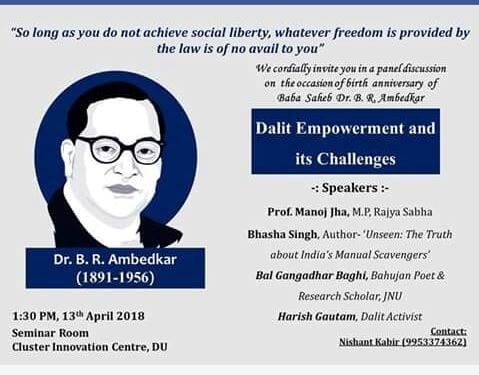
Just as the world was gearing up for the 127th birth anniversary of Bhimrao Ramji Ambedkar, a seminar at Cluster Innovation Centre (CIC), University of Delhi, was allegedly cancelled at the last moment.

The seminar ‘Dalit Empowerment and its Challenges’ was scheduled for 13th April at 1.30 p.m. in the CIC seminar room. The posters for the same were posted across the North Campus and circulated diligently on social media.

The illustrated speakers list included Manoj Jha, a member of Rajya Sabha and the national spokesperson of the Rashtriya Janta Dal, Bal Gangadhar Baghi, a Bahujan poet and Jawaharlal Nehru University research scholar, Harish Gautam, a Dalit activist, and Bhasha Singh a journalist and an author.

According to the Nishant, a final year student of B.A. Honours (Humanities & Social Sciences), the seminar room was booked on 9th of April and the intent of booking was made clear to the director’s office. However, just a day before the event Prof. Harinder P. Singh, Director, CIC, declined the permission after the organisers personally informed him about the event. The Director cited security issues and instead asked the organisers to attend another event which the University is conducting on April 14th and in which Union Social Justice Minister is taking part.

Another student, on the condition of anonymity, told DU Beat that the Director asked the organisers to shift their venue from CIC to Shankar Lal Hall because he “doesn’t want any controversy in the Centre”. “The Director gave us a long speech explaining a complicated procedure that we were suppose to follow. Honestly, these are all excuses. Everyone knew that the seminar is going to happen. As we are working with the Communal Harmony Project, the project mentor, Prof. Ashu Misra, knew about the seminar. While filling the form for booking we explicitly wrote the purpose of booking. The administration is seeking refuge under ignorance. We spent weeks trying to contact the panelist. It broke my heart when I had to cancel all invites. All money that was put into posters is wasted,” he rued.

Speaking to DU Beat, Dr. Saleem Mir,  Coordinator of B.A. Hons. (Humanities and Social Science), said that permission wasn’t sought before the event. “As a Programme Coordinator, I was also not informed about the upcoming seminar. I got the call from the Director about the event and I couldn’t tell him anything about it. The students just sought permission to organise an event without giving the details of who is coming and why it is being organised. Any talk, event, workshop, lecture, activity, be it academic or co-curricular or extra-curricular, can be organised, but prior permission has to be taken from the Coordinator and the Director.”

He further stressed, “When even teachers take permission from the authorities prior to inviting the people or planning the event then shouldn’t students also do the same? Sometimes you can take permission a little later, but not just one day before the event. How is the University going to make security arrangements especially when a politician is coming to speak?”

When DU Beat contacted the Director’s office, Mr. Prem Bhagat, Assistant, told us that due to upcoming National Assessment and Accreditation Council (NAAC) visit and other engagements the Director missed the details of the event. He also told us the event was merely asked to be postponed.

The press release issued by the organisers claims that the permit was revoked “under pressure of some groups and individuals who are against the idea of Babasaheb”. “The abruptness with which the permission for the programme was cancelled shows the deep-seated Brahaminical attitude of some groups and individuals in Cluster Innovation Center,” the statement further asserts. The press release also accused Prof. Pankaj Tyagi, Coordinator, M.Sc. (Mathematics Education), of vandalising the posters. DU Beat’s attempts to reach Prof. Tyagi were unsuccessful.

Refuting these allegations Dr. Saleem Mir, Coordinator, B.A. Hons. (Humanities and Social Science) said, “Is our Director a Brahmin? He is a Sikh. Is the Coordinator a Brahmin?  I am a Muslim. I don’t understand where from did this Brahaminical pressure thing is coming from. As responsible citizens, we must not level such allegations so casually. As students of CIC, the organisers must feel ashamed before leveling these allegations in an environment like CIC where the faculty is always talking about the nation building with minorities, Dalits, tribals and the marginalised as the main engines of the progress of a nation. Our curriculum is designed in such a way that we undertake our semester-long projects majorly focusing on problems of the poor and downtrodden.”


Feature Image Credits: Nishant Kabir

Niharika Dabral

[email protected]

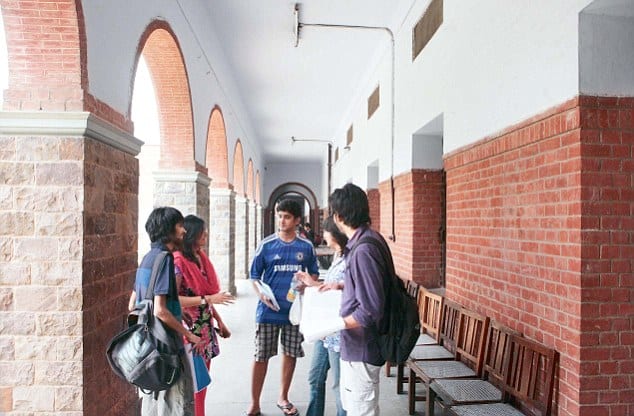
Known for the diversity of its student community, the University of Delhi ends up masking the dominance of the privileged in its spaces by not addressing the emptiness of the concept of merit.

Despite the perpetual complaints of corruption and inefficiency within public institutions and government offices, public higher education institutions continue to be icons of (relative) integrity in India. Government colleges regularly top the lists of best institutions in the country. Unlike private institutions for one, they seemingly are based on merit alone rather than unscrupulous “donations” and have a sense of legitimacy associated with them. The University of Delhi is no exception, with it painting a picture of being socially progressive with its apparently diverse crowds from all over the country.

However, a simple examination of the makeup of the student body shows a different side. While the geographical diversity holds up to an extent, it shows a dominance of those from urban areas. This is important for a seemingly inclusive institution, considering the fact that about 70% of the population lives in rural area, and is also indicative of the obvious dearth of facilities in rural areas. Socially, a look at the merit list shows the disproportionate lack of lower caste and minority religions. An article by Nidhin Shobana pointed to her similar observations of the alumni list of Miranda House and is worth a look.

Even without the statistics, encounters with the caste/class privilege are routine and invisible. If you had lived in a big city, chances are you probably have a few schoolmates in the University, too. Or, there must be other students in the University from your city, from the same circle of three or four top schools of that city. Or, maybe you’ve had instances where you’ve run into an old classmate/neighbour/family friend on the University campus, wondered “What a small world!”, and left it at that. If you ask those who do not belong to your social strata, however, it turns out that these chance meetings and coincidences have their frequencies going down as one’s social standing goes down.

Of course, this is not a sweeping generalisation. There is no total dominance. It does seem odd, though, that most people who seem to do well as per the narrow definitions of marks scored are of a numerically minuscule class, and will probably also dominate corporate and administrative fields when they leave these institutions. Even worse, there seems to be no conversation on this unfair dominance that hides diabolically in the name of “merit”.

A quick activity can illustrate the point that this article is trying to make – we urge our readers to ask within their respective classes, students who are Dalits and Bahujans, to raise their hands. The few hands will speak for itself.  Premier institutions of the country, like the ones within the University of Delhi, reek of the hegemony of the Brahmin-Savarna class. Merit isn’t the sole reason that lands them within the confines of such colleges, but the perpetual cycle of a fairy advantageous existence because of their social standing within the larger society. It is the ugly truth that we must confront. It is the norm that has dictated the corridors of such colleges for decades now. Nidhin Shobana’s article, speaks of the same.

So, the next time you hear someone in the university merrily quip, ‘what a small world’, pat them on their backs and ask them to think twice.


Feature Image Credits – Fuccha.in


Ankita Dhar Karmakar
[email protected]

Rishika Singh
[email protected]