The tussle between academics and activities causes trouble to almost all students in the Varsity. But why should such a situation arise at all ?
The students studying in the University of Delhi (DU) are among the top scorers in India. The level of competition therefore, is very high. And these students are good not only in academics but other activities as well. Societies constitute a very important part of the college. There are so many students who prioritize societies over classes. That can be a good thing and a bad thing at the same time.
It is difficult to choose academics or activities, if you have to choose one. I write about this choosing one simply because a point comes during college where you end up tripping, trying to balance between classes and society work. It is not an easy task to choose one, of course but when one has his/her priorities straight, it is not such a difficult task too. For example, in most of the colleges attendance plays a very important part in getting you the admit card for sitting in the examination. Now, when you are involved in an active society, you are to commit yourself towards it. Here, a confusing situation arises. Students often find themselves questioning whether they should go sit in the lectures for the attendance or go for the session of their society.
For all the newbies, here’s a suggestion: Take some time for yourself. Do some thinking. Get your priorities straight. If the lectures feel enlightening and you want to pursue your career in academics in the future, chuck the society. You are one human being who can only manage a couple of things at a time. And there’s no moral obligation here. Talk to your seniors if you find yourself in such a situation. They’ll understand if you’re lucky. Likewise, if the society means much more to you than classes, then go for it. Be honest and make your stance clear.
The thing however, is that this is not always a black and white case. We are encased within this system where we have to attend classes no matter how unhelpful we find them. What is the point of sitting in the classroom, listening to a teacher when your mind is focused on the students sitting outside under the light of the sun practicing their music? It is not just the academics that can guarantee us a successful career, after all.
The academic congress started its buzz with “Pre-Academic Congress” events and workshops conducted by various departments of the college.
Body Image Workshop at LSR
Mirror on the Wall: Am I the Loveliest of them All?
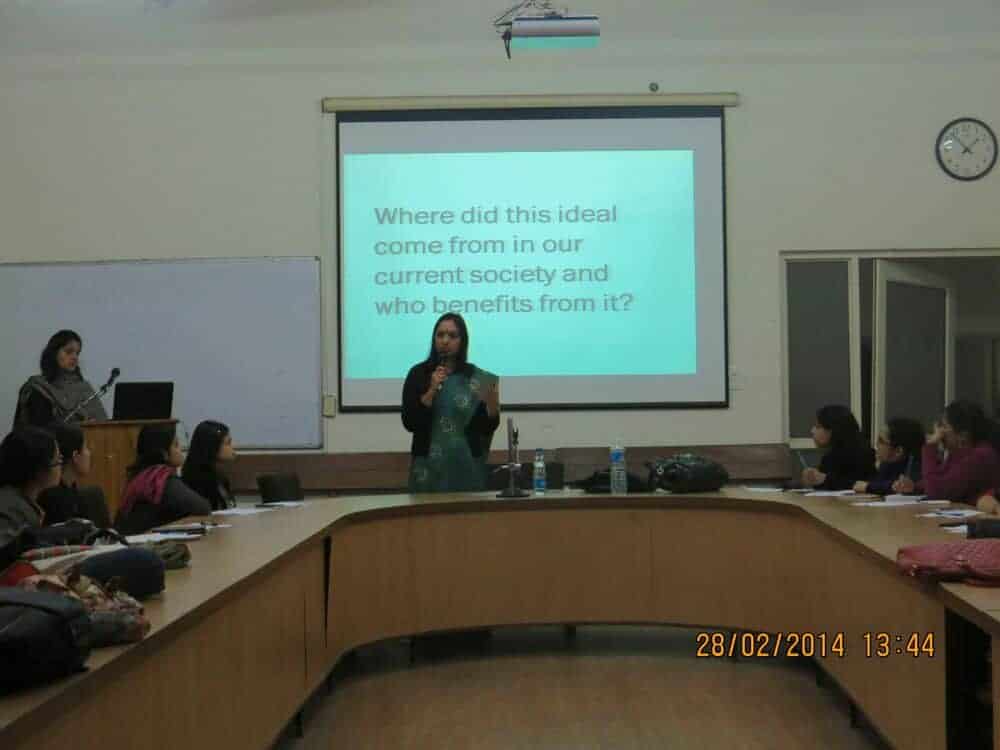
Dr. Kanika K Ahuja, Associate Professor, Department of Psychology, Lady Shri Ram College for Women conducted a body image workshop, ‘Mirror on the Wall: Am I the Loveliest of Them All?’on 28th February as a pre-event to the academic congress. It was an experiential workshop that challenged popular notions of beauty and the ideal body. A striking feature of the workshop was the Mirror Assignment, which required the participants to stand in front of a mirror, observe themselves and write down at least 6 positive qualities about themselves. In the words of Neha Yadav, a second year student, “It made me appreciate those qualities that I normally don’t care enough to notice.”
One Directional Woman and the Feminization of Labour
Dr Nandini Chandra, Assistant Professor in the Department of English at Delhi University, in her session titled, ‘One Directional Woman and the Feminization of Labour’, succeeded in giving a new perspective to feminism. Quoting from important Hindi texts like ‘Naukar ki Kammez’, she expressed the power dynamics that earlier worked, and still prevail in the bourgeois Indian families. In a society that exploits both men and women, she discussed how men are counted as ‘living labours’, with specified working hours and holidays while the women are treated no more than ‘dead labours’, machines that have to work endlessly. This was followed by an interactive question and answer session where Dr. Chandra engaged with the students and faculty.
Workshop on Sexuality
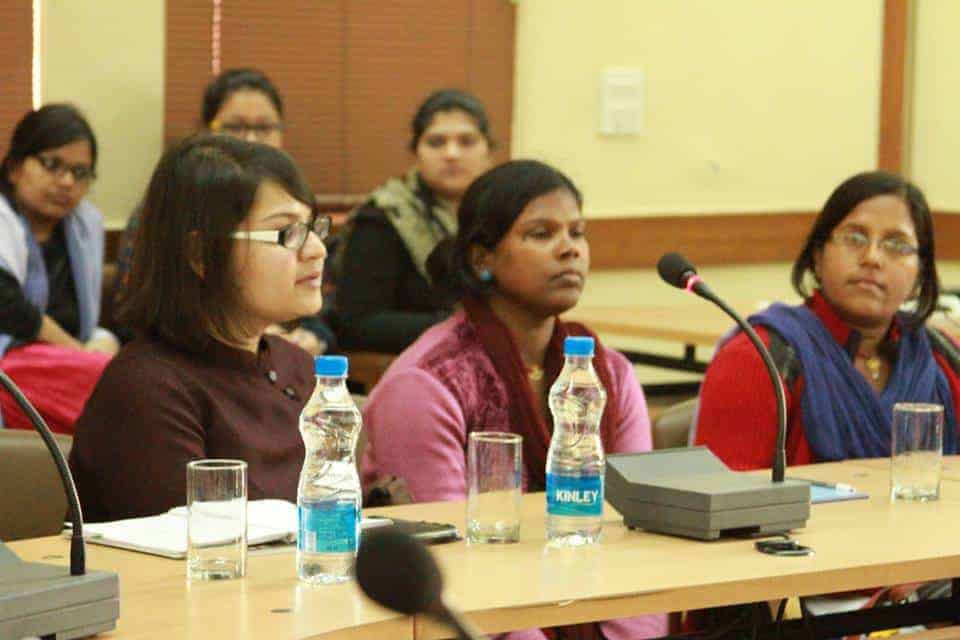
The Political Science Department hosted a workshop on “Sexuality” on 1st March. The workshop was conducted by CREA (Creating Resources for Empowerment in Action), which is a feminist-human rights organisation based in New Delhi. It is one of the few international women’s rights organisations based in the global South, led by Southern feminists, which works at the grassroots, national, regional, and international levels. The workshop focused on the sexual and reproductive rights of women and investigated the links between sexuality, rights, gender and health and their interface with socio-cultural and legal issues.
Image Credit: Meenakshi Pahuja
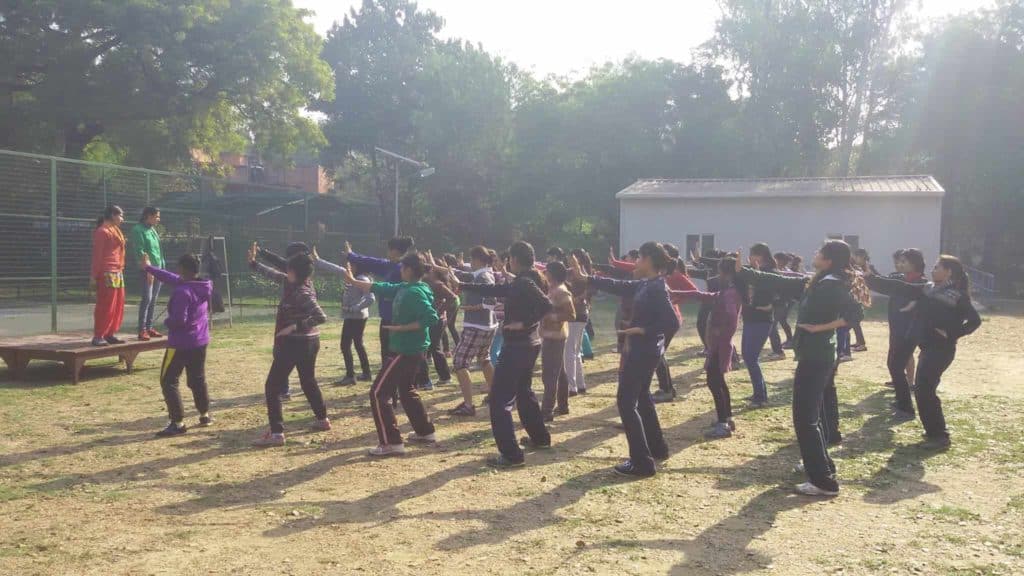
Other academic congress pre-events include a “Self Defence Workshop” a five day workshop facilitated by the Delhi Police and Ms. Meenakshi Pahuja from 3rd-7th March. On the workshop, Ms. Pahuja says, “The purpose of this workshop is to empower young women especially those who travel alone in Delhi. Our aim is to emancipate women to at least help protect themselves if they are unable to help others.”
On 3rd March, the Journalism and Mass Communication Department organized an interactive session with women journalists of “Khabar Lahariya”, an Indian newspaper published in certain rural dialects of Hindi, including Bundeli and Awadhi. This session was facilitated by Nirantar, which trains and provides ongoing support to rural women journalists publishing the Khabar Lahariya newspaper in local languages.
The Journalism department hosts a session with women journalists of Khabar Lahariya.
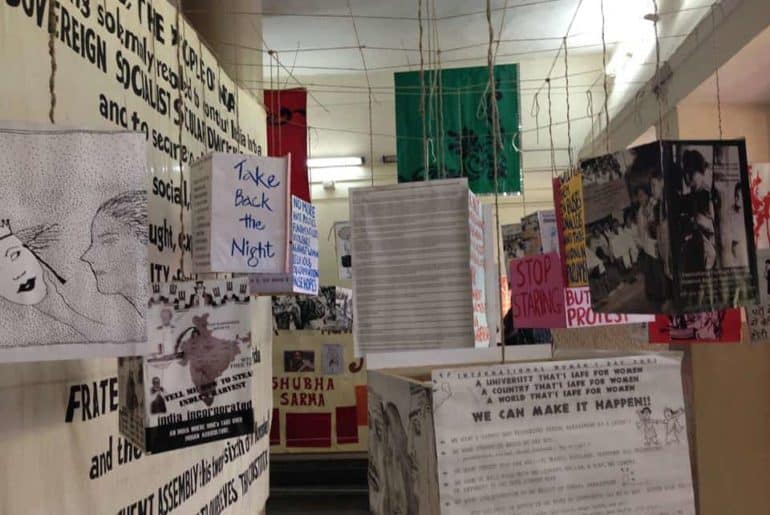
The pre-congress event schedule also boasts of a creative touch to the conference with “Occupy Wall Street” where we will display graffiti art work of the students on the theme of the congress.
With that the pre-events came to end on 4th March with parallel sessions of a special lecture by Professor Jayanti Ghosh on ‘Gender and Globalization’, screening of ‘Jai Bhim Comrade’ followed by discussion with Anand Patwardhan and ‘Paper Presentation on Gender and Sports’ by Meenakshi Pahuja.
Jayanti Ghosh concluded her talk stating, “I always enjoy coming to Lady Shri Ram College. It is always nice to interact with an intelligent bunch of girls who make me feel positive about the future.”
Patwardhan’s analysis of caste on the other hand helped reflect the gendered caste nature setting a theme for the “GenderKnowledge” with special mentions like the brutal Khairlanji Rape Case.
Bilingual knowledge was also witnessed with a Special Lecture by Dr. Kanchana Natrajan on “The Question of Gender in Hindi Literature” giving a perfect prelude to the academic congress.
The pre-events ended with the declaration that the United Nations Secretary- General Ban Ki-Moon will be sending his message of solidarity through Ms. Kiran Mehra-Kerpelman, Director of the United Nations Information Centre (UNIC) tomorrow for the Gender Congress on the occasion of International Women’s Day!
The National Science Fest at St. Stephen’s College began with the ‘Inaugural Ceremony’ at 2 pm on 24th January. Principal Rev. Dr. Valson Thampu inaugurated the event with a motivational speech encouraging the young science students to strive for the best, followed by a screening of National Science Fest 2014 official video.
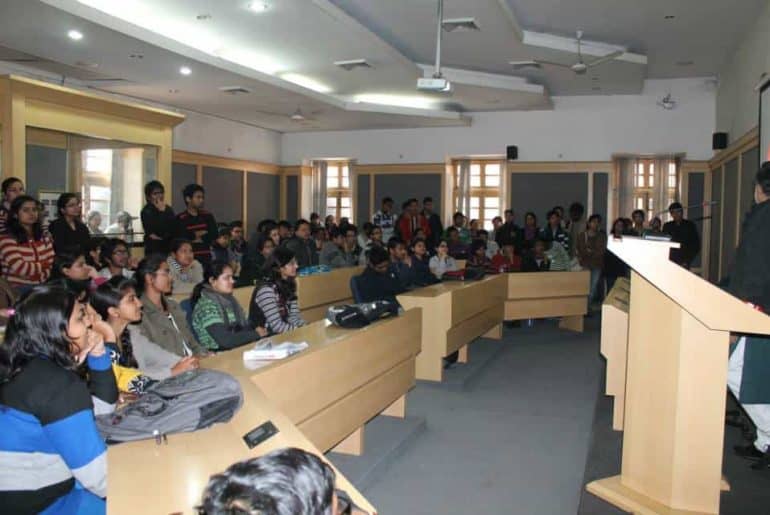
Dr. Patrick Dasgupta, presently a professor at Department of Physics and Astrophysics, University of Delhi, in a NSF Talk, spoke about the fundamentals of black holes, be it Schwarzschild radius or Hawking Radiation. Known for his work in the field of gravitational waves, quasars and cosmology he went on to present the ‘Information Loss Paradox’ associated with black holes. The talk was followed with a question-answer session where the members of the audience, varying from undergraduate students to research scholars, interacted with Dr. Dasgupta. After Dr. Dasgupta’s talk, the triathlon of events began at various venues of the college with the Paper Presentation event in Room A, Debugging Electronicz event at the New Physics Lecture Theatre (NPLT) and a talk on “The Fascinating World of Chemistry” by Dr. Subho Mozumdar, a faculty member of the Department of Chemistry at University of Delhi.
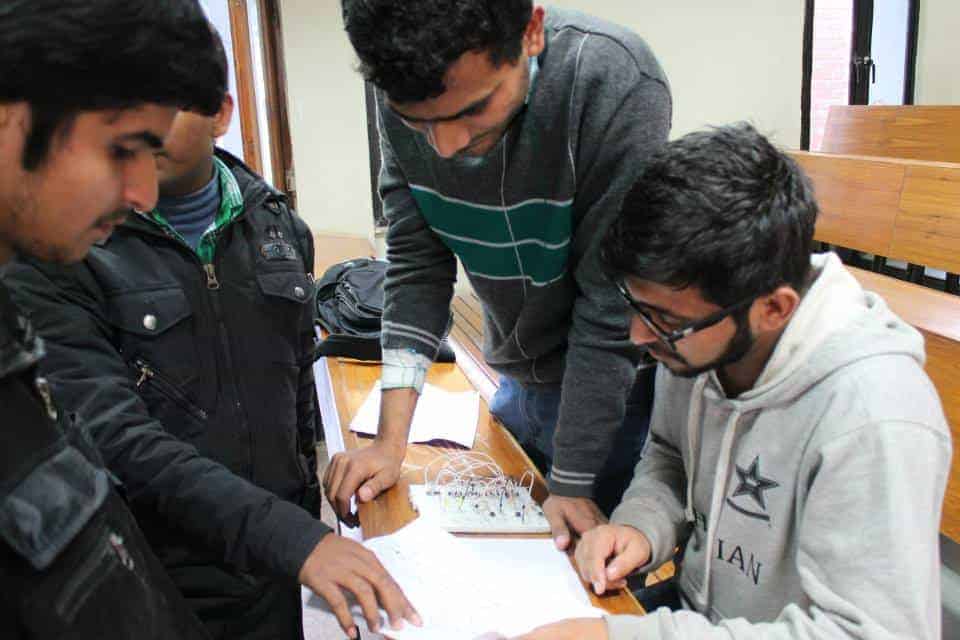
‘Debugging Electronicz’ was based on the idea of testing the participants’ interest and expertise in electronics, and their capability in debugging flawed electronic circuits. It led to an intense final between the two best teams on an actual large circuit, basically a convoluted Adder circuit, where the finalists had to find out the flaws inherent in the realized circuit. Finally, in an all-Stephanian final, Ankit Dhanuka and Motaram clinched the first position, while Abel and Ojasvi received the second prize.
Along the main corridor, in Room A, the paper presentation competition took off with 15 student entries from all over the country belonging to various courses of study. Sahil Mathur, student of Information Technology & Mathematics at the Cluster Innovation Centre (CIC) earned the top spot for his paper on “Developing Genetic Algorithm inspired intelligent routing protocol for Wireless Sensor Networks”. The second prize was shared by Raktim Sen and Manasij Pal Chowdhury of Stephen’s and an individual entry by Deepto Mozumdar.