What unfolded as a dispute on ‘Scroll.in’ between Jakob De Roover—a professor of India Studies and Comparative Science of Cultures at Ghent University, Belgium and Professor Anil K. Aneja—Head of the Department, Department of English, University of Delhi, set in motion a series of attacks over the understanding of scholarly standards.
On 7th September 2024, Jakob De Roover published an article on Scroll.in titled, “Why a professor from Belgium was branded ‘anti-India’ after Delhi lecture on 18th-century Dutch text” which accused the Department of English at Delhi University of failing to critically engage with a text and instead “cancelling” De Roover for being “anti-India.”
Professor De Roover was invited to lead workshops under a government-funded project titled “Indian-European Entanglements.” His approach, as claimed by him, aimed to explore how European narratives about India often reflect more about European self-perception than about Indian reality. Drawing on his extensive experience and education received under the mentorship of Professor SN Balagangadhara, he sought to encourage critical engagement with historical and contemporary stereotypes about Indian culture.
During a workshop on August 24, 2024, Professor De Roover analysed a 1799 Dutch children’s magazine that presented a racially hierarchical view of humanity, positioning Europeans at the top and depicting Hindus as lesser beings. His intent was to provoke discussion around how such outdated ideas persist in modern discourse.
An excerpt from the same Dutch magazine caused confusion amongst the students, as asserted by De Roover, the alleged excerpt being:
“Everywhere human beings are divided into ranks or classes, but these classes approach and mingle with each other from time to time, and those belonging to the lowest ranks at least have some hope to improve their condition over time; but in Hindustan this hope has been cut off completely.”
De Roover put forth the idea that narratives based on little empirical evidence and research into the understanding of caste in 1799 could then prove to be substantiated facts about caste in contemporary India. He emphasised that the text exemplifies “ignorance about India and a biblical story about humankind.”
This contestation disturbed the students who began to defend the statement as a truth about their own society. These doubts were to be tackled by the professor in the following workshop, scheduled on 28th August.
The workshop never took place. The head of the department, Anil Kumar Aneja, told De Roover that the upcoming lecture was cancelled owing to “the lack of availability of venues”. It was later revealed that his cancellation was because of external pressure to censor what was claimed to be an anti-India sentiment. He was informed by his colleagues that the university administration had called for an examination of the recordings of his workshops to investigate the matter of the lectures. Professor Jakob De Roover accused members of the executive council of Delhi University’s Teachers Association (DUTA) of circulating messages that misrepresented his academic intentions as portraying India in a negative light.
According to De Roover, he was engaging with academicians who could not distinguish between quoting a text, for analysis and criticism, and endorsing a text. The claims cited by the speaker were ascribed to the speaker himself. This effectively deprived the students of learning. Further, he accused the hosts of succumbing to pressure and allowing censorship, without confronting him.
On behalf of the English Department, Professor Anil K Aneja vehemently refuted all the allegations made against the department in general and him in particular. It was asserted that the article misrepresented the events surrounding his visit and the nature of his interactions with faculty members.
In the detailed statement, the department underlined its traditions of encouraging academic debate and the assurance of quality in education. It noted its disappointment at, what it termed, a failure to meet journalistic standards on the part of Scroll.in for publishing the article without first verifying its claims.
The department specifically addressed a few points taken from Professor Roover’s article, pointing at them as fabrications and misrepresentations, as highlighted below:
Allegations of ‘Anti-India’ Sentiments: The department unequivocally denied labelling Professor Roover “anti-India” during his visit. They asserted that no faculty member, including the Head of the Department, Professor Anil Aneja, used such terminology or accorded him anything but respect.
Workshop Focus: The department refuted Roover’s assertion that the workshop centred on European representations of India. They clarified that the workshop was titled “Digital Humanities & Methodological Tools,” and that the intended academic focus on digital humanities was not adhered to in his sessions either directly or indirectly.
Students’ Reaction: Roover mentioned that students became disturbed during his lecture and began to defend their culture against the statements made by him, which the department suggested indicated an intent to provoke controversy rather than engage meaningfully with the workshop’s topic, thereby losing thread of it.
Cancellation of Subsequent Lectures: The department asserted that Professor Roover’s claims about the cancellation of following lectures owing to a lack of venue was false. Contrary to his claims, he did take a three-hour lecture on the following 28th August, the maintained attendance of which could be produced for verification. Further, the readings for the participants of the next session scheduled on August 31st, 2024, were shared on August 29th. The department clarified that if Roover was labelled “anti-India”, the readings would not have been circulated on the 29th.
Departure from the University: The department expressed shock at Roover’s abrupt departure from the university without notification, which left the workshop coordinator and attendees waiting for his appearance at a later session. They criticized Roover for not informing the coordinators of his departure, labelling it unprofessional. Further, the Coordinator, Professor Ujjawal Jana’s attempts to reach him via call/text/WhatsApp were unsuccessful.
Allegations against Professor Anil K Aneja: The article written by Professor Roover was said to be biased, deliberately ignoring facts to malign the reputation of HOD Anil K Aneja.
On “endorsing” the Text: The department stated that the text in question was endorsed by the Ghent University professor which can be inferred from his permission to allow digressions to take place in the session, actively participating in and, at times, defending these digressions, as well as getting offended when questioned on the relevance of all such digressions to the topic of the workshop “Digital Humanities and Methodological Tools”.
Misrepresentation Of Academic Integrity: The department condemned Roover’s suggestion that faculty members were silencing academic discourse. They asserted that there is a strong tradition of open discussion in their department, particularly in post-colonial studies. Further, they accused Roover of undermining the capacity of the Indian intelligentsia and disgracing India by extension.
In their response, highlighting the value of journalistic integrity and ethical reporting, the department urged Scroll.in to give them an opportunity to air their side of the narrative. It demanded a balanced representation of facts, concerned that the publication could do irreparable damage to the university and its faculty’s reputation. The department concluded its statement by requesting that its detailed response be published alongside Roover’s article to ensure readers receive a comprehensive understanding of the events in question. They once more affirmed their commitment to academic excellence and open discourse within the university and beyond.
As the situation continues to unfold, it nudges forward the question of academic integrity and accountability in academia. The commitment to academic freedom and scholarly discussion remains under threat as scholars debate the reliability of testimonies and accuse the other of mistreatment.
Featured Image credits: Scroll.in
Read also: DU Teachers’ Associations Unite to Take on RSS-backed Union in DUTA Elections
Bhavana Bhaskar
[email protected]

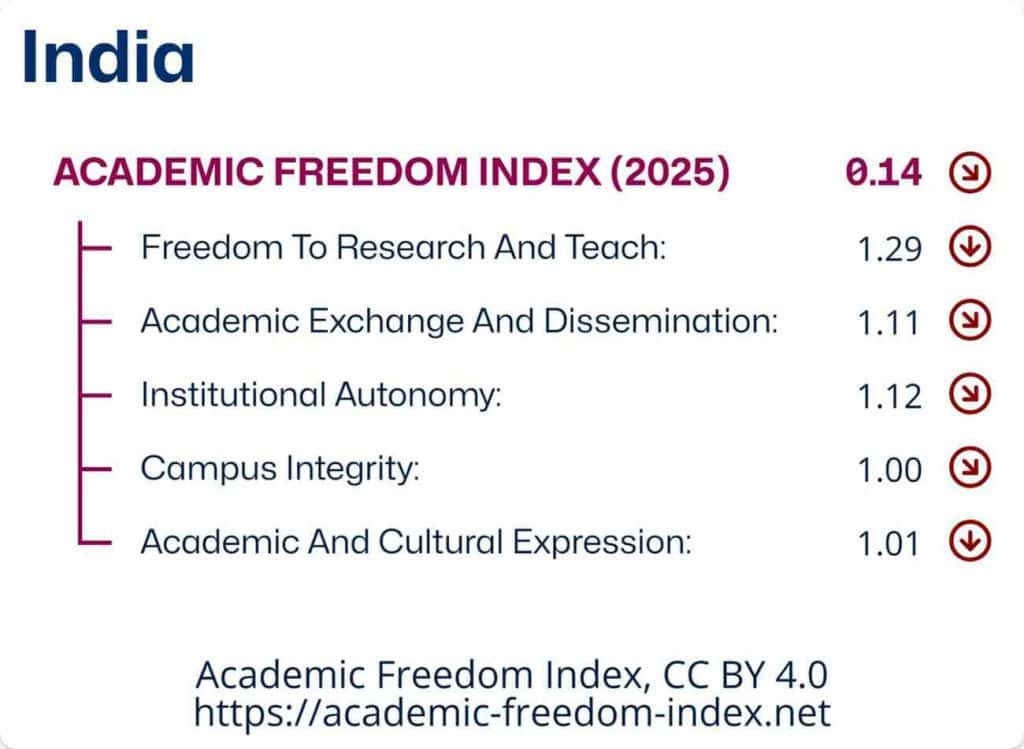 Source: V-Dem Academic Freedom Report