Tag

ABVP

Browsing

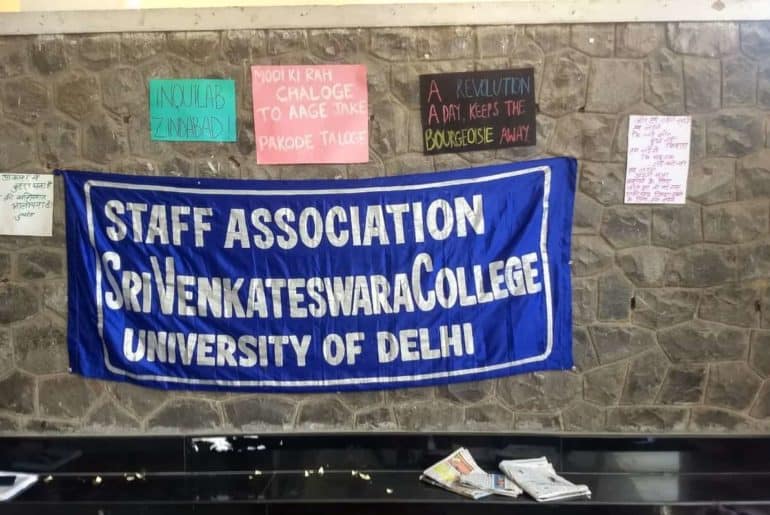
The DUTA strike held from the 19th of March witnessed student quarters of different colleges espousing the cause of the teachers’ strike. In the event of the unfortunate lack of camaraderie between two student groups enveloped by a conflict of interests, a tussle broke out in Sri Venkateswara College on the 23rd of March 2018. There were allegations by a group of students who were protesting with the teachers, that members of the ABVP unit of the college stormed their protest and disrupted the strike.

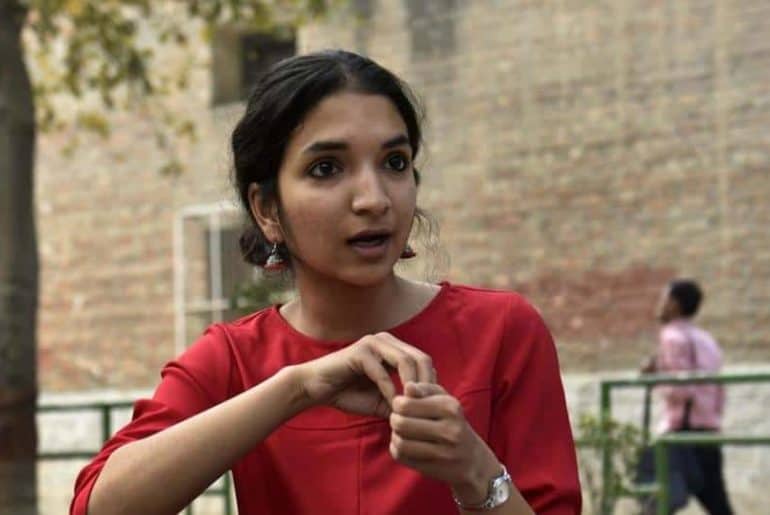
In a phone call conversation with the DU Beat correspondent, Akangsha Chetri, a student protester, described the incident, “While we were striking along with the teachers, the Vice President Alok Rajput and the Joint Secretary Sanjay Sharma walked in with a group of people who aren’t even from our college. They were carrying Bhagat Singh’s poster because it was his birthday. And they suddenly announced that they’d be organising a tribute and asked us to move from there. They said that our music was disrupting their program.” She went on to say, “We tried to talk it out peacefully. We told them that we would turn our music down, but then they started threatening male members of the strike with physical violence. They flung abuses at the girls. One of our professors C. Rawat who tried to mediate was insulted.”

Student protester Nikhil alleged, “While the ABVP people flagged slogans such as ‘Bharat Mata Ki Jai’ and ‘Vande Mataram’, they also screamed ‘Vaampanthiyon Ko Kabar Mein Daalo’ (bury the communists), thereby referring to the protesters.”

In lieu of the incident, some of the student protesters had decided to hold a silent protest outside the administration office on the 24th of March, wherein they would wear black and put tape over their mouth. It was supposed to commence at 10:45 a.m. However, as told to this correspondent by Prema, the hostel President, the administration released a notice early in the morning informing the students that the college would remain closed for the occasion of Navratri. The correspondent was further informed that the protesters weren’t allowed to hold their silent protest in the college premises thereafter.

When the DU Beat approached the President of the college Prabal, he observed, “Taali Kabhi Ek Haat Se Nahi Bajti (you need both hands to clap). Both sides are at fault. The ABVP members had requested the striking students to lower the volume of their music, but the striking students started shouting anti-ABVP slogans. The ABVP members got enraged and that resulted in a tussle.”

When asked about a video of the tussle uploaded online by a professor, Prabal remarked, “Some of the striking teachers are biased towards the students who support their cause.” He further went on to assert, “These students share the leftist ideology. Some of them are even members of All India Students’ Association (AISA).”

On being asked about the future course of action, Akangsha said, “We have been able to procure a promise of action from the administration with regards to the security of the campus and also regarding the filing of FIRs against people who were accused. So right now, we are writing testimonies and sending applications to the Principal to bring justice to our students.”


Feature Image Credits: Akangsha Chetri

Vaibhavi Sharma Pathak
vaibhavis@dubeat.com

Kawalpreet Kaur, the University of Delhi (DU) President of All India Students’ Association (AISA), has alleged that she was harassed and verbally abused by students affiliated to the Akhil Bhartiya Vidyarthi Parishad (ABVP) at an event at Satyawati College, on 22nd February 2018. Some students and teachers of Satyawati College also alleged that the members of the ABVP had disrupted the event for which Kawalpreet Kaur was invited as a panelist.

After the incident, the staff council at Satyawati College held a meeting and passed a unanimous resolution condemning the incident. They also suspended two of those ostensibly involved in the disruption, namely Kunal Yadav and Aman Awana, students of the same college.

During a phone call conversation with the DU Beat correspondent, Kawalpreet described the incident, “I had finished speaking and was sitting in the front row with the organisers when a group of 30-40 students -all males- barged into the auditorium demanding that I be kicked out of college immediately. At that time, the teachers started to negotiate with the students. But they continued with their hooliganism. During the same, they started verbally abusing the professors and were also targeting me. In fact, some of the professors were manhandled as well.” She further stated, “Even the Principal had taken the podium and requested these students to maintain the dignity of the college. But she was booed down.” Thereafter, Kawalpreet filed a complaint at the Bharat Nagar police station against the members of the ABVP on February 23rd.

On being asked about their side of the story, Kunal Yadav, Secretary of Satyawati College Students’ Union who was suspended for purportedly disrupting the event, said, “We were protesting because Kawalpreet Kaur was banned from our college last year. She came for the college fest and then later filed molestation complaints against some students. After that, the college banned her. We didn’t want something of that sort to happen again, so we were talking to our professors and saying that if her event is over, she should leave.”

However, during the phone call with the DU Beat correspondent, Kawalpreet asserted, “I was never banned from the college and the Principal has confirmed this. In fact, such a ban cannot be proposed against me because I myself am a student of DU.”

When the DU Beat correspondent approached Saket Bahuguna, National Media Convener of ABVP, he said, “The protests were done by the Students’ Union of Satyawati College. Some of them are our members, but none of them are ABVP office bearers. Kawalpreet is very tactical. She knows that if she mentions ABVP, she’ll get all the media attention. It is like Arvind Kejriwal blaming Modi all the time whereas Modi is not even present.”


Feature Image Credits: The Hindustan Times
Vaibhavi Sharma Pathak
vaibhavis@dubeat.com

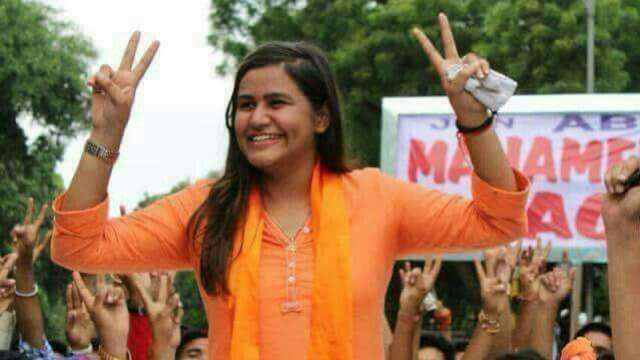
Mahamedha Nagar, an Akhil Bharatiya Vidyarthi Parishad (ABVP) activist and the Delhi University Students’ Union (DUSU) Secretary, has written to the Minister of Human Resource Development, Prakash Javadekar, urging him to make education for transgender students free in the University of Delhi (DU). The Indira Gandhi National Open University (IGNOU) and Jamia Millia Islamia’s distance learning programmes have already made education free for transgenders. Manonmaniam Sundaranar University (MSU) in Tamil Nadu has also made all courses free for transgender students.

Mahamedha told a DU Beat correspondent what compelled her to write this letter. She says, “I’ve always had interest in knowing more about transgenders. One night, I was generally watching this documentary on YouTube after which I came up with this idea!” If we talk about transgender students specifically in DU, in 2015, students were allowed the option to be recognised in the male, female, and other category. What is problematic though is that not a single student who identified as transgender took admission in DU (research by DU’s Adult, Continuing education. and Extension department).  In an India Today piece published in 2016, transgender students in the varsity talked about being openly discriminated, harassed, mocked, and humiliated. Rules and one-off events are not enough to make an impactful enough change, everyday realities need to be taken into account as well. It is important that our education actively rejects the gender-binary, and programs to sensitise students and faculty towards gender-minorities be introduced. In 2016, no transgender student took admission in regular colleges and only 18 students took admission in the School of Open Learning (SOL).

Therefore, the idea of making education free for transgender students may sound like a noble one, its impact will continue to be miniscule as long as there are only 18 transgender students in the University. Scholarships are an extremely effective incentive to ensure greater participation of minority groups in the education sector, but they alone are not an incentive enough to promote participation of transgender students in the educational sector.

Amongst Indian states, Tamil Nadu and Kerala have been bearing the torch in creating a more inclusive society, especially in the context of transgender rights. In recent times, we have read heartening pieces of news like the first transgender person becoming a Sub-Inspector in Tamil Nadu police or the Ministry of Drinking Water and Sanitation’s decision to allow transgenders to use public toilets of their choice, it is important to remember that these are still marginal victories. Nagar, by writing to the HRD Minister regarding transgenders, has sparked conversation around trans rights in the education sector and has successfully brought to the forefront a neglected topic. Major societal changes are born about the youth through the tools of education and dialogue. Therefore, it is important the message behind this this initiative be respected and transgender rights and rights of minorities be taken more seriously.


Feature Image Credits: DNA

Kinjal Pandey
kinjalp@dubeat.com

After weeks of campaigning, the Delhi University Students’ Union Elections 2017 were held on Tuesday, 12th September in colleges across the University of Delhi. At the end of the day, the voter turnout was said to be 42.8%, which was a huge improvement from last year’s turnout of 34.3%. The results for the same were announced on the afternoon of 13th September.

Rocky Tusheed and Kunal Sehrawat from the National Students’ Union of India (NSUI), affiliated to the Indian National Congress, won the posts of President and Vice President respectively. This was an enormous leap for NSUI, as they emerged victorious over Rajat Choudhary and Paarth Rana from Akhil Bharatiya Vidyarthi Parishad (ABVP), affiliated to the Rashtriya Sawayamsevak Sangh (RSS). ABVP has maintained monopoly over these 2 posts for the past 4 years in DUSU. The post of Secretary and Joint Secretary has been won by Mahamedha Nagar and Uma Shankar from ABVP.

However, in a recent turn of events, the counting of votes for the post of Joint Secretary is being taken to the Delhi High Court by NSUI. Neeraj Mishra, the National Communications In charge of NSUI, said, “The average NOTA vote count for the post of Joint Secretary had been declared as 5000, however ABVP claims the NOTA vote count to be 9000. Due to the discrepancies in these numbers, the matter of the final vote count will be moved to the High Court by NSUI”. The final tally of votes were, President: NSUI (16299), ABVP (14709). Vice-president: NSUI (16431), ABVP (16256). Secretary: ABVP (17156), NSUI (14532). The post of Joint Secretary has been won by Uma Shankar from ABVP as of now, however the final decision will be declared by the Delhi High Court.


Feature Image Credits: DNA India

Joyee Bhattacharya

(joyeeb@dubeat.com)

Known as one of the largest student elections in the country, but the question remains; are they representative of all the students who cast their vote, or is it just a game of political dominance with a handful of players participating each time?

Beginning from a sociological point of view, it is imperative to state that the caste system forms the foundation of Hinduism. Its ubiquity can be guaranteed from the simple fact that its absence from any of the aspects of life will lead to the collapse of the religion as a whole. In recent years, it has successfully made its way into student politics.
Be it the power of a temple in the state of Uttar Pradesh, or the presence of students belonging to aspiring minority communities in bulk in the University of Delhi (DU); caste as an entity has struck at every rung of the political system.

With the nearing Delhi University Students’ Union (DUSU) election day , parties are leaving no stone unturned to establish their presence in every DU student’s life by featuring life size posters boasting of the names of the contesting candidates . However, if observed carefully, one can conclude (like I have), that almost all the candidates belong to either the same community or different communities within the same region; predominantly the Jats, the Gujjars and the Yadavs. Hence, caste becomes an overarching term bringing region into its fold as well; in this case, Haryana, Uttar Pradesh and Delhi.

This practice becomes evident through the composition of major student wings such as the ABVP (Akhil Bharatiya Vidyarthi Parishad) of the RSS (Rashtriya Swayamsevak Sangh) and the NSUI (National Students’ Union of India) of the ‘INC (ndian National Congress) . When I consider the range of DUSU elections all over the country, I do not find any candidate from down South, the East, or the North-East. The northern region remains centripetal not just for the monetary and muscle factors, but also for the empathy factor that works in the undercurrent.

Taking into account the statistics of elections conducted in the last couple of years, it has been observed that the candidates elected for the post of president have belonged to either of the communities. For example, Amit Tanwar, the outgoing President from ABVP belongs to the Jat community. There were others such as Arun Hooda and Ajay Chhikara from NSUI, and Mohit Nagar from ABVP.

Apart from the ABVP and NSUI, who usually grab the ballots’ limelight; minor parties such as INSO (Indian National Students Organization) and CYSS (Chhatra Yuva Sangharsh Samiti), the student wing of the AAP (Aam Aadmi Party) too invest in candidates from these communities so as to gain impetus. AISA (All India Students Association), the student wing of CPI (ML) (the Communist Party of India’-(Marxist Leninst) ) mostly banks on female candidates for its premier posts.

With another round of elections coming up this year, while nothing can be ascertained until the declaration of results, some things form the norm! But, for more, we will have to wait for the big day!

Feature Image Credits: Indian Express

Shrija Ganguly
shrijag@dubeat.com

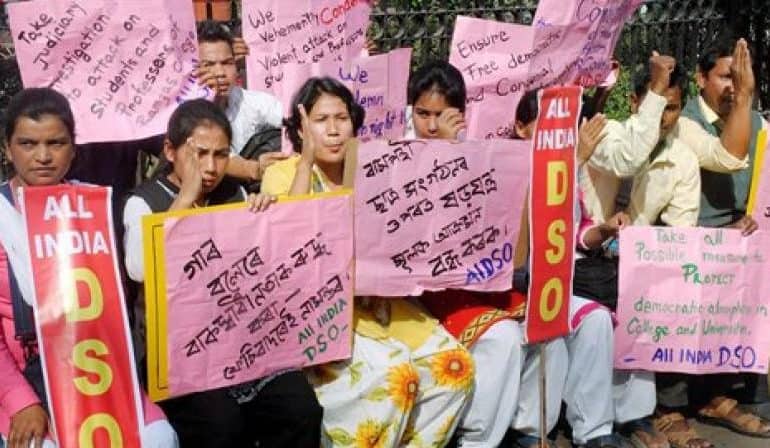
The Delhi State Committee of Students’ Federation of India (SFI) has decided to join hands with All India Democratic Students’ Organisation (AIDSO), with an aim to fight against Akhil Bharatiya Vidyarthi Parishad (ABVP), the student wing of the Bharatiya Janata Party for this year’s DUSU election.
In a press release, AIDSO said, “We believe in forging a broader unity of the left and democratic forces.” The radical transformation of university space in DU cannot be accomplished without building the broadest possible unity of all the progressive forces in the campus based on students’ rights, which are being attacked by the ruling ABVP led DUSU in collaboration with the Central government”.
Furthermore, their statement also stated, “SFI believes Left politics wholly depends on mobilising the masses, and this can happen only by forging broad alliances of progressive political forces in the University. In pursuance of the need for a greater unity, SFI-AIDSO has come together in Delhi University Students’ Union Elections to forge an alliance of struggles.”
The student panel standing for the election from this alliance is as follows:
1. Rafat Alam: DUSU President (SFI), M.A, from Department of Social Work
2. Jitendra Kumar: DUSU Vice-President (SFI), LLB from Campus Law Centre
3. Kolisetty Lakshmi: DUSU Secretary (SFI), from Shri Ram College of Commerce
4. Roshan: DUSU joint Secretary (AIDSO), from Satyawati College.
All India Students’ Association (AISA) is the only other Left aligned party contesting the election. Earlier this week, ABVP, NSUI and AISA also released their student panels for this year’polls.

Image credits: Asian Age

Joyee Bhattacharya
joyeeb@dubeat.com

Akhil Bharatiya Vidyarthi Parishad(ABVP), the student wing of RSS organised a press conference on 2nd September to discuss the work accomplished by ABVP-led DUSU last year. The panel consisted of Amit Tanwar, Priyanka Chhawri, and Ankit Singh Sangwan, the three outgoing DUSU office-bearers along with Monica Choudhary, ABVP’s National Secretary, Bharat Kumar, the State Secretary of ABVP and Saket Bahuguna, their National Media Convener.

During the conference, multiple achievements by ABVP in the past years were brought into notice and the rolling issue of discriminatory girls’ hostel rules was discussed. They further went on to talk about their role in a fight for printed mark sheets and hunger strikes held to promote students who had failed their last year of college. The outgoing Vice-President, Priyanka Chhawri spoke in length of the initiatives taken by DUSU in the past year, which included the DU paralympic sporting events and a university wide marathon being organised in North Campus along with cultural events and intellectual seminars under their hood.
Saket Bahuguna, ABVP’s National media convener touched upon subjects like DUSU’s controversial budget and the prevalence of violence across DU. Amid accusations, lies and slander, ABVP alleged opposition parties of putting forth “off-beat agendas to misdirect attention” and the university administration that had failed to competently handle the issue of permanent appointments in the staff. After a one-sided discourse on DUSU’s activities, questions were raised about ABVP’s involvement in the Ramjas issue and their stance on the thousands of posters defacing college walls throughout the campus. On this issue, Saket said, “It is practically impossible to cover all colleges that vote in DUSU in a span of 2 days. Even if we go by the cheapest means of transportation, we cannot cover all cost under 5000 rupees. Demands for a wall of democracy in every college has been placed in front of DU authorities, but no improvement has been observed.”
The conference concluded after the question-answer round and a hopeful parting note for DUSU elections 2017.
The party released its manifesto today.

Image credits: DU Beat archives

Vijeata Balani

vijeatab@dubeat.com


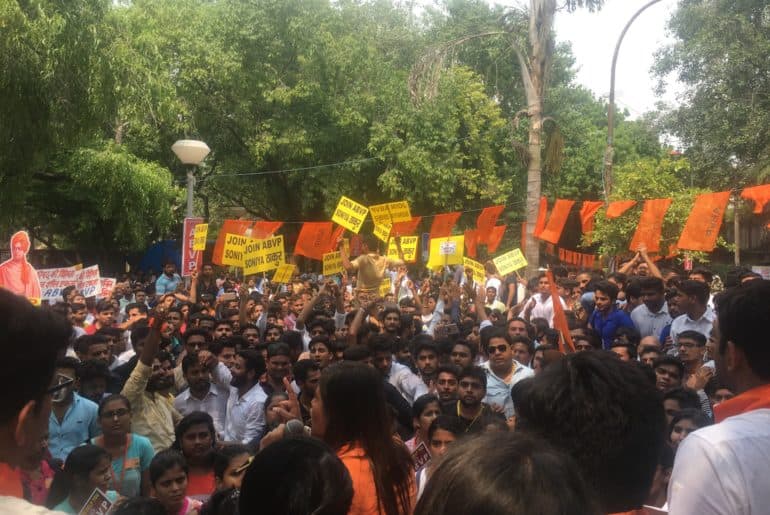
In the sunny afternoon of 30th August 2017 Akhil Bharatiya Vidyarthi (ABVP) organised a ‘Chattra Adhikar Rally’ at the north campus of Delhi University. The rally which was organised in the wake of the upcoming elections, ABVP pushed forward its demands for U-Special Buses, more hostels and supplementary exams from the administration.
The rally which was scheduled to begin at afternoon beginning at 1 PM. The rally started with the speeches by several supporters and activists. The crowd which was sparse at the beginning started growing in its size within an hour as individual candidates arrived with their supporters in large numbers. This was followed by speeches by the prime candidates who aspire to fight DUSU elections on an ABVP ticket. Amidst shouting of support slogans of candidates, some of them spoke about their plans for the upcoming year, if they win the elections. The major plank on which ABVP is going to fight the elections this year is hostels, U-Special buses and supplementary exams.
While speaking at the rally some leaders took the credit of drawback of FYUP as well as printing of statement of marks. Some of the candidates also highlighted that keeping anti-national forces out of the University would be their prime focus. A brief spell of rains in the middle of the event forced the supporters to seek shelter under roofs available nearby. As the rains paused, the rally begun from the arts faculty and proceeded through the Ramjas College and then passed through the arts faculty through the road in front of SRCC. The rally ended with slogans of ‘Bharat Mata ki Jai’ and ‘Vande Mataram’.
Speaking to DU Beat, Saket Bahuguna-the national media convener of ABVP said “The rally was organised in the wake of elections. This coming out of students in large numbers is a wakeup call for the administration to fulfil our demands.”

Image credits: Srivedant Kar for DU Beat.
Srivedant Kar
srivedantk@dubeat.com

Are there certain patterns that DUSU elections follow? How much of a role does ones caste, gender and socio-economic background play? With election season round the corner, we try to answer these questions.

Winning the students’ union elections in the University of Delhi is an immense feat. Major national political student parties like Akhil Bharatiya Vidyarthi Parishad (ABVP), National Students Union of India (NSUI), and All India Students Association (AISA) amongst others are the key players in the Delhi University Student’s Union (DUSU) elections.  Along with muscle-power and extensive campaigning, a lot of strategy goes into the DUSU elections. Are people from a community, gender, or political party more likely to win this election? We try to answer these questions through an analysis of past election data.

1) The rise of ABVP -The last time NSUI won all four DUSU posts was in 2007, some ten years ago. In the last ten years, ABVP has won the DUSU elections seven times (the criterion being winning three or more seats). Out of these seven times, in 2009 the ABVP won one seat. Howsoever the President (independent) and Joint Secretary (Samajwadi Chattra Sabha) publicly credited ABVP for their victory. Only twice was NSUI able to win majority seats in the panel. In 2012, both ABVP and NSUI won two seats each. In the last ten years, Delhi University has seen six ABVP, one independent (credits ABVP) and three NSUI Presidents. This shift in voting patterns is unconventional since DUSU had a NSUI stronghold for a long time.  From 1996 to 2008, NSUI maintained its position as the key player in DUSU politics, winning the majority of seats.

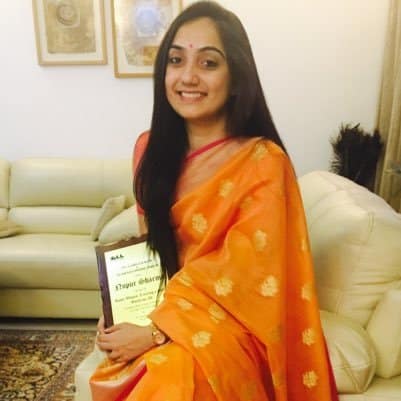
Source: @nupursharmabjp on  Twitter
Nupur Sharma was the DUSU President in 2008. She won the Presidential seat for ABVP ending a long NSUI stronghold, surprising many. There has been no female DUSU President after her. Source: @nupursharmabjp on Twitter

2) Fall in the participation of women – Between 2011 and 2017, out of the twenty-four candidates that became a part of the DUSU panel, only five were women. The role of women in the last six years has been limited to the positions of General Secretary and Joint Secretary, with ABVP’s Priyanka Chhawri (Vice President) being the only exception. It would be strange perhaps to find out that women were not always relegated to the role of a token in DUSU politics. In fact between 2001 and 2010 women won twelve seats in DUSU overall with five of them being President and two being Vice President. Where there should have been an improvement in the position of women, there has been a decline. This fall in the number of female candidates winning and the lack of female DUSU Presidents is strange. In fact, while the awareness about gender-equality and feminism is greater than ever. While DUSU President of 2008, Nupur Sharma, believes this is because posters with faces were no more allowed; Ragini Nayak, DUSU President of 2005, believed it is so because the number of days of campaigning has been shortened to four or five days, and this kind of aggressive campaigning is easier for men to accomplish. (Source: Hindustan Times)

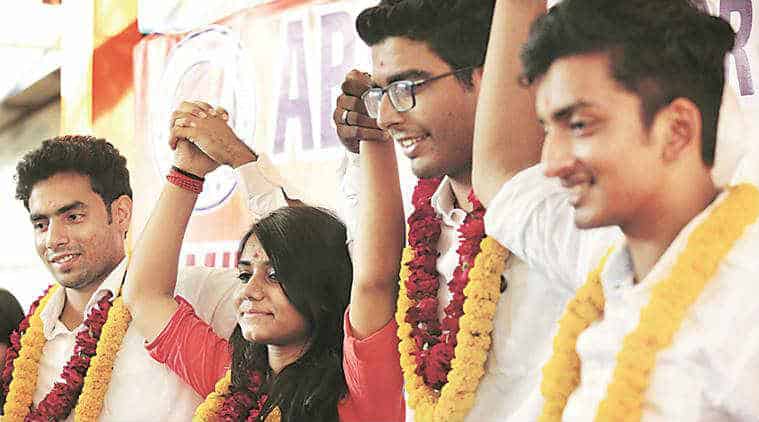
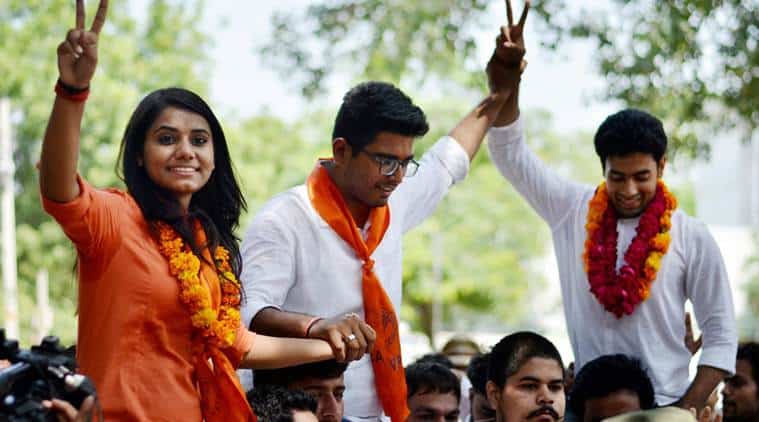
L-R:  Priyanka Chhawri, Ankit Singh and Amit Tanvar after winning the 2016 DUSU elections. All four post holders in the 2016-17 DUSU union are from either the Jat or Gurjar community.
L-R: Priyanka Chhawri, Ankit Singh and Amit Tanvar after winning the 2016 DUSU elections. All four post holders in the 2016-17 DUSU union are from either the Jat or Gurjar community. Source: The Indian Express

3) The dominance of the Jat and Gurjar community – From 2011 to 2017, every DUSU President has been from either the Jat or the Gurjar community. The last four DUSU Presidents belonged to the Gujjar community while the two before them from the Gurjar community. In fact not just Presidents, but often the entire panel hails from these two communities. For instance, in 2016-17 all four post holders hailed from the Jat or Gurjar community. This dominance of certain communities in DUSU is recent but it clearly shows how major student parties are not shy of fielding candidates hailing from influential communities who have immense social capital at their disposal, in order to win.  

4) Emerging alternatives to ABVP and NSUI – Parties like AISA and the Students’ Federation of India (SFI) have continuously been gaining relevance in DUSU politics. In the 2016 elections, on almost all posts, AISA candidates managed to secure the third highest vote share, thus securing its position as the third party in the DUSU political scene. It managed to secure a total of 30,000 seats. It also managed to secure an increase in its vote share for each post.


Feature Image Credits: The Indian Express

Kinjal Pandey

kinjalp@dubeat.com


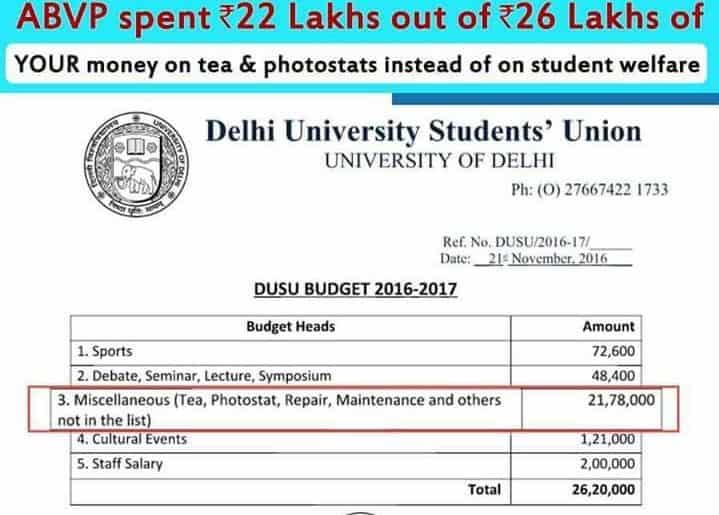
Right before elections, a photo uploaded by the National Students’ Union of India (NSUI) had started making rounds on the internet. The picture alleged the Akhil Bharatiya Vidyarthi Parishad (ABVP) of spending Rs. 22 lakhs out of the assigned 26 lakhs for the Delhi University Students’ Union (DUSU) budget on tea.

Soon, there was an outrage in the student community regarding the blatant misappropriation of expenses. NSUI officials claimed that Mr. Mohit Garid, the Joint Secretary of DUSU, provided the information as he has got access to all DUSU official records.

20914196_110099089717513_600105314418395050_n

But when DU Beat reached out to ABVP, the other side of the story was unfolded. Mr. Amit Tanwar, president of DUSU, explained that the document making rounds is the budget of DUSU and not the expenditure. He further told DU Beat that many other events were conducted which didn’t fall in any of the other categories, hence, were included in miscellaneous sections.

Mr. Saket Bahugana, the national media convenor of ABVP, shared with us the original complete document, which clearly reflects the signature of Mr. Mohit Garid on the document.

img-20170822-wa0013
Image Credits: DUSU office


Mr. Bahugana adds, “Why didn’t the Joint Secretary object to the budget while it was being proposed?” He also alleged that Mr. Garid had taken more than Rs. 5 lakhs from the DUSU fund but failed to utilise the money towards an event with the money.


Feature Image Credits: NSUI Twitter Handle 


Sandeep Samal

sandeeps@dubeat.com