
Tag

abroad

Browsing

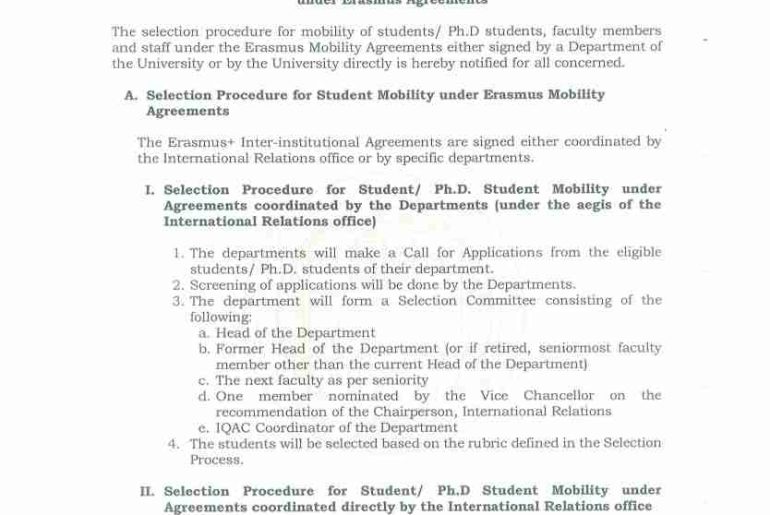
Delhi University issued a notification on 22 October setting out eligibility criteria and selection procedures for Erasmus mobility across four categories: students, PhD scholars, teaching staff and non-teaching staff.

DU has formalised the selection process for Erasmus mobility opportunities available to students, PhD scholars and staff under its bilateral agreements with foreign higher education institutions. The notification, issued on 22 October with the competent authority’s approval, prescribes separate procedures depending on whether an individual department coordinates the agreement or the university’s International Relations office coordinates it directly.

For students, the minimum CGPA requirement is 7.5 for candidates from the Unreserved, OBC and EWS categories, and 6.5 for SC and ST candidates. Applicants must have passed all papers in completed semesters without any essential repeat, meet a minimum attendance of 66.67 per cent and hold a valid passport with at least two years of remaining validity. Prior participation in any Erasmus mobility programme disqualifies a candidate.

For students other than PhD scholars, the selection process gives the highest weightage to academic record at 50 per cent. The interview carries 30 per cent, while the statement of purpose, faculty recommendation, departmental contributions and attendance account for the remaining 20 per cent. The interview will assess subject knowledge, communication skills, clarity of thought and the candidate’s stated objectives for the exchange.

For PhD scholars, the research proposal carries the most weight at 40 per cent. Alignment between the candidate’s research area and the host supervisor’s expertise accounts for 20 per cent, and the interview for 30 per cent. UGC or CSIR NET or JRF qualification contributes 10 per cent. Scholars must submit both a recommendation letter from their DU supervisor and an acceptance letter from a prospective supervisor at the host institution. Preference will be given to candidates with publications in Scopus-indexed journals.

Faculty applying for teaching staff mobility must have at least five years of full-time teaching experience at DU and must not have participated in the programme in the preceding five years. The same five-year gap requirement applies to non-teaching staff, whose applications are restricted to Group A officers, and whose proposed training must align with their job responsibilities.

According to the notification, the Vice-Chancellor holds final authority over any difficulties in interpreting or implementing the Erasmus agreements.


Image source: du.ac.in

Read Also: DU to Hold 103rd Convocation on November 20; Over 92,000 Students to Receive Degrees


Abhishek Goverdhan
[email protected]

Dr. Shaik Suleman is the General Manager of Overseas Education Services at EdCIL India Ltd. EdCIL is a mini-ratna government company under the Ministry of Human Resource Development which provides education consultancy services to the MHRD.

  1. Russia launched an initiative known as ‘5/100 initiative’ to boost the international faculty and students in its universities by 2020 as part of a wider plan to develop the global competitiveness of their universities.  How does the government plan to increase its institutions’ global competitiveness?


Indian government in the recent days is trying to enhance the standards of the premier institutions of India                  and is already inviting foreign faculty through the ‘Gyan’ program. We are progressing in this endeavour.


  1. According to HRD ministry’s All India Report on Higher Education 2015-16, only 45,424 foreign students were enrolled in Indian educational institutes whereas Indian students are the second largest source of international postgraduates in the UK. Are there any incentives the government plans to offer to invite more international students?


The official number is 45,424 students but informally more students are coming to India i.e. 1 lac students.                    Currently the government isn’t planning for any incentives but is working to generate more opportunities for                foreign students to come and study in India. At present, our premier institutions like IIMs and IITs do not have          any quota for foreign students but the government being a part of the Kasturirangan Committee is planning on            providing some quota to foreign students which will hopefully increase their number.


  3.  At present, roughly a third of all German students spend some time at a university outside                    Germany during their degree programme and are working to increase it to 50%, are any plans in        the pipeline for us, Indian students?

The UGC (University Grants Commission) has given directions to the universities stating that in the designing of         the curriculum there should be an ‘Industry Interaction’ like Barcelona where students attend morning classes             for theory study and in the afternoon they visit industries. Some of the deemed universities are planning for                 similar industry interaction. The government has initiated and the plans are in the initial stages, nothing has               been finalised yet.


  1. The University of California at Berkeley is setting up a new campus at Richmond Bay, California, where it plans to host 4-5 Asian and European universities.Has the Ministry thought of setting an Indian university in their campus?

We have not yet been given green signals regarding the same but renowned private universities of India like                 Manipal University etc. are planning to set up their campuses on foreign soils.


  1. Providing incentives and inviting more international students would strength India’s ties with their countries and greatly influence India’s image as an emerging ‘education hub’, don’t you think?

We can provide scholarships to foreign meritorious students in the fee structure etc. Other than that, quality of            education in the institutions need to be improved. Also, the communication and liaising between the                              institutions and foreign students need to be strengthened like smooth travelling, helping them in settling down            in the Indian culture and exposing them to the Indian culture and diversity. Such aspects play a major role as              well. For India to become an education hub, we need to upgrade our curriculum and provide courses with                      international validity like Big Data, Data Analytics or IOT (Internet of Things). On the other hand, we are very              strong with IT and Science field. The other courses where we are not renowned but good marketing would solve          the problem, then there is no stopping India from becoming an education hub.

Feature Image Credits : DU Beat

Prachi Mehra

[email protected]