Tag

2025

Browsing

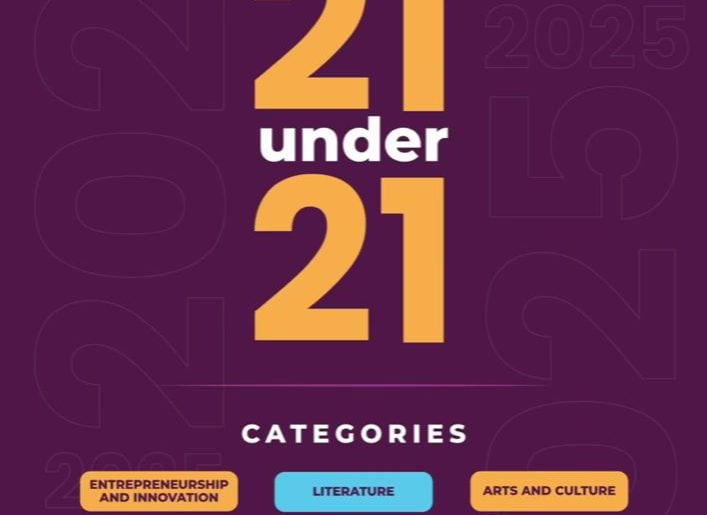
DU Beat 21 Under 21, 2025 edition is live! This time bigger and better. With 7 categories that span across different spectrums of ambition and impact, 21 Under 21 is here to show that excellence at DU is not one-dimensional. Phase 1 deadline 30th December 2025

In a university as crowded, competitive, and quietly brilliant as Delhi University, it’s easy for exceptional work to dissolve into the background noise of deadlines, societies, and survival. DU Beat 21 Under 21 exists to interrupt that silence.

Launched in 2020, 21 Under 21 is a yearly initiative that recognises 21 students from across DU who have done something remarkable before turning 21. It is, in essence, a hall of fame for young achievers. It is for those who refused to wait for the “right age” to start making an impact. Five years on, it has grown into one of DU Beat’s flagship projects, drawing applications from over 30 colleges and generating lakhs of impressions across the campus ecosystem.

At its core, the initiative is about visibility. It spotlights young changemakers who are making a difference, achieving early, and inspiring others simply by existing unapologetically in their ambition. More importantly, it builds a community, one that reminds students that excellence is not limited to toppers, nor impact to titles.

To reflect the many ways students shine, 21 Under 21 recognises achievers across seven categories: 

Entrepreneurship and Innovation celebrates builders and future founders bold enough to take ideas seriously. 

Literature honours writers and poets whose voices resist replication in an era of AI slop. 

Arts and Culture recognises creators who refuse to let imagination go quiet. 

Social Impact and Activism spotlights those challenging injustice and amplifying communities. 

Sports features athletes defined by discipline and grit. 

Science and Technology celebrates curiosity-driven problem solvers shaping the future. 

Academics recognises scholars whose pursuit of knowledge sets new benchmarks.

The process is straightforward. Applications open in December, inviting students from across DU to submit their achievements. In January, a jury along with the DU Beat team reviews applications and shortlists finalists. By February, the final 21 are announced, and their stories are published.

Phase 1 applications for this year’s edition close on 30th December 2025. If you’ve ever wondered whether your work counts, this might be the reminder that it already does.

When cultural brilliance meets coastal vibes, you get Waves – and this year’s edition proved why it’s one of India’s most anticipated college fests.

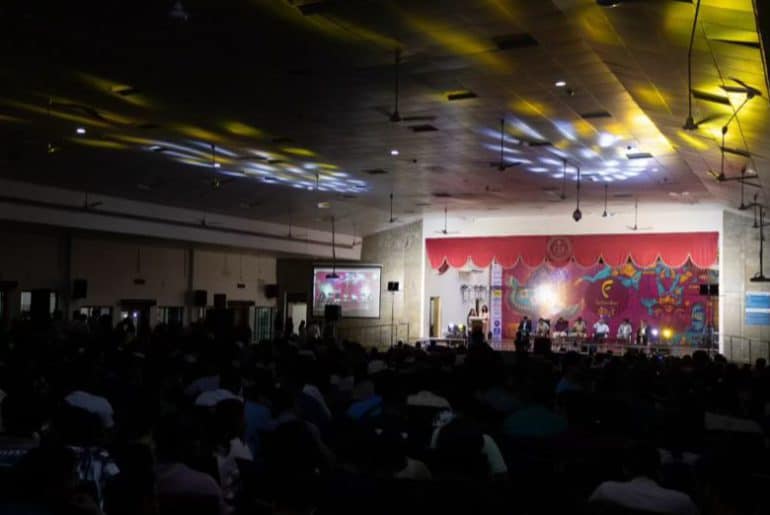
From October 31st to November 2nd, BITS Pilani’s Goa campus transformed into a cultural powerhouse, hosting Waves 2025 – three days of electrifying performances, fierce competitions, and memories that’ll last way beyond the fest hangover. With over 8,000 participants from 150+ colleges converging on one of India’s most vibrant locations, Waves proved once again why it’s rapidly climbing the ranks as one of the country’s largest student-run cultural festivals.

The Star-Studded Lineup

Let’s talk about what everyone was really there for – the nights that made us lose our voices (in the best way possible).

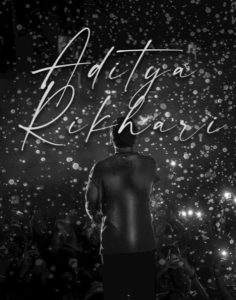
Day 1 kicked off with Aditya Rikhari setting the perfect tone for the fest. The indie vibes had everyone swaying under the Goan sky, listening to “Sahiba” and honestly, is there a better way to start a cultural fest than with some solid indie music?

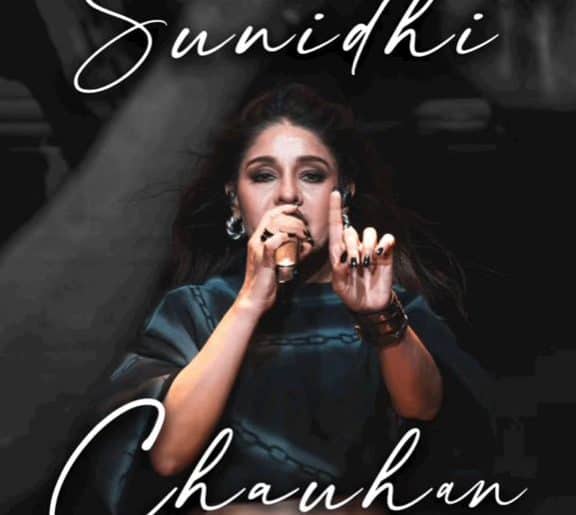
Day 2 brought the house down – literally. Sunidhi Chauhan graced the Bollywood Night, and if you’ve ever wondered what 5,000+ people singing along to “Sheila Ki Jawani” sounds like, well, you missed out. The energy was absolutely electric, with the Bollywood diva delivering hit after hit that had the entire crowd on their feet.

Day 3 wrapped things up with a bang as DJs Krispy Kristina and Ravator took over for the EDM Night. The bass drops, the light shows, the collective jump when the beat drops – it was the perfect crescendo to three unforgettable days.


Beyond the Headliners: Where Competition Meets Creativity

But Waves isn’t just about the celebrity performances (though let’s be honest, they’re pretty hard to beat). The fest hosted over 40 events. The competition was fierce, the talent was insane, and the stakes were high.

The Big Four – Waves’ flagship events – saw some of the most intense showdowns:

  • Natyanjali brought dance crews battling it out in what’s essentially the Olympics of group dance competitions
  • Sea Rock proved why it’s the country’s largest semi-professional band competition, with eliminations held across 12 cities before the grand finale
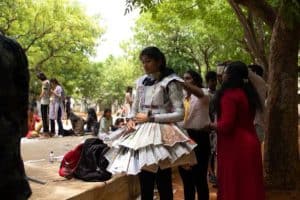
  • FashP (Fashion Parade) turned the auditorium runway into a spectacle of design and choreography
  • Mr. & Ms. Waves tested personalities and talents, with finalists going thro

    ugh intense rounds over all three days

Then there’s Sizzle – the solo street-dance competition that always draws massive crowds and has racked up millions of views on YouTube. Picture a dance battle, but make it college fest level, with students forming circles and losing their minds over every killer move.

And if you thought that was all, think again. Waves also hosts a 

Prom Night – because what’s a cultural fest without some elegant, dressed-up vibes? It’s the perfect breather between high-energy competitions, giving attendees a chance to slow down, dress to impress, and create some Instagram-worthy moments.

The Verdict

If you’re still reading this and thinking “damn, I should’ve been there” – well, you’re right. But here’s the good news: Waves is only getting bigger and better. With its explosive growth, massive footfall, and consistently impressive lineups, this is one fest that deserves to be on every college student’s bucket list.

Whether you’re into dance battles, comedy nights, fashion shows, or just want to vibe to some incredible music in Goa, Waves has something for everyone. The 2025 edition might be done and dusted, but it’s set the bar pretty high for next year.

Mark your calendars for Waves 2026, folks. If this year was any indication, you really don’t want to miss it.

For updates on Waves 2026, follow @wavesbits on Instagram and check out the official website at register.wavesbits.org. Trust us, you’ll want to be there when the next edition rolls around.


Day 2 of Rendezvous’25 at IIT Delhi lit up with Shalmali Kholgade’s Pronite, soulful Qawwali Night, and vibrant cultural showcases. From case competitions and debates to comedy, art, and carnival games, the campus buzzed with innovation, performance, and celebration, embodying the fest’s theme—Golden Threads of Time.

The campus buzzed from morning to midnight as IIT Delhi continued with Rendezvous’25 with the same spark and energy. With the theme “Golden Threads of Time” every corner of the campus came alive with a blend of competitions, performances, innovation, and pure cultural joy. By the evening the campus was filled with students waiting for the pronite to begin! 


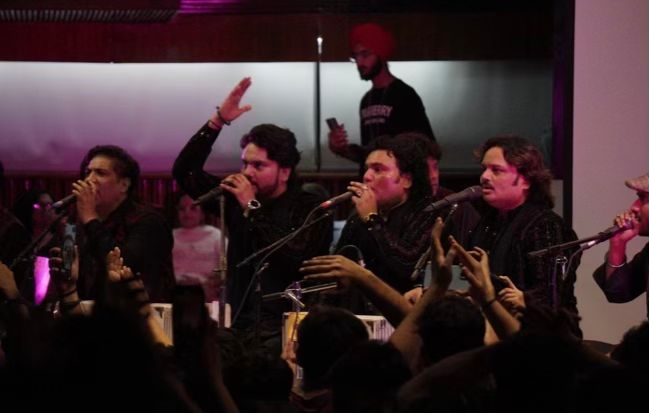
The most anticipated events were undoubtedly the flagships. Beginning with Pronite: Shalmali Kholgade—a musical storm that had the audience on their feet, the evening was later lit up with Qawwali Night at Dogra Hall. The Nizami brothers who performed there are regarded as cultural ambassadors of traditional Sufi music, blending age-old Gayaki (vocal tradition) with modern sensibilities. It painted a soulful contrast as voices rose in harmony, mixed with the claps and cheers of the dancing crowd—the hall subdued in a truly timeless performance. For those who preferred daytime festivities, the Live Stage ensured there was never a dull moment. The Lifestyle Show in the evening added a glamorous edge, with fashion and creativity weaving seamlessly into the festival fabric.


The day was filled with intellectual chatter to accompany the festive spirit. Empowering Encounters with Shri Anurag Thakur brought a thoughtful pause amid the chaos, as students engaged with the former Minister for Information & Broadcasting and Youth Affairs & Sports, in an enriching dialogue. The Faces of Rendezvous turned into a spotlight for raw campus talent, paired with the Flavour Fest, where flavors from around the world delighted tired yet eager attendees. Social media culture found its own arena in Influencer United, featuring Nishant Chahar and Neha Agrawal, bridging the gap between digital fandom and on-ground festivity. Meanwhile, laughter echoed through the Comedy Hunt with Naman Jain as the judge for the event. Though, rules had to be altered to remind the contestants of propriety, amid the common theme of semi-dark humor and unbecoming comments. It set the stage for raw talent and real humor with the cohort ranging from 18-35 years in age and just starting their standup journey as recently as just 6 months. The entry to the grand lecture hall building was lined up with the Auto Expo, where car enthusiasts marvelled at the fresh addition to this year’s lineup. 


The lecture halls were each a different world, ranging from casecomps to slam poetry. From cracking numbers in the Guesstimate League to pitching ideas at the Startup Expo, innovation was on full display. Students dived deep into global problem-solving with Ecostrat: Global Policy Simulation, debated business models in the BloodConnect Case Comp and Enactus Case Comp, and coded for glory at the Krafton Hackathon.Writers and poets spun words at Word Weave and My Jottings, while quizzers battled over cricket scores and trivia in the Sports Quiz and SBT Quiz. The creatives were on display in the Art Gallery and Natika Vatika, while performers set the stage ablaze in the Street Battle. 


Step outside the lecture hall building and Day 2 felt like a carnival. Students queued up for Ice Breaker Games, dove into immersive worlds at Virtual Reality Entertainment, and battled it out in Laser Tag. The Hanging Challenge continued until dawn with every corner of Informals offering some light-hearted fun. By evening, the entire campus was glowing—food stalls served late into the night, pop-up merchandise flew off shelves, and groups of students sprawled across lawns, catching their breath between events. The crescendo of the day built toward the Pronite, where Shalmali Kholgade gave a performance that left the audience buzzing long after. The night closed on a soulful note with Qawwali, making Day 2 a perfect balance of intellect, art, fun, and culture.


Read Also:Rendezvous 2025: Creativity, Culture, and Conversations Mark Day 1

Image Credits: Ayushmaan Patwa for DU Beat 


Shreya Bhushan 

[email protected]

Golden Threads of Time: IIT Delhi’s Rendezvous ‘25 officially starts on 27th September 2025. This year’s fest reached the country with nationwide elimination and tons of competitions and activities on day 0 itself. 

The buzz was real at the Indian Institute of Technology Delhi on September 27th as they officially kicked off Rendezvous’25 (RDV’25), their huge annual cultural fest. With the theme ‘Golden Threads of Time’, this year’s edition is a landmark celebration, commemorating the golden jubilee of IIT Delhi’s iconic fest. Day Zero started a bit slow, but it totally caught fire later on. From serious competitions to wild fun, the whole campus was alive by evening.

The whole thing began with the grand opening ceremony, ‘Udgam’ (which means ‘The Beginning’), held in the Seminar Hall. It was a beautiful tribute to how Rendezvous started, and the stage was graced by some true legends of IIT Delhi. The event was honored by the Chief Guest, Prof. R.C. Malhotra, the retired professor known as the Founding Father of Rendezvous, alongside other incredible figures like Prof. S.C. Datta Roy, Prof. S.S. Jamuar, Prof. Prem Vrat, and a distinguished alumnus, Mr. Raghu Hari Dalmia. 

After the ceremony, the schedule filled up fast, and the entire lecture hall was vibing in the competitive spirit. The day saw plenty of brainpower in action with the formal sessions of the Model United Nations (MUN) and Debutant (Asian Parliamentary Debate) starting up. Business students tackled real-world problems in the Startup Expo Case Comps and the Mystery Business Challenge, while tech enthusiasts jumped into the intense coding battles of the Eightfold Hackathon and Aries Hackathon. If you liked trivia, there was a Crimes and Controversies Quiz and a Universal Challenge Quiz to test your knowledge. Creative and performance arts were everywhere too, with poets and speakers showing off their skills in Sam Blues (Poetry competition), Kavi Sammelan (Poet’s Meet) and JAM (Just-A-Minute), and dance groups putting on their best moves for the Western Group Dance Prelims.

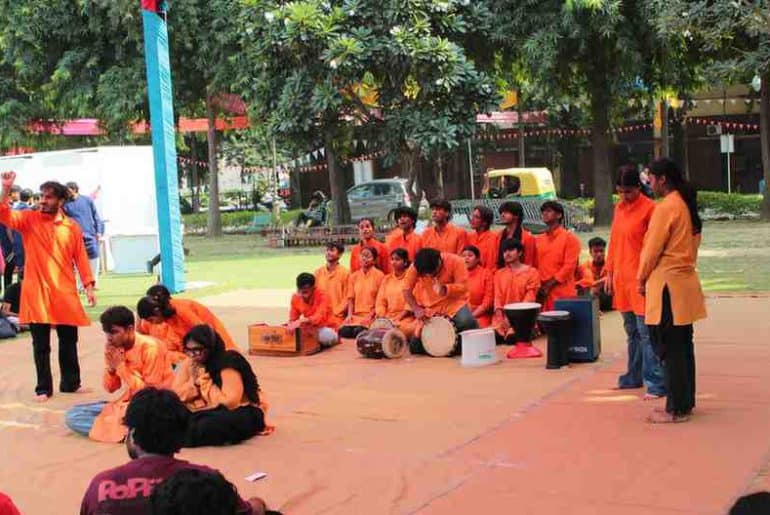
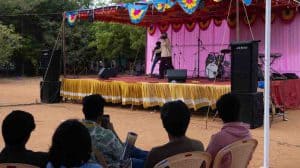
Beyond the official schedule, the campus grounds transformed into a massive carnival. The air was thick with the smells from the food stalls and pop-ups. Major brands set up interactive stalls, often featuring fun games, giving away the best freebies—branded merchandise, discount coupons. The Biotech Lawn was booming with energy all day long, hosting the stage for Mimansa (The street play competition) along with games like Laser Tag, Virtual Reality, and Adventure Games. The day’s energy peaked with two huge evening events: the colorful, traditional Dandiya Night at the SAC Lawns, and an energetic Silent Disco at the Red Square. 

Importantly, Rendezvous’25 isn’t just an IIT Delhi event anymore. They’ve launched Nationwide Eliminations so students from all over can qualify for the finals without even coming to Delhi first! With rounds held in Jaipur, Bangalore, and Pune, RDV’25 is truly sharing its golden celebration across the country. With such a strong, meaningful start, the stage is perfectly set for an epic few days.

Read More: Festember 2025: India’s Grand Cultural Celebration

Picture Caption: Stage set at Mimansa: The street play competition at IITD Rendezvous ‘25

Picture Credit: Aastha Bishnoi for DU Beat

Juhi Bansal

[email protected]

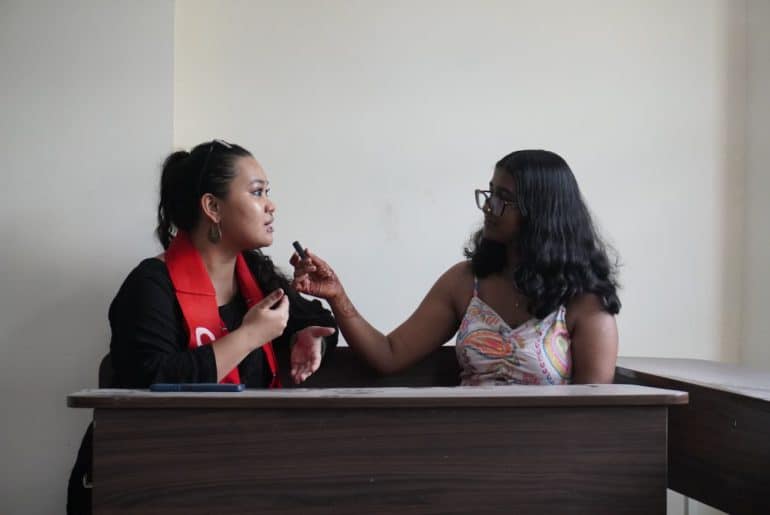
DU Beat in Conversation with Abhinandana Pratyashi

Abhinandana: So, hello everyone! My name is Abhinandana, and I am from North East, Assam. Assam is very popular for its floods, right? You must know Assam like that, but it is much more than that, because today I have become the first ever North Eastern Tribal person to contest for DUSU. I did my schooling in Assam, and I was the state topper both years. Now, I’m in Hindu College, pursuing Sociology Honours. I’m from SFI (Student Federation of India). 

Neeraja: Thank you for the introduction! I would like to start with, what do you think is the biggest challenge that DU students face right now? And how do you think you could improve on it?

A: See, the biggest challenge that Delhi University is facing right now is the hegemony of muscle and money politics that we see everywhere, right? We understand how the status quo prevails. People who are part of the hierarchy never want anybody else from below or outside the hierarchy to come and take space. And this is what that is personally, and that’s why socially and organizationally happening to me as well. Being a queer and being a Northeastern person, right? So, all these muscle and money politics and organizations that we see around ourselves, they are so visible. They have the money to visibilize themselves, right? So, they always take power over issues that are much more grounded. Those issues that need to be addressed, right? Like, for example, any of these issues that SFI is picking up. We can talk about fee hikes, we are talking about metro passes, and we are talking about women’s safety. But all of these issues, most of the time they are either co-opted by people who are not really affected by them or like just overpowered by muscle and money politics. So, this is like the biggest issue that we have right now. And the only way to challenge this or to combat this is with ground-level work. Unless there is proper education, there won’t be agitation.  And unless there is agitation, there won’t be an organization. And only when we have an organized mobilization of people, and only then, can we have some real change. And which is visible right now. So, right in front of me in my team, that’s Sneha, right? Sneha is standing right there. So, Sneha, without muscle and money politics, without the visibility of muscle and money politics, she was contesting last time; she gained 9000 votes.  And the person who won instead of her gained around 12,000 to 13,000. Look at the margin; this is a very small margin. So, this is the ground-level work we are talking about while combating the muscle and money politics that we see around ourselves.

N: Absolutely, thank you so much. Can I know some insights into the key pointers within your election manifestos?

A: Election manifestos, see, we are very grounded in the common student problems. First of all, the fee hike. Not many can afford to pay the fee that we are seeing right now. And that too, that is hiking, right? So, in Hindu College, in sociology honors, I am paying above 25k. If I had not had the scholarship that I have right now, I would not have even dreamt about coming to Hindu College and studying. I would have had to drop my education. And this is happening everywhere. Like in the Law Faculty, the fee before the new education policy, 3-4 years back, was Rs. 3000; now it is Rs. 8000. We see this constant fee hike. And in equivalence to that fee hike, we don’t even have basic to basic facilities. Like I said, I am from the North East, and Hindu College does have a girls’ hostel. But even there, I did not have the chance to get a seat in the hostel. So, if a girl from the North East is not getting a seat, then who will? You know the very popular case about the Hindu college boys’ hostel? It’s been privatised to such an extent that it’s been under construction for the past five years. In comparison, it took six years to build the Burj Khalifa.  And this is a problem everywhere. We are talking about affordable hostels so that the children do not have to commute so far, so that the students are not exploited by the PG mafia, the flat mafia. So, affordable education, first of all, means there is no fee hike. There should be a choice of accommodation. There should be a choice. There should be good and cheap food in the canteen. There should be a metro pass. See, a common student like us cannot afford to have our commuting prices go as high as 60 rupees in a single day. 100 rupees in a single day. That means, in a month, that is 3000 rupees, 2000 rupees. And you will see that the organizations with muscle money politics are roaming in big cars, BMWs, Thar, etc. What difference will it make to them that a common student like us cannot pay so much, right? So, this is one of the biggest issues we have been picking up in our manifesto. Because the students should at least get a concessional metro pass. Because it is simply very visibly non-affordable for our students, right? And apart from that, if we go to some branches of the points, Northeastern representation, of course, queer representation, of course. Because this is our space. Queer people say that half the sky isn’t enough. Of course, it’s not enough for us. We want representation. We want at least some kind of reservation. In the Hindu College Parliament, we have reservations. We are demanding the reservation of queer individuals, not just women, right? Not just cis-hetero women, but queer individuals, like I said. Along with that, basic issues, basic humanitarian issues. That xenophobia shouldn’t be there. That homophobia shouldn’t be there. That transphobia shouldn’t be there. So, these are some of the issues we are talking about. Like, basic to basic issues we are talking about in our manifesto.

N: That sounds amazing.  As you said, there are increasing financial crises that are happening. Like, the metro price hike, a fee hike, and hostel unavailability. How are you going to advocate for someone who is, like you said, the common student?

A: See, this is a very relevant question. Because this is seen everywhere. You must know that when we were contesting, the contestants who were contesting for the election had to sign a bond for 1 lakh. Right? So, a common student who comes from a marginalized background, the background I come from, I can’t even dream of contesting and having some representation in Delhi University Students’ Union. Because if you are signing a bond for 1 lakh, how will I pay the money? The people who are roaming around in cars can, of course, pay for it. But the one who is coming from a marginalized background, the already ostracized, is being continually ostracized. When you are putting up such bonds, when you are putting up such demands. So, this is a success of the panel that we are standing in, SFI AISA, our coalition of progressive organizations. So, you must know that the High Court has taken back this bond. Because we protested, we submitted a memorandum. So, when you ask how we combat these financial issues, that is combating. Combating can only happen through organization.  As I said, until there is no education, there will be no agitation. Without agitation, there will be no organization. People will have to organize on these common issues. Not just this 1 lakh bond. See, the rule passed by the Lyngdoh Committee this time, that people can’t throw around pamphlets. Because these pamphlets name people, reminding them, who can do that? The one who has muscle and money power, who has such funds, who has resources. So, people like us, coming from an ostracized background, have very little chance. Right? If we can’t have pamphlets flying around, how will people remember our name? How many times can we campaign, going from person to person? We can’t hire people to give away flyers. You must have seen, outside the college, people wearing Doraemon’s costume, Nobita’s costume, distributing flyers. We can’t hire such people. So, this time the Lyngdoh Committee has passed, so you can’t have such defacement. It can’t happen anymore. So, this is something that is, on a very minute level, combating the muscle and money politics, combating the financial discrepancy that we see. And, like, that’s why we are moving towards a more egalitarian election this time.

N: Like you said, this is something that might be personal to you also. DU has a diverse student culture across campuses, cultures, etc. How do you think you can represent people from all factions if you get elected?

A: See, even if you are from Bihar or if you are from Manipur, everyone is getting a free hike. Just because you can afford it, doesn’t mean you should have to. Because education is a fundamental right. Student mobility is a fundamental right. Students’ safety on campus is a fundamental right. So, the question of diversity pushes it further in a better direction. Here, fighting elections in a diverse environment, it’s much more inspiring because we see that, even after having a diverse background, these people are facing the same issues. So, it reinstates our power, in the idea, in the concept of the common student. Free hikes are happening with everyone. When a woman is exploited here, it’s not just about what background she is coming from; on the way, anyone can be catcalled. Right now, the background I come from, if a classmate from a different background comes from the North-East, she will be called a chinky here. I am queer, visibly queer, if a rich queer, or a poor queer, whose visible representation is queer, they will be hurled with homophobic slurs. So, I understand how class can have an impact on the discrimination we face, but just because of class differences, there is no discrimination against anyone. It’s not like that. Discrimination can be in different hierarchies. Like, a Dalit woman is more exploited, right? But that doesn’t mean that an upper-caste woman is not being exploited. So, in SFI, we believe in the organisation, until all of us are free, none of us are free. So, when I talk about diversity, diversity is one of the most positive things that we can have, when moving, when we are talking about our common student issues. 

N: What are some of the specific, achievable targets with which you can show your progress to students? How can you measure it, and how can you show it, in a specific sort of way?

A: When we say achievements that we have had as a common students’ organisation, first of all, I can talk about Hansraj. In Hansraj, the administration got land to make a girls’ hostel, right? And this is the case, everywhere. I mean, there is a space in SRCC, there is land in MLNC, to make a hostel, but the hostel is not being made. So, when this happened in Hansraj, then the admin said, No, we will make a cow shed here. Then, SFI, the common students’ organisation, protested that yes, you can make a cow shed. Of course, you are doing a good deed. Do a good deed outside the college. What is the right inside the college? What is the fundamental right of the girls? To make a hostel so that students are not exploited by the PG mafia. Expensive, unsafe PGs should not be there. Today, because of these protests, in Hansraj, a girls’ hostel has been set up. This is the power of a common students’ organisation. In JNU, you will see that the SFI AISA union has won many times in JNU. A left panel always wins in JNU. In JNU, you will see, every single student has access to the hostel. What they pay in a month for the room rent is 10 rupees. This is the power of a common students’ organisation. In Miranda, you will know, Miranda’s hostel fees are very popular for their low cost, right? And why is that? When in the middle of the night, the fee in Miranda went up 5000, right? See, 5000 might not mean much to people with BMWs and Thars, but 5000 means a lifetime to us. When it went up, SFI protested,in the middle of the night, and the fee was lowered, I mean, so this is the power of a common student’s organisation. And we were talking about concessional metro passes, right? At Hyderabad University, SFI has formed a union. Now, every single student in Hyderabad University has a concessional metro pass. They get 60% off. The 80 rupees we pay here, they pay 35 or 40 rupees there. This is the power of a common students’ organisation. So, when you say achievable things, when we talk about achievements, it is also an inspiration for us, that yes, when a common students’ organisation comes to power, things can happen. Now, I am from Hindu College. In Hindu College, there was a very regressive culture, V-Tree Pooja, Virgin Tree Pooja. When I came in my first year, in Virgin Tree, they used to hang water-filled condoms. They used to paste pictures of women whom they wanted to break their virginity with. When I came in the first year, my picture was also pasted there. It’s clearly a type of harassment, right? So, along with SFI, I had protested, and today, V-Tree Pooja doesn’t happen there anymore. This is the power of a common students’ organisation. Be it fee hike, be it affordability, accessible hostels, metro passes, or be it misogyny. All of these fights have been achieved, all of these things have been achieved, with SFI being in the union, without SFI being in the union. Because, whether it is an election or not, whether you are a common student or not, if you are a common student, then you have to fight, always.

N: Absolutely. Thank you so much for the interview!


Read Also: Campus Promises: ABVP, NSUI, and SFI–AISA Manifestos 2025

Neeraja Unnikrishnan

[email protected]

 

The highly anticipated cultural fest Festember is alive once again at the National Institute of Technology, Tiruchirappalli, from the 18th to the 21st of September, 2025, under the theme “Saga of Secrets”. This year’s theme dives into the allure of mystery and discovery, inviting participants for a journey where every event, performance, and interaction unveils a hidden story waiting to be uncovered. Blending intrigue with artistry, Festember 2025 promises an exciting lineup of events that will captivate hearts and minds, drawing students from across the nation.

Festember 2025 will showcase a diverse array of activities, including amazing proshows, captivating events, thought provoking workshops, and inspiring guest lectures from respected artists and industry leaders.

Festember has earned its reputation as one of India’s most celebrated cultural festivals, and this year’s edition aims to elevate that legacy. With an impressive annual footfall of 18000 students from 500 different colleges, the festival is not only a platform for showcasing talent but also an opportunity for students to network with friends and escape the daily monotony of academics.

Festember has always brought the stage alive  from Benny Dayal and Amit Trivedi’s beats to the soulful voices of Karthik and Neeti Mohan, every pro-show has been a showstopper. And this year? Expect nothing less.

The guest lectures have seen legends like Sid Sriram, Jonty Rhodes, and chess grandmaster Vishwanathan Anand take the mic. So, get ready once again for talks that will inspire and spark ideas within.

With clusters of events, fan-favorites like Fashion Show, and workshops ranging from fencing to glassblowing, Festember packs something for everyone.

Festember has grown every year to become one of the nation’s most celebrated cultural festivals, and this edition is no different. With preparations going full on, the stage is ready for an unforgettable experience that is meant to last.