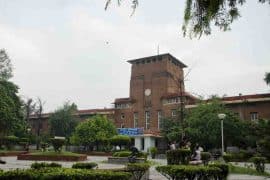
From its establishment in 1949 to first elections in 1954, the Delhi University Students’ Union has had a long run, one that preceded India’s Independence and saw the rise and fall of multiple governments in its lifetime.
It has become difficult to discern the notion of student politics at any level in India without mentioning the inception of the country’s biggest Student’s Union, DUSU. Seven lakh students, ninety-one colleges and a run of over seventy years: the Delhi University Students’ Union has had a legacy that continues to define and re-define student elections and politics in India.
Late historian and professor, Aparna Basu, in her book, University of Delhi (1922-1997) details the formation of the body politic of the university at a time when quiet rebellion against British Raj was brewing, alongside a surge of student-led activities. It becomes imperative to note that the opposition to colonial rule worked in tandem with student demands for a space where they could air out concerns in relation to administration, education and other issues in relation to DU on democratic terms. It all began in the same year India got Independence—1947.
Students across colleges under the University had been raising demands for a Union that catered specifically to the needs of DU students, a task into which discussion was initiated by the–then Head of DU’s Economics Department, VKRV Rao. A provisional committee consisting of presidents of all unions across colleges was set, following the undertaking of a general meeting with an advisory board. Two years after, in 1949, the Delhi University Students’ Union was inaugurated by the–then Prime Minister, Pandit Jawaharlal Nehru and was inculcated into the University.
DUSU’s origin story can be traced back to a few years prior, when in 1942, during the Quit India Movement, students from colleges of North Campus like Hindu, St. Stephen’s and Indraprastha went from college-to-college encouraging students to participate in protests for liberating Congress leaders who had been jailed previously.
The students then went down the road adjacent to Chandni Chowk, shouting slogans and organizing protests the records of which can only be found in resources like Basu’s book. The Union was the product of a multitude of college students across the DU circuit coming together to champion the quest for a platform that was for the students, by the students and of the students.
As the years passed by, DUSU had made contributions to some of India’s biggest political movements, demonstrating participation in the Jayaprakash Narayan Movement that originated in Bihar in 1974, as well as the imposition of the Emergency under Prime Minister Indira Gandhi in 1975.
The Union has four office bearers officially: President, Vice President, Secretary and Joint-Secretary, all of which can be contested for by student organizations across the college circuit. Positions are elected individually, which means that members that make up the Union need not be from the same political affiliation. It can be said that DUSU exist as a microcosm of majoritarian politics in India, given that some of the biggest names in the game, Akhil Bharatiya Vishwa Parishad (ABVP) and National Students’ Union of India (NSUI) are affiliated with political parties (the Bharatiya Janta Party and the Indian National Congress respectively) that have held office at different times and have defined the political landscape of India we see today. In all of DUSU’s recorded history, with the exception of one candidate (Manoj Choudhary, who held the seat from 2009-2010 and contested as an independent candidate), all student-elected Presidents belonged to either of the two organizations. ABVP candidates have been elected President nine times more than NSUI candidates, a testament to the party’s legacy as the largest student organization in the world, having over a fifty-five lakh membership count.
This is not to say that student parties are partial to majoritarian politics. Left-leaning parties like All India Students’ Association (AISA), which works in association with the Communist Party of India (Marxist-Leninist) have made waves in the landscape of student activism in India. Though their popularity amongst students of the University has been largely clipped, and cannot rival the widespread acclaim they have gathered in similar institutions like Jawaharlal Nehru University, left parties have played an integral role in taking up issues that have drowned under the flashy displays of money and muscle power.
While student leadership in India did not begin with DUSU alone, it continues to remain one of the most longstanding and successful examples of it. As Delhi University’s official website puts it, “In the past, several of the official bearers of Delhi University Students’ Union have gone on to hold public offices in State and Central Governments.” Some of the biggest names in DUSU have gone on spearheading a similar route in Indian politics, including the late Arun Jaitley, who served as India’s Minister of Finance and Corporate Affairs from 2014 to 2019.
While pursuing his bachelor’s in Commerce at SRCC, Jaitley was elected President of the Delhi University Students’ Union (1974–75) and it was under his informal leadership that DUSU made the shift from indirect to direct elections through an agitation that lasted almost fifty days. Between 1972 and 1973; the University was shut down without a formal day of re-opening, and administration settled on allowing all students from colleges affiliated with DU to participate in voting directly for their leaders. Jaitley, the-then President of his college’s Students’ Union was pivoted into stardom after being one of the few familiar faces who led the crowd, and ABVP made a clean sweep across all contesting positions in the elections held in the following year. Jaitley was elected DUSU President.
The Delhi University Students’ Union has had a legacy that stretches far beyond the divisions of the multi-party system that it took from the country’s election system. It is not merely a topic of discussion for students enrolled in one of DU’s colleges, but a multi-tier apparatus that exists as a larger reflection of the timelessness of student activism, student politics and student leadership in India.
Image Credit: Hindustan Times
Image Caption: Former DUSU President Arun Jaitley, as seen post-1974 win
Aastha Singh
[email protected]