
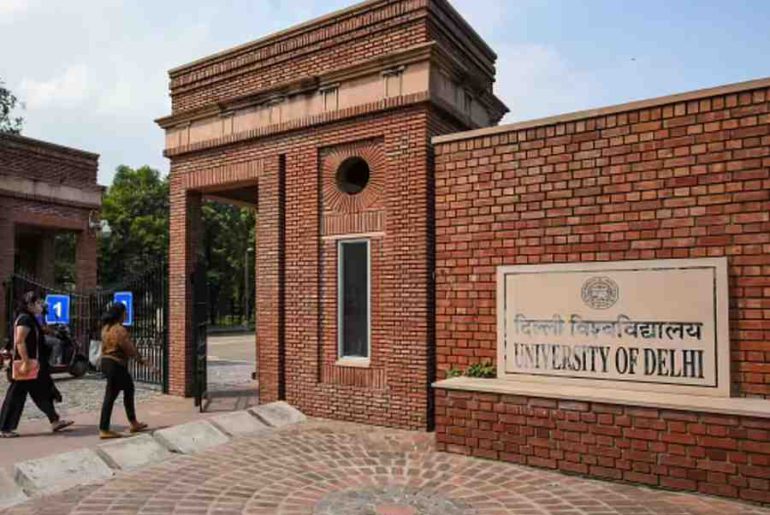
Delhi University offers a range of postgraduate diploma programmes across its colleges and departments, spanning fields from peace-building to cybersecurity. Here is what is on offer for 2026-27.
For students looking beyond conventional master’s degrees, Delhi University has several postgraduate diploma programmes worth knowing about. Some have deadlines coming up this week, so if any of these interest you, do not wait.
PG Intensive Diploma in Chinese, Japanese, or Korean Language
The Department of East Asian Studies offers intensive postgraduate diploma courses in Chinese (CF-1), Japanese (JF-1), and Korean (KF-1). Admissions for 2026–27 are open, with the deadline extended to 5th July 2026. Eligibility criteria and the admission notice are available here.
PG Diploma in Conflict Transformation and Peace-building
Offered through the Aung San Suu Kyi Centre for Peace at Lady Shri Ram College, this programmme focuses on conflict resolution and peace-building. The application deadline for 2026-27 is 12th July 2026. Further details pertaining to eligibility criteria and syllabus are available on this page.
PG Diploma in Cyber Security and Law (PGDCSL)
Offered by the Institute of Cyber Security and Law and conducted in Shaheed Sukhdev College of Business Studies, this programme covers the legal and technical dimensions of cybersecurity. Details on admissions for 2025-26 are available on the institute’s website, which indicates the new session would tentatively start mid-August.
PG Diploma in International Marketing and Analytics
Sri Guru Gobind Singh College of Commerce offers a postgraduate diploma in International Marketing. Admission details for 2026-27 have not been announced at the time of publication, but an official LinkedIn post confirms that details are forthcoming, along with the restructuring of the course. The bulletin of information from the 2025-26 session is available here.
PG Diploma in Financial Technology
Also offered by Sri Guru Gobind Singh College of Commerce, the details for 2026-27 sessions are forthcoming. Interested candidates are advised to regularly check the website for further updates.
PG Diploma in Global Business Operations
Shri Ram College of Commerce offers a postgraduate diploma in Global Business Operations. Based on last year’s cycle, applications are expected to open in December 2026. Candidates are advised to monitor the admissions portal for updates.
PG Diploma in Dietetics and Public Health Nutrition
Lady Irwin College offers a postgraduate diploma in Dietetics and Public Health Nutrition. Admission details for 2026-27 have not been announced at the time of publication. Eligibility criteria from the previous session are available here. Interested candidates may wish to contact the college directly for updates.
Diploma in Dietetics and Public Health Nutrition
The Institute of Home Economics offers a diploma in Dietetics and Public Health Nutrition. Admission details for 2026-27 are not confirmed at the time of publication; the most recent admission notice available is from the 2024-25 session. Programme details are on the institute’s website.
PG Diploma in Bioinformatics, Computational Biology, and Drug Discovery
The Dr B.R. Ambedkar Centre for Biomedical Research offers a postgraduate diploma at the intersection of biology and data science. The last available admission notice is from 2024-25. Prospective applicants should check the DU website for updates.
Candidates are advised to verify all deadlines and eligibility criteria directly with the respective institutions, as details are subject to change.
Read Also: Delhi University Releases Academic Calendar for 2026–27
Rishika Jain
[email protected]

Trending