Author

DU Beat

Browsing

NTA cancels the earlier NEET examination amidst leak allegations, prompting sharp reactions from student bodies over growing institutional mismanagement and uncertainty.


On May 12th, the National Testing Agency announced that the NEET UG Examination, which took place on 3rd May 2026 and is a crucial exam for medical aspirants across the country, stands cancelled. This decision was made after an alleged leak of questions was detected, despite there being heightened security measures across test centres in the country, according to the NTA. 


This year, more than 22 lakh students appeared for the NEET examination which came under scrutiny after claims surfaced that a “guess paper” circulated before the test closely matched several actual questions, particularly in certain areas of Rajasthan and Uttarakhand, according to a report by NDTV. The NTA then acknowledged complaints regarding possible malpractice, and the matter was soon referred to investigative authorities. The controversy intensified after the Rajasthan Police Special Operations Group reportedly found significant similarities between the circulated material and the examination paper, prompting nationwide concern over the credibility of the medical entrance test. Growing public outrage and mounting pressure eventually led the NTA, on May 12th, to cancel NEET UG 2026 and announce a fresh examination. Multiple detentions have already been made regarding the matter in Rajasthan, with over 45 people under scrutiny. 


This situation not only raises questions about the competence of the NTA itself, but also puts the futures of students on the line. The examination had integrated GPS-tracked movement of question papers, biometric verification, AI-assisted CCTV monitoring and deployment of 5G jammers in test centres across the country this year. In conversation with DU Beat, a medical aspirant who attempted the examination for the first time earlier this month, said,


“I feel that this is likely NTA’s greatest screw-up because this is not the first time this has happened, 2024 being the biggest example. It’s just so disappointing to see this happening despite the NTA having three years to learn from their mistakes. Giving a retest like this is basically just toying with people’s futures and their lives. Many might say that this is an opportunity to improve ranks or marks, but it’s not just about that second chance; this is about those who have given years to this three-hour exam just for it to get cancelled because of a leak. It really questions the NTA’s integrity and the security of conducting these examinations.” 


For many students, the cancellation implies restarting preparation with added emotional distress and travel costs for those aspirants living in rural areas. For those who have taken several drop years in hopes of clearing the examination, this may just lead to another year wasted with no fault of their own.


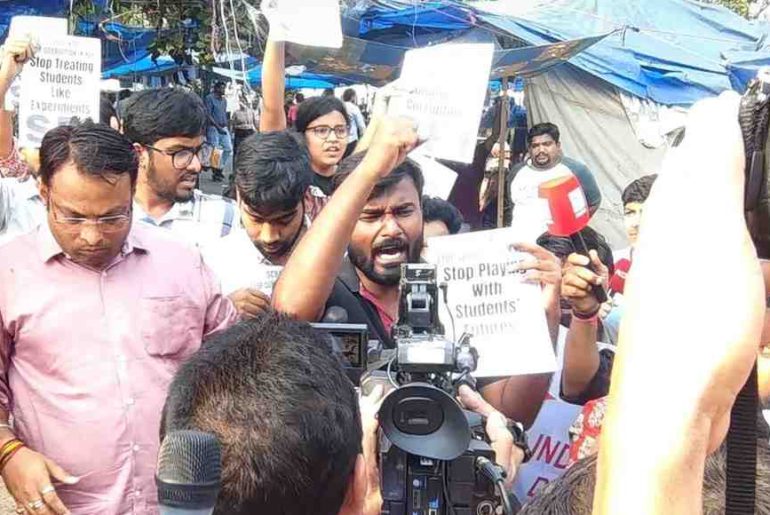
Soon after the cancellation was announced, members of the National Students’ Union of India (NSUI) took to the streets outside the Education Ministry in Delhi under the leadership of NSUI National President Vinod Jakhar. They demanded the resignation of Union Education Minister Dharmendra Patel, who refused to take any questions from the media, according to many news channels, and also to ban the “corrupt NTA”. ABVP and AISA also released official statements on their social media regarding the matter. SFI activists were even “brutally detained” during the peaceful procession outside the Shastri Bhawan, which included the SFI All India President Adarsh M Saji, All India Joint Secretary Aishe Ghosh and Delhi State President Sooraj Elamon. They wrote, “NTA has proven its inefficiency over the years and the NDA government hasn’t moved a finger. It proves the nexus between the coaching mafia and the government agencies.” 


Evidently, the student body at large is outraged over this controversy. However, the NTA has given some official instructions regarding the re-examination. They have mentioned that the new examination dates and reissued admit cards will be communicated through official channels in the coming days, the matter having been referred to the Central Bureau of Investigation (CBI). Also, no fresh registration or fee will be required; the data from the earlier examination will be carried forward to the re-conducted one. This crisis also comes at a time when educational institutional failure is already at large, considering the uncertainty surrounding semester examination timetables within the Delhi University administration itself.


Earlier today, the Federation of All India Medical Association (FAIMA) also moved to the Supreme Court regarding the matter, seeking to replace the NTA with a “more robust, technologically advanced and autonomous body.” The plea demands the formation of a “High-Powered Monitoring Committee” to conduct the NEET UG re-examination of this year until the new body is formed, as well as a shift to Computer Based Test (CBT) mode and the release of results of the cancelled examination to detect anomalies. This committee is proposed to be chaired by a retired Supreme Court judge, a cybersecurity expert and a forensic scientist. 


Image source: @sfidelhi on Instagram

Read Also: Delhi University Revises UG Exam Timetable, Sunday Papers Added for NEP Students


Manya Marwah
[email protected]

DU students held a follow-up infrastructure-safety protest at the VC lawns on 11th May, which was reportedly stopped by the Delhi Police during a VIP lockdown.

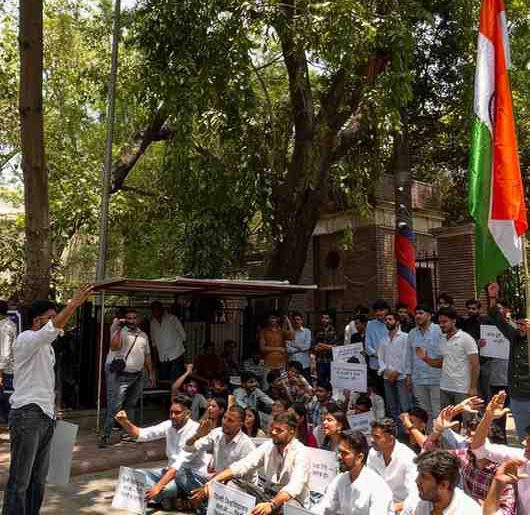
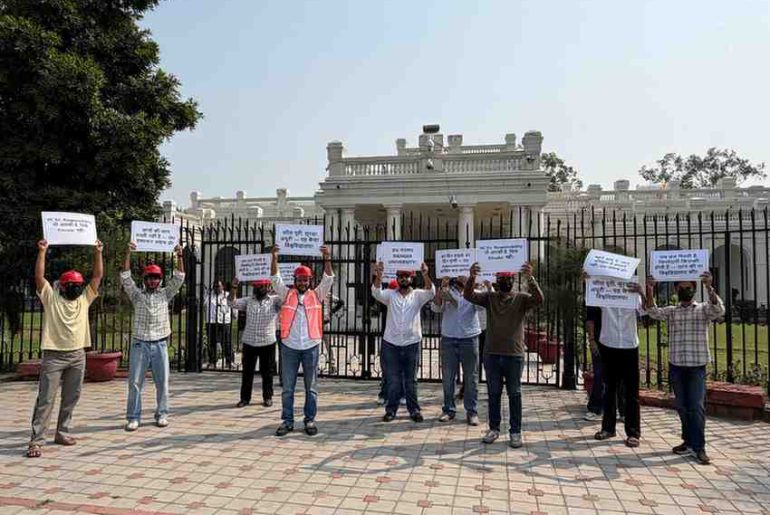
Students of the University of Delhi staged a protest on the Vice Chancellor’s lawns on 11th May over concerns about campus infrastructure and student safety. According to photos and videos shared with the editorial team, around 15 students participated in the demonstration led by NSUI member Gopal Choudhary.

Protesters were seen sitting outside the VC lawns wearing construction helmets and holding placards carrying slogans such as “DU matlab, DANGER UNIVERSITY!” (“DU means Danger University”) and “VC Sir, Responsibility bhi aapki hai, sirf circular nahi” (“VC Sir, responsibility is also yours, not just issuing circulars.”) Other placards read “padhne aaye they, jaan jokhim mein daalne nahi” (“We came here to study, not to risk our lives”).

Unlike the earlier protest held at the Faculty of Arts, the 11th May demonstration took place directly outside the Vice Chancellor’s premises and involved a smaller group of protesters attempting to raise their concerns before the university administration. Videos from the site showed police personnel speaking to the protesters and questioning whether permission had been taken for the demonstration and whether the police had been informed beforehand.

According to students present at the protest, they were unaware that a VIP movement was expected at the VC lawns and believed that holding demonstrations within the campus premises was permitted, citing previous instances of student protests within the university. 

In a video posted online following the protest, Gopal Choudhary stated that students had already given the Delhi University administration an ultimatum of 21 days regarding their demands and described the demonstration as part of continued efforts to show that the protesters were serious about the issue. Students involved in the protests have been demanding structural safety inspections, repair work in unsafe buildings, and greater administrative accountability concerning campus maintenance and student safety.

The demonstrations were organised in the backdrop of a recent incident reported at the Department of Botany, Faculty of Science, where the false ceiling of a laboratory allegedly collapsed during an MSc practical examination on 4 May 2026, injuring students present inside the room. Following the earlier protests, the Delhi University administration has reportedly instructed colleges and departments to conduct structural and electrical safety inspections across campuses

Image Source: Gopal Choudhary

Read Also: Protest Leader Gopal Choudhary Gives DU Administration 21-Day Ultimatum Over Campus Safety Concerns

Suansh Dembla

[email protected]

The care economy is the most foundational ingredient of a resilient economy. Where then, is the recognition?


The sound of my childhood is many things. It’s waking up to an auntie aggressively sweeping the floor, knocking things over as she makes her way through the room and haphazardly putting them back. It’s the sound of the pressure cooker, the tawa sizzling, the tandoor crackling away as sweet potatoes bathe in the heat of the coal. In almost every way, the sound of every average Indian child is also the silent one of compliance, to the system that is brazen in its onerous ways, to the family that unknowingly falls victim to this system, and the realisation that eventually accompanies it. 


Compliance, in this context, is borne from the sentiment that really has no viable response, no widely feasible solution, except a few, but that discussion will perhaps be better suited for the latter part of this piece. “Agar main nahi karungi, toh kaun karega? (If I don’t do it, who will?)” That is exactly why the question of how to include the care economy into traditional economic activities has left economists hanging. It’s because care is elusive; the methodological fundamentalism of any study that involves the economy or the economic being requires that the rationality assumption be fulfilled. This is where the concept of the ‘rational economic man’ comes into the picture, and why the care economy fundamentally cannot function within a historically orthodox mainstream or neoclassical framework, because care itself isn’t driven by rationality in any sense. Love, concern, responsibility, and obligation may motivate care work, but rationality may neither be achievable nor conceivable as an option for most care workers. If it were so, most mothers, domestic workers, and home nurses would not be doing what they are, and instead engage in economic activities that are traditionally more ‘productive’. 


The important point to consider here is that the care economy is absolutely essential. Of course, this is a historically recognised fact, but it cannot be ignored that certain sections of society must bear the burden of not only providing care work, but having it remain hidden, unrecognised, and as a service existing in perpetuity. This is where the issue lies. First of all, by restricting endless aspirations, individual nuances and souls behind the obligation of care–without which the economy would falter completely, there remains no real possibility of redistribution. The heteronormative structure that divides familial responsibility is efficient, and is definitely rational, but whether it is equitable, or even realistic in the humanistic sense, is the question we must ask ourselves. Secondly, we all have heard non-participants in the care economy singing praises of those who function under it. What they do is selfless, they say, the hallmark of a good, responsible caretaker and person; they are just as they should be, there is no other place for them to exist in. All of this is an illusion to distract from the reality of the situation, the fact that as soon as there are people performing obligatory economic activities with no true compensation (except perhaps the validation of those they care for, or maybe society) or a wage of any kind, it reduces their bargaining power almost to oblivion. They become passive participants in the political and economic diaspora of their environment and, in a way, displace the control over their own fate.


In India, especially, once we consider care and extended care activities that the classical economic models generally ignore, the labour force participation rate for females (in the heteronormative structure) increases dramatically, three or four- fold in comparison to when they are not included. What this means is that there is a particularly large chunk of society in the country right now, which is moving from working in a recognisable space where there is formal compensation, to unpaid, unrecognised work. Isn’t that deeply concerning?


This is a complex situation to resolve because creating a distributive care economy would, firstly, require an overturning of generations of psychosocial training, and secondly, entail authorities to acknowledge that there is even a requirement to overturn a system that fundamentally operates in their favour. When care work is outsourced, as many Indian households do, it creates a supply chain that leads to the same outcome for another individual. For example, if a domestic helper is paid to cook and clean for a particular household, they would not have enough time to do the same at home. It is then likely that, if they have the means to, they outsource their care work as well (or train future care workers within the family) or exist in a perpetual state of “time poverty”. There simply isn’t enough time to work, to care for children or elderly family members, and to care for the house as a whole, while still caring for oneself. The most important thing that gets lost here is recognizability, monetary and otherwise, and there must be a way to regain it. Perhaps, it is otherwise false to claim that we enjoy a democratic setup when so many people aren’t even given space to exist within it. 


Image credits: Carlin, a Peruvian political cartoonist

Read also: When Reclamation Becomes Recklessness, But the Fight for Respect Becomes a Spectacle


Manya Marwah

[email protected]

Bihar Governor’s directive mandating “five hours of daily teaching” for university faculty has triggered sharp backlash, with FUTAB and DUTA contesting the interpretation of UGC norms.


The Bihar Governor’s recent directive mandating ‘five hours of daily teaching” for all University faculty in the state has sparked protests. The Federation of University Teachers’ Associations of Bihar (FUTAB) has launched a formal protest against the directive, claiming it to be in violation of the University Grants Commission (UGC) 2018 norms. The 2018 regulations set forth a national standard for appointment and workload of teachers. 

The Delhi University Teachers’ Association (DUTA) has also joined the pushback, penning a letter to the Governor-cum-Chancellor Syed Ata Hasnain to withdraw the controversial order. 

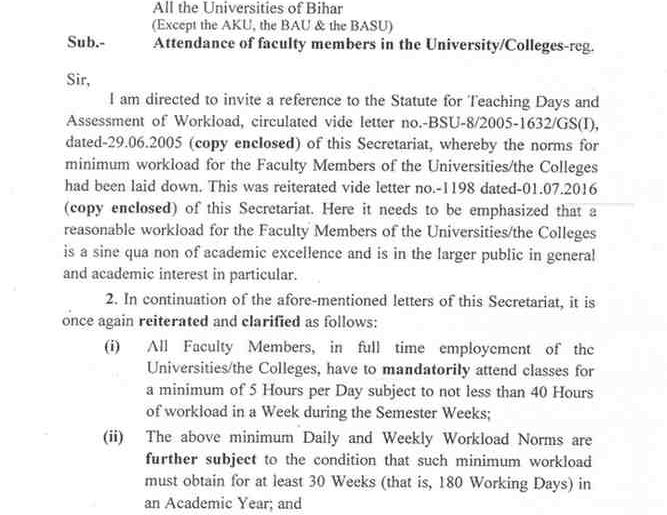
The directive was sent to all vice chancellors of universities/colleges in the state on 7th April 2026, via Kalpana Srivastava, the Officer on Special Duty (OSD-Judicial). The notice mandates all faculty members in employment of the universities to “attend classes for a minimum of 5 hours per day….not less than 40 hours of workload in a week.” The notice further states the UGC Workload norms to be the basis of the directive. 

Document excerpt showing UGC workload norms for teachers, including the clause on five-hour daily availability and weekly teaching hours for assistant professors and professors.
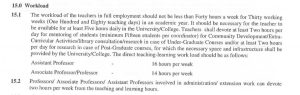
Excerpt from UGC workload guidelines stating that teachers should be available in colleges or universities for at least five hours daily during the academic year.


The main point of contention was the interpretation of the ‘five hour rule’. The teachers’ body contested that the norms define the five-hour rule as “stay-in hours” and not “direct teaching hours”. FUTAB president Kanhaiya Bahadur and general secretary Sanjay Kumar contested the directive in a letter to the Governor’s Secretariat, dated 13th April. They argued that the norms merely require the physical presence of faculty in college for five hours per day, and not direct teaching. 

The UGC regulations set down a workload of 40 hours per week across a minimum of 30 working weeks per year. Teachers must be available for at least five hours daily at the university/college. Teachers are also asked to dedicate two hours a day to mentoring students. The guidelines also describe explicitly the limit for the number of direct teaching and learning hours allowed for faculty. No more than 14 hours a week is allowed for Professors and Associate Professors, and 16 hours for Assistant Professors.

The letter from FUTAB noted that this distinction between “stay hours” and “teaching hours” was previously clarified by the Ministry in the Rajya Sabha and through official press releases in 2016, as reported by The Indian Express. “A teacher stays for five hours, but teaches for the specific hours allotted by rank,” the letter stated.

The teachers’ body has threatened intensified protests if the order is not withdrawn soon. In a statement with The Indian Express, president Kanhaiya Bahadur shared “We have written to the UGC to provide a fresh clarification. If Raj Bhavan does not withdraw the letter within a month, we will escalate our agitation.”

A spokesperson for the Bihar Governor’s Secretariat announced that the matter is under review. “The Governor is looking into the issue. We will examine the legal and practical aspects of the letter issued by the OSD (Judicial),” the official said.


Image Source: Governor of Bihar (Official Website)

Read Also:   Delhi University Revises UG Exam Timetable, Sunday Papers Added for NEP Students


Anjali Paruvu

[email protected] 

DU’s final UG exam date sheet for May-June 2026 schedules examinations on Sundays. The move, aimed at speeding up the process for final year students, has drawn criticism from students and teachers alike.


Delhi University has released the final schedule for its undergraduate examinations for the May-June 2026 session. The exams will begin on May 16 and are set to conclude by June 14. As part of the new schedule, some students will have to appear for their end semester examinations on Sundays as well.

The original schedule had exams running from May 16 up until June 19, a stretch of over a month. The university has now compressed the examination window. Specifically for those students in their sixth and eighth semesters, the examinations will be concluded within 14 days starting from May 16.

The Controller of Examinations, Gurpreet Singh Tuteja, explained the rationale behind this change. “We had to reconsider the dates as semester six and semester eight students may have to appear for other examinations, interviews, or job opportunities,” he told PTI. To compress the schedule within a shorter window, the decision was made to hold papers on alternate days, including Sundays.

Students in their second and fourth semesters will remain affected by the compressed schedule. Their exams will continue after the sixth- and eighth-semester students finish, with all end-semester exams scheduled to wrap up by June 14.

This year’s exam season marks a milestone for the university as the first time eighth-semester examinations will be conducted. The examinations mark the implementation of the four-year undergraduate programme introduced under the National Education Policy (NEP) 2020. The first batch of NEP students are now in their fourth and final year, making the exams a historic moment for the university.                                   

The revised schedule will also accommodate sixth and eighth semester students who have a backlog of papers from previous semesters, shared university officials.

It has also been noted that the revised schedule with alternate-day and Sunday examinations applies only to those students enrolled under the NEP. Those students still giving exams under previous systems, such as the Choice Based Credit System (CBCS) and the Learning Outcomes-based Curriculum Framework (LOCF), will follow their original schedules. 

Despite statements explaining the rationale from various officials, the decision to hold exams on Sundays has drawn criticism from students and faculty. The move has sparked much online discourse against the schedule.

Students are advised to check the official examination website at exam.du.ac.in for the final date sheet, arranged course-wise, specific to their own programme and semester, under either NEP-UGCF-2022 or CBCS-LOCF, depending on the system they are enrolled under. 


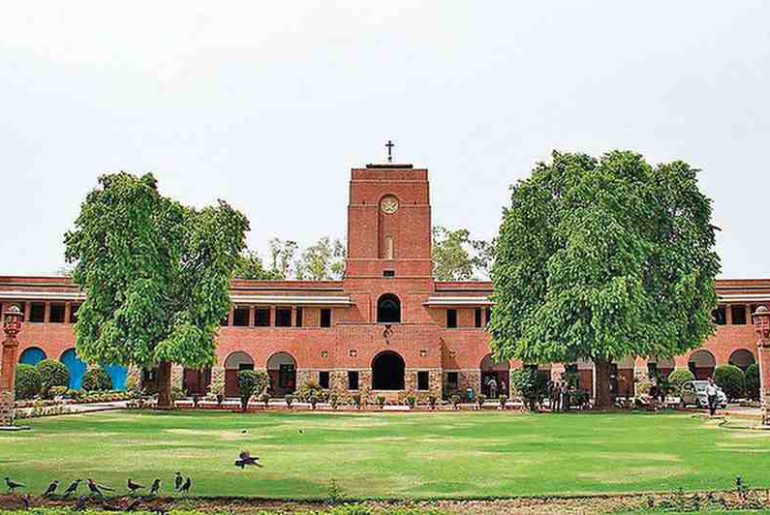
Image source: Telegraph India 

Read also: Hansraj College suspension row: Parth Srivastava moves to Delhi High Court alleging selective targeting after 29/30 suspensions revoked


Arshia Sharma

[email protected]

Late at night, on 9th May, police shot and arrested two wanted criminals who were allegedly involved in the Karol Bagh shooting incident that occurred two weeks prior.

Alleged criminals, identified as Sahil and Avinash, were arrested after an encounter with the Delhi Police. The incident occurred late at night on 9th May, near Gate 3 of Zakir Husain Delhi College on Jawaharlal Nehru Marg. Both the accused are speculated to be involved in the recent Karol Bagh shooting incident, where gunshots were fired in broad daylight on the 24th of April, by unidentified individuals, injuring one person. This prompted a manhunt, leading the Delhi Police Special Staff team to Sahil and Avilash, under the leadership of Central District DCP, Rohit Rajbir. They had been on the Delhi Police’s list of most wanted criminals for several days due to their suspected involvement in the Karol Bagh shooting case. 

According to the Delhi Police, the Special Staff received specific intelligence inputs suggesting that those involved in the Karol Bagh shooting incident would likely visit the area around Zakir Hussain Delhi College on the night of May 9th. The reasons for their visit remain unclear, even to the police, with officers speculating the criminals were in the area either to meet an associate(s) or to commit further offences.

A Delhi Police vehicle and a motorcyclist on a road near Zakir Husain Delhi College at night after a police encounter.
Image Source: X (@ians_india)

Upon receiving the information, surveillance around the college premises and adjoining roads was intensified, and police had set a trap for the criminals. According to officials, the accused tried to resist arrest and escape police custody, opening fire on police personnel. Police say that nearly 10 rounds were shot in the encounter. In an act of defence, the police fired at both Sahil and Avinash, injuring both criminals in the legs, before overpowering them and arresting them on the spot.

The injured criminals were immediately taken to Lok Nayak Hospital, where they are currently admitted and are receiving treatment. Both the accused are currently under police supervision. Investigators were able to recover illegal firearms and live cartridges from the scene, likely used by the accused during the exchange of fire with the Delhi Police. Further investigations have been launched to ascertain the criminal backgrounds of the accused and confirm allegations of connections with illegal gangs and criminal groups operating within the city. The motive behind the Karol Bagh incident and any plans of future attack, particularly in the central Delhi region,  is being probed by investigators. 


Image Source: du_public on instagram

Read Also: Protest Leader Gopal Choudhary Gives DU Administration 21-Day Ultimatum Over Campus Safety Concerns


Souparnika.S.Rajkumar

[email protected]

Raising concerns regarding repeated infrastructure-related incidents across campuses, students of the University of Delhi organised a protest at the Faculty of Arts. 

Students of the University of Delhi staged a protest at the Faculty of Arts earlier this week over alleged negligence regarding campus infrastructure and student safety. NSUI member Gopal Choudhary reportedly led the demonstration. Students raised concerns over a series of infrastructure-related incidents reported across various colleges and departments under the university.

Demonstrators demanded immediate structural safety audits of university buildings, urgent repair work in deteriorating facilities, and greater administrative accountability regarding campus safety measures.

Following the protests and growing concerns regarding campus infrastructure, the Delhi University administration has now reportedly instructed colleges and departments to conduct proper structural and electrical safety inspections across campuses. However, there is no official statement from the University administration regarding this decision.

Among the demands raised during the protest was the provision of life insurance and compensation support for students injured in infrastructure failures within university premises. Protesters also called upon the administration to publicly address recent incidents and implement preventive measures to avoid similar occurrences in the future.

In an interview with the Editorial Team of DU Beat, Gopal mentioned,

We have given the administration of DU an ultimatum of 21 days. During this time, we want them to conduct thorough inspection of all DU colleges and suspend classes as well as exams in campuses with poor infrastructure. Otherwise we will again stage a hunger strike until stricter actions are taken. We are also planning to file a RTI in 1-2 days time for how the annual budget is spent in every college. When we approached the administration of DU, they pointed us towards the individual colleges. And the admin in the colleges pointed us back to the VC. There is no end to this cycle and both of them are equally responsible. At the end they’ll have to work together if change is desired. 

Other than that, we are protesting for water coolers and ORS facilities in every classroom during the exam season in light of the prevalent heatwave. In addition to this, the 66.67% attendance criteria is also problematic. I will be attending a meeting on Monday with the administration to address these concerns.” 

Slogans such as “DU Campus or Danger Zone” and “Have we come here to study or die?” were seen on placards and raised during the demonstration, reflecting concerns among students regarding safety conditions on campus.

The protest follows a recent incident reported at the Department of Botany, Faculty of Science, on 4 May 2026 during an ongoing MSc practical examination. According to statements circulated online, the false ceiling of Lab Room No. 26 allegedly collapsed between 3:45 and 4:00 PM, along with a projector and nearby panels, while students were writing their examination.

One student reportedly sustained a severe head injury requiring several stitches and was taken to a nearby hospital in Civil Lines. Another student allegedly suffered minor shoulder injuries. The incident prompted renewed discussion among students regarding the structural condition of university buildings and the response mechanisms available during emergencies.

Visuals from the protest showed students assembled with placards and banners outside the Faculty of Arts premises, with slogans reportedly focusing on student safety and institutional accountability. Protesters alleged that multiple warnings and complaints regarding infrastructure conditions had previously been raised across colleges.


Image Source: Instagram gopal_choudharynsui

Read Also: Delhi University student petitions High Court for separate vegetarian mess facilities


Suansh Dembla

[email protected]

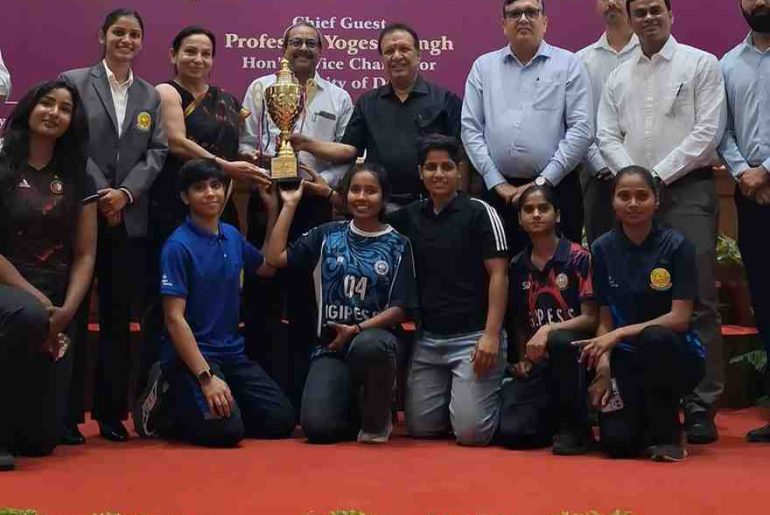
On 8th May, the Annual Sports Awards Function was organised, where several student athletes were honoured by the Vice Chancellor of Delhi University and Director of the Delhi University Sports Council for their remarkable athleticism and dedication.

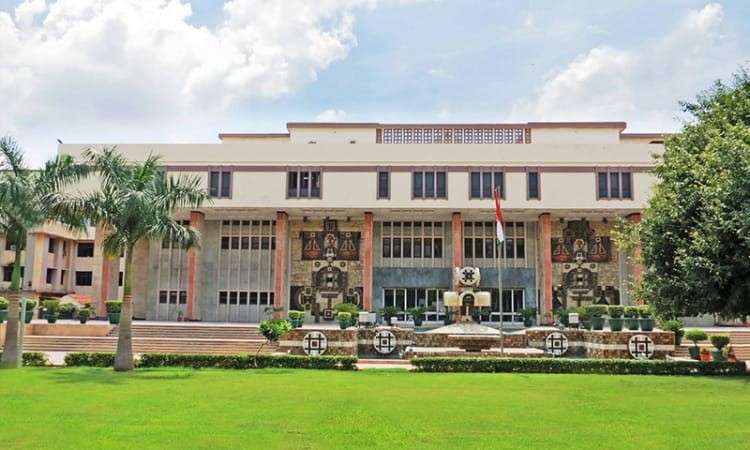
The Annual Sports Awards Function 2026, conducted by the Delhi University Sports Council (DUSC), was held on 8th May 2026, from 11:30 am onwards at the Convention Hall, Vice Regal Lodge, University of Delhi. Prof. Yogesh Singh, the Vice Chancellor of the University of Delhi, was honoured as the Chief Guest. The event was organised to recognise the achievements of students across various colleges of the University of Delhi in the realm of sports and bestow upon them accolades for their remarkable contributions in the arena. 

The event saw the presence of several dignitaries who graced the dais alongside Prof. Yogesh Singh, including Dr Anil Kumar Kalkal, Director DUSC, who facilitated the Vice Chancellor; Dr Vikas Gupta, Joint Registrar; Prof. Rajni Abbi, Director South Campus, and Prof. Payal Mago, Director, Campus of Open Learning.

The Delhi School of Journalism (DSJ) was designated as the media partner for the event, with the Officer on Special Duty (OSD) of DSJ being assigned the role of convener of the Media and Website alongside a role in the Central Coordination Committee. “We have put together a team of students for the task, and will be performing our duty as intended,” they said.

The event began with the presentation of the DUSC’s Annual Report, followed by a welcome address from the Director of the Delhi University Sports Council, after which the Vice Chancellor addressed the audience. In his speech, the VC urged that sports be seen as “core curricular” rather than “co-curricular,” citing the importance of movement and physical activity in people’s lives. He also asked the principals of various colleges present at the event to not only encourage students to partake in physical activities but also to make use of the sports infrastructure provided, citing the Rugby ground, gymnasium, and indoor sports facilities at the Multipurpose Hall of the University Sports Complex. Additionally, he also commemorated the students who had shown talent, determination, and dedication in their respective fields, in his speech.

Following the Vice Chancellor’s Address, the award distribution ceremony commenced. Notably, a large portion of the students honoured were women. Individual students as well as college teams were honoured, with Deshbandhu College’s Women’s Archery team and Kirori Mal College’s Women’s Basketball team, amongst others, winning the Intercollege Tournament. For the second year in a row, the Indira Gandhi Institute of Physical Education & Sports Sciences was awarded the Champions’ Trophy.

After the conclusion of the event, students were seen celebrating, trophies in hand and coaches by their side, clicking pictures in the afternoon sunshine.


Image Credits: Souparnika.S.R

Read Also: Delhi University student petitions High Court for separate vegetarian mess facilities


Souparnika.S.R

[email protected]

A petition was filed before the High Court by a student frustrated with the lack of vegetarian-only food facilities. The issue has revived food-related debates among students.

 A Delhi University student has filed a petition before the Delhi High Court asking for separate, vegetarian-only food facilities in hostel messes and college canteens across the university. The petition was filed on Wednesday and is likely to be up for hearing in the following days.

Vijeta, the petitioner, filed the plea through advocate Barun Kumar Sinha. She took the step after finding issues with her women’s hostel. In her petition, she stated that she was “directly and substantially” affected by the vegetarian and non-vegetarian food being prepared and served together in her hostel mess.

She went on to say that the lack of segregation had caused her “grave prejudice”, inconvenience, and violation of her rights. She also alleged that food safety regulations and hygiene standards are being broken regularly. According to Vijeta, no action was taken despite raising this issue multiple times with hostel staff and officials. 

The petition seeks to direct authorities to set up separate vegetarian mess facilities at a reasonable distance from areas where non-vegetarian food is cooked and served. It also seeks proper segregation of veg and non-veg food in storage and serving areas across hostels and canteens, along with strict compliance with food safety and hygiene laws. The petitioner has further asked for a clear policy for students with strict vegetarian dietary requirements, an adjustment in mess charges for those using only vegetarian facilities, and a grievance redressal mechanism so students have a proper and timely way to raise complaints related to mess and canteen services.

Such issues are not new to the university. Food-related tensions have been faced commonly in the past few years. In January 2023, Hansraj College quietly stopped serving non-vegetarian food in its canteen and hostel after it resumed classes post-COVID. The decision came as a shock to many. 

A second-year student at the time told news agency ANI,

 “Earlier, non-veg food used to be served, but suddenly non-veg food and eggs were stopped. The students who have come from the south face a lot of issues because they have the habit of eating non-veg.”

In mid-2025, a similar controversy broke out at JNU’s Mahi-Mandavi hostel, where a “veg-only” notice appeared in the mess. The JNU Students’ Union (JNUSU) reacted strongly, with president Nitesh Kumar calling it an attempt to divide students and a violation of hostel norms. 

The current petition has also triggered mixed reactions on campus and on social media. Some students claim they feel genuinely uncomfortable when meat is cooked in shared kitchens. A student of Hansraj College had earlier told ANI, “People who want to eat non-veg can have it outside. Students are happy with vegetarian food.” The issue has also sparked significant online discourse. “If a student has raised it through the proper legal channel, the court should at least listen,” one DU student posted on Instagram.

The Delhi High Court is yet to take up the case for a formal hearing. No response has been given by Delhi University or the government so far. The petition is expected to come up before the court in the coming days.


Image source: Live Law

Read Also: Datesheet dilemma finally ends; Last date to fill the examination form passes.

Arshia Sharma

[email protected]

A protest linked to NSUI disrupted a book launch at the University of Delhi over DD News editor Ashok Srivastava’s past remarks on Rahul Gandhi, leading security personnel to evacuate protesting students.

On Thursday, 7th May, students from the NSUI (National Student’s Union of India) allegedly staged a protest during an event. The event was scheduled as the launch of the book, ‘Decolonizing the Bharatiya Minds: From Colonial Roots to Cultural Marxism’, at the Shankar Lal Auditorium of the University of Delhi. The event was attended by keynote speaker Mr. Ramlal, Akhil Bharatiya Sampark Pramukh of the RSS (Rashtriya Swayamsevak Sangh); chief guest Mr. Ashok Srivastava, Consulting Editor at DD News; and the book’s author, Dr. Prashant Barthwal.

Poster for the launch of the book ‘Decolonizing the Bharatiya Minds: From Colonial Roots to Cultural Marxism’ at the University of Delhi on 7 May 2026.
Poster via Gargi Care Foundation Instagram
for the DU launch of Decolonizing the Bharatiya Minds.

The event was organized by INSIGHT and Gargi Care Foundation in collaboration with the University of Delhi. The protests were triggered by the past remarks of the DD News anchor, Ashok Srivastava, against Rahul Gandhi. As covered by PTI, the remarks included that Rahul Gandhi is “not even equal to the dust under Veer Savarkar’s slippers,” which is most likely linked to the protest. Ashok Srivastava was allegedly heard saying this during a TV debate.

This remark has already triggered protests outside the DD News office by Youth Congress and NSUI workers in April. The protest saw slogans of “Ashok Srivastava Haye Haye” (Ashok Srivastav Shame Shame!), “Ashok Srivastav Murdabad” (Down with Ashok Srivastav), and “Godi Media Go Back.” One of the protesters included Rahul Jhansla, the vice president of the Delhi University Student’s Union and an NSUI supporter.

As the atmosphere grew charged, the security officers stepped in, and the protesting students were evacuated from the auditorium.

Read More: Hansraj College suspension row: Parth Srivastava moves to Delhi High Court alleging selective targeting after 29/30 suspensions revoked

Image Credits- Instagram Page of indiafrontwire_


Divyanshi Dusad

[email protected]