Author

DU Beat

Browsing

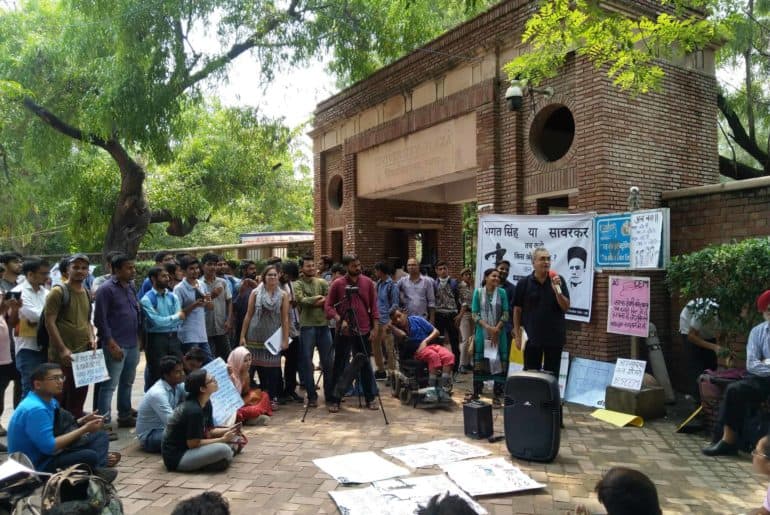
A host of student organisations invited various academicians for a ‘public talk’ on the legacies of Bhagat Singh and VD Savarkar on 28th August.

The controversy about the busts of VD Savarkar, Subhas Chandra Bose, and Bhagat Singh – which were installed, and then removed from the University campus – might have subsided, but the ideological clash still seems to be alive.

Various student parties and collectives – like Parivartankami Chhatra Sangathan (Pachhas), All India Students’ Association (AISA), Students’ Federation of India (SFI), Bhagat Singh Chhatra Ekta Manch (BSCEM), Pinjra Tod, Krantikari Yuva Sangathan (KYS), and others – held a public talk titled ‘Bhagat Singh Ya Savarkar: Tay Karo Kis Ore Ho Tum (Bhagat Singh or Sarvarkar, decide which side you are on)’. Eminent historian S. Irfan Habib, author, former DU professors Shamsul Islam and Madhu Prasad, and Jagmohan Singh, author and nephew of Bhagat Singh, were present as guest speakers at the event, which was marked by sloganeering, songs and condemnation of Savarkar’s ideology and actions.

“Sacrilege to club all three together”

Mr. Habib, whose work has been instrumental in transforming the perception about Bhagat Singh – from one limited to just a martyr to one of a revolutionary thinker – pointed out the different style of politics practised by Bhagat Singh and Subhas Chandra Bose on the one hand, and VD Savarkar on the other. He said that while Savarkar’s supporters can push him independently, it was a sacrilege to club all three together.

Responding to the claims of many supporters of Savarkar that Bhagat Singh had praised his work, Mr. Habib said that while this was true, Bhagat Singh’s approbation was limited only to a few lines about Savarkar’s book on the revolt of 1857, and not about the latter’s political thought.

“Angrezon ka dalal”

The author of over half a dozen books on Savarkar, Golwalkar, Hindu nationalism, and the Rashtriya Swayamsevak Sangha (RSS), Dr. Shamsul Islam seemed especially scathing in his critique of the father of the Hindutva thought. Keeping a bunch of documents and papers handy with himself as evidence, Dr. Islam went over the mercy petitions that Savarkar had sent to the British officials while being imprisoned in the Cellular Jail in Port Blair.

He further said that Savarkar had sabotaged the Quit India Movement and helped the British by training “thousands of Hindus to join the British army,” while the Hindu Mahasabha had formed coalition government with the Muslim League in four provinces. He repeatedly made an appeal for state-funded publication of all of Savarkar’s writings and them being made compulsory readings in schools and colleges; the purpose behind this, as he highlighted, was that it would lead to a supposed exposé of Hindutva organisations. “Don’t install Savarkar’s bust, publish his writings,” was his call.

The other two speakers, Mr. Singh and Ms. Prasad also contrasted the life and legacies of Savarkar and Bhagat Singh. The former said that Bhagat Singh wanted to bring Inquilab in people’s lives, while calling for usage of the complete slogan “Samrajyavad murdabad, inquilab zindabad.” Ms. Singh urged the audience to stop using the title “Veer” for Savarkar. “Ye kaayar they aur hain (they were and are cowards)” she said.

One-way traffic?

Despite the eminence of the speakers present at the event, the public meeting seemed to speak in one tone: a unanimous condemnation of Savarkar. At one level, that state of affairs can be understood; the organisers of the public meet do not subscribe to Savarkar’s ideology. Just like an event organised by supporters of Savarkar might be expected to be in his favour, one organised by critics would raise their voice against him. But would it have been a better, more educational experience to organise a debate with representatives of both sides instead?

When we posed this question to Deepak Gupta of Pachhas, one of the main organisers of the event, he replied, “Aapko aisa lagta hai ki jo debate ki jagah maar-peet karte hain wo aise program ko hone denge? (Do you think those who prefer violence over debate will let such a program happen?)”

A similar sentiment was voiced by Dr. Islam, “Wo aayenge nahi (they won’t come)”, he said, while alleging that Hindutva organisations and their supporters hide their original documents whilst he keeps publishing them.

Feature Image credits: Prateek Pankaj for DU Beat

Prateek Pankaj
[email protected]

For the upcoming Delhi University Students’ Union (DUSU) elections, Akhil Bharatiya Vidyarthi Parishad (ABVP) reveals that building new hostels is going to be the main agenda in their manifesto.

As reported by The Hindu, Sidharth Yadav, the State Secretary of ABVP said, “Building hostels will be the key agenda in our manifesto. With the commercialization of private hostels, rents have gone up.”

On 25th August 2019, the candidates from ABVP visited the University students living in hostels and paying guest accommodations and raised the issue of insufficient accommodation facilities provided by the University of Delhi (DU) for outstation students. Monika Chaudhary, the National Media Convener of ABVP said, “We had sent an application to the administration a while back with respect to building new hostels but they have not reverted to us, so we are going to campaign for it now. We are also hoping to get strong support from the government of Uttar Pradesh to build hostels for students from there. With regard to this, our President, Shakti Singh had a meeting with the Uttar Pradesh Chief Minister Yogi Adityanath a while back.”

ABVP talked to the students about their campaign for the construction of new hostels in the University as a step against students having to pay a lot for their residence while completing their education. They asked for support concerning this in the upcoming DUSU elections.

Many students across the campus have shown support for this campaign. Sana Sharma, a student of DU and a resident of paying guest accommodation in North Campus said, “The University has very few hostels which are not able to accommodate even half of the student population. Only very few people get a place in these hostels and the rest of us have to have to pay very high prices for accommodations in Delhi. It is very inconvenient and costly. I support ABVP’s campaign to build new hostels and hope that the administration will hear us.”

Feature Image Credits: IndiaTV

Juhi Bhargava
[email protected]

When it rains, it’s time to dust your umbrellas up and take them out for a ride to school. It’s also time for you to rethink about your attire and wardrobe. Here are a few footwear choices to think about along with your clothes.


The slight rains in Delhi these days, come as a relief to many people including residents who have had to depend on Municipal corporations to get adequate water. As the rains bring good news it also demands a change in your wardrobe.

That’s where footwear becomes an important factor after all nobody wants to go to college wearing drenched socks which would smell eventually. Many times, it’s the last thing that we bother about but choosing the right footwear not only protects you from the everyday puddles and little ponds in the city. It also adds a sense of style. As the saying goes A person is judged by their shoes!

So, here are some footwear choices to try out for your college day!


Sports shoes

They are also a favourite choice for students who tend to have an athletic side to them but as these shoes require for you to wear socks, it could become a disaster for you in no time. Wearing no show, linear and pad socks would be a greater alternative as these socks stop at the ankle and thus won’t get wet.


Chappals

Turns out that a vast number of students would prefer chappals in the rain than anything else. Yes, it’s true. Wearing chappals is not the biggest fashion blunder to make as these not only are the comfiest footwear but also dry off quickly. A great number of fashionable chappals have come up in the market and thus are surely a good choice.


Crocs

his wonder has taken the fashion space by storm and has been dominating it for quite some time now. A mix of both the slippers and shoes. Yet sleeker than both is a great option for students to cope up with their rainy day. Crocks, not only offer comfort but also enables you to hide your legs. These have come up in a number of variations and are available at great prices as well.


Boots

An all-time choice for rains, these, may not be the first choice when it comes to pairing them up stylishly with your outfit, but boots have a great sense of style to them. The market today has many variations to the classic boots, with available in leather and other such water-resistant materials. The bulky resemblance also adds weight to the whole appearance and also gives you the ideal cowboy look when paired with jeans. If that is not the ideal look for you there are variations like the motto boots and the duck boots that can obviously find a way to your wardrobe.


These are some of the many options that you can try out for the rains. They are, of course, the question of what goes with what.

Experiment with your footwear this season and stand out from the rest of the crowd because who doesn’t.

 Featured Image Credits- Video Blocks


Stephen Mathew

[email protected]

The theatre collective that started 76 years ago has left an indispensable mark on Indian theatre art and Bollywood.

“If you are doing something on IPTA, there’s a chance you will get lost? Because which chapter do you pick up?” said Jagan Shah, a writer and a theatre director who has been putting together Indian People’s Theatre Association (IPTA)  story from its inception till date. For starters, Indian People’s Theatre Association or IPTA is a theatre collective which brings together theatre artists from across India to illustrate political and social issues through dramas, street plays, and theatres. It closely adheres to the ideology of Communist  Party of India and seeks to inform and educate people about a plethora of issues concerning the common man by means of art.

IPTA’s history can be traced back to 1943 when two major historical incidents were gaining momentum. The struggle for India’s independence had reached its peak and World War II had galloped the world in a deadly conflict. The Bengal famine of 1943 along with Nazi force’s intrusion over Soviet Russia evoked intellectuals in India to initiate an organization which could inform the masses about these problems. Artists too felt the need to contribute in India’s freedom struggle through their art and thus the group was born at a conference in Mumbai in 1943. Subsequently, a lot of committees of IPTA were created all across India.

Despite its unabashed left leaning stance, IPTA had members who were staunch leftists as well as those who had no or naïve  political views. Along with politically charged individuals like Bijon Bhattachary and Mulk Raj Anand, it has prolific Bollywood personalities like Prithviraj Kapoor, Balraj Sahni, and Utpal Dutt as its members too.

One of the most important plays made by IPTA member Bijoy Bhattachary was Nabanna (New Harvest) in Bengali which depicted the plight of the Bengal famine. Another play called Nava Jiboner Gaan by Jyotirindra Moitra and the film Dharti Ke Laal  reciprocated the conscience of people of that time.

IPTA had a firm presence in the University of Delhi during the pre-independence era. Indraprastha College for Women had a dedicated IPTA group that performed anti-government plays. Even when government did not give them space and mikes to perform, they arranged their own materials and venues. When they were not allowed to publicise their plays in newspaper, they would write the name of venue on papers with pen and stick them on walls.

IPTA has substantial influence on the Bollywood movies of 1950s and 1960s as many directors, actors, scriptwriters, lyricists, music directors, and choreographers who came together to make a film were previous members or contributors of IPTA. Among the renounced actors who had alliance with IPTA were A.K Hangal, Balraj Sahni, and Utpal Dutt. Song writers like Majrooh Sultanpuri, Sahir Ludhianvi, Shailendra, and Kaifi Azmi along with music directors Hemant Kumar and Salil Chaudhary were associated with the theatre group.


At the time of partition, when the entire country was burning with Hindu Muslim divide, IPTA (along with other cultural organisations like Progressive Writer’s Association) made its best efforts to extinguish the fire from places like Mumbai, where it had substantial presence. Stalwart Prithviraj Kapoor along with young sons Raj Kapoor and Shammi Kapoor sought out on a truck procession to ease out the tension between native Hindus and Muslims of Mumbai.

Post independence, IPTA began to face clamp downs and repression by government. The organisation which once enjoyed the support of nationalist leaders, now started to face their resistance as the onus of power now lied on these nationalist leaders. Gradually members of IPTA started to drift away from the main organisation and led new factions in various parts of the country. Bahurupee, IPTA Mumbai, and the Delhi based theatre company Jana Natya Manch started by Late Safdar Hashmi are successful offshoots of IPTA that still continue to produce political dramas to express dissent through art on contemporary issues. IPTA in its original essence might not exist today but it certainly is kept alive by common thoughts like idea of rebellion and struggle for equality espoused by like minded artists.

Feature Image Credits: IPTA Facebook


Priyanshu

[email protected]

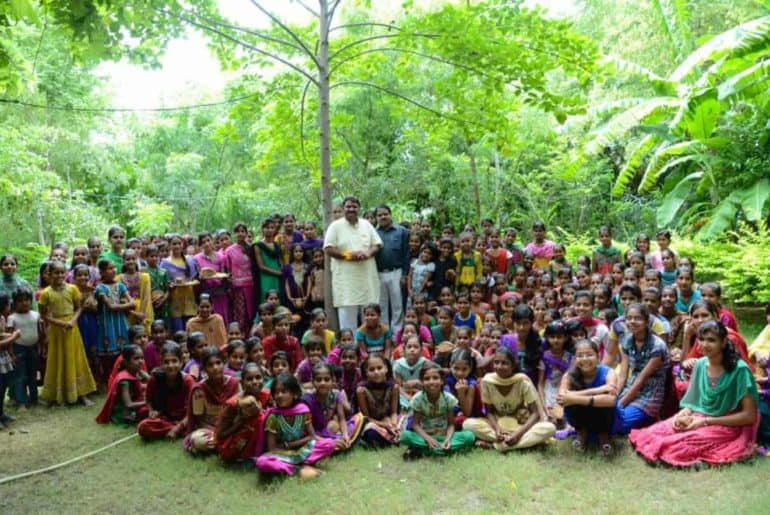
In Rajasthan, a state often characterised by low sex ratio and an arid climate, the villagers of Piplantri in Rajsamand have resorted to planting 111 trees with the birth of every girl child to battle female foeticide and climate issues.

In Piplantri, whenever a girl child was born, the family pushed a hard, jagged grain into her mouth to cause infection and ensure her death. Shyam Lal Paliwal never understood this practice.He had always loved his daughter. So when Sarpanch Shyam Lal Paliwal’s 16-year old daughter Kiran died in 2006, he planted a burflower tree in her remembrance and vowed that no one would mourn the birth of a baby-girl in Piplantri anymore. Instead, it would be celebrated with the planting of trees.

Before 2005, Piplantri had been a drought-prone area. Shyam Lal recalls that once in 2005, the drought had been so bad that the government were forced to send water trains to the village. But it all ended with Kiran’s tree and Shyam Lal’s vision.

Alongside planting 111 trees, whenever a girl child is born in Piplantri, donations are collected so that INR 31,000 can be saved and put aside, so that with investment, there is a sum to match a potential dowry, allowing the families to become financially independent and in turn, be able to send their daughters to school, not marry them before they turn 18, and care for the planted trees as well. Along with this, getting inspiration from his wife, Shyam Lal also helped establish an aloe vera business in the village. After training, women can make and market aloe vera gel, juice and pickle, and some earn up to INR 6,000 a month.  The Sarpanch has also started a rainwater harvesting plant in the village.

Aloe Vera gel made by the women of Piplantri village. image Credits: Lifegate
Aloe Vera gel made by the women of Piplantri village.
image Credits: Lifegate

The government of Rajasthan, which has been shamed with a concerning sex ratio for years, decided to introduce a yojana (scheme) inspired by Paliwal’s work. Under the policy, the family receives INR 2,500 on her birth and the same amount on her first birthday. This is doubled to INR 5,000 if she finishes class five and class eight. When girls complete their senior secondary education i.e. class 12th, they get INR 35,000, making an overall total of  INR 50,000.

Piplantri has become an inspiration to various villages in rural India and holds itself up to be an important symbol of not only women empowerment, but also sustainable development in India.

Feature Image Credits: Procaffenation

Shreya Juyal

[email protected]

After the initial week of jitters and anxiety finishes, faces start to become familiar and the freshers’ no longer need to ask three people for directions to their classrooms. Here’s looking at college life, through the eyes of a fresher.

 Somewhere between metro rides, attending lectures half-asleep and making innumerable plans to meet at the nearest chai tapri each day, college life for the most recent batch has kick-started. And it is exultingly unexpected and exhausting at the same time. High school puts most of us in a sheltered and protective delusion where one is far away from the finer nuances and greater responsibilities of adulting.

My initial experience of college life at the North Campus of the University of Delhi (DU) has been liberating and eye-opening. The diverse spectrum of students, the dynamics of an all-girls institution and the ever-lasting juggle between academics and co-curricular activities forms the entire experience of college which continues to teach me something new every day.

The college has become a stepping-stone of unlearning for me. The judgments, opinions, norms, realities, and conditions that I was exposed to earlier, have all been rethought. The political protests, opinionated teachers, vocal classmates, and active media on campus have exposed me to broader perspectives, new ways of thinking and encouraged me to look at things through a fresh lens.

Satviki Sanjay, a first-year student of B.A (Honours) Philosophy from Miranda House says, “Despite popular belief, going to college in DU is so much more than just “chilling”. It gives you the much-needed space to work on your interests and your area of study, which was not possible in school. Being at the University gives you freedom but at the same time, it teaches you the idea of being responsible for yourself. For me, the most enriching experience so far has been meeting different people in numerous societies and being exposed to varying opinions.”

The diverse and democratic environment of the University has exposed me to its rich legacy and heritage. It has already pushed me to put my best foot forward, push myself, make the most of the opportunities at hand and get out of my comfort zone. Like me, many first-years are looking forward to the next three years of college and live by the motto – “Sleep more than you study, study more than you party, party as much as you can!”

Feature Image Credits: DU Beat

Bhavya Pandey

[email protected]

After the initial week of jitters and anxiety finishes, faces start to become familiar and the freshers’ no longer need to ask three people for directions to their classrooms. Here’s looking at college life, through the eyes of a fresher.  Somewhere between metro rides, attending lectures half-asleep and making innumerable plans to meet at the nearest chai tapri each day, college life for the most recent batch has kick-started. And it is exultingly unexpected and exhausting at the same time. High school puts most of us in a sheltered and protective delusion where one is far away from the finer nuances and greater responsibilities of adulting. My initial experience of college life at the North Campus of the University of Delhi (DU) has been liberating and eye-opening. The diverse spectrum of students, the dynamics of an all-girls institution and the ever-lasting juggle between academics and co-curricular activities forms the entire experience of college which continues to teach me something new every day. The college has become a stepping-stone of unlearning for me. The judgments, opinions, norms, realities, and conditions that I was exposed to earlier, have all been rethought. The political protests, opinionated teachers, vocal classmates, and active media on campus have exposed me to broader perspectives, new ways of thinking and encouraged me to look at things through a fresh lens. Satviki Sanjay, a first-year student of B.A (Honours) Philosophy from Miranda House says, “Despite popular belief, going to college in DU is so much more than just “chilling”. It gives you the much-needed space to work on your interests and your area of study, which was not possible in school. Being at the University gives you freedom but at the same time, it teaches you the idea of being responsible for yourself. For me, the most enriching experience so far has been meeting different people in numerous societies and being exposed to varying opinions.” The diverse and democratic environment of the University has exposed me to its rich legacy and heritage. It has already pushed me to put my best foot forward, push myself, make the most of the opportunities at hand and get out of my comfort zone. Like me, many first-years are looking forward to the next three years of college and live by the motto – “Sleep more than you study, study more than you party, party as much as you can!” Feature Image Credits: DU Beat Bhavya Pandey [email protected]]]>

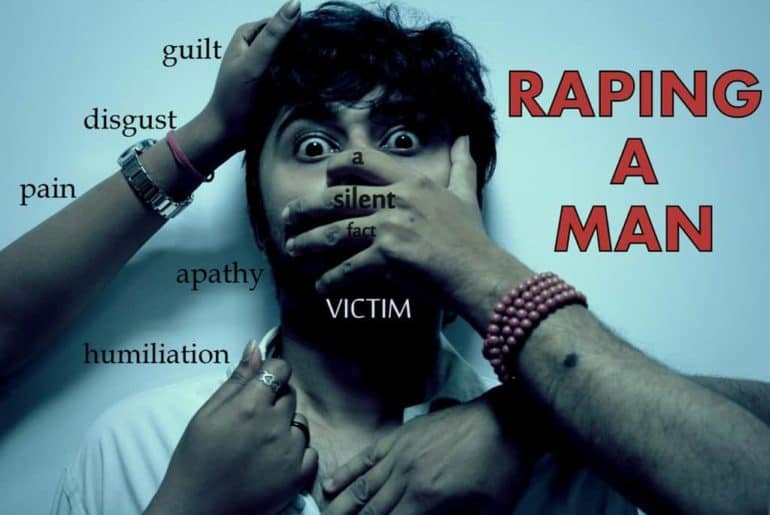
The discourse on rape of men has never shaped up in a society where irrespective of the sexes “consent” and “no” are considered redundant words.

Wikipedia defines rape as, “A type of sexual assault usually involving sexual intercourse or other forms of sexual penetration carried out against a person without that person’s consent.” Notice the use of the word “person” that should naturally include women, men, transgender, and all other recognized or unrecognized genders. But unfortunately, the law of the land has devoid consideration of men as victims of rape crimes. In August 2014, 4 men in Muzzafarnagar, Uttar Pradesh were booked for sodomizing a 16-year-old boy in a government-run protection home. A year later, in April 2015 a Madarsa teacher was booked for attempting to sodomize a male student in the same town. We use the word sodomy (anal intercourse) instead of rape here, which no longer is a criminal offence after the Supreme Court amended the language of Section 377 of IPC in September 2018 to decriminalize same-sex relations.

It was a landmark decision that freed the LGBTQ community to come out of the closet without facing the fear of legal scrutiny.  But at the same time, it abridged adult men of their only legal remedy in case of forceful anal penetration. The rape laws in our country treat men only as perpetrators and not as victims. According to Section 375 of the IPC only a man can commit rape on a woman without her consent, or with consent but under the fear of death, or with consent but under false pretences. It makes no mention of rape as a crime against men and leaves section 377 to cover that.

“A huge contributor to the social stigma around male victims of sexual assault is the lack of a functioning legal framework for them to back on,” writes Mardaangi, an Instagram page with around 3000 likes that uploads stories and mentions of sexual assaults on men.

A 2nd-year law student at Delhi University, talking about the discriminative rape laws in our country, on a condition of anonymity says, “As a welfare state our laws are more concerned towards the upliftment of downtrodden section of the society. Women and children due to historic injustice have always been given special protection under the law.” He added, “Men, on the other hand, have always been considered to be the dominating members as they are mostly in the position of power.”

Lack of consent remains an indispensable factor that naturally should make cases of unwilling sodomy come within the ambit of rape. Despite that, not only the legal framework of our country but the social conditioning too makes it tremendously tough for men to report rape crimes and avail a timely justice. The common notion that men are not vulnerable and that they always crave for sex has diluted the conversation around rape of men. Friends, peers and even the authority will likely deride a male victim and label the incident redundant leaving him traumatized.

Rape laws in India have developed over time. The law whose genesis can be traced in Macaulay’s Indian Penal Code of 1860 got amended many times before reaching its current stage. Changes include the inclusion of custodial rape, which criminalized rape by a public servant in 1983 and the Criminal Law (Amendment) Act 2013 followed by the Nirbhaya rape case. In 2012, The Protection of Children from Sexual Offences Act or POCSO was passed which made rape against a child under the age of 16 a criminal offence and laid provisions for the investigation of the crime in a manner that the child doesn’t get traumatized. This law is gender-neutral and treats male children as victims as well. A legal framework for the protection of adult males can be a next step in the evolution of rape laws.

Feature Image credit: themileage.org

Priyanshu

[email protected]

In the light of the recent Unnao rape and assault case, it can be discerned that there is a double-edged sword of patriarchy and poverty looming over the justice system for crimes against women.


In 2017, 17-year-old goes missing from her village, Mankhi in Uttar Pradesh. She was allegedly gang-raped by BJP MLA Kuldeep Singh Sengar, his brother Atul Singh and their goons. The only association she had with the four-time Member of Legislative Assembly (MLA) from Bangermau was that she had approached him for a job. Her family filed a missing person case with the police, and the girl was found in Auraiya village, two weeks later.


The next day, a case under Section 363 (kidnapping) of the Indian Penal Code (IPC) was registered against the men. The next developments, in this case, took place more than a year later, when in April 2018, Sengar was arrested days after the girl threatened to set herself aflame outside Uttar Pradesh (UP) Chief Minister Yogi Adityanath’s residence in Lucknow. In the meantime, her father was arrested in an arms case and died in police custody. It has been alleged that the Central Bureau of Investigation (CBI) has deliberately left out the names of MLA Sengar and his brother in the case of the victim’s father’s death.


in the face of such brazen show of power, the family wrote to the Chief Justice of India on July 12, requesting refuge in the face of grave danger from the accused. Earlier last month, the uncle of the survivor was convicted in a 19-year-old case of attempt to murder that had been filed by Atul Singh. A few days later, in Rae Bareli, a truck-car collision (where the number-plate of the truck had been blackened) left the girl and her lawyer critically injured and two of her aunts were killed in the accident. The truck-driver and cleaner of this truck have been asked to undergo a narco test by the CBI.


Currently, the victim is battling for her life at the All India Institute of Medical Sciences (AIIMS), Delhi now with multiple fractures, head and chest injuries, her lawyer is also on ventilator support. Meanwhile, the CBI has promised to take action against the Station House Officer (SHO) of Mankhi for causing deliberate delays in recording the victim’s complaints.


On August 1st, MLA Sengar was expelled by the central leadership of his political party and the Supreme Court transferred five cases of crimes committed against the rape survivor and her family from a CBI court in Lucknow to its counterpart in Delhi and ordered the UP government to pay her INR 25 lakh as interim compensation. The Tis Hazari court of Delhi has also found prima facie evidence to frame charges of rape, kidnapping, and criminal conspiracy against Sengar. He will also be charged under some sections of the Protection of Children from Sexual Offences (POCSO) Act.


UP has a high rate of crimes against women, mainly because many are reported, unlike in some other States. According to National Crime Records Bureau figures, released in 2016 – the last time data were uploaded – of the 38,947 cases of rape reported, the second highest was from U.P. (4,816). As for all crimes against women, Uttar Pradesh reported 14.5% (49,262 out of 3,38,954 cases) of the total, according to a report by The Hindu.


In a state where the abuse of power by virtue of political or bureaucratic connections has been the norm, the delivery of justice to the poor and backward sections of the society has always been a concern for law-keepers and policy-makers. In the specific context of crimes against women, there is also the added layer of complexity with respect to the inherent patriarchal values that have been normalised in the psyche of people for ages. The compensation to the victim and her family might bring some relief, despite the inordinate delay in justice but the reality is that even seven years since the shocking Nirbhaya case of Delhi, nothing changes on ground-zero. German professor Maria Mies once said, ‘Peace in patriarchy is a war against women,’ a statement that aptly summarises the reality of the justice system with respect to crimes against women in our country.


The rampant impunity of crimes against women and the outrageously unsafe living conditions in our society have failed each female of our nation, each day.


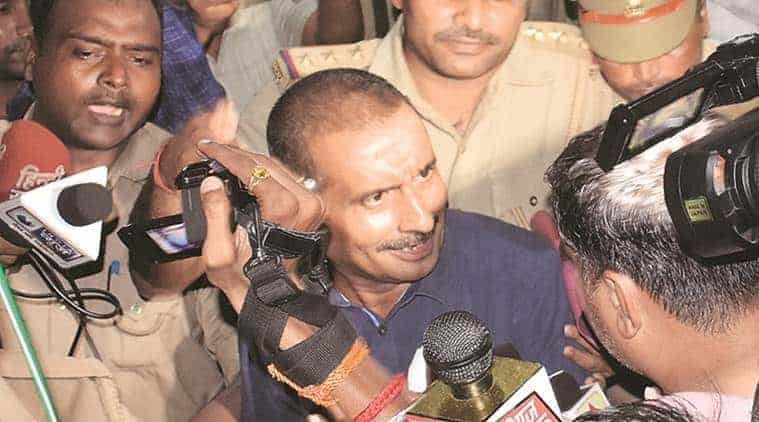
Image Caption: Accused MLA Kuldeep Sengar from Bangermau, Uttar Pradesh

Image Credits: Indian Express


Bhavya Pandey

[email protected]


‘People who study in these colleges are nationalists’ was chanted all throughout the country when students of University of Delhi(DU) either climbed walls to be part of Quit India movement or colleges gave shelters to the revolutionaries.


Despite that, DU contributed actively in the form of cadre and infrastructure in the Indian freedom struggle. In the University’s contribution to the freedom struggle, St. Stephens college played a prominent role.

The college has been a dreamland for all, known for its excellence in education and holistic growth of its students, St. Stephens College is rightly one of the top colleges, the University of Delhi has to offer.

The college was founded on 1 February 1881. Along with Ramjas College and Hindu College, it was one of the first three colleges to be affiliated to University of Delhi (DU).

If only one could lean over to listen to the walls of St. Stephens College, one would witness tales of bravery and patriotism.

St Stephen’s College along with Ramjas College played a vital role during nationalist movements such as the Non-cooperation movement and the civil disobedience movement.

Lala Hardayal, the first revolutionary, and Sir Chhotu Ram, who became the leader of Unionist Party of Punjab, hailed from St. Stephens College.

Aditya Rajendra Kumar, BA Programme, First Year, St. Stephens College told DU Beat that “It feels very humbling and slightly dizzying to know that I walk the same halls where the destiny of the country was decided”

They say that the only real freedom is freedom from fear and people in St. Stephens college were absolutely fearless. The desire to see a Free India surpassed the students and even resonated with the teachers as they were also an active part of the national freedom movements.

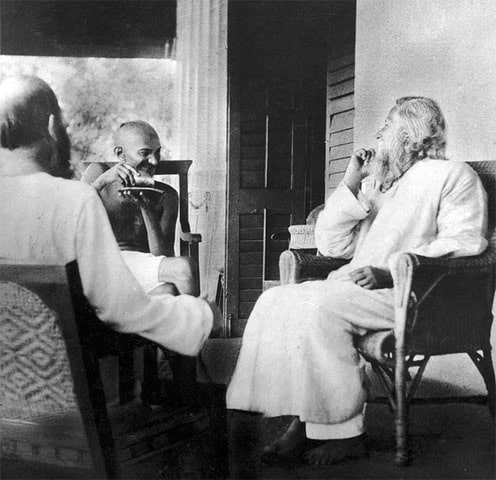
According to the official website of St. Stephen’s College, Charles Freer Andrews, an English teacher in the college, was known for his work as a conciliator and fighter against social injustice and political exploitation. Andrews was close friends with Mahatma Gandhi and Rabindranath Tagore. It is said that Andrews went to South Africa in 1914 to persuade Gandhi to come to India and lead the freedom movement.

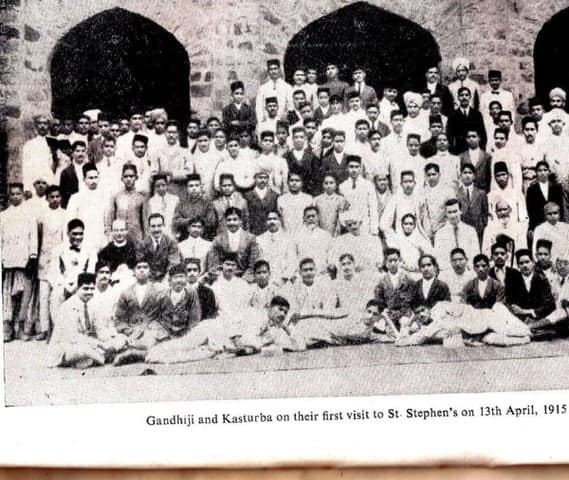
Perhaps not many know the connection St. Stephens college shares with Mahatma Gandhi and with being the place where many leaders sat and decided the country’s future. For venerable St Stephens College, Mahatma Gandhi had a very special relationship, Gandhiji on his maiden visit to Delhi (after he came back from South Africa in 1915) had stayed with the principal of the college, Prof Sushil Kumar Rudra, inside the college premises.

Gandhiji stayed in Delhi from April 12 to April 14, 1915. During those days, the college used to run from the building in Kashmiri Gate. According to eminent historians of Delhi, he had confined to college premises on the first day. Some teachers, though, came to see him. They were keen to know as to how he fought for the rights of blacks in South Africa.

On the second day of his stay, students and teachers from nearby Hindu College came to meet him. The draft for the Non-Cooperation Movement and the open letter to the Viceroy, giving concrete shape to the Khilafat claim were prepared at principal Rudra’s house at Kashmere Gate.  A photograph, recording this visit of Mahatma and Kasturba Gandhi is still there in the principal’s office.

IMAGE 2

Gandhiji And Kasturba Gandhi at St. Stephens College when they first visited Delhi.

In the times when the British Government manifested high into the roots of the country, the time when they even controlled the funds of the University of Delhi. There was CB Young, an English professor and editor of the college magazine, who had the valour to write against the reigning government condemning the Jallianwala Bagh massacre.

Stephens has a glorious tradition and the fact that our college had participated in the national struggle is a significant indication of its commitment to noble ideals of patriotism and service to the nation.

Anushka Dasgupta, St Stephen’s College, BA History, First-Year said “We feel proud to have come into this inheritance and feel that it is our responsibility to keep up the ideals of our institution. It’s during the difficult times of our nation that we the youths come together and prove to be a true Stephanian.”

There was not a hint of fear in then, just 19 years old students when they went to great lengths for freedom. They actively participated in protests during various phases of the Indian Freedom Struggle. In 1946, Sameeruddin Khan, a Stephanian, disrupted the morning assembly and with 50 to 100 boys, they boycotted classes, organised a protest march, and pulled down the Union Jack from the flagstaff. Though the college was mostly run by Christian missionaries, it produced many freedom fighters like Amir Chand, Asaf Ali, Awadh Bihari, Brij Krishna Chandiwala.

On a quiet day, one could lean over to listen to the walls of St. Stephens College and one would witness tales of bravery and patriotism.


Image credits :

  1. edu
  2. Quint

Chhavi Bahmba

[email protected]