Author

DU Beat

Browsing

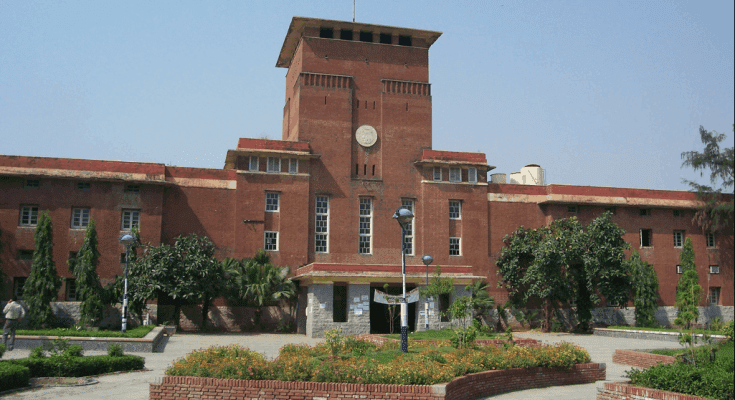
In a press release dated 19th March 2020, Delhi University Teachers’ Association (DUTA) released a set of demands for the Vice-Chancellor regarding COVID-19.

In the midst of the global pandemic, DUTA has released a set of demands for the working conditions of the DU faculty regarding COVID-19. The statement contained five sets of demands brought forth by DUTA, pertaining to the management of the faculty and teaching done by the university regarding the pandemic.

DUTA has requested the administration of a few colleges that are still insisting that teachers working on ad-hoc and guest basis should necessarily be present in the College to desist from doing so and not request the physical presence of the teachers, and instead adhere to e-learning and online resources to continue with the teaching in the university, and to not discriminate ad-Hocs and guest teachers in relation to the preventative measures put forth by the university to prevent the spread of COVID-19. They have also asked for financial compensation for guest teachers who are making themselves available through e-resources during their assigned teaching hours, and to use the online resources and assistance that they’re providing to students as a record for the payment. DUTA also insists that the semester exams and activities be pushed back and rescheduled accordingly, as e-resources and online classes can not compensate for in-class lectures and that various students of the university residing in other parts of the country do not have access to a stable internet connection. The organisation has, therefore, urged the administration to make an example of the other universities who have pushed back and/or rescheduled their exams and semester schedule for the same purpose. They have also urged the administration to think of the students and teaching faculty of SOL and NCWEB, and ensure that the stipulated contact hours are met, and also to keep in mind the financial need of the guest-teachers of these organisations. Lastly, DUTA has urged that the University implements similar preventative measures to reduce the contact points of non-teaching staff as it has for its teaching faculty and to decrease in theworking days and staggered working hours for those on duty, to prevent the spread of the disease for this section of the workers of the university as well.

We hope that the University responds by providing necessary institutional help to all sections of the University in this hour of crisis,” the press release stated.

The university has suspended classes till 31st March to provide relief and prevent the spread of COVID-19 amongst students and faculty and urges students to practice social distancing to stay healthy.

Feature Image Credits: DU Beat Archives

Shreya Juyal

[email protected]


As we shut our ears to the cacophony of the other side, the institution of democracy loses its ability to hold people together. 

If the numbers are right, we are moving towards a world where everything is stretched and tied to two ends. Cass Sunstein, a Professor at Harvard University, argued whether the new public sphere woven by the internet acts as ‘echo chambers’ or not. In a paper published in 2002, Sunstein uses activities on Facebook to quantify people’s engagement with the other side. Several studies suggest that while interactions across the ideological divide are almost negligible, the ability to selectively exclude certain pages and people to pop into one’s feed can lead to both polarization and convergence.


Birds of a feather flock together

The idea of homophily is intrinsic to human beings. There’s a tendency to bond and associate with similar others. That is why people of a community tend to hold together in foreign lands. It is also the reason why Indians and Pakistanis bond so well as immigrants in a western country, particularly due to a South Asian affinity.

The feathers begin to rot when they’re painted with political colours. People begin to ignore facts and constantly attempt to prove the other side wrong. Political polarization then extends to sensitive issues like LGBTQ rights, climate change and abortion. The Red states in the US actively deny climate change, even after being exposed to facts which claim the opposite. Groups, therefore, have shared opinions on most issues.

Political Echo Chambers allow think tanks and entrepreneurs to exploit voters by fooling them using certain tactics. They help leaders to present different images to different people, which helps them to secure a place in the heart of every voter. A single leader can be present at many places ideologically, by presenting themselves differently to different kinds of voters.


The Internet as a ‘Public Space’

The bricks of these chambers are placed by the invisible hands of the Internet. With its invention, people believed that the world will now be able to interact with each other in a better manner, thereby filling chests with tolerance and empathy. As a fact, on Facebook, 99.91 per cent of the two billion people on it belongs to a single huge component, and hence everyone is connected to everyone in some manner. Unfortunately, none of this has led to fruitful conversations among people.

For one, sites like Twitter and Facebook function as echo chambers. The design of such websites allows people to adopt a homophilic approach, which narrows the divide between the Internet and the real world. A study of 2.2 million politically engaged users on Twitter in the US finds that while there are roughly 90 million network links among these users, 98 per cent of first retweets of Republican voters come from conservative voters. The corresponding number for Democrats is 86 per cent.


Offline Polarization

But polarization is not limited to the internet users. Fake news was invented long before Facebook, and partisanship existed through newspapers and TV channels. News Channels, to maintain their viewership, picked sides and broke their supposed vow of remaining unbiased. While Fox news moved towards the right, channels like MSNBC started appealing more to liberal voters of the US. A homogeneous audience pushed them towards their extreme sides, something that these channels might not have anticipated. Polarization has increased the most for an older audience, who are least likely to be on the internet and consume articles produced by traditional media houses.


Effect on Preferences

Economists like to assume that preferences are both stable and coherent. But the former might lose ground if the idea of Echo Chambers yields the expected results. Absurd preferences, such as a hatred for blacks, can get intensified with repetitive exposure to similar views. Such peculiar opinions keep persisting due to limited exposure to the other side. Furthermore, the opportunity to choose the news one consumes adds fuel to the fire.


An Ailing Civic Discourse

An understatement would be to say that Echo Chambers do not encompass matters of civic importance. Social media has made it easier for news to originate and circulate, which means that virtually anyone can produce a rumour within seconds, and these chambers can, in turn, empower such people. It kills the production of reliable news and analysis. Moreover, original pieces aren’t credited, since copying something is easier than ever now.

Facts cease to matter after a point. Constant repetition of certain ideas targeted at certain people pushes them into a cult. Ideas become elements of belief for people, an ideology they must hold onto to ‘prevent’ the other side from attacking them. Conversations become violent and stop yielding results. Lack of confrontation in the virtual world erodes mannerism, which encourages sharp language that only results in chaos. As Plato pointed out in Allegory of the Cave, ridiculing the uninformed is the worst form of enlightenment, and radicalization is the only fruit.


The Democracy of the Future

As people get disconnected over a network of connections, the idea of democracy weakens. Polarization, as is evident, happens offline as well, which affects people of all ages. Radical views are supported by numerous people now, and the truth loses its value. Democracy, which is supposed to work for everyone, folds itself into the world of a group of self-conforming individuals who hold mirrors and reflect similar ideas. The walls prevent interaction with the outside world. An example of how a Radio company’s actions in Rwanda led to a mass genocide of fifty thousand people is chilling. The way out of these chambers is unknown since people can customize what they view.

But this choice itself can be a saviour. Experiments show that people choose to move towards the centre when informed about the leanings of all media houses. But such laboratory customized experiments can only reveal a little about this world. We are yet to solve most of our problems.


Featured Image Credits: BBC Future


Kuber Bathla

[email protected]

The Aurat March is an annual political demonstration organised in various cities of Pakistan. 

On the occasion of International Women’s Day, Pakistani womxn organised Aurat March across various cities in Pakistan. The Aurat March is organized under the banner of “Hum Auratain” (we women), an umbrella term for a collective of feminist women, transgender individuals, nonbinary persons, and gender and sexual minorities who stand against the patriarchal structures that result in the sexual, economic, and structural exploitation of women.

It all started two years ago when a couple of feminist groups from Karachi decided to hold a march on International Women’s Day, 8th March. Nighat Dad, the founder of Digital Rights Foundation and one of the organisers of the march in Lahore wrote, “The agenda of the march was to demand resources and dignity for women, for the transgender community, for religious minorities, and those on the economic margins, but more importantly, to acknowledge that women’s emancipation is inherently linked with improvement of all mistreated groups and minorities”.

According to the ‘Hum Auratain’ collective manifesto, there was no NGO or corporate funding and no political party alliance. It demands economic justice including implementation of labour rights, the Sexual Harassment against Women in the Workplace Act 2010, recognition of women’s input to the ‘care economy’ as unpaid labour and provision of maternity leaves and day care centres to ensure women’s inclusion in the labour force. It also demands environmental justice.

Women’s right to climate justice and resilience must be recognised and ensured, it said, access to safe drinking water, safe and clean air, protection of animals and wildlife, including cessation to the culling of stray dogs, and ensuring and protecting women’s food sovereignty, and recognition of women’s participation in the production of food and cash crops.

Other points in the manifesto included accountability and restorative justice against violence, access to a fair justice system, the inclusion of women with disabilities, the inclusion of transgender community, reproductive justice, access to public spaces including transport services and clean public toilets, inclusion in educational institutions, etc.

Then there were the more sedate messages. Five coffins were placed at one end of the park, with chilling signs stuck to them. ‘Honour Killing’, Transgender Killings’, ‘Child Victims’, ‘Domestic Workers/Polio Workers murdered’, and ‘Domestic Violence’ – a reminder of why women are killed every day.

The rally, organised by a collective called ‘Hum Auratain’ was huge and held in different cities – Karachi, Lahore, Islamabad, Peshawar and Hyderabad.


Feature Image Credits: Zuneera Shah for Dawn

Paridhi Puri

[email protected]

With the advent of the novel Coronavirus pandemic, Delhi University (DU) teachers demand permission to work from home, DU administration releases press release to accept their demands. 

On 15th March, Delhi University sought permission for teachers from the Varsity administration to work from home as the classes were suspended for all students till 31st March,2020 due to COVID-19.

Four Academic Council members sent a letter to Yogesh K Tyagi, Vice Chancellor, DU, wherein they requested extending the semester session to make use of the time lost due to regular classroom teaching coming to a halt and make necessary changes to the examination schedule.

The members said in a joint letter, “The University must seriously consider extending the semester session by a fortnight to make up for the teaching time lost due to this temporary cessation of regular classroom teaching.”

In addition to this, they also added, “Teachers should be permitted to work from home to avoid unnecessary travelling of around 10,000 citizens.”

Assistant professors Deo Kumar, Kanchan and, Saikat Ghosh, and Associate Professor Rajesh Kumar, requested work from home permission in a letter they wrote to the Vice-Chancellor as some Principals of colleges affiliated to Delhi University had asked the faculty members to report to college despite the suspension of classes. Many faculty members from various colleges extended their support to the members of Academic Council.

In response to the letter, Delhi University issued a press release that said, “Teaching-learning process shall continue through e-resources. The teachers have the option to work from home.”

The study material will be provided to students on a weekly basis on the website of every college till the suspension of classes. However, the teachers are unclear about how successful this arrangement will be.

The members also said, “Online teaching cannot be a substitute for practical learning and laboratory work where regular teaching-learning is essential.”

Feature image credits: Niharika Dabral for DU Beat

Suhani Malhotra

[email protected]

Not just monotonously draped women in Sarees and custom roles designed by Men, women craft their own niche on the Indian Celluloid perfectly and permeably.

Ever since the ‘release’ of Kama Sutra: A Tale of Love and Fire in 1996, stirred rows of controversies among the audience, the population was laid exposed to multiple cultures that were about to ferment in the decades to follow. The perception of women in Indian imagination sought to have a great thrust now, but what was more monumental were the two directors – Mira Nair and Deepa Mehta, who re-narrativised the ‘Bhartiya Nari and Sabhyata‘ in a post modern view.

The global egalitarian debate has pulled the female representatives at multiple fronts to collect together for achieving gender neutral objectives in – politics, business, sports and perhaps the most important the arts and entertainment industry; without any doubt the women in entertainment business exercise the highest influence and its Indian counterparts are no different, in recent times Indian celebrities have found a global following and new icons are emerging every year.

The Indian Film Industry occupies a central space in every household and it’s Pan India reception makes it even more desirable and challenging. The glamorous lead women over the years have instilled a feeling of aspiration among many young girls who dream to get a slice of ‘The Dream Pie’ and this in fact has turned true in many cases. From Durgabai Kamat to Rekha, Waheeda Rehman to Madhuri Dixit, Shabana Azmi to Priyanka Chopra many female leads have made the marks on the world memory, apart from lead actresses, playback singing seemed to be the only alternative for women for many years in this male dominated industry. But, in the last two decades the industry has witnessed many talented women who have impressed everyone with their skillful exuberance of potential as directors, screenwriters, music directors, cinematographers, etc.

My discussion on the professional female enterprise in Indian film industry has a tripartite perception – firstly, as an avid Cinemaphile general output; secondly in terms of the political depictions, thirdly as a demarcation between the West and the East.

Women making Films not your Food

1926 release ‘Bulbul Ae Paristaan’ saw a major moment in Indian Cinema when Fatima Begum became the first female writer, producer and director. Female Filmmakers like Kalpana Lajmi,  Sai Pranjpaye and Tanuja Chandra might be alien to many but their productions ‘Katha’, ‘Rudaali’ or ‘Dushman’ have captured an audience of its own. Similarly, Aparna Sen and Sumitra Bhave have successfully exploited Bengali and Marathi regional cinema with films like ’36 Chowringhee Lane.’

To reiterate the genius of Deepa Mehta and Mira Nair are beyond words, their movies have garnered critical acclaim not only in India but globally with topics that were really necessary.

Promising female directors like Meghna Gulzar of ‘Raazi’, Kiran Rao of ‘Dhobi Ghat’, Reema Kagti of ‘Talaash’, Nandita Das of ‘Manto’, Zoya Akhtar of ‘Gullyboy’, Farah Khan of ‘Main Hoon Na’, Gauri Shinde of ‘Dear Zindagi’, Shonali Bose of ‘The Sky is Pink’, Alankrita Shrivastav of ‘Lipstick Under my Burkha’ or Ashwiny Iyer Tiwari of ‘Bareily ki Barfi’ have been received well both by audience and critics and have severely diversified into script writing, editing, short films and online content.

Instigators of New Ideas

Female filmmakers have brought a range of topics like Surrogacy, sexuality, same sex relationships and horrors of patrirarchy and misogyny to attention. Depiction of lives of a lesbian relationship in ‘Fire’, a widow’s condition in ‘Water’, mental health in ‘Dear Zindagi’ or surrogacy in ‘Filhaal’, the women have hit the bell hard for others; parallely movies like  ‘Firaaq’ and ‘Salaam Bombay’ comment about the socio political condition of India in a sharp tone.

Not just Makers

Women are known for their adorning skills, their presentation has nuances of meticulousness which has been visible in recent times not just as directors or filmmakers but also in music production like Sneha Khanwalkar and Bombay Jayshree or the lyrics business like Anvita Dutt Guptan and Kausar Munir. Where Choreographers like Farah Khan, Vaibhavi Merchant and Geeta Kapur have grooved their way, designers like Niharika Khan, Anaita Shroff Adjania and Bhanu Athaiya have marked their own style.

Cinematographers like Priya Seth, Fowzia Fathima and Archana Borhade have captured stories that must hit film Critics like Subhash Jha hard when he comments as, “It comes as a surprise that the film is shot by female cinematographer Priya Seth. The images her camera captures are rugged, virile and predominantly masculine.”

The Critical Women

Nikhat Kazmi to Anupama Chopra and Namrata Joshi, women have been acclaimed critics for years, reviewing movies and it’s various aspects they have derived the opinions for the Indian Masses particularly and successfully.

It won’t be enough to say that these women are merely talked here for the sake of being one but particularly to affirm the success of these women in a misogynistic environment where their efforts have striven hard in order to see results. The male dominated land had to send out a message for the viewers who voraciously consume what is screened and pretended by their stars on and off the screens and in a state, where the patriarch and opressing society needs to acknowledge these women substantially.

Image Credits: ForbesIndia


Faizan Salik

[email protected]


“Our democracy will not sustain if we can’t guarantee freedom of speech and expression,” PM Narendra Modi said in June 2014. But the recent police action against protestors showcases that in India what you preach is not what you practice. 

Our country is currently being rocked by protests against the Citizenship Amendment Act in various places. Although there exist divided views on the issue, the major concern that has arisen is the importance of expressing dissent in a democracy and the biased stance of the police in the matter. 

Dissent can be defined as non-agreement with an idea, policy or entity. Democracy sustains and strengthens because of its ideals as well as voicing the collective will and diversity in views. It is only through acts of dissent that we can truly assess the efficacy of a democratic system. But in recent times, any kind of objection to the current government or its policies are blatantly termed as ‘Anti-national and seditious’ by the government, members of the ruling party and some other organisations. A large number of people who have criticised the government policies or even Modi, have either been arrested or brutally trolled on various social media platforms. Student protests against CAA – NRC have been ridiculed as immaturity and propaganda of the opposition. In places like Jamia Millia Islamia, Aligarh Muslim University, Assam, etc. non-violent protests have been aggressively curbed using police force. 

The matter in question is not whether these policies and decisions are worthwhile, but the growing intolerance towards any form of opposition or disagreement to the popular decision and the police using its powers in a prejudiced manner. Scores of images, videos and other evidence have come up that have questioned the integrity of ‘kanoon ke rakhwale (Law Keepers)’. Victims of police brutality have shared horrific accounts of how they were detained on falsified charges, abused and even labelled as ‘Pakistanis’. This clampdown on civil society activists and critical minds is not a recent phenomenon. For instance, in the Bhima-Koregaon case of 2018, activists speculated to have Maoist links were arrested. Later, a fact-finding committee found that Hindu extremist groups planned Bhima-Koregaon riots, but the police targeted the activists due to pressure from the state government to protect the perpetrators. The recent transfer of the case to NIA by the Home Ministry raises further questions. Same accusations have been levied during CAA protests as the police raised their lathis and guns against some groups of protestors only. Hostility of the police is often justified on the grounds of maintaining peace and unity and colonial era laws of sedition and criminal defamation are used as crutches to support the lies. This rampant silencing by police is worrying and aggravates dubiety – whether the scales of justice always favour the privileged and the majority. 

Nurturing dogma, which restraints criticism and disapproval, will surely befall great doom upon our country. With increasing education and awareness, the police cannot act as bigoted individuals, launch a ‘witch – hunt’ on a sectarian basis and then expect the people to stay mum. 

 A democracy is prosperous when it comprises active citizens who dissent against the unjust and express their devotion and respect towards its ideals through nonviolent means and in turn, the government and its agencies too welcome their revolutionary views. That is when we become truly free and enjoy the true essence of our existence as a human. 

‘The Constitution gives us a voice

to raise against any unjust.

But they try to steal our choice

and tell us, to their whims we must adjust.

No longer will we be played as toys

cos it’s time to rise and voice our dissent.’


Image Credits: Manav Ahuja and Jassman for DU Beat

Ipshika Ghosh 

[email protected]


What is the justification of that Judicial regimen, where due justice becomes a jargon of unjust juxtapositions judiciously jaundiced with jibes and jabber? 

Six years ago, a concern regarding justice in matters related to crime against women was raised before a panel of judges of the Calcutta High Court at a legal seminar in Asansol, the incident pondered another question about female participation in investigative teams and without much of surprise, there wasn’t a single woman advocate to actually answer my question or explain the condition anyways.

The pursuit of an egalitarian and gender-neutral society under due actions of female representation and supervision of institutions seems quite paradoxical in the Indian context. While the legislature, is mostly up to the consensus of the general population, the rationality in demographics of the executive needs to be looked upon in a separate column, this leaves us with probably the most important of these institutions – The Indian Judiciary.

Over generations, the Indian Judiciary which has historically been a reserve of few mighty men has undergone multiple amendments to allow itself to cater to the rightful place and needs of women. The first initiative to enter the Black Robe Men Sanctuary was taken by a Bengali Calcutta University Law Graduate named ‘Regina Guha’, who applied as a pleader at the district court of Alipore on 1st September, 1916, her case was dismissed by a bench of male judges under the Legal Practitioners Act.

But, following the Sex Disqualification Act, 1919 another Bengali lady by the name of Sudhanshubala Hazra augmented another petition in Patna District Court for her appointment as a pleader. The bench at Patna High Court which was redirected to preside upon the case passed a similar judgment as of the previous case debarring her to enter the legal practice.

Sudhanshubala Hazra in the 1920s said, “If there is any country, where Lady practitioners are necessary, it is India… they (women) cannot instruct the lawyer of other sex and consequently they became victims to the dishonesty.”

After a great struggle the year 1923 saw the passage of Legal Practitioners (Women) Act dismissing the disqualifications based on sex. Since, then prominent female lawyers like Congress Leader Violet Alva, who became the first women lawyer to appear before a High Court in India in 1944, rose to limelight and advocated rights of women fiercely.

In 73 years of Independence, India witnessed just a few judges at the High Courts and the Supreme Court of India. In 1959, Anna Chandy became the first female judge in an Indian High Court, subsequently more like Konameneni Amareswari and Janaki Amma were appointed later at different High Courts of India. But it was only in 1989, that M Fathima Beevi was promoted as the first female judge at the Supreme Court of India. In total out of the 214 ex-judges of the Supreme Court, only five were women, whereas out of the 33 sitting judges at the Apex Court only three namely India Malhotra, R Banumathi and Indira Banerjee are women.

Apart from the chair of the judge’s significant women have inspired young and aspiring advocates with their strong skills and iconic cases that have prospered tales for generations to come.

Flavia Agnes of the ‘Majlis’ foundation is the first name that one can think of for her gender and minority rights advocacy in courts and well as papers, her initiatives for action against domestic violence is a self-experience that inspired and helped many women rightly. The 2012 Nirbhaya Case prompted another strong advocate of Anti Rape Bill who has been a defining name in criminal, constitutional, media and policy laws. As a ferocious advocate of Free Speech, Karuna Nundy fought ardently for the survivors of Bhopal gas tragedy and has been leading many in the Anti CAA (Citizenship Amendment Act) NRC (National Register for Citizens) and NPR (National Population Register) protests.

Veteran Supreme Court Advocate Pinky Anand who is currently serving as an Additional Solicitor General of India has expertise in Constitutional, Property, Family and International law. Talking about another and the first Additional Solicitor General of India, Indira Jaising is one of the highest-ranked leaders whose voicing of child, women and minority rights is hailed with respect, she has argued cases of homeless and environment concerns in the Supreme Court and is currently representing the students of Jamia Millia Islamia who suffered the Police brutalities and action. Vrinda Grover is another female lawyer who has raised student’s pleas in the previous case, previously she has represented the victims of the1984 Anti Sikh Riots and has been instrumental in the formulation of POCSO (Protection of Children from Sexual Offences) Act, 2012 and Prevention of Torture Bill, 2010.

Rebecca John is probably the first woman Criminal lawyer who has handled numerous cases with like the 2008 Noida Double Murder Case. The Kathua Rape Case petitioner Deepika Singh Rajawat has certainly epitomized empathy with ferocious meticulousness; as a human rights activist, she has closely worked with ‘CRY'(Child Relief and You) and other NGOs.

The Corporate field would be incomplete without the famous and iconic Zia Mody who has sought to revolutionise the field for better at national as well as the global front. In a stark parallel to the corporate world, Sudha Bharadwaj has fervently advanced trade union and land acquisition laws in India, with a ground experience of working with the Dalits and tribals, Bharadwaj has strongly voiced their concerns multiple times. Lawyers like Menaka Guruswamy and Arundhati Katju who made a big progression after winning the battle against same-sex relationships are making their way as well.

With these names standing up to the double reputation of India’s judiciary and its women, the allegations, proceedings, and judgement regarding the sexual harassment charges levied against ex-Chief Justice Ranjan Gogoi has rightly brought up the fears of women where the case went up to country’s apex Court but in a rather bizarre manner. This surely reiterates Sudhanshubala Hazra’s aforementioned quote and necessitates the female participation in Indian courts for the greater good of all.

Featured Image Credits: Scoopwhoop 

Faizan Salik

[email protected]


The conversation surrounding menstruation has largely been women-centric, is it time to go beyond the binary and include trans men, and queer folks? 

‘Bleeding makes me feel empowered’ is one of my go-to statements while I am menstruating. Most of the cis-gendered womxn I have encountered are surrounded by differing experiences, from squirming ovaries to period sex. Come womxn’s day, menstrual hygiene management, sanitary products, cramps, advertisements, literature, most of them cease to acknowledge that, not all womxn menstruate and not all people who menstruate are womxn.

Always, a menstrual product company owned by Procter and Gamble removed the ‘Venus’ symbol from their products, thus, dissociating their product packaging with womxn, making it more inclusive. Cis-womxn felt rather excluded believing that they are being erased from the conversations. They have criticised the inclusion of non-binary, trans men, and individuals of other genders and considered it disrespectful. What is feminism if not intersectional? 

A chance encounter with Vihaan Peethambar, Queer Feminist and Trans Activist at a Summit in Delhi last year threw light on the idea of trans men aka, those individuals who were assigned female at birth, implying that they menstruate well into their transition. We as a society tend to draw the line of womanhood at menstruation. We equate menstruation with feminity.

Gender does not have anything to do with one’s biological anatomy. Vihaan talks of the sheer disparity of bringing the non-binary and queer folks into the conversation surrounding menstruation. Anyone with a functioning uterus, ovaries, and hormonal system will menstruate until menopause. Umaima, a cis-gendered woman says, “The problematic aspect of the approach towards a subject which itself is a taboo is when womxn talk of mensuration in the specificity of it being about them and their oppression which is the partial truth. It sort of puts them in a superior light of oppression than those who disassociate from binary therefore furthering a difference of gender which shouldn’t exist in the first place.”

A gynaecologist in conversation with sheknows says, “If you have a uterus and aren’t pregnant/breastfeeding, menopausal, hormonally suppressing your periods, or dealing with a condition like PCOS, then you’re likely menstruating.” It is essential to disregard gender as a societal construct and focus on the functioning of the uterus. Sex-education is highly heteronormative and tends to chunk out a large community altogether. Transmen find menstruation a reminder of their ‘feminity’, a part of them that they would want to shed. It is a blaring alarm pointing towards their gender dysphoria. Streamlining the conversation towards cis-womxn and limiting it to womanhood, empowerment, and unleashing one’s power of reproduction eliminates and ostracises conversations, social action, public health, and legislative measures of an entire community.

The feminist movement has failed if its sense of feminism limits itself to cis-gendered womxn. It goes beyond the binary, intersectionality is the future of feminist discourse, it is time that the narrative incorporates womxn.

Feature Image Credits: helloclue

Anandi Sen

[email protected] 


With forthcoming breakthroughs of technology, lingers a threat of out doing human synapse of comprehension and consumption of information.

Limitless possibilities afloat of what one can dismiss as impossible only to find out that technology can prove otherwise. 2017 saw a manifestation of ‘deepfakes’ in the West which is an artificial intelligence software which works by mechanising synthetic algorithms to superimpose the voice or face or both of someone else over the subject and make it appear that they said it in real-time. In 2018 comedian Jordan Peele released quite a believable video of former President of the States, Barack Obama saying things as a PSA which was doctored by the comedian himself. The purpose was to mediate the message of the extent to which Deepfake can be deceiving and the ease of creating and sharing them.

Deepfake video of Barack Obama taken from YouTube channel of Good morning America!

This software was initially used in the porn business to generate revenue. Graphics of celebrities and well-known faces were easily accessible from the net thereby making them easy targets for the subject of their content. Lately, this technology is doing rounds in harbouring fake news as it has been seeping into politics.

A day ahead of Delhi elections, Bharatiya Janata Party (BJP) MP, Manoj Tiwari’s video of criticizing the Kejriwal led government surfaced in multiple languages on WhatsApp and other social media platforms, aimed at targeting prospective voters. The singer/actor turned politician can be seen speaking in fluent English and Haryanvi making appeals to the Janata to vote for his party when in reality the actual video was him speaking on the affirmation of passing of Citizenship Amendment Bill (now Act) in the house of parliament.

Video of Manoj Tiwari speaking in English and Haryanvi taken from The Vice

The negative repercussions of Deepfake are directly proportional to the ease with which it can be accessed feasibly. Politicians tailor their needs of reaching more target voters than their opponents in more authentic ways possible. People who consumed Manoj Tiwari’s hoaxed video felt more attached to him when he spoke in their language. A major threat with the upcoming of such videos is that denial would become a lot easier for people who can be easily caught in their wrongdoings via citizen journalism. They can immediately call out the video for being falsified. Even worse, anyone can be made to say things which they didn’t and share that video extensively.

In a country like India which is vulnerable to riots, such videos will serve as a very good bait to disturb peace and harmony.

Actual video of Manoj Tiwari taken from The Vice

Prateek Sinha of Alt news- a fact-checking website, in an interview with Vice said,” At this point in time it’s impossible to fact check or verify something that you don’t recognise is doctored.”

It has become a whole lot easier to deceive people especially the ones who are in the oblivion of the technological jargon.

A critical approach in understanding these videos would be an ideal case scenario but in reality, we are a nation which believes in United Nation giveaways of honorifics to Indian festivals and national anthem. How can we decipher the face2face algorithms and others incorporated in making such lies? A New York-based software company is working on detecting Deepfake videos. It would be a relief to say that ills of technology are countered by technology itself, however, it’s imperative that we exercise extreme caution before believing any content. Fact check it while we can and run it through multiple sources before sharing them because separating the act of consuming and sharing of information has the ability to impede the pace of harm that this new technology bores as it’s potential.

Suggestive fact checking websites: altnews.in, indiaspend.com, boomlive.com, www.hoaxslayer.net, mediavigil.com

Feature Image Credits: m.phys

Feature Image Caption: AI enabled technology superimposed actor Nicolas Cage’s face on Tesla’s CEO Elon Musk.

Umaima Khanam

[email protected] 


Pornography through videos, images, and stories has been prevalent since time immemorial. Humans are inherently voyeuristic which has led to sex and pleasure being placed at the pedestal. Staring from the Kama Sutra to virtual reality porn, we surely have come a long way. 

Pornography with its several dimensions and categories has gradually developed into an extremely male-pleasure centric idea. With perfect bodies catering to the patriarchal idea of beauty, porn not only encourages a false set of reality and expectations, but it also paves the way to the idea of men being dominant and seeking pleasure in the suppression of women.

PornHub’s #4 most-watched video of the first week of January 2020 with over 4 million views is of a teen girl with her hands/feet shackled down, mouth gagged, penetrated with a machine and electrocuted. Several individuals objected to the very act and deemed as non-consensual, evoking violence and abuse.  However, the performer, Addee Kate, later clarified that it was consensual.

Manvi Jain, a student of Sri Venkateswara College says, “Understanding porn is extremely subjective because there are so many categories of porn. For instance, if you watch femdom, it’s more empowering as the woman is in charge and is not shown as an object. Whereas, if you watch BDSM or just plain vanilla, it portrays the woman as a mere sexual object.”

BDSM or Bondage/Discipline, Dominance/Submission, and Sadism/Masochism has been questioned and refuted as highly patriarchal and sexist towards all the performing genders. Seeking pleasure by evoking pain in others through torture is inherently leading to a dominant and submissive relationship where mostly, the male and female respectively take their positions.

Even though consent forms the ground rock of all sexual practices, why are porn and its categories considered demeaning? 

BDSM and degradation of women hang on a very thin thread. The difference between the two lies on a concept as simple as consent. It is essential to understand that dominating and choosing to be submissive is a choice, however, constant consumption of a similar kind of act, say, male domination over a female, implicitly states the normalised hierarchy in a heterosexual relationship.

Sneha Agrawal, a Journalism student says, “In porn, women come with the very heavy cost of losing control over how they’re being treated during the course of sexual activity. Porn normalises such treatment, where men inherently feel that it’s normal or alright if they behave in a certain manner, which is the most problematic part.” She continues talking about how porn serves as a ‘sexual guide’ to a large number of adults. The repercussions of which is, they assume whatever is being done to their partner in order to derive pleasure is normal.

On similar lines, Disha Arya believes BDSM to be inherently problematic and arising from a desire to control. “I dislike how rough sex is romanticised. I dislike how male domination and female submission is normalised. We as a society expect women to be submissive. Men are introduced to porn pretty young, seeing this as the norm, they believe that they’re the ones who are supposed to take control.”

Porn is inherently so male-centric that they had to make a separate category to cater to women’s needs under the banner of ‘porn for women’. In 2016, there was an increase of 168% in searches for lesbian and 218% in female-friendly. These numbers portray that mainstream porn clearly doesn’t cater to their XX chromosome audience. Talking of consent implying choice and desire, 64.6% want to be dominated as opposed to the 53.3% men.


Feature Image Credits: Goodreads


Anandi Sen

[email protected]