Author

DU Beat

Browsing

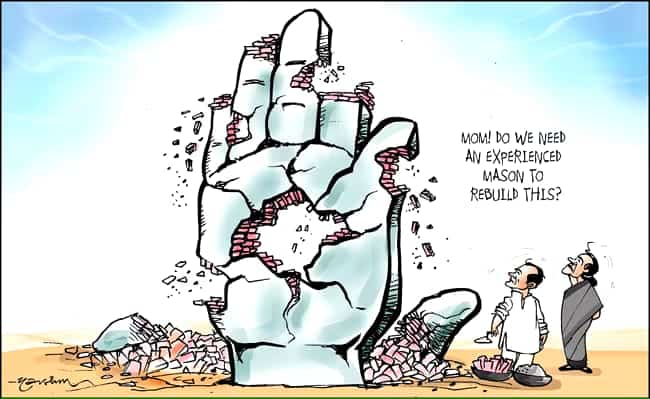
As the populist Bharatiya Janata Party vouches for a massive 370+ seat victory showdown in the Lok Sabha Elections of 2024, the question arises: what does the future hold for India’s opposition and, essentially, its democracy?

As the largest democracy in the world gears up to vote for its 18th Lok Sabha starting on April 19, 2024, elections in India today are the sole sustainers of the bare bones of its democracy. From the consecration of the Ram Temple to the electoral bonds to the arrest of Delhi Chief Minister, Arvind Kejriwal, pre-elections within India have always been accentuated with a sprinkle of political hustle-bustle. However, with the massive saffron juggernaut crippling the opposition with each passing day, the concern shifts from whether the BJP will be able to secure a 400+ victory to how many more years will the opposition in India survive, considering the current state of political affairs?

Political analysts within India and beyond have poured in opinions regarding the rusty machinery of the Indian opposition—the INDIA alliance and Rahul Gandhi at the helm of it. The 27-member bloc of the Indian National Developmental Inclusive Alliance, popularly called the INDIA Alliance, was formed to take on the so-called invincible Modi Empire but has been bereft of success throughout. Unlike the saffron empire of Narendra Modi, the INDIA Alliance lacks a face, agenda, or narrative. On a comparative scale, the Bharatiya Janata Party provides ordinary Indians with a populist mix of Hindu nationalism and economic empowerment. Narendra Modi’s brand of Viksit Bharat and Ek Bharat Shresth Bharat makes people proud again of being Indian, even if it’s a page out of the populist playbook. This brand attributed to Modi plays upon an ordinary person’s sense of vulnerability and lack of self-esteem and grants an identity punctuated with pride and confidence in being an Indian and a Hindu, according to the BJP book. Hence, the BJP gradually appropriated the Bharat tag, to be recognised as a great power in spite of all their shortcomings.

Political experts often mention the failure of the Congress to rebuild its organisation and political machinery to take on the BJP during its decade in opposition. While the INDIA Alliance initially constituted 28 blocs, including several local opposition heavyweights like Mamata Banerjee’s Trinamool Congress and the Samajwadi Party, the Congress Party and its face, Rahul Gandhi have been at the helm of this alliance. In the recent run-up to the general elections, the INDIA Alliance has faced several defections, ideological differences, and a lack of a cohesive campaigning or a catchy narrative to fire up the voters’ imagination. Despite Rahul Gandhi’s 4200-mile-long Bharat Jodo Yatra, the Indian opposition finds itself on an uneven playing field in this election; all the odds keep stacking against it, but how and why?

Rahul Gandhi, the star power of the Congress, despite being a recognized name within the opposition, is said to lack leadership skills, according to election strategists and political analysts. Political tactician Prashant Kishor, in his recent interview, also pointed out several opportunities where the opposition “dropped catches” in the run-up to the general elections. Prashant Kishor mentioned that the decline of the Congress Party began post-1984, when it registered its biggest win, but has been unable to win elections on its own since then. He mentions Rahul Gandhi’s tactical error when it comes to the Bharat Jodo Yatra and pinpoints that the campaign should have been undertaken under the INDIA Alliance rather than as a leader of the Congress Party; otherwise, it becomes a way to divert attention from such a critical election. 

Unfortunately, Kishor’s predictions have rung true, and the INDIA Alliance has faced massive defection blows, with Nitish Kumar switching to saffron colours right before the general elections and West Bengal Chief Minister Mamata Banerjee disagreeing upon a seat-sharing negotiation between the Indian National Congress and the Trinamool Congress and consequently backing off from the Opposition Alliance. Seat-sharing negotiations have underlined major break-ups within the INDIA Alliance, with the Congress pitching a majority of its candidates for the seats within constituencies of importance. Kishor articulates Rahul Gandhi’s strategic error concerning election campaigning by saying that:

It is as if you are leading a multi-country army, but at the time of war, the Commander-in-Chief of the multi-country army has left the headquarters and is somewhere outside.”

Prashant Kishor also mentions Rahul Gandhi’s fear of contesting from the Hindi heartland of Amethi in Uttar Pradesh after his defeat against Smriti Irani in the preceding general elections but from the South-Indian constituency of Wayanad.

“You cannot win India unless you win the Hindi Heartland.”

Kishor’s words are emphasized by the evidential facts that he pours in concerning the misplaced strategies of the opposition. According to Prashant Kishor, “Your (the opposition’s) fight is in Uttar Pradesh, Bihar, and Madhya Pradesh, but you are touring Meghalaya and Manipur.” He even adds that the alliance is not effective in defeating the ruling party, as there is a one-on-one contest in 350 seats where the competition just boils down to the Congress vs. the BJP.

Ever since 2014, the opposition has given away several opportunities to take on the ruling party head-on. Prashant Kishor mentions three invaluable moments when the BJP was in a downslide but the opposition’s “laziness” prevented it from mounting any challenge. Kishor mentions the BJP’s barren phase during 2015-16, when it lost several assembly polls across the country except in Assam. Moreover, the BJP also faced a poor run post-demonetization when it almost lost power in Gujarat and was defeated in several states in 2018. Most importantly, the COVID-19 pandemic of 2020 and the subsequent years also saw the BJP facing losses in West Bengal due to its inability to invest in health infrastructure. However, the Indian Opposition was not quick to capitalize upon the weaknesses of the ruling government and pose a challenge to what has now snowballed into the all-powerful saffron regime.

Despite such shortcomings from the BJP, it has rebuilt its picture quite well to ensure its ‘Abki Baar 400 Paar’ in the 2024 general elections. Modi’s assurance of establishing India as a global superpower with the country’s leadership in the G20 Summit of 2023 and the infamous moon landing has reconstructed his image as a strong, popular leader who is perceived to use the machinery to stay in power pretty well. While alternative media and international institutions speculate upon the Modi Regime’s crackdown upon democracy, the saffron juggernaut has been impeccable in executing its Scorched Earth Policy against the crippled opposition—just wipe out whatever comes in your way so that the power mammoth can move without any obstruction or challenges.

While the opposing Congress has sewed out several failures of the ruling government in its election campaigns, its struggles are insignificantly synonymous with a lilliput taking upon the might of Gulliver, which is the Saffron Alliance. The basic dimensions of a democratic state—the legislature, the judiciary, the media, and the ‘autonomous watchdogs’ like the Election Commission, the Reserve Bank, the Enforcement Directorate, and the Central Bureau of Investigation—all come under the perception of being hijacked by the rulers. Narendra Modi’s government has been labelled as an ‘electoral autocracy, weaponizing state agencies to stifle, attack, and arrest opposition politicians and undermining democratic principles.’

As the usual game of politics unravels, the opposition can now only capitalize upon its accusations against the BJP, but the tragedy remains that they are at the end of their rope. While the strategic errors of the opposition remain to be blamed for the BJP holding fort for the third term, the supposedly autonomous Indian media might also be another factor for why the Indian opposition lies weak and (almost) dead. Mainstream media within the country today has become an echo chamber celebrating the Modi government. While narratives are sown, painting Narendra Modi as a deity forging the rebirth of Rama Janmabhoomi and Rahul Gandhi getting mugged during the Bharat Jodo Yatra is all the coverage the opposition is provided within mainstream channels. Synonymously, Arvind Kejriwal’s arrest in late March of 2024 was also portrayed as a ‘party in power serious about fighting corruption’ with no speculation or debate regarding the timing of the arrest. News anchors rejoice upon the G20 Summit, the Ram Temple, and the Chandrayaan and attribute them to Modi’s Viksit Bharat, while at the same time failing to cover the ruling government’s inability to increase education opportunities, improve medical infrastructure post-pandemic, or invest in youth employment, which still dips below 50 percent among 20 to 24-year-olds. While the fourth pillar of democracy gradually falls into shambles, the other dimensions follow the same tragic downfall.

The opposition’s cries of ‘tax terrorism’ with the Congress’ bank accounts being frozen by the Income Tax Department due to a dispute from 2018 and thereby crippling its ability to campaign pre-elections today fall upon deaf ears. Atishi Marlena, Education Minister of Delhi’s accusation against the BJP of forcing opposition leaders to switch parties under the threat of ED arrest, all weave into the narrative of the ‘Washing Machine Effect’ today—that opposition leaders are more interested in power than political ideology in serving their electorate. Moreover, autonomous institutions have also been clenched by this ruling superpower today, with police quelling peaceful protests and detaining activists and dissidents. An investigation led by the Indian Express emphasizes that 95% of the ‘autonomous’ agencies’ investigations have focused on the opposition, contrasting with the numbers under the previous government, which were 54% of the Enforcement Directorate and 60% of the Central Bureau of Investigation probing the opposition. In a similar investigation, The Wire also claims that nearly 12 opposition leaders joined the BJP while facing criminal charges in the past months, with Nitish Kumar switching sides before the ED planned to arrest him on charges of money laundering. Even as Amnesty International describes this ‘crackdown on the opposition’ as ‘a crisis point’, there is no exit from this supposed emergency upon democracy.

The lack of a staunch narrative or agenda leaves the Indian opposition barren today. The Congress has been hollowed out with infighting and accusations of corruption within the party. There was a time after independence, and for many years after independence, it was said that you would find a Congress flag in every single village in India. That is, however, no longer true. Even as Congress Party President Mallikarjun Kharge implores voters to ‘Save the Democracy’ at the historic Ramilla Maidan, where once the same opposition had toppled the Indira Gandhi Regime 40 years ago, the unfortunate truth lies that the time has ticked out and the race has already been lost.

Nevertheless, dear reader, if you have successfully reached the end of this overly-long piece, I am sure the question will arise in your mind: if not Modi, then who? And you have all the rights to ask this. But the sad fact answer to your question is that there is no other ‘who’ besides Modi today, after all. Today, the question is not about how big or thrashing the BJP’s margin will be in the Lok Sabha elections, but if 400 seats out of the 543 within the Parliament are within the stronghold of a singular ideology, will democracy really survive?

The world once viewed us as the ‘largest democracy in the world’. Today, however, the country is crippled by a paralyzed democracy and an obliterated opposition, deluded amidst its saffron pride and ‘Sabka Saath, Sabka Vikaas’ with no heed to poverty, inflation, unemployment, and yet a subconscious fear towards the survival of the Constitution and democracy. But what does the future hold? The answers are murky, and it’s all a scary test of time now.

Read Also: Lok Sabha Elections 2014: A dance of democracy, glamour and technology

Featured Image Credits: IndiaToday

Priyanka Mukherjee
[email protected]

This piece delves into the issues that centre around allegations of sexual harassment against Professor Priyadarsi Mukherji, a senior faculty member at the Centre of Chinese and South East Asian Studies (CC&SEAS) within the School of Language, Literature and Culture Studies (SLL&CS) at Jawaharlal Nehru University (JNU) and the subsequent voices challenging the accused.

A second-year Master’s student from the same centre as Prof. Mukherji, has accused him for engaging in unwelcome behaviour, including persistent messaging, calls, requests for “personal” meetings, and sending lewd poems. Moreover, when she rebuffed his advances, the professor allegedly threatened her with academic consequences, specifically mentioning potential failure in her coursework. 

The survivor lodged a complaint with the Internal Complaints Committee (ICC) on 10 April, 2024, but no restraining order was issued against the accused by the ICC, and he continued to teach even after that. The Order of Restraint mentioned here is a procedural tool within the Internal Complaints Committee (ICC) of educational institutions. This order is part of the institution’s disciplinary process and it outlines behavioral expectations for the accused during ICC investigations, restricting actions like contacting the complainant or influencing them. 

In conversation with DU Beat, Avijit Ghosh, Vice President of JNU’s Student Union, added, “Since the complaint was against a professor by his student, the order also needs to restrict him from teaching. So, after the enquiry process starts, the accused is technically forbidden to take classes of the second year batch as the survivor is from that batch. However, the accused professor was taking classes for both M.A. 2nd year and 1st year. All the 13 batch mates of the victim are demanding that he should be debarred from teaching in any of the batches in the center and not just their batch as he can exert some influence if he continues coming to the center to teach other batches while the enquiry process is still going on; so they want this to be addressed under the restraining order which has not happened yet”.

Upon no concrete action, the students of CC&SEAS filed a complaint of sexual, mental and academic harassment on 15 April, 2024 with the ICC. 

Avijit shared, “The union is in constant touch with the student. Two days before we met the students of M.A. second year batch with school councillors. The students also had a meeting with the VC to demand a speedy enquiry, however no action was taken, neither was any interim relief provided to the survivor or the class by the ICC.

He also underscored the inadequacies of the Internal Complaints Committee (ICC) in addressing harassment cases effectively. He highlighted the need for a more transparent and student-inclusive body, drawing attention to the previous Gender Sensitization Committee Against Sexual Harassment (GSCASH), which had elected student representatives. He claims that the ICC can be partial, in its judgements.

In response to the situation, the JNUSU has issued several demands to the university administration, including the immediate restraint and strict disciplinary action against Prof. Mukherji (including suspension),  the acceleration of complaint proceedings, and assurance of protection from any academic repercussions for the survivor. 

Additionally, there was also a demand for postponement of the seasonal exam and setting a new date for the exam. A Master’s student from the School of Language, in conversation with DU Beat, revealed, “Since many M.A. Second year students have not been attending classes for 15 days or more, and their sessional exams were ensuing, they demanded the session should be postponed and they should be given more time (about one and a half weeks) to prepare well and this demand was accepted by the Chairperson of Chinese And Southeast Asian Studies Center.”

He also revealed that the students went to meet the chairperson, “While the chairperson said that they’ll look into the matter, he also said that they as, faculty members don’t have much to do in this, and it is the job of ICC, which is not acknowledging any sexual harassment activities. Whenever a survivor tries to file a complaint in ICC, questions like, ‘What type of dress were you wearing?’, ‘You were out with whom?’, ‘What was the time when you were out?’ are asked which makes the process of filing a complaint even more upsetting.”

There has also been the involvement of student organizations like ABVP, who during one of the protests against the inaction, supposedly threatened and barged into the accused’s office, which students of the department protested against. Even, AISA DU condemning the university administration’s handling of the matter and calling for the reinstatement of the Gender Sensitization Committee against Sexual Harassment (GSCASH). 

Anjali, AISA DU Secretary, in conversation with DU Beat shared, “Being a gender minority and a student, it’s scary how over the past 10 years, sexual harassment and rape have come to be normalized in our campuses.” 

This case underscores broader concerns about the handling of sexual harassment complaints within academic institutions and the urgent need for institutional accountability and support for survivors.

Similar allegations of sexual harassment have been made in Delhi University’s Psychology Department. In the wake of this students are demanding swift action in the form of increased surveillance and security.

According to Simran, a student representative from the Students’ Federation of India (SFI), the need for a functional Women’s Development Cell or a GSCASH within the university, is imminent. She emphasized, “I met the HOD today and they told me an academic council is being made for patrolling day in and day out. But the psych department comprises women majorly, and, sadly, the patrolling will be again done by men. There needs to be a woman’s body to deal with this issue… We need a university-level body, a movement surpassing departments (because this has happened with the English and B.Ed. department too in the past), engaging with women and queer people on campus, and a student-run cell.”

The demands put forth by students include expedited inquiries into the reported incidents, immediate action against those responsible for the harassment, and the establishment of a transparent and accountable mechanism to address cases of sexual harassment on campus. Additionally, students are advocating for gender sensitization programs and initiatives to create a safer and more inclusive environment for all members of the university community.

Image Credits: Youth Ki Awaaz

Kavya Vashisht

[email protected]

Read Also: delhi-universitys-swift-response-to-sexual-harassment-allegations-garners-campus-solidarity/


Back in the director’s chair after Dhobi Ghat (2010), Kiran Rao takes over the cinema by serving the right blend of simplicity, humor, and wit in a cup of gentle feminism.

Significantly departing from the typical Indian cinema landscape, which often perpetuates regressive and hypermasculine ideals, Kiran Rao’s film embraces a nuanced form of feminism, delicately highlighting the uncomfortable realities within society that often silence women and strip them of agency in various aspects of life. The film beautifully captures the journey of ‘Laapata Ladies’ (Lost Women) who ultimately discover their true selves and emerge empowered by the end.

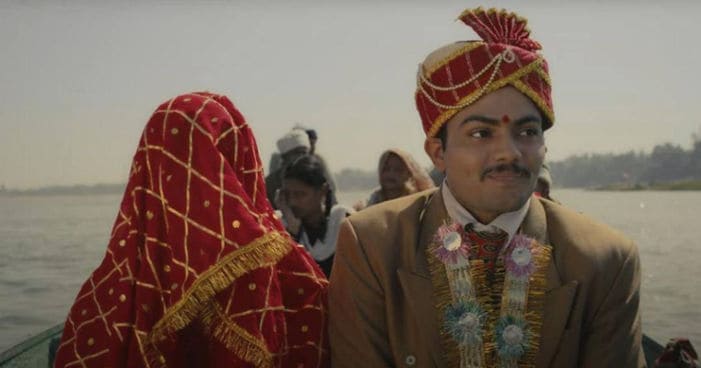
Written by Sneha Desai, the story is set up in the fictitious central state of Nirmal Pradesh, where Kumar (Srivastava) is on his way back home after marrying Phool Kumari (Goel). Amidst the hurried chaos of changing trains at night, he mistakenly grabs Pushpa’s hand and rushes off the train with her. It’s only upon reaching the village that he realizes the bride swap, setting off a series of comedic and heartfelt moments. Throughout the movie, the ‘tamboo-jaisa ghoonghat‘ or veil remains a powerful symbol of societal constraints, yet it is not held accountable by the elders for the challenges it poses in identifying women, ultimately leading to the swap. As the story unfolds, Jaya finds herself in Deepak’s joint family by mistake, while Phool is left stranded at the charming Pateela railway station. Here, Phool forms a unique bond with the station’s residents, including the firm yet empathetic tea kiosk owner, Manju Mai (Chhaya Kadam).

The two brides, Pushpa and Phool, are portrayed with distinct personalities. Pushpa’s mysterious nature attracts suspicion from Shyam Manohar, who closely monitors her activities. On the other hand, Phool, feeling out of place at the railway station, forms friendships with individuals working at Manju Mai’s. Kiran Rao’s perspective in the film shines through in her portrayal of empowerment for women on both sides of the spectrum: those who venture out to study and pursue their dreams, as well as those who find empowerment and fulfillment in being homemakers, departing from the ideals of a bashing feminism that solely focuses on women stepping out.

Breaking away from the conventional narrative of “aurat hi aurat ki dushman hoti hai” (women are each other’s enemies), the film also beautifully showcases the power of women bonding and supporting each other. Whether it’s through Manju Mai’s direct conversations with Phool, Jaya’s determined efforts to bring her back home, or Jaya refusing to be lost in the monotony of daily life and helping to uncover the hidden artistic talent of Poonam’s drawing in the process, Kiran Rao skillfully explores the theme of women bonding in the film.

Beyond the female characters, it’s also the male characters that become the heart of the film. Shyam Manohar (Ravi Kishan), the village cop, delivers some witty one-liners and punchlines, keeping the audience laughing out loud throughout the film. It was even Kishan’s transformation depicted in the end who proved to be a greasy-police officer but also someone whose conscience has not been completely corrupted. Srivastav’s portrayal of Deepak in the perfect shades is flawless. Despite occasional fumbles, his profound English and responsible actions toward Pushpa, despite missing Phool, define him as a well-rounded character. His stellar performance adds up to capturing the audience’s hearts.

The film not only captures the lows of the village, highlighting pesticide-driven crops, corruption, and the sickened societal mindset, but also artfully captures the nostalgic essence and romanticism associated with railways. It portrays not only the trains and stations but also offers us samosas and chai. Additionally, it transports viewers to the charming aspects of rural life, spanning from the era of Nokia mobile phones in the early 2000s to Mai’s bread-pakoras, with a little scold on asking for extra green chutney again!

The beauty of ‘Laapata Ladies’ lies in its ‘addressal’ of various issues of gender dynamics, marriage, dowry, education, individual rights, agriculture, and scientific thinking, but without becoming overly preachy or trivializing the gravity of these concerns. The essence of Rao’s film is in its carefree spirit, playful and lively tone, and ability to approach serious topics with a light touch. Exemplifying a cinema that is astute and thoughtful yet spontaneous and genuine, “Laapata Ladies” is akin to a comforting chai-pakora experience. It tackles pertinent issues while also embracing the audience with a giant, warm hug.

Read Also: An Attempt at Feminist Validation: Animal

Featured Image Credits: Kindling Pictures/Aamir Khan Productions/Jio Studios

Dhairya Chhabra

[email protected]

In a swift response, Delhi University takes action against a staff member accused of sexual harassment, reflecting a commitment to student welfare. As students rally for justice at the Central Institute of Education, officials ensure a thorough investigation by the Internal Complaints Committee, prioritizing safety and transparency.

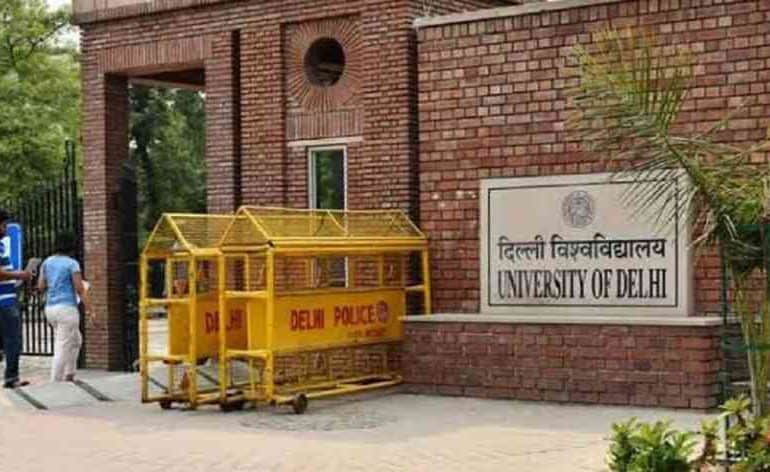
The University of Delhi’s Establishment Branch has terminated the employment of a non-teaching staff member who was allegedly involved in the sexual harassment of a student at the Central Institute of Education (CIE) earlier this month. The incident occurred in the Department of Education’s new building, per the student’s official complaint with the Head and Dean of CIE. The defendant is alleged to have engaged in several inappropriate behaviors, such as unwanted approaches, invasive personal inquiries, and acts that created a great deal of discomfort and fear for the student’s safety.

The student has asked for her peers’ support, expressing how the encounter violated and deeply distressed her. She also expressed fear for her safety because the harasser was walking around the department unhindered. Students came together to plan a demonstration at CIE on Wednesday to support the student’s right to justice.

The Indian Express was notified by Pankaj Arora, Head and Dean of CIE, that the Internal Complaints Committee was notified of the student’s complaint as soon as it was received on Monday. The accused, who worked for the company under a contract, was let go early on Wednesday.

We have engaged in extensive discussions with the students and have assured them that the university’s ICC will handle the matter with care.” Arora said in response to the protest.

While the ICC investigates the case, questions remain about the student’s ongoing safety and the support system available. Did the University offer counselling services or connect her with external support groups specializing in trauma recovery? Transparency regarding the ICC process would also be beneficial. What are the expected timelines for the investigation? Are there resources readily available to explain the process to students involved in such cases?

The case is presently under review by the ICC, and until the process concludes, it would be challenging to disclose specific details of the proceedings.” said DU Proctor Rajni Abbi.

The Students’ Union or other student committees at CIE likely played a crucial role in supporting the student and organizing the protest. Including a statement from a student representative would amplify the students’ voice and highlight the collective stand against harassment. The incident serves as a stark reminder of the prevalence of sexual harassment in educational settings. By creating a culture of support, ensuring a fair and transparent investigation process, and implementing robust prevention programs, universities can foster safe learning environments where every student feels empowered and respected.

Read Also: Where are you ICC: Looking at DU’s History of Sexual Harassment 

Featured Image Credits: India TV News

Divya Malhotra

[email protected]

JNU VC Santishree Dhulipudi Pandit emphasized that JNU was never anti-national, and the institution is not subjected to saffronization, following the University’s 20th ranking in QS World Rankings for development studies.

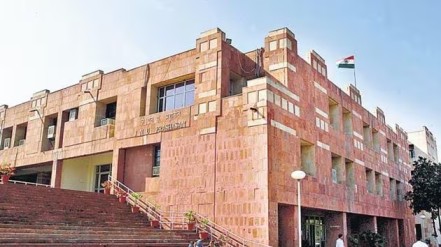
In a recent meeting with the editors of the Press Trust of India (PTI), Santishree Dhulipudi Pandit, the first female Vice-Chancellor of Jawaharlal Nehru University (JNU), addressed various aspects concerning the university’s current state and its past challenges. Ms. Pandit emphasized that despite speculations, JNU is not subjected to saffronisation or undue pressure from the Central Government in its daily operations. She asserted, “As a university, we should be above all this. JNU is for the nation, not for any particular identity.”

Acknowledging the presence of divisions on campus during her tenure, Ms. Pandit termed that period “unfortunate”. She attributed errors to both the administration and the students, acknowledging the mishandling of the situation by the leadership. 

I think that phase was bad, and there were mistakes on both sides, and because of polarization and the leadership not understanding… You have to understand that people will differ and argue. The university was never anti-national. When I studied (at JNU) it was the height of the Left’s dominance, even then nobody was anti-national.” – Ms. Pandit remarked.

Furthermore, she openly declared her affiliation with the Rashtriya Swayamsevak Sangh (RSS), stating that she neither conceals nor regrets it. 

Ms. Pandit reaffirmed JNU’s commitment to fostering dissent, discussion, and democracy, asserting that the university has never been “anti-national” or associated with the “tukde-tukde” gang. She stressed the university’s dedication to inclusivity and development, encapsulated in the seven principles of Development, Democracy, Dissent, Diversity, Debate and Discussion, Difference, and Deliberation.

Reflecting on her journey, Ms. Pandit shared details from her birth in St. Petersburg, Russia, to her upbringing in a middle-class South Indian family in Chennai. When she assumed the position of Vice-Chancellor in 2022, the University was grappling with student unrest, compounded by the aftermath of the 2016 incident involving purportedly anti-national slogans being raised on campus. 

I believe there was a phase of unfortunate ignorance on the part of the administration regarding JNU.”- she commented. 

Regarding this tumultuous phase, Ms. Pandit acknowledged mistakes on both sides and criticized the leadership’s attempt to control the situation, emphasizing the inevitability of disagreements and the importance of handling extreme viewpoints with understanding.

You have to accept that disagreements and arguments will arise. The college never held anti-national views. Even at the height of Left dominance, when I studied (at JNU), nobody was anti-national.” – Ms. Pandit reflected. 

The meeting concluded with Ms. Pandit’s reaffirmation of JNU’s commitment to its core principles and her dedication to steering the university towards inclusive growth and academic excellence.

Read Also: ABVP and Left Front Clash Ahead of JNUSU 2024 Elections

Featured Image Credits: Hindustan Times 

Divya Malhotra

[email protected]


Naima Khatoon Gulrez, recently appointed as Aligarh Muslim University’s first female Vice Chancellor, faces controversy over her appointment amid allegations of nepotism. 

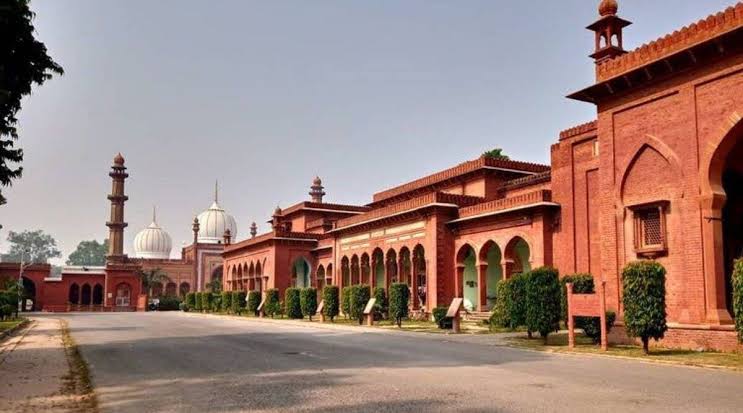
Naima Khatoon Gulrez, the principal of Aligarh Muslim University’s Women’s College since 2014, has been designated as the University’s inaugural female vice chancellor. She reportedly assumed office as the new VC on the evening of April 22. However, her appointment has been accompanied by complexities, controversies, and overarching implications, including the nuanced interplay of institutional governance and familial ties.

Naima Khatoon’s elevation to the esteemed position of Aligarh Muslim University’s (AMU) first woman Vice-Chancellor marks a pivotal moment in the institution’s storied history as she becomes the first woman to hold the position in the University’s 123-year history. Emerging from a modest family background in Jajpur district, Odisha, she is the only other woman to have held a top post at AMU since Begum Sultan Jahan, who was appointed as the Chancellor of AMU in 1920. Her professional journey includes serving as Professor and Chairperson of the Department of Psychology before assuming the role of Principal at Women’s College in July 2014. She has a diverse background, having taught at the National University of Rwanda, Central Africa, and fulfilling various administrative roles at AMU. She has authored, co-authored, or edited six books and published numerous papers in national and international journals. Additionally, she has supervised fifteen Ph.D. theses and a considerable number of dissertations, specializing in clinical, health, applied social, and spiritual psychology.

However, her journey to this ground-breaking appointment unfolds against a backdrop of intricate institutional dynamics and heightened scrutiny. 

Central to the discourse is the prominent role played by Professor Mohammad Gulrez, the outgoing acting AMU VC and Khatoon’s husband, as he chaired the meeting that included her on the list. The involvement of Gulrez in the selection process sparked contentious debates regarding potential conflicts of interest and allegations of nepotism, casting a shadow over the transparency and fairness of the proceedings. These challenges were mounted in the Allahabad High Court, alleging procedural irregularities, with petitioners questioning the integrity of the process. However, the petition was ultimately dismissed, allowing Khatoon’s appointment to proceed.

The AMU Court shortlisted three candidates for the position and forwarded their names to President Droupadi Murmu for final selection in November last year. Professor Muzaffar Uruj Rabbani, former Dean, Faculty of Medicine, AMU, and Professor Faizan Mustafa, V-C, Chanakya National Law University, Patna, were the other contenders for the position.

This intersection of academia and politics lends an additional layer of complexity to Khatoon’s inauguration. Against the backdrop of the looming Lok Sabha election, the timing of Khatoon’s appointment assumes added significance, with observers interpreting it within the broader context of political maneuvering and outreach efforts to Muslim women by the BJP government. The significance of her role extends beyond the University campus, resonating with the broader Muslim community in India and abroad. In this light, Gulrez’s appointment was reportedly ratified by the Election Commission (EC) with the stipulation that it would not be publicised, and no political advantage would be derived from it. The EC’s approval was conveyed to the Education Ministry on April 9. Khatoon’s appointment is for a period of five years or until she reaches the age of 75, whichever comes first, according to an official notification from AMU. 

Founded in 1875, Muhammadan Anglo-Oriental College was renamed AMU in 1920, becoming one of the oldest universities in India. Despite its long history, AMU has never had a woman vice-chancellor until Naima Khatoon’s appointment. As she embarks on her tenure, Khatoon’s appointment holds profound implications for the future trajectory of AMU, with the AMU community eagerly anticipating her vision. In navigating the complexities of her new role, Khatoon faces the challenge of upholding fairness, transparency, and impartiality, as acknowledged by the Aligarh Muslim Teachers’ Association (AMUTA).

Despite the controversy surrounding the selection process, including challenges raised in the Allahabad High Court, Khatoon’s appointment reflects a step forward in breaking traditional barriers within AMU’s leadership structure. 

Read Also: Kerala’s SIO Protests Against PM Modi’s Anti-Muslim Comments 

Featured Image credits: Indian Express

Kavya Vashisht

[email protected]

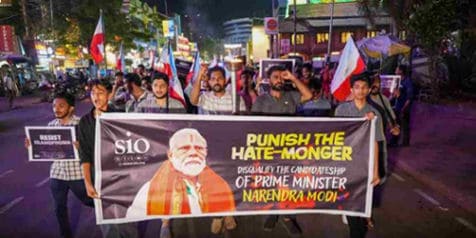
The Kerala unit of the SIO (Students Islamic Organization of India) took to the streets of Kochi to protest against Prime Minister Narendra Modi’s rhetoric targeting Muslims during the election campaign in Rajasthan.

On Wednesday, April 24, activists from the Students Islamic Organization (SIO) in Kerala organized a protest rally in Kochi. The demonstration aimed to condemn Prime Minister Narendra Modi’s hate-filled speech targeting Muslims during his recent Lok Sabha election campaign in Rajasthan. The activists fervently raised slogans and demanded action against the prime minister during the protest.

During the protest, a group of students was seen carrying torches and a large banner that read, “Punish the hatemonger. Disqualify Narendra Modi’s candidacy… Resist Islamophoia… Resist Hindutva. etc.” Throughout the protest march, activists raised slogans against PM Modi and the RSS.

The protest stemmed from the Prime Minister’s remarks made during a rally in Rajasthan’s Banswara, where he hit out at the Congress over its wealth redistribution survey promise and said that the party, if voted to power, would distribute the country’s wealth to “infiltrators” and “those who have more children,” an apparent reference to Muslims. “It will be distributed to the infiltrators. Should your hard-earned money go to the infiltrators? Do you approve of this? The Congress manifesto says they will calculate the gold with mothers and sisters, get information about it, and then distribute that property. They will distribute it to whom? Manmohan Singh’s government had said that Muslims have the first right on the country’s assets,” PM Modi said.

In the wake of the hate speech that sparked widespread outrage across the nation, opposition leaders vehemently criticized PM Modi’s remarks, particularly those aimed at a specific community. Additionally, some leaders also urged the public to petition the Election Commission of India in response to the concerning statements made by the Prime Minister. Previously, the SIO Kerala Unit had also participated in a similar protest at Providence Girls Higher Secondary School in Kozhikode, where students were forbidden from wearing hijabs. The protest highlighted a broader issue regarding religious freedoms within educational environments.

Read AlsoRajasthan: Students Protest Against Suspension of Muslim Teachers – Reject “Conversion” and “Love- Jihad” Allegations

Featured Image Credits: SIO Kerala

Dhairya Chhabra

[email protected]

Trigger Warning: Hate Speech, Islamophobia

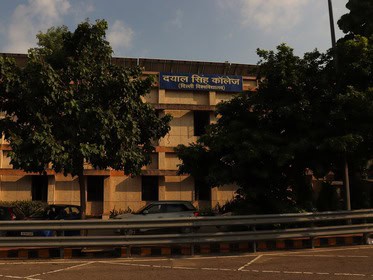
Umang, the fest of ENSO, the Entrepreneurship Cell of Dyal Singh College witnessed stand-up comedian Vivek Samtani make Islamophobic remarks through his jokes. Consequently, the stand-up comedian along with ENSO issued a public apology followed by condemnation posts by the Student Federation of India (SFI).

On 22 April, 2024, stand-up comedian Vivek Samtani performed at Umang, the societal fest of ENSO, the Entrepreneurship Cell of Dyal Singh College. However, the performance was interrupted by hate remarks, targeting the Muslim community, as can be observed from this video that has been circulated widely across social media. However, soon enough the comedian issued a public apology on stage, followed by ENSO issuing apologies on their social media handles as well. 

Post the event, SFI Delhi University issued a press release dated 24 April, 2024, condemning the Islamophobic comments passed during the event and urged, “strict action against perpetrators”.

The Press Release quotes that:

“By trivializing acts of terrorism and reducing Muslims to caricatures of violence, these so-called “jokes” contribute to the stigmatization and marginalization of an already vulnerable community. In a country where Muslims are routinely targeted and demonized, such rhetoric only serves to fuel hatred and intolerance. It has no place in our universities and should be condemned unequivocally by the student community!”

The Press Release also draws upon the recent pre-election speech by the Prime Minister in Rajasthan:

“This insidious narrative has been actively promoted by certain political leaders, including the Prime Minister, who has made derogatory remarks referring to Muslims as “infiltrators” and accused them of “producing many children” to skew demographics.”

The Press Release concludes with, “comedy cannot be employed as a tool to pass off such dehumanization.”

Aditi, Delhi University Convenor of SFI confirms that ENSO of Dyal Singh College sought an apology from the stand-up comedian after the event and he did so, as can be observed from this video. She adds that,

“ENSO has ensured that they do not support such hateful remarks that have been advocated by the stand-up comedian, Vivek Samtani. SFI has put out a statement that we understand ENSO’s statement of apology but hold the comedian responsible for his speech. We might go ahead with an FIR against the comedian.”

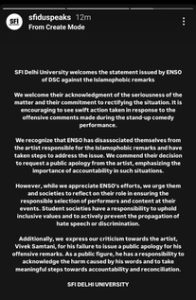
An excerpt from SFI’s statement supporting ENSO’s action against the comedian reads that:

SFI Delhi University welcomes the statement issued by ENSO of DSC against the Islamophobic remarks. We welcome their acknowledgement of the seriousness of the matter and their commitment to rectifying the situation. It is encouraging to see swift action taken in response to the offensive comments made during the stand-up comedy performance.”

Reaching out to team ENSO as to what conspired during the event, we were able to gauge that the society had forewarned the comedian before his performance to not pass any “offensive comments” or use “foul language” since such remarks would be considered  derogatory within an educational setting. The performance ensued with jokes pertaining to ‘ college drama – academics, relationships and the usual with Islamophobic comments sprinkled through the set. 

A member of ENSO, in conversation with DU Beat, mentions that:

“The comedy performance by Vivek Samtani was a closed event with around 200-250 members seated within the auditorium. However, before inviting the comedian we had researched upon his previous performances to make sure that nothing ‘problematic’ would ensue. But after his offensive remarks, our members sought a public apology from the comedian on stage which he rendered at that moment. Not just that, ENSO has posted a public apology to all on their Instagram handle and we have reached out personally to people to issue apologies. Post the event, our team had a conversation with the comedian within the conference room regarding his offensive remarks and the comedian even contacted us personally after leaving the college to check if the situation within the college had not worsened. However, members within ENSO have been receiving hateful messages ever since this event occurred, even though we are trying our best to resolve the issue.”

The public apology issued by ENSO on their Instagram page mentions that:

“We are deeply sorry for the recent incident at our event. Please know that we condemn the artist’s actions and are committed to rectifying the situation. We want to clarify that we do not support the offensive comments made by the artist. Despite our warnings to him, things didn’t go as planned, and we took immediate action. We have no personal affiliation with the artist however, we have asked him to issue a public apology as well.”

While the 15-second clip of Vivek Samtani’s performance has taken over the Internet, student bodies are willing to correct the situation so that such hateful instances do not arise within educational spaces in the future.

Read Also: The Hidden Economy of Hate

Featured Image Credits: Bharish for DU Beat

Priyanka Mukherjee

[email protected]

I know we were taught to “never look back” or to just “keep moving forward.”  I believe that sometimes it’s healthy to look back. Look back at those who stood still when you went out to be your own person—those people you left so far behind because life moved too fast.

“Well, here at last, dear friends, on the shores of the sea comes the end of our fellowship in Middle-earth. Go in peace! I will not say: do not weep; for not all tears are an evil.” ― J.R.R. Tolkien, The Return of the King

Do you remember the day you learned how to ride a bike? Or when you were dropped off for your first day of school? It was confusing, and more than that, it was daunting beyond comparison. But after we finally let go and had our first taste of independence, it felt awfully good, so much so that we forgot to look back—back at the person who held onto us until we were ready to be on our own. The moment they took their hands off the back of our bikes or handed us our school bags, we left filled with excitement and fear of what came next while they stood still, watching us move ahead in life. That parent, sibling, friend, or whoever else who guided us through those initial steps is the reason behind our great adventures. And at the end of the day, when we look back at them, we thank our lucky stars for having the guts to leave when, in fact, the real strength came from those who were left behind.

For every young adult leaving for college, for every soldier leaving to defend their country, and for every death in the world, there is a parent, a spouse, and a loved one who had to let go. And while letting go is something that goes both ways, being left behind is often harder than leaving.

The worst part of it all is usually the memories you’re forced to live with while you go about your regular life. My boyfriend encountered this great work opportunity that prompted his move to London. It’s easy to feel jealous or neglected, while the other person enjoys the thrill of their new life. And then you start to hate yourself for feeling the way you do. There are too many mixed emotions, and it’s hard to deal with that, but at the end of the day, you keep trying to make it work anyway.”  – said Sara, a 24-year-old, while discussing her long-distance relationship.

A separation like this usually leaves a person feeling helpless and stuck.

For surrogates, the separation from the children they give birth to can be emotionally challenging. While they may understand the arrangement intellectually, the emotional bond formed during pregnancy and childbirth can still be strong. And after providing the ultimate gift of making someone a parent, they go home alone, feeling like a mother but not actually being one. Similarly, when a soldier leaves, the spouse left behind must carry the burden of managing the household and family responsibilities alone while also dealing with the constant worry and uncertainty about their partner’s safety. This is often overlooked in discussions about military life.

Death is perhaps the most permanent form of separation, leaving loved ones grappling with grief and loss. The pain of losing someone dear can be overwhelming, and those left behind may struggle to find meaning and purpose in their lives without their loved one. For foster children, watching their friends get adopted and leaving them behind can be heartbreaking. They may struggle with feelings of rejection and abandonment, wondering why they weren’t chosen, or feeling like they are not worthy of love. These are a few of the experiences that are often neglected in real life, in literature, or in advice. As one person aptly put it, “Sometimes the hardest part isn’t letting go but learning to start over.”

“Jealous, sad and stuck” said Aryan, are some of the feelings he feels when asked about his friends leaving the city after college while he remained here struggling to find a job. He talked about how, even though he felt happy for his friends, he hated the idea of being left alone which is something that great authors like Hemingway and Didion explored in their works too.

I know we were taught to “never look back” or to just “keep moving forward.”  I believe that sometimes it’s healthy to look back. Look back at those who stood still when you went out to be your own person—those people you left so far behind because life moved too fast. Those are your people because they’ll remind you just how far you’ve come in life, and that’s a good reminder to have.

Featured image credits: SoJourners

Read Also: Is it Even a Goodbye Without Looking Back

Lakshita Arora 

[email protected]

Bidding farewell to college is like bidding farewell to a sense of stillness amidst the chaos in your life. What’s even more difficult is sometimes bidding farewell to the societies within these spaces, which is perhaps way more difficult for the juniors left behind.

Disclaimer: Readers might be left with a bittersweet feeling in their heart and might shed a tear or two, so proceed with caution.

Dear Reader,

As we close a chapter on the batch of 2024, turning the page on perhaps the most personal part of our college lives – our societies – might be even more painful. As an anxious, scared, and confused college student, the author found comfort and solace in one such society, and as a second-year student, she finds it even harder to say goodbye to the senior who made college feel like home. Friends’ Corner, the Mental Health and Counselling Cell of Hindu College, became a warm cup of chai during the rain for this author, and its president, Suangouding Guite, became the rainbow after the rain. Some might say his infectious smile, quirky one-liners, and him saying “period” after every sentence just helped them feel comfortable and safe in an otherwise overwhelming college space.

You know when you’re anticipating that your drink might be too hot or too cold, but when you take a sip, it’s the perfect temperature. This happiness, satiety, and comfort were what I got when I first interacted with Gouding. He, along with our seniors Soham and Varnika, made an amateur at society work like me, feel appreciated, and feel at home, and this society soon became my comfort space.” – says Vidita Verma, a second-year English Literature student at Hindu College.

In conversation with DU Beat, Gouding, a third-year sociology student and the president of Friends’ Corner, shared his experience at FC and how bidding farewell to this space feels personal.

For me, bidding farewell to Friends’ Corner is more like closing a chapter on my life, to the important and beautiful people and memories that make FC, as it became a part of me in these past three years, which I don’t want to let go of. I want FC to be known for its safe space, open conversations, and belongingness, which allow others to be vulnerable, and I hope I was able to create that legacy. This space became synonymous with Hindu for me, and this goodbye just feels personal. It was a society I joined for its safe space and open conversations about mental health, as it won’t really fetch you any CV points, and I stayed because it allowed me to be whatever I wanted to be and to feel whatever I wanted to feel, as it exists for others to grow and for them to learn from.” – Suangouding, president of Friends’ Corner, reflected. 

We’ve all had our fair share of uplifting and disappointing moments, intertwined with promises that sometimes fall short but are cloaked in sweetness. College societies have brought us together in unexpected ways, fostering beautiful connections for some and challenging experiences for others. The author did find herself in a pickle while writing this piece as she has been a part of the healthier and less emotionally daunting side of college societies, or rather has been quite lucky with the people, particularly the seniors she met, but a student from South Campus College who wished to remain anonymous remarked about its dramatics society.

I happened to have worked with seniors who would rather throw you under the bus for the sake of asserting their dominance. Favouritism, selective targeting, and insensitive manipulative behaviour, are some of the qualities they’d be passing onto their juniors. My seniors honestly sucked, and I’m more than happy to be bidding them farewell.” – they reflected. 

Performing Arts societies in DU might be known for their (valuable) experience, hectic schedules, overwhelming work, and hierarchies, but despite their generalised perception, they do end up becoming free and homely spaces for students, and we might meet seniors who make it just that.

In conversation with DU Beat, Manya Mallika, a third-year Physics student from Hindu College, opened up about her fruitful tenure at Masque, the English Theatre Society, not just as its co-director but as a first-year student who joined the society through online inductions during the lockdown.

After coming to Delhi after an online semester, the only people aware of my presence were in Masque, which initially seemed like just another college club. Despite finding other ways to engage in theatre, Masque somehow provided me with an identity in college, where I could be myself, through its lack of hierarchy and uniting people through their love for theatre rather than fear. I stayed because I felt a sense of belonging, and some friendships just stayed. My biggest realisation here is that human beings are prone to making mistakes; we are all flawed in some way. College should be a time of exploration, learning, and growth, and being patient and kind to others and ourselves. Remind ourselves to take a deep breath, as we’re all going to die anyway.” – Manya discussed. 

An anonymous first-year student from Hindu College, in conversation with DU Beat, bid a heartwarming farewell to their senior at Aria, the Western Music Society.

Priyansha (Yuhu) is a special person, not just for me but for the entire Acapella team of Aria. While being a great leader with her management and communication skills, she is a softie who cracks quirky jokes with her nasal voice, lighting up the mood of the entire team whenever we lose a competition (and that’s every time, lol). She built a family within a society, and while I wish her well for her dazzling future, bidding her farewell feels bittersweet as it’ll be very difficult to fill the void left behind by our very own Yuhu.” – they remarked. 

Anvesha Tripathi, a second-year Economics student at IPCW, shares how La Cadenza, the Western Music Society, ended up being the biggest and most exciting part of her college life, mostly owing to the seniors that she found there.

My seniors at Cadenza were nothing short of supportive, understanding, kind, and so unabashedly funny that every doubt vanished the second I walked into the practice room and helped us navigate this crazy circuit. One senior in particular stands out though: Ashna Dongre, who is a vision to look at and an absolute honour to be around. Every second I spend with her is enriching and leaves me either smiling or laughing my guts out. She is an absolute breath of fresh air on dreary days. I have sought in her love, support, and a simple shoulder to share my burdens with, and practice without her will feel incomplete, and so will the rest of my time at college.” – Anvesha said. 

It is said that first-year students enter DU with dreams in their eyes and passion in their hearts. Amidst the pool of batchmates, unspoken bonds, and sometimes fragile friendships, a lot of us struggle to strike a bond with any of our seniors in our respective departments. But lucky are the ones who end up discovering that friendship, solace, and guidance in that one senior in a society. An anonymous first-year student found such comfort in a senior at Vivre, the Film and Photography Society of Hindu College.

I learned a lot from them, and it’s definitely hitting me now that I have to bid farewell to them. It’s going to get hard for me because I don’t have a lot of friends or people I hold close to my heart in the second year. There’s one senior in particular, who I’m perhaps the closest to in the entire college. This is my person, and I hold them very close to my heart. Saying goodbye to them is going to break my heart, and I don’t want to think about it. What makes it sadder is that they are also leaving Delhi, so I might not see them ever.” – the student commented. 

S. Bangshing Panja, a third-year philosophy student at Hindu College, shares how bidding farewell to his college and his society might be hard, but it’s time for him to make space for others.

Although societies haven’t become synonymous with Hindu, there’s definitely a bittersweet feeling in my heart while waving goodbye to the safe spaces I found in the North East Cell and Aria, as they have been a huge part of me. The kind of legacy I’d like to leave my juniors, especially in the North East Cell, is that we should not be ashamed or scared to take up space. We are here in such a competitive institution, and we are here for a reason, and that makes us equal to everyone else. We just have to prove ourselves visible to the world, the people around us, and back at home. It’s sad that I have to say goodbye to them, but it’s about time. I’ve been here for three years, and I feel I have to leave in order to make space for others to come and feel the same things I felt and share the same friendships I’ve shared.” – they shared. 

Dear reader, while navigating the whirlpool of emotions college life at DU sometimes (certainly) pushes you in, some of us manage to find that one society and that one senior who just becomes your lifeboat. Bidding farewell to these small spaces within college that have become synonymous with home is difficult, to say the least, for the third years and the juniors left behind with a void in their hearts. How does one even journal such complex emotions and bittersweet memories in mere words? But I sincerely hope our words did justice to those feelings. Here’s a toast to the batch of 2024. We are forever grateful for your warmth, resilience, and comfort.

Read Also- Natural Selection: Unpacking Diversity in DU Societies 

Featured Image Credits: Sukriti for DU Beat 

Gauri Garg

[email protected]