Author

DU Beat

Browsing

Trigger Warning: Sexual Assault

Amidst growing concerns about student safety in Delhi schools, the alleged sexual assault of a five-year-old girl in her school bus casts a stark light on the issue, revealing the fragility of the safe and secure campuses boasted by prominent private schools in South Delhi. 

In August 2024, a five-year-old girl, from South Delhi was sexually assaulted in her school bus, allegedly by a 19-year-old Kenyan national currently studying in Class 11. The student was only suspended on 7th February 2025 after 100-150 parents peacefully protested outside the school premises. It has also been reported that the alleged perpetrator’s mother is a counsellor to the Kenyan High Commission. The First Information Report (FIR), registered under the Protection of Children from Sexual Offences (POSCO) Act, confirmed that he holds diplomatic immunity, which necessitates a waiver for legal proceedings to proceed. The concerned authorities have been contacted as two more FIRs have been lodged against the same individual.

While the incident occurred last year, it has received little media attention, and the school’s name remained largely undisclosed until recently when an alumnus of the school posted about it on their Instagram account.

Speaking to DU Beat, the alumnus emphasised on the tactics used by the school to curtail the situation without dispensing justice to the victim. Instead, they have advised the parents to change their daughters’ school.

They [school administration] are using everything to stop it. Even teachers from different branches don’t know about this.” he added

The parents allege that the local police and the school deliberately mishandled the case.  

When we first approached the school authorities regarding the matter, they told us the student involved was a 16-year-old Nigerian. Our daughter was called to the school to identify him, but he was absent that day and the teachers told us that he had gone for a field trip”  said the parents of the student while talking to The Times of India

Since then, they repeatedly tried to seek justice through the school’s administration, but these efforts have been largely unsuccessful. 

We are still waiting for justice …my daughter without any fault of her missed her school and the culprit freely was attending school and molesting more other girls which they reported to the teachers but they didn’t do anything.” the parents added

This trend of school administrations evading accountability is neither new nor isolated and sets a dangerous precedent where power and privilege outweigh social justice.


Read also: Nepali Student’s Alleged Suicide Sparks Protests at KIIT; Over 500 Students Forced to Leave the Campus


Yashika Jain 

[email protected]

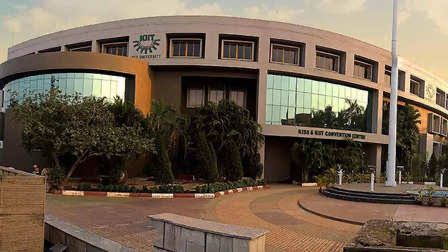
Protests erupted on the campus of Kalinga Institute of Information Technology, Bhubaneswar, after the alleged suicide of a student from Nepal. Following the protests, the university dropped off Nepali students at various railway stations and asked them to return home.

On February 16, 2025, Prakriti Lamsal, a 20-year-old student of Kalinga Institute of Information Technology, Bhubaneswar, hailing from Nepal, was discovered hanging from the ceiling fan of her hostel room after alleged prolonged assault at the hands of a fellow student, now identified as Advik Shrivastava. She is alleged to have taken her own life while being on a video call with the accused. Following the incident, several Nepali students had blocked the road near the campus, alleging that the university took no action after the students reached out to the International Relations Office at the university. Police officials have claimed it to be a self-evident case of suicide, and Advik Shrivastava, the boy who allegedly played a role in the death of the student, has now been detained following his attempted escape from Bhubaneswar through flight.

The student body has alleged that the victim had suffered continuous abuse at the hands of the detained. Her suicide note, which is now missing, and her phone, now in the custody of the administration, have all important and necessary information regarding it.

As of recently, a video has been circulating on social media featuring the college administration’s response to students from Nepal and their requests for a formal investigation to be launched, with one of the phrases used being, “Pack your bags and leave.”

Source: X 


The KIIT management has passed an official order calling for hostels to restrict the movement of students with immediate effect, and students of Nepalese origin have been threatened and beaten into vacating the college premises after having met with hostilities following direct relation to the case. their protests. A notice issued by college authorities read:

The university is closed for all international students from Nepal. They are hereby directed to vacate the university campus today, February 17.

According to reports, on Monday, over 500 Nepali students were asked to board buses, dropped at various railway stations and requested to head home.

Further sources claim that students were allegedly forced to vacate the college campus.

No train tickets or any directions have been provided to us. We were just loaded up on the hostel buses, sent to Cuttack railway station, and ordered to leave for our homes at the earliest. The staff members entered the hostel, made us vacate, and even hit those who were not vacating quickly,” claimed a student from Nepal.

Many anonymous sources have gone on to claim that this was not an incident in isolation, and similar cases of racial discrimination against international students, as well as student suicides and gendered violence, have occurred and have subsequently been brushed under the rug by concerned authorities of the college.


Read Also: Jamia Millia Islamia administration cracks down student-led protests; imposes arbitrary disciplinary proceedings


Featured Image Source: Times Now

Aastha Singh

[email protected]

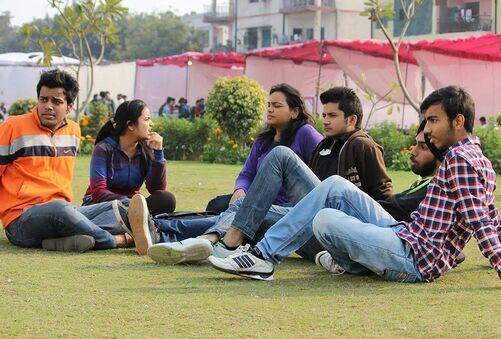
We often hear tales of romances from teenagers that leave us baffled and maybe even get a chuckle or two out of us. Here are excerpts from my chat with teenagers enrolled at the University of Delhi trying to figure out why teen romances seem so fickle these days.

“Everyone is  always on the hunt for someone better.”This quote vividly captures much of what might come to mind when encountering corny, often irrational teen romances during your daily scroll. Criticizing teenagers for their mistakes hardly makes sense, as—despite what they may want us to believe—they are still in their formative years.  Nevertheless, as someone who recently hit a miserable milestone (i.e., celebrated their 20th birthday), I thought it’d be fun exploring what the kids are up to these days. Finding people who are up for a chat is rarely a problem on college campuses, so we assembled a group of people, sat down for a cup of tea, and heard their story, trying to figure out what’s made teen romances a funny affair.

“The preferability of hookups to lasting romance in the gay space practically decreased my odds of finding love, not in Delhi anyway.”.

Gabriel, a second-year college student enrolled at the University of Delhi, laughed when making this remark, but the misery of never being able to find love couldn’t be more apparent. Dating in the queer space presents more challenges than most; to get there to begin with is a win for most. Despite the recent progress, homosexuality is still and has been historically frowned upon in most sections of the globe. Some say it’s the sexual repression that’s led to a preference for sexual pleasure over lasting romance in masculine/gay corners of the queer space that Gabriel referred to earlier.Another historical explanation often cited is the trickle-down effect of the sexual liberation movement across the West in the second half of the 20th century which retains its essence in various sections of the queer community to this day. 

“Such is life that it began the very week I stepped foot in Delhi,” said Gabriel with another poignant smile, telling how he thought he’d found love in someone who’d go on to ghost him later. Heck, they even shared birthdays!!He seemed rather at odds with how he felt about apps like Grindr, which on one hand have made dating fellow queer mates more convenient than ever and have helped him make new friends in a city relatively unfamiliar but also led to people fearing/moving away from commitment, given the barrage of options that they have now. Despite his abysmal run in the Delhi dating scene, we are hoping he twins birthdays with someone very soon!

While Gabriel’s story reflects a rather unlucky tale of teenage romance, others like Serena view queer relationships with a fondness I had hardly seen before.” I’ve had breakups before; nothing has hurt the way it hurts when she’s upset with me.” Boy, could she have put it any better? Her tale is different from that of Gabriel in that she has found herself a partner, her first and, as she hopes, last. Our chat reminded me about the variables that make young love so pure. She explained how appreciative she is of having someone she can rely on emotionally when the going gets tough, someone to help kickstart her day and, similarly, help end it. Serena speaks in glowing terms of life feeling as though it’s being viewed through rose-tinted glasses when you’re emotionally invested in someone you love, naturally not a big fan of hookups.

How often do we see videos about red flags and green flags in relationships on our tabs? These videos often reduce attraction, which could be multifaceted to very shallow and non-pluralistic parameters, i.e., music, movies, and whatnot. And because the algorithms are designed in such a way that they get us stuck in an echo chamber of like-minded people who subconsciously affect our decisions. This perhaps can explain why so many young people increasingly feel more and more caged with their partners once the initial happy-go-loving phase is over. Serena too cautions people against other mono-ritualistic parameters being deciding factors for something as multifaceted as love. “Why even bother dating if you aren’t even emotionally invested in them?” she recalled dismissing my question about music potentially playing a big role in her relationship…

Serena was someone who found comfort in emotional investment, yet in a world that’s growing at breakneck speed, that is something that’s becoming an increasingly rare virtue. In the last of my chats, I ran into Rob and Miley, sharing their insights on the matter.

” The fear of commitment in the world of fast fashion is what puts people off of long-term relationships.”

 Rob remarked when asked about the deteriorating state of a meaningful connection in recent years. This led to a brief chatter about the rise in situationships, as not so long ago, it used to be synonymous with what you call the “talking stage” but has now taken the long-term route, often leaving people somewhere in the middle for months. Not sure whether it’s the “old man speak” in me, but maybe we should do away with it, at least this iteration of it, where it may last as long as 6 months, if not more. 

Miley, on the other hand, was harsh on people giving up at the first hurdle they came across. “Everyone is looking for someone better than their current partner or isn’t willing to work it out when things get hard. They seek an easy way out,” she recalled when asked about the problems with most modern relationships. It made sense, given the number of people who avoid conversations, misjudging them for confrontation, and proceed to let the resentment build up inside of them instead of talking things out and attempting to resolve conflicts.

Ultimately, these conversations revealed what might not be the revelation one may have been expecting but was important nonetheless. Like anything else in life, love, for better or for worse, is multifaceted, with various dimensions affecting an array of people. From Gabriel’s misfortune to the raw beauty of Serena’s first love to Rob’s tale of naturally becoming indifferent to his ex-partner. As he so succinctly put it:

“My previous relationships fell apart as there was not enough attachment; maybe we didn’t try hard enough to cherish each other, and over time, we became indifferent towards each other.”

Read also: Nostalgia and Break Ups That Engulf Valentine’s Day

Featured Images credits: Hindu College

Yash Raj

[email protected]

Following the lead of several universities banning student activism on campus, Jamia Millia Islamia has intensified its crackdown on student-led protests. 


A circular was issued by the college administration dated 29 November 2024, explicitly banning protests, dharnas, sit-ins and any form of sloganeering against constitutional dignitaries, days after students raised slogans against the current Prime Minister, Narendra Modi. In lieu of these supposedly new guidelines, students requested permission to hold a sit-in protest on 15 December 2024, commemorating five years of the anti-CAA protests held at Jamia, which turned violent when a protesting student, Shadab Najar, was shot. Permission for holding this event was denied, and the college shut down the library and the canteen on the said date, citing “maintenance reasons,” which was allegedly done to suppress dissenting student voices. 


Despite this, approximately 300 students participated in the peaceful protest after class hours, so the said demonstration did not disrupt any academic activities. 

– Saurabh, a PhD student at Jamia via EdEx


The administration, however, quickly responded by issuing show-cause notices to Saurabh and four others, accusing them of disrupting campus order and pushing certain political agendas. On 6 February, 2025, the administration further issued Disciplinary Committee hearings against the concerned students, stating that their responses to the show-cause notices were unsatisfactory. In response to this, students began a sit-in protest demanding an immediate revocation of these show-cause notices and a withdrawal of Disciplinary Hearings issued against protesting students. Larger demands of the protesting students include a revocation of the guidelines issued on 29 November, 2024 and 29 August, 2022. 


When students know that standing up for their rights could cost them their education, it forces self-censorship, making the environment even more repressive. This decision reinforces the ongoing erosion of dissent, making it evident that critical conversations, even within academic spaces, are no longer welcome. 

– Azhar via Youth Ki Awaaz


The administration further refused to engage in dialogue with the students and responded by increasing barricading around campus, deploying 20+ security personnel armed with lathis around the protest premises. In a gross violation of the protesting students’ right to privacy, their names along with their addresses and phone numbers have been pasted outside the university’s front gate. 


This incident is not an isolated instance but part of a larger pattern of crackdowns on student activism and academic freedom, especially across public universities in India, reflecting the Center’s broader attempt to suppress dissent by directly attacking intellect.


Read Also: Student protest in Ramjas College against the sexual harassment charges on Prof. Dhani Ram violently disrupted by ABVP


Featured Image Credits: The Observer Post


Sakshi Singh

[email protected]

This piece reviews the comedy series, ‘Hacks’ which armed with its reliable humour and eccentricity, challenges an ageist industry and audience. Hacks season 3 premiered in 2024. 


I love old people. I love movies about old people. Don’t get me wrong, I am not a gerontophile. I just find older people to be wittier, sassier, and snarkier than the rest of us. The years of experience living account for more than just joint pain and cataracts. I think it makes people more honest and carefree, for when you are 70, you have little to lose, the worst that could happen to you is that you could die and most 70-year-olds are dying anyway. ‘Hack’, a derogatory word, refers to an older person, past their prime, doing repetitive and mediocre work in a professional field. So, creators Lucia Aniello, Paul W. Downs, and  Jen Statsky chose to call their show about a 60-year-old, female comedian, ‘Hacks’. But Deborah Vance (Jean Smart), a steel-hardened, veteran stand-up comedian with 100 shows at Las Vegas’s Palmetto Casino is anything but a hack. Having cemented her 40-year-old career in comedy, Deborah saunters between the casino and paid appearances during the daytime, only to return to her cavernous mansion and dogs in the evening, take off her wig and gaudy outfit, and dine alone. She has paid a very dear price for success- years ago,  her husband, jealous of her comedic spurt, had left her and married her sister. But Deb isn’t lonely, she is quite happy celebrating Christmas with her house staff and manager, having cut off her sister from her life.  But despite her legacy, Deb cannot escape the fragilities of age and fears her career waning when the casino’s owner slashes her shows on Fridays and Saturdays every week. 

In a desperate attempt to freshen Deborah’s content, her manager Jimmy sends in a 20-something, unemployed TV comedy writer Ava (Hannah Einbinder) to Deb’s aid. They get off to a rocky start, scoff at each other, roll their eyes but eventually soften up. Ava is useful, she livens up Deb’s material, brings her to publicly apologise for her racist, sexist, ableist jokes in the past, and cuts down on the usage of her private jet to reduce her carbon footprint. Ava is young and was born in the age of cancel- culture and climate change activism. She makes Deb more relevant. She, in turn, learns from Deb how to be unflinchingly self-reliant to survive in a hostile world and carve her niche. They make a great team. Throughout the 3 seasons, Hacks has remained reliably, consistently funny. To watch Hacks is like watching yourself argue with your parents, both parties hold their ground, refusing to give up until one of you caves in. It is heartfelt and emotionally cumbersome at the same time. 

Because it is a 30-episode long series (that I binge-watched in 2 days), Hacks could devote a lot of time and screen space to developing well-rounded personalities of the supporting cast who are just as eccentric and geeky as the leads. Deb’s daughter (whom she named Deborah Vance Junior) is a self-absorbed entrepreneur who sells handcrafted jewelry, but because that makes her no money, she hires private agents to take ugly pictures of Deborah to sell to the media. Imagine! They have a difficult relationship. From Marcus, the CEO of her company to Kiki, her personal blackjack dealer, Deb has herself surrounded by a loyal tribe that keeps her from dying of boredom, or narcissism. She pays everybody a lot, a lot! Kayla, Jimmy’s bratty assistant is a joy to watch and at times,  I would find myself waiting for her to make an appearance, with little interest in Deb and Ava. That is the key to forging side characters, I’ve learned, that creators shouldn’t just sprinkle side characters to fill screen time, they should devote to them, traits and trajectories that make them a person in their own right, not just reduced to being the gay friend, or the black friend, or worst of them all, the fat friend. Tokenism is so last century. 

The supporting cast and leads, when Hacks won the Best Television Series- Comedy 

Image credit: Rolling Stone


I think it is hard to make a show about 2 women, harder if there’s an older woman, simply because an ageist audience does not want to watch a show about wrinkle cream, menopause, and lentil soup (it’s easy to digest). Old people are just not as visually pleasing, they walk slowly and slur. So, for Hacks to have won Primetime Emmys and Golden Globes and gotten a 99% rating on Rotten Tomatoes, it must have done a lot of things right. Another one of my dear favorite shows that has as in its lead a 64-year-old Julia Louis-Dreyfus (from Seinfeld) is Veep, a fictional political satire that traces the journey of the Vice President of USA, Selina Meyer (Dreyfus) and her team as she desperately claws at becoming the President. Her staff is dysfunctional and so is she. Veep was so, so funny, the outfits were so beautiful, it bagged so many awards. If you are chronically online and/or unemployed and can watch a 7-season-long show, then Veep might just keep you occupied for some time. 

It is important we make and watch more shows about old people. We cannot give up on people when they turn 60, they have too many remarkable stories to tell and too much property that they’re not taking anywhere with them. 


Read also: https://dubeat.com/2024/09/04/dub-review-angry-young-men-do-bhai-dono-tabahi-actualised/

Image Credit: Indiewire


Chetna Rani

[email protected]

The recent LA fires have led to widespread destruction and loss of houses and heirlooms for the rich, clearly leaving us all heartbroken. 


NewYear celebrations in Hollywood were rudely cut short when on 7 January, a series of wildfires destroyed the Los Angeles metropolitan area leaving some of the biggest celebrities homeless. Well, not really, they just relocated from one multi-duplex to another. Adam Brody, Julia Louis-Dreyfus, Bella Hadid, and Zooey Deschanel are among the many stars who lost their homes in the ferocious blaze that was reportedly fueled by powerful winds and dry conditions. Since evacuating, many celebrities have expressed anguish, poured tribute and started GoFundMe Campaigns to collect funds for the restoration of the Californian region. 


“I can’t hear them cry over the music” 


While the public grieved the loss of livelihoods and property, the Recording Academy which hosts the Grammys awards every year decided that it was just the right time to host the 67th Grammys. On 3 February, 2025, celebrities dolled up in statement gowns and perfect smiles, turned up at Crypto.com Arena in Los Angeles to applaud outstanding music of the year and to pay tribute to victims of the fire and honour the perseverance of the LA people, of course. The Musical Awards were a sombre affair this time, with performances and commercial breaks broadcasting fundraiser efforts urging attendees and viewers at home to donate for relief. In a bid to temper the celebrations (lest they seem too tone-deaf), the week-long parties that annually mark the Grammys, were cancelled. 


Lady Gaga and Bruno Mars performed a duet of California Dreamin’ after an emotional video montage highlighting the severe devastation. In a heartfelt tribute to the relentless service of first responders,  members of the L.A. County fire departments took to the stage to present the coveted Album of the Year award to Beyonce. However, it was the push for public donations that did not sit well with some viewers who called out the irony of celebrities asking commoners—many of whom are reeling with loss, to donate. One X user commented that the mega A-listers in the Grammys could afford to rebuild the entire state of California without feeling a pennyworth’s loss. 


Woe is Me: Only the Rich can grieve


Grieving, American socialite Khloe Kardashian wrote on Instagram, “My heart breaks for my city.” In 2022, sustainability marketing firm, Yard revealed that Kim Kardashian was among the top 10 celebrities with the worst private jet CO2 emissions. In 2022 alone, Kim’s jet emitted 4268.5 tonnes of carbon emissions over 57 flights: 609.8 times more than the average person emits in a year. So, as an eco-terrorist, Kardashian only cares about the climate when there’s a fire in her backyard, literally. With the fire blazing through Pacific Palisades, even Climate warrior Leonardo Di Caprio who constantly raises awareness about environmental activism, fled to Mexico in a fuel-guzzling private jet and was branded a hypocrite by netizens online. Armchair activism goes a long way, it can get you all the way to Mexico.


While losing a home is a painful experience for anyone, the hardships posed to celebrities with multiple safety nets and properties are far removed from the permanent loss of homeland and family borne by the Palestinian people in Gaza for over a year now. Most celebs have conveniently remained tight-lipped about the Palestinian genocide. One wonders why fundraisers and donation drives weren’t initiated during the many awards that have taken place since October 2023. Why weren’t video montages of the systematic slaughter of thousands of Palestinians played, in a desperate plea to wake the conscience of the moneymakers? It is because America only cares for its own. The glam of the red carpet is too blinding for white socialities to pay attention to anything apart from their accolades and appearances. There is privilege in mourning, in grief and celebs are the most privileged of us all. It is heartwrenching to know that pop singer Paris Hilton watched her home burn in the fire, but you don’t feel the same sorrow knowing about the nameless Palestinians who have been reduced to being a statistic in the death toll. That’s the manoeuvring of the media. Reportage only feeds off of and caters to the rich. 20 years from now, they will make a movie about the genocide, paying ‘homage’ to the lives wrecked, give it a lazy title like ‘The Palestinian Pain’ or something and then that movie will be awarded Best Motion Picture – Drama at the Golden Globes. 


This might seem like yet another piece bashing the rich, but it’s really not. I am equally saddened by the LA fires too. I was a serial consumer of Architectural Digest’s celeb Home tour videos that have been delayed indefinitely now. I just don’t know what to do with my time anymore. What an unimaginable loss, truly. 


Read Also : Writing Off Accountability: How the Literary Industry Forgives Its Own, from Neil Gaiman to Beyond.


Featured Image Credits: Los Angeles Times


Chetna Rani

[email protected]

The University of Delhi has once again found itself amid another controversy; owing to a series of thefts that happened within many college premises during the most recent semester examinations. This has raised questions about negligence and disregard for student safety on the university’s part.

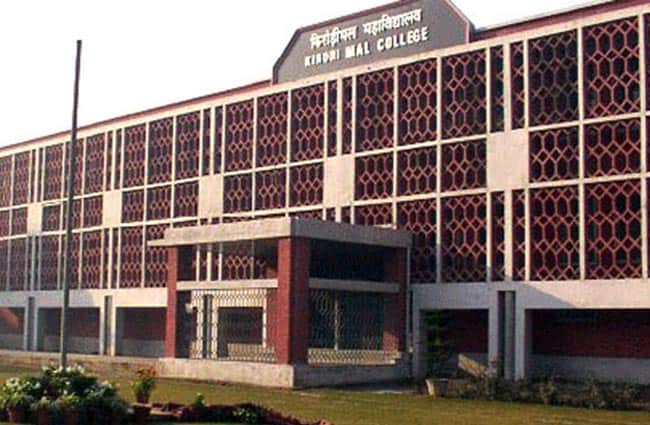
On 10 December 2024, several students at Kirori Mal College reported having had their phones stolen. This took place during the semester-end examinations for undergraduate students at the University of Delhi. The students reported being disappointed by the college administration and forced to act independently. Numerous instances of stolen goods at Shyam Lal College, Kirori Mal College, and a couple of others were reported in the last two months. One of the faculty members themselves has reported having had their laptop stolen from within the college staff room. 

During our examination, I and a few other students had our phones stolen from them, from outside our classrooms where we were told to leave our bags,

one of the affected students remarked, clearly frustrated with what had gone down.

The Kirori Mal incident saw over half a dozen people lose their phones in a couple of hours. The administration faced criticism, given its allegedly reckless, waiting-for-a-disaster approach to safety, as they had not installed the required number of security cameras. Kirori Mal College only had one camera for the entire floor where the incident occurred. As shared with us by one of the victims, Dinesh Khattar, the principal at Kirori Mal College, allegedly refused to take responsibility and instead used the “government-funded” rhetoric at the students in an attempt to deflect any blame that could have been put on them.

Given that we are a government-funded institution, we cannot afford to install more security cameras than we already have. The students were, in any case, warned not to bring their phones on the back of their admit cards,

the students reported the principal saying when we discussed the administrative response.

The crucial detail in the admit card as mentioned by the principal has an intriguing piece of ambiguity attached to it, as the students pointed out. It does warn students against having phones inside the “examination hall” but never quite distinguishes between what qualifies as an examination hall and what doesn’t. One’s assumption would naturally be that the classroom is their designated examination hall, but not if we go by the administration’s alleged words. These students could not afford to leave their phones at home, as most spend hours on daily commutes, often getting home very late.

Moreover, worsening the fiasco was an alleged confession. Speaking to us, one of the first-hand witnesses and victim alleges that they heard one of the staff members joking about the fact that the thefts happened much earlier than they usually do during exams. This alleged blatant disregard, despite being aware of the situation, comes off as negligence of the highest order, which is only paving the way for more such cases, the affected claimed.

Furthermore, the alleged narrative that the college is publicly funded, as spun by the administration, begins to lose steam once we look at where the money is being used. The college is rebuilding its auditorium, which is estimated to cost nearly 10 crores, and regularly invests heavily in events centring around high-profile names. A lack of pressure from the student body to install additional security cameras and security guards to prevent something of this magnitude from happening again is also partly to blame, an inquiry revealed. Many claim that the highlighted failure of the student body is a downward spiral that youth politics in India has found itself stuck in, in the last few years.

Read also: Student protest in Ramjas College against the sexual harassment charges on Prof. Dhani Ram violently disrupted by ABVP

Featured Images Credit: The Indian Express

Yash Raj

[email protected]

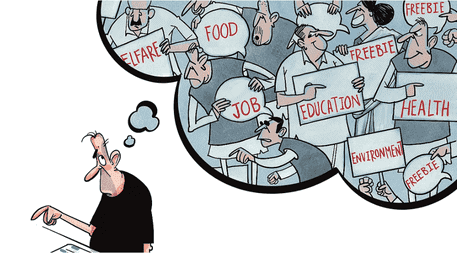
A distortion of democracy? A betrayal of a social contract? A passive receipt of benefits or an active political participation towards a welfare state?

The language of democratic exercise often employs, not merely as its endorsers but also its practitioners, various sweet shop owners who incentivize capital-based campaigning. The Delhi state elections are a display of such a state of war, which has as its highlights, the various monetary biddings made over very selective and political demographics.

It is not unknown that the Aam Aadmi Party (AAP), in its manifesto, has promised a sum of INR 2100 to women under the aegis of the ‘Mukhyamantri Mahila Samman Yojna’. The certainty of this scheme is contingent on the party securing a majority. However, a serious delirium of such schemes is the incompetent and biased nature of such claims. While it is true that a welfare state works for its marginalized citizens, the composition of Delhi and its voters demands serious scrutiny. The marginalized of the capital are an extremely heterogeneous group, and certainly, when a distinction is made in the category of women by the state, the exclusion of migrant and transgender women disallows any serious engagement towards actual welfare.

Nitara, a transgender woman and a student of Delhi University told DU Beat:  

There are about four to five thousand registered trans voters in Delhi, the official number of which I believe to be much higher. Women are promised INR 2100 in monetary assistance by AAP, following which the Congress and BJP have promised INR 2500. While it’s good they do it, why don’t trans women get similar aid? Don’t we deserve it? In fact, a trans woman is more vulnerable than a cis woman is. This is the bare minimum we can be provided with. We are not promised incentives because our numbers are low. Nobody wins elections with 2-3 thousand votes. Delhi Vidhan Sabha elections tell you that you’ll only be cared for if you are a big vote bank, else nobody is with you.”

Nitara’s statement underscores the transactional nature of electoral promises where welfare is not a matter of rights but of electoral arithmetic. The exclusion of transgender women from such schemes reveals the shallow inclusivity of political manifestos, which are tailored to appease large vote banks rather than address the systemic vulnerabilities of marginalized communities. This is not merely an oversight but a deliberate strategy to prioritize electoral gains over equitable welfare. The Delhi elections, in this regard, are a microcosm of a larger national trend where democracy is reduced to a marketplace of freebies, and voters are treated as consumers rather than citizens.

With the imposition of the Model Code of Conduct, a partial hiatus has been put to the mockery of democracy and development. However, desperate attempts to milk out this inconsistent idea have not stopped. AAP, for instance, has included a ‘Pujari-Granthi Samman Yojana’ for temple and gurudwara priests.  Arvind Kejriwal, the National Convener of AAP explained the scheme in a Economic Times report,

Pujaris and granthis are an important part of our society, but they are often a neglected section. For the first time in the country, we are introducing a scheme to support them, under which they will receive a monthly allowance of INR 18,000.”

This circles back to questioning the intentionality of such a culture of voting. Lest it be taken as a pitting of one religion against the other, it is a certain fact that other religious minorities such as the Muslims and Christians undergo neglect and invisibility at much deeper scales but any affirming reality escapes them during election season. The culture of freebies, while seemingly beneficial on the surface, is a hollowing democratic practice that undermines the very essence of governance. Political parties, in their bid to outdo each other, have turned welfare into a competitive sport where the highest bidder wins. For instance, in the 2021 Tamil Nadu elections, the DMK and AIADMK engaged in a bidding war, promising everything from free laptops to cash transfers, with little regard for the fiscal sustainability of such schemes. Moreover, the freebie culture perpetuates a dependency syndrome among voters, where electoral choices are driven by immediate monetary gains rather than informed deliberation on policies and governance. This undermines the democratic ideal of an engaged and informed citizenry, reducing elections to a transactional exchange of votes for cash or goods. 

The critique of freebie culture is not a dismissal of welfare schemes but a call for their rationalization and equitable implementation. Welfare measures must be designed to address structural inequalities and empower marginalized communities, rather than serve as tools for electoral manipulation. For instance, schemes like the Mahatma Gandhi National Rural Employment Guarantee Act (MGNREGA) have been lauded for their focus on creating sustainable livelihoods rather than doling out cash handouts. While the hollowing of democratic ideals is saddening, it is not very different from what we as participants are used to believing as development at all times. This makes one question if a democratic ideal is but a sweet shop economy?

Read Also: Yeh Kya Hua, Kaise Hua: Dissecting the Congress’ Lapsus Regnī 

Featured Image Credit: Sourav Rai for Indian Express

Bhavana Bhaskar

[email protected]

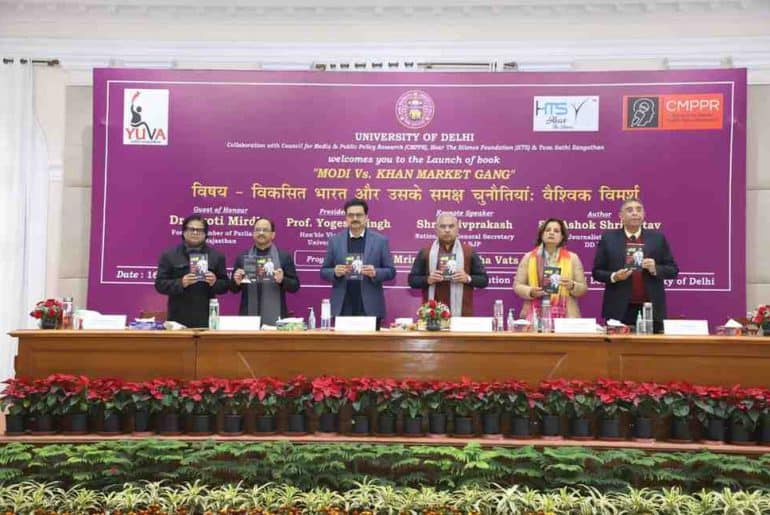
Delhi University Vice Chancellor, Yogesh Singh, faced heavy criticism from faculty members on 16 January, 2025, Thursday, after he endorsed Ashok Srivastava’s ‘Modi vs Khan Market Gang.’

On 16 January, 2025, Delhi University Vice Chancellor, Yogesh Singh, appeared to endorse the Bharatiya Janata Party ahead of the Delhi election scheduled for February. The endorsement came at a book launch held at the Convention Hall of the Vice Chancellor’s office, organised by the Council of Media and Public Policy and Research along with the Silence Foundation in collaboration with Delhi University. The book titled ‘Modi vs Khan Market Gang’ has been authored by Ashok Shrivastava, a news anchor for the state-sponsored public broadcaster, DD News.

Khan Market Gang was notably a strategic attempt to take digs at the opposition in the lead-up to the 2019 Lok Sabha elections. It was in response to the opposition parading “Chowkidar Chor hai” at the incumbency at the time. Khan Market, a double-storey complex amidst bungalows that pay host to lawmakers and civil servants, is often considered the most expensive retail area in India. Prime Minister Narendra Modi, who doesn’t shy away from letting people know about his humble beginnings, uses this as a political binary against the elites of the Indian socio-political system.

The main objective of the book, according to Srivastava, was to make people in academia aware of the fake narratives that have been thrown around during the incumbent’s tenure. As has been a recurring theme of the Bharatiya Janata Party’s (BJP) attempts to deal with critics, Prime Minister Narendra Modi once again was talked about synonymously with India at the event. Those who weren’t uncritical of the government, both the journalists and notably institutes abroad, were called out and mocked subsequently.

Sweden, smaller than most Indian states, decided to establish V-Dem several years ago and deemed India undemocratic ahead of both the 2019 and the 2024 elections. A nation as small as that critiquing us makes sense when you look at the people funding it,”

said Yogesh Singh whilst talking about the various anecdotes Srivastava had used in his book to prove how the “Khan Market Gang” transcends borders and nationalities.

Singh didn’t shy away from his allegiances at a time when the model of conduct was placed in the state. He suggested that the Indians enjoy unprecedented freedom and that the global rankings and indexes are all part of a broader narrative against the prime minister and thus India. India curiously ranks 159 out of 189 countries in the latest edition of the Press Freedom Index. His statement comes at a time when central universities have never been more politicised. The changes brought forth by the National Education Policy (NEP), in the curriculums and the regular seminars and events in colleges that align with the ideological tilts of the government, reflect a growing trend of educational spaces turning into arenas for parroting the broader narrative set forth by the ruling party and a slow departure from the intelligentsia.

The event was attended by the members of the Akhil Bharatiya Vidhyarthi Parishad, the youth wing of the BJP, who have themselves been in hot water following the incident where they were seen assaulting students in Ramjas College. Several high-profile BJP leaders were also present at the event where Yogesh Singh was described as the “Chief Organiser” by Ashok Srivastava.

Several Delhi University faculty members condemned the book launch at a time when the model of conduct was in force in Delhi.

Abha Dev Habib, an assistant professor at Miranda House, deemed the event “a political misuse of a publicly funded university” in a conversation with The Print.

I am amazed to find that in a premier public-funded university, where scores of faculty members routinely publish their work on a myriad of issues, including publications in support of the current ruling regime’s policies or critical of the ruling establishment, the university administration has decided to privilege a publication like that of Mr. Ashok Shrivastav, who is an outsider to the university,”

said Maya John, an assistant professor at Jesus and Mary College, in an email to the vice-chancellor.

Prakash Singh, part of both the organisation team and DU’s South campus director, denied that the event was linked to DU and that DU had simply received a “request” for the use of its space for the event, despite Srivastava deeming Singh the “Chief Organiser” of the event.


Read also: Student protest in Ramjas College against the sexual harassment charges on Prof. Dhani Ram violently disrupted by ABVP


Featured Images Credits: @UnivofDelhi on X


Yash Raj

[email protected] 


India now stands at the cusp of becoming one of the global powerhouses, especially in South-East Asia. The real heroes behind this remarkable achievement are the working class, operating the country. However, can we only consider economic metrics as the real indicators of development or are there other factors too? With growing cases of sodomy and workplace harassment, there is a much bigger story to unfold before we truly consider ourselves as a developed nation.

The three-member Justice Hema Committee, established in 2017, unveiled its report on August 19, 2024, exposing harrowing accounts of discrimination, exploitation, and sexual harassment faced by women in the Malayalam film industry. The committee was tasked with examining issues of sexual harassment and gender inequality within the Malayalam film industry. The WCC itself was formed after a Malayalam actress publicly alleged abduction and sexual assault in Kochi. The subsequent investigation by the Kerala Police pointed to Malayalam actor Dileep as a key suspect. Following the release of the report, the spotlight has shifted, and major movie stars are now under fire this time not from film critics, but from the public. Pay scale disparity has always been one of the leading contentions of debate in Bollywood. Still, the Hema Committee Reports narrate a bigger story of the regional production houses behind the glitz and glamour of the movie screens. One of the long-lasting concerns the reports have showcased is that even after celebrating 75 years of independence and painting a distorted narration of a “Free India”, our country is actually not safe for women to work at their workplaces. In the modern-day world, the term,’ workplace’, is not confined to only flashy office buildings rather its interpretation has widened significantly and now covers a bigger ambit wherein under any circumstances, whether it is in-house official work (within the boundaries of the official office), or off-campus work, an employee who is employed to complete their designated task, at the required position deserves all the necessary amount of security they are entitled to. The POSH Act 2013 (Prevention of Sexual Harassment Against Women At Workplaces), brought forth the Vishaka guidelines, which proved to be a colossal breakthrough when we talk about workplace safety for women. But the underlying question here, even after 2013, is why there is an unprecedented increase in sexual offences against women at their workplaces, especially in metropolitan cities. 

The report uncovers a troubling reality where sexual favours have long been regarded as a gateway into the Malayalam film industry. It also sheds light on the alleged presence of a powerful clique, capable of wielding control over the entire industry, and the pervasive influence of the notorious ‘casting couch’ culture.These affect a range of women across the industry — actors, technicians, make-up artists, dancers and support staff. The report also deals with other inequities that disadvantage women in the industry, including the lack of essential facilities such as toilets, changing rooms, safe transportation, and accommodation at the shooting spots which are violative of the right to privacy; and discrimination in remuneration, and a lack of binding contractual agreements. This puts a major amount of spotlight on our existing statutory provisions and the extent of their applicability. After the introduction of the new criminal laws like BNS 2023 (Bhartiya Nyaya Sanhita), many jurists and policymakers appreciated that the new laws provide many liberal interpretations to multiple sections mentioned in the erstwhile IPC (Indian Penal Code), but at the same time, the many have also critiqued that the language of these provisions is still very short-sighted, in the sense that they still recognised major offences in binary gender terms. The Hema Committee reports shedding light on a larger narrative, revealing a dual reality: while offences against women in workplaces are on the rise, offences against men also occur but often remain hidden in the shadows, overshadowed by silence. This makes the inclusion of gender-neutral provisions more urgent at present. Project 39 A, a research think tank operating under the aegis of National Law University Delhi, provided an in-depth analysis of how the language used under BNS 2023 provisions was very much orthodox. We can infer the same, through the language of the statutory provisions, given in BNS (Bhartiya Nyaya Sanhita):-

Section 63 Illustrates: A man is said to commit “rape” if he— 

(a) penetrates his penis, to any extent, into the vagina, mouth, urethra or anus of a woman or makes her to do so with him or any other person; or 

(b) inserts, to any extent, any object or a part of the body, not being the penis, into the vagina, the urethra or anus of a woman or makes her to do so with him or any other person; or 

(c) manipulates any part of the body of a woman to cause penetration into the vagina, urethra, anus or any part of the body of such woman or makes her to do so with him or any other person; or 

(d) applies his mouth to the vagina, anus, or urethra of a woman or makes her do so with him or any other person,

Like many other sections dealing with the offence of sexual harassment in BNS, under section 63 Also, words like, ‘A man is said to commit “rape” if he…’ clearly showcases that the act has portrayed the capacity of committing such offence being confined to one gender only. Similarly, the POSH Act (Prevention of Sexual Harassment at Workplace), is a much-appreciated move to diminish and alleviate sexual harassment in workplaces. But at the same time, the entire act restricts harassment towards only one gender and that is females, whereas it is a very common occurrence in many corporate spaces that a lot of new male freshers employees face harassment from their senior male counterparts. This is something which needs to be worked on urgently. It is massively disappointing when premier research think tanks like Niti Aayog, don’t have a single standalone report or any official record of harassment cases against men or the queer population. On one end, these policymakers contest for the upliftment of these marginalised communities by providing them reservations in the government sectors and conducting seminars for private companies motivating them to strengthen their DEI (Diversity, Equity, Inclusion) policies but on the other end, when these policies are drafted they are restricted to only a few people, so how does it fulfil its expansive criteria of covering maximum number of people? If people are not safe at their workplaces, where else will they be then? 

This is one of the most infamous fables being narrated in the corporate spaces. We all live in a digital era and that is why the dissemination of information happens faster now, and that’s why more stories are now being narrated: –

“I’m a 22-year-old (male) employee, working at EY. I had just completed my first 6 months here and for the first time, I had felt this much awkward and uncomfortable, especially at my office. During our orientation week, I remember my team leader, who is a 45-year-old male employee, caressing me inappropriately on my upper thighs. At the moment, I couldn’t understand what was happening, later when I did I couldn’t do anything about it because I had two options, either I could lose my Jon because I’m just a fresher here or I could visit the ICC members (Internal Complaints Committee), but it is again futile.”

This is again, a story of a lot of people out there who either are unaware whether their company has an ICC (Internal Complaints Committee), or either they are not protected under its ambit. We need to have more constructive legislation in this domain if we want to bring in some change because abuse has no gender.    

Samvardhan Tiwari

Gmail: [email protected] 

Featured image credits: hrmasia

Read also: Where are you ICC?