Author

DU Beat

Browsing

Delhi University has introduced a new undergraduate elective titled “Negotiating Intimate Relationships” for the 2025–26 session. Aimed at addressing rising emotional distress and youth violence, the course explores love, intimacy, and toxicity in digital and real-life relationships.

Delhi University has introduced a first-of-its-kind undergraduate elective titled “Negotiating Intimate Relationships” for the 2025–26 academic session. The four-credit elective, offered by the Department of Psychology, is open to students across disciplines and colleges and is aimed at helping young adults understand and navigate the complex realities of romantic and platonic relationships in a digital age.

Amidst increasing overlaps between digital and physical spaces, the course seeks to equip students with the tools to understand, reflect on, and negotiate romantic and platonic relationships in the age of dating apps.

The course consists of three lectures and one tutorial each week and is structured into four major modules, including Theories of Love and Sexuality, The Psychology of Friendships and Intimacy, Recognising and Responding to Toxic Patterns and Building and Sustaining Healthy Long-term Relationships.

Designed as an interactive course, students will be asked to analyse their own social media networks, engage with everyday relational challenges, and analyse pop cultural depictions as well as real-life case studies. The course aims to use personal and digital experiences as key sites of exploration.

Pop culture will play a central role in these explorations, with films like Kabir Singh and Titanic used to critique how toxic behaviour is often romanticised in mainstream media. Students will also use Sternberg’s triangular love scale to assess one’s love towards a romantic partner.

“Films like Kabir Singh reflect how unhealthy behaviours are often glorified as passion, and we unconsciously absorb those ideas,” said Rishika Raj, a second-year student at Bharati College, DU.

The course has been introduced in the backdrop of a rising number of crimes among teenagers and young adults, many of which stem from unchecked emotional turmoil and toxic relationship dynamics. Between May and June alone, Delhi recorded at least three murders connected to possessiveness and emotional manipulation in young romantic relationships.

“I can say from personal experience that one faces a lot of hardships when it comes to navigating relationships at this age. We’ve never really been taught the do’s and don’ts of intimate relationships,” said Kumari Kajal, a first-year student at Hansraj College.

According to Naveen Kumar, a professor from DU’s Department of Psychology, young people today face unique relational challenges that earlier generations did not.

“With both parents working and ‘digital parenting’ on the rise, young people are granted a kind of freedom they aren’t always emotionally equipped to handle,” he told AajTak.


“People want freedom but don’t know where the boundaries lie. This lack of clarity leads to stress, mistrust, and often the breakdown of relationships.” He further added

Professor Kumar also pointed to the increasing transactional nature of modern relationships, which are often built more on intensity and immediate gratification than on emotional resilience. He warned that this shift can escalate to dangerous extremes, as evidenced by the recent spike in violent incidents among teenagers and young adults in Delhi.

According to reports, the university introduced this course in response to growing concerns about emotional distress and rising instances of violence rooted in toxic relationships among young people. Through structured academic engagement, the goal is to help students build emotional awareness and develop resilience.

Read Also: Exploring the state of teen love in an ever changing landscape

Image Credits: Hindu College

DU Beat
An 18-year-old student from Delhi University was allegedly lured by her classmate, Arshkrit Singh into Sanjay Van where she was stabbed, strangled and murdered by him. 

Just five days before her 19th birthday, an 18-year-old was reported missing on June 1st and was found murdered at South Delhi’s Mehrauli. The alleged murderer who was the victim’s classmate, Arshkrit Singh has reportedly been arrested. Police reports state that both the victim and the accused were students of Delhi University’s School of Open Learning. 

According to reports, the victim left her residence at Jahangirpuri for classes on Sunday morning but did not return home. 

She had last informed her mother around noon that she would be back soon. When she failed to return, her family began searching for her,

a senior police officer reported.

Later that day, the family of the victim received a call from the accused’s father who claimed that the victim had attacked Arshkrit with a knife that led to his hospitalisation in Pitampura. This prompted the victim’s parents to file a complaint with the police and register a kidnapping case. 

Based on suspicion and past altercations between the victim and Arshkrit, the complainant alleged that he may have abducted her,

a police officer told the Deccan Herald

Further investigation of CCTV footage led the police to Singh who was arrested. On further questioning, he revealed that he had lured the victim to a secluded area of Sanjay Van where he had stabbed and strangled her to death and attempted to burn her body. 

After the attack, he tried to burn the body. He sustained minor injuries during the stabbing and fled to the hospital for treatment. The body was discovered based on his information,

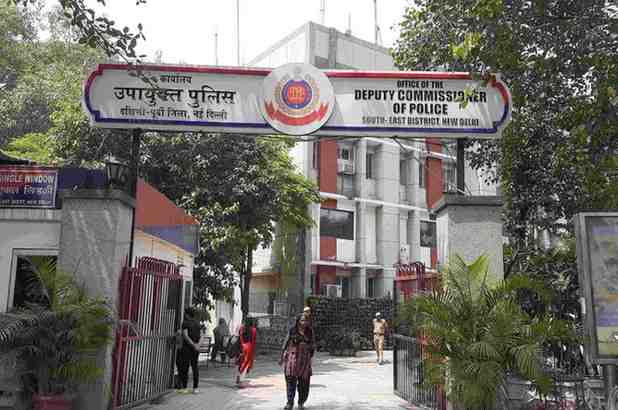
stated the Deputy Commission of Police (South Delhi), Ankit Chauhan.

In a conversation with Times of India, the victim’s family revealed that Singh had been harassing the victim, his daughter for months after she had cut off all ties with him. They further denied her being in a relationship with Singh and stated that they met at a party where they became friends. The victim’s father said, 

We advised both of them not to meet, yet the youth would come to my house every couple of months to start arguments. We informed his parents too. Though he apologised, the harassment continued. 

He further added that Singh had allegedly disrupted his daughter’s Korean language class by starting an argument and twisting her hand. In conversation with the Indian Express, the victim’s sister revealed, 

He met my mother near the gurdwara. When my mother confronted him about his coercive behaviour, he grabbed my mother’s hand and tried to snatch my sister’s phone from her

She further added,

He used to often threaten my sister with suicide, which would scare both her and my mother.

Shocking details regarding the case have been revealed by the police who claim that Singh used a fake social media profile of someone the victim knew to lure her to Sanjay Van. Singh was seen entering the forested area at around 8:30 in the morning and the victim was located there at around 10 AM. Leading her to an isolated spot, Singh stabbed the victim multiple times, strangled her and tried to burn her body. He was later spotted exiting the area in the afternoon. 

On Sunday, they sat and talked about their relationship for almost two hours before he killed her… she had apparently told him that she was betrothed to someone else, which was when the situation escalated,

a senior police officer revealed.

In conversation with the Indian Express, Singh’s neighbours expressed disbelief at the accusations.

Alleged statements by the accused reveal that he suspected that the girl was speaking to other boys which led to frequent arguments and ultimately led to him planning the murder. While investigations are currently underway to determine the actual motive, the murder weapon has been found and the accused has been reportedly booked under Section 103(1) for murder and Section 61(2) for criminal conspiracy.

Read also: Minor Girl Rescued After Gang Rape Near Moolchand, Alleged Police Inaction


Image Credit: Hindustan Times

Aaratrika Ghosh

[email protected]

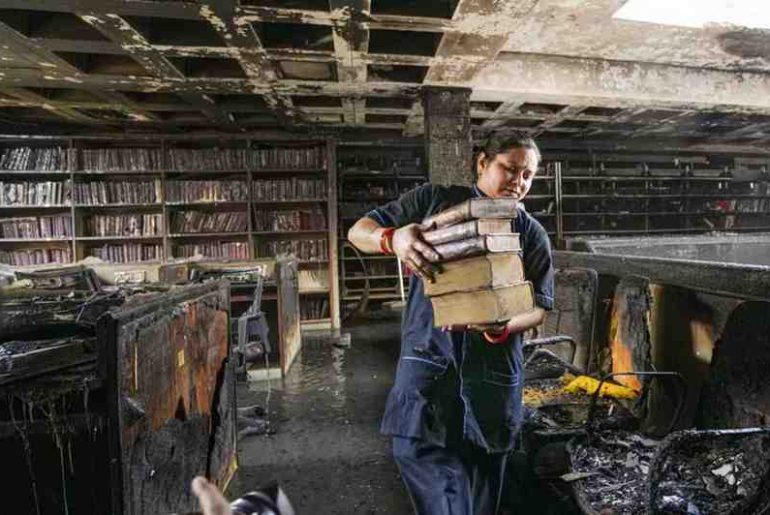
Delhi University’s Sri Guru Gobind Singh College of Commerce reported a massive fire in the college library on Thursday morning, destroying over 3000 books and leading to the cancellation of the morning semester exams. 

In Northwest Delhi’s Pitampura, a massive fire was reported at Sri Guru Gobind Singh College of Commerce, University of Delhi in the morning hours of Thursday, May 15th, 2025. According to the Delhi Fire Service (DFS) chief Atul Garg, the fire broke out around 8:55 in the morning and 11 fire tenders were rushed to the college who managed to bring the situation under control by 9:40 A.M. In response to the ongoing cooling operations, a senior fire official added, 

Several window panes shattered due to the high flames, and the fire spread rapidly due to strong winds. Our teams responded swiftly and managed to douse the flames.”

Originating in the college library, the fire impacted the building’s first, second and third floors, extensively damaging the infrastructure and academic material. Reports state that though there were no casualties, over 3000 books have been destroyed along with the library’s online system being damaged. Although investigations are currently underway to determine the exact cause, a senior college official informed the Press Trust of India

A short circuit in the library’s server triggered the fire, extensively damaging hundreds of books in the section that housed old books. The library is still filled with smoke, and a detailed assessment of the losses will be possible only once visibility improves.”

Sri Guru Gobind Singh College’s Principal expanding on the extent of damage added

Only the top floor of the library was caught in the fire. The books on that floor were damaged due to the blaze, but we kept old editions of books and those in less circulation on the top floor. The newer editions of books were on the ground and second floors. There was no damage to our archival section as it is not on the top floor.”

Although there is widespread damage, the library’s facility system is reportedly functional with the manual issuing of books to students amid the ongoing end-semester examinations of Delhi University. Around 400 undergraduate students were scheduled to take the examination during the morning session which was cancelled in lieu of the fire breakout. However, since the library was housed in a separate building, the examinations scheduled to take place from 2:30 to 5:30 P.M. were conducted after the handover by the fire department. In conversation with the Indian Express, Principal Jatinder Bir Singh further stated, 

Since lights were to be cut off for the fire department to extinguish the fire, we postponed the exams scheduled in the morning. Afternoon examinations went on as usual. The controller of examination is yet to notify a fresh date for the exams”. 

Recently, Delhi University’s Kalindi College reported a ceiling fall falling on the head of a faculty member causing serious injury. In light of such incidents outrage has sparked amongst students who raised concerns of student-faculty safety and welfare over the deteriorating condition of the infrastructure of DU colleges. In a statement released by the National Students’ Union of India (NSUI) on 15th May, they questioned the negligence and demanded immediate safety audits in all colleges throughout Delhi University. 


Read also: Thefts and an Unaccountable Administration Raise Concerns at Kirori Mal College

Image Credits: The Telegraph

Aaratrika Ghosh

[email protected]

A minor girl allegedly trafficked from West Bengal was rescued after enduring months of abuse, culminating in a gang rape near Moolchand Metro Station in South Delhi. The survivor was held captive for nearly five months. After escaping, she came under the control of an auto driver in Delhi, who allegedly raped her repeatedly over a week. On the night of May 5th, he and others allegedly gang-raped her near the Moolchand Metro area. The accused, reportedly an auto driver, confessed to the crime at the police station.

A local rickshaw puller who found the girl in distress informed locals, who were out feeding stray dogs, about her condition. The locals found the girl curled up under a sheet. She spoke in Bengali that neither they nor the rickshaw puller could fully understand until a translator was called. When the girl saw a man pass by, she began screaming.

The rickshaw puller explained that this was the auto driver she was accusing of rape and abuse. When confronted, the accused became violent and struck the girl in front of others. A crowd gathered and beat him before escorting both the victim and the accused to the Amar Colony Police Station. At the station, the auto driver reportedly confessed. Despite this, he was allowed to rest in an air-conditioned room while the victim was made to sit on two uncomfortable chairs. After undergoing a medical examination for sexual assault, she was not administered painkillers or any form of trauma care.

Formal action has been delayed. The incident took place on a service road near Frank Anthony Public School, close to Moolchand Metro Station. The location is in proximity to educational institutions like Lady Shri Ram College for Women and Bluebells International School, and lies within a densely populated student-occupied PG area in the National Park.

The area where the crime occurred is frequently used by students and young professionals, many of whom identify it as unsafe. Students have long reported incidents of sexual harassment, flashing, and even attempted abductions along the back gate’s service road. These complaints have rarely received official acknowledgement or resulted in increased security

I have personally felt threatened several times on my way to college every day. With such incidents of casual harassment happening on quite literally every possible road you could take within the area, safety becomes a privilege. The complacency and at times, indifference of the Amar Colony Police Station only further compounds this issue. We are left with no alternative but to leave our own campus early, in the hopes of avoiding creepy men
– Student from Lady Shri Ram College for Women

The survivor provided detailed accounts of sexual assault, including the use of foreign objects and burn marks on her body. Despite this, police were allegedly reluctant to file a formal complaint, and one of the accused has already fled the state. Some are concerned that delayed legal action may once again deny justice.

National media outlets such as The Times of India and The Indian Express reported the incident, which has been criticised by the original complainant for its inconsistencies, calling the girl a “vagabond” and misstating her age, and further, for reinforcing victim-blaming narratives. Students of Lady Shri Ram College who were planning to go to the Amar Colony Police Station to raise complaints were asked to refrain by the original complainant, due to escalating tensions there. They expressed a desire for the child to have her hearing with the magistrate on 8th May, without disruptions. A peaceful protest may be organised soon.

This incident in itself, however, is not isolated. It reflects a systemic failure to protect survivors and ensure public safety. The imbalance in how the accused and victim were treated highlights deeper issues within the system, where those seeking justice are often left to suffer in silence while perpetrators evade punishment. As students and residents in the area continue to demand accountability, the case has sparked renewed calls for police reform, institutional sensitivity, and tangible steps to make Delhi safe for all.

Image Credits: ETV Bharat

Ritobrita Mukherjee

[email protected]

Grand finales, tearful exits and shocking plot twists—to bid farewell in pop culture is to laugh, cry and carry a piece of our favourites into nostalgic remembrance. 

“In case I don’t see you … good afternoon, good evening and good night.” 

  • The Truman Show

To bid goodbye is an art that very few have mastered, both in reality and on the silver screen. Introductions are often easy; it doesn’t have to be perfect, for the story goes on and mends itself along the way. But conclusions are defining; in simple words, the way you end, why you end and how you end sets the stage for how you are remembered for years, if not decades, to come. 

It is often the premonition of a farewell that lingers even before its actual end; foreshadowing is a cinematic technique used by screenplay writers to subtly hint at a character or plot’s ultimatum, their goodbye. The beauty of foreshadowing is not predictability but the audience’s realisation—the shock, the rewinding and the gaping eyes that try to connect the dots.

Minutes before Mufasa’s death in The Lion King, in the backdrop of a sunrise and a melancholic soundtrack, he tells Simba, “One day, Simba, the sun will set on my time here and will rise on you as the king.” Foreshadowing is as subtle as that; there are no giant billboards screaming out a character’s fate but elements as simple as a nostalgic dialogue, a wistful musical composition and a setting sun that indicates a goodbye nobody is prepared for. 

Some goodbyes hit harder than the others (even when unwanted spoilers ruin your cinematic experience). Watching a houseful audience in theatres tear up in unison all because of a single snap is a telling of how to make farewells a tear–jerker, often an unexpected one. “I am Iron Man,” says Tony Stark in Avengers: Endgame and just like Peter Parker, every teenager who grew up watching and living the Marvel experience felt a pang of pain. Perhaps that is how farewells in popular culture are meant to be: heartbreaking and soul-wrecking. 

Hidden in whispers and a silent letting go of the hand, it is in Romances and Dramas that goodbyes feel like the lingering pain that hits you after ages. Some goodbyes are dramatic—the screaming and crying of Harry silenced by the director’s cut in The Order of the Phoenix as he watched Sirius die and vanish into the realm of death. At times, it is the quiet look of acceptance of love and grief that, to a romantic viewer, metamorphoses a ‘love story’ into a ‘horror’. La La Land does the beauty of silent mourning and simplicity the right way. A reminiscing of the ‘what ifs’, exchanges of the eye and a quiet letting go. Perhaps heartbreaking goodbyes are often shaped like that; “a sobering reminder of reality”. 

Yet, goodbyes do not always have to always be drenched in tears and sorrowful mourning. Mirroring reality, some goodbyes are bittersweet; you recall them with longingness in moments of nostalgia but bid them goodbye with heartfelt emotions. “O Captain, My Captain”, says Todd. To every dreamer, poet and appreciator of good cinema, Dead Poets Society consumes the meaning of ‘to bid farewell’ in its series of goodbyes—unexpected, tragic, yet bittersweet. Bidding farewell to Mr. Keatings, for many of us, mirrors the goodbyes we’ve whispered to our teachers as we walked from the familiar school corridors to the unknown red-bricked hallways of college; a nostalgic remembrance. 

Nostalgia drives emotions and people towards continuity, perhaps why goodbyes in sitcoms are more impactful; they aren’t merely TV shows but fictional characters and events that you share experiences with, in every episode. Ending its 10-season run, Friends waved farewell to its audience and to the purple-walled apartment of Monica and Chandler for the final time. A debated ending, a nostalgic final run to Central Perk and characters etched forever in BuzzFeed Quizzes, a two-decade-later reunion and the hearts of binge-watchers; farewells are meant to be such. The trope of a new beginning in the endings of family sitcoms has been a tradition inspired by reality; life must move on and people must go on despite goodbyes. The Pritchett-Dunphy-Tuckers of Modern Family also step into new chapters of their lives, for goodbyes do not always have to be permanent; sometimes a simple fare-thee-well till the next moment of togetherness suffices.

As farewells in pop culture and real life blur into a commonness of longing, remembrance and nostalgia, one must look back and think how lucky they are to have people, memories and places that are so hard to say goodbye to. It is perhaps the hardest goodbyes that form the best moments of our lives – in cinema and in reality. As Judy Collins puts into lyrics, “Farewell to my comrades/ For a while we must part/ And likewise the dear lass/ Who first won my heart.”

Read also: In Fond Remembrance of Chandler Bing

Featured Image Credits: YouTube

Aaratrika Ghosh

[email protected]


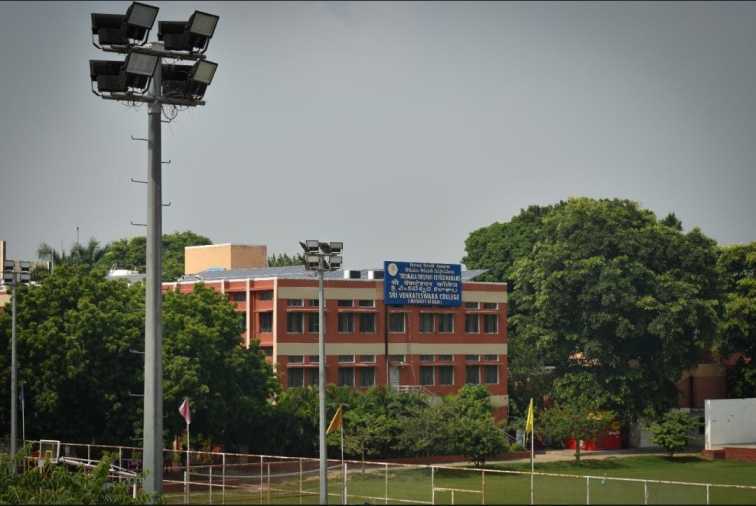
University of Delhi’s Sri Venkateswara College witnessed a massive footfall following the culmination of its Annual Fest, NEXUS, in March.

Sri Venkateswara College, under the aegis of the University of Delhi, celebrated its Annual Fest, NEXUS, on the 3rd, 4th, and 5th of March this year. Upon entering the college gates, one witnesses what appears to be the college’s way of presenting an ode to Delhi—a Jashn-E-Dilli, if you will. Every corner has been decorated with banners naming popular sites of everyday pilgrimage, from the Faqir Chand and Sons bookstore to Sarojini Nagar.

An inauguration ceremony preceded the performance of the Dramatics Society of the college as they took to the front lawns on Day 1 from 9.30 A.M. onwards to celebrate Madari’25, an annual street play event, abuzz with the energy of the performers. Crescendo, the Western Music Society of Sri Venkateswara College, presented the Battle of Bands from 1 to 5 P.M. as a tribute to Delhi, the heart of the country’s music revolution. In the midst of it all, Alaap, the Indian Music Society of the college, presented Raageshwari, a polyphony of melodies, at the Indian Classical Choir Competition. While Nrityangana, the Indian Dance Society, took to the dance floor in solo and group dance competitions.

As you enter the building, leaving behind the cacophony of singing voices and the chants of the dramatists, you are met with Mehfil-e-Tamasha, an improv battle taking place in Room 57. If there is one thing that has stood out by now, it was the dedication with which all artists performed, the veneration they heaped onto artistry, eventuating in a showdown for the history books.

Kurukshetra, the crew-based dance competition, preceded the performance of the night by The Frequency Project, who gave music a Sufi spin in their own rendition of popular classics.

Day 2 was marked by Effulgence, Sri Venkateswara’s Photography Society’s annual display, Kodachrome, taking place in tandem with Opera D’Arte 3.0, Leonci Art Society’s annual display. A student from Lady Shri Ram College for Women, who planned on staying for the Mr. Professor’s DJ nights after participating in H#, the Western Acapella Competition, stated:

It’s been an interesting run so far. The wins were well-deserved. I’m staying here till 6 for the DJ.

As is the case with every DU-affiliated college, the sole event that marked Day 3 was the performance of the much-awaited artist. This time, Javed Ali of Guzarish fame took to the stage. Post Dilli Ke Darshan, the concert gave people in the audience a lifetime of memories and then some more.

Featured Image Credits: Arush for DU Beat

Aastha Singh

[email protected] 

The final day of Nexus 2025 at Sri Venkateswara College saw unexpected crowd surges, security lapses, and logistical issues, raising concerns about event management and attendee safety.

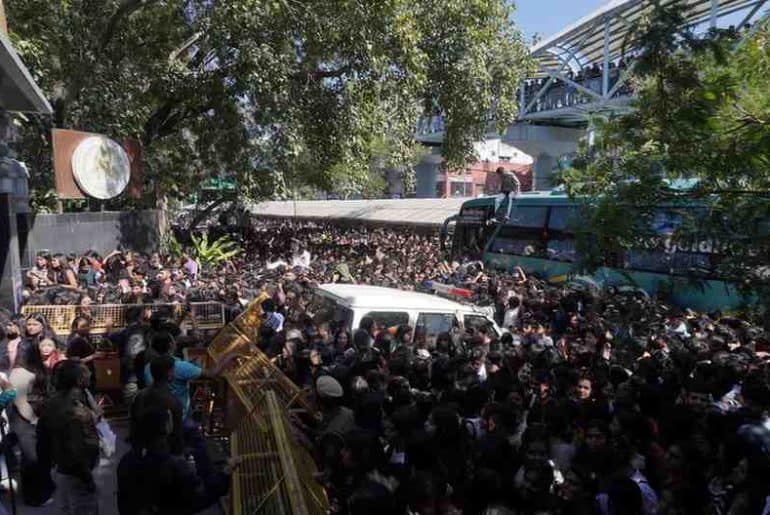
Sri Venkateshwara College (SVC) hosted its annual fest, Nexus, from March 3 to March 5, 2025, bringing together students from across Delhi for three days of music, cultural events, competitions, and live performances. However, the third day in particular witnessed an overwhelming surge in attendees due to the much-anticipated concert by renowned singer Javed Ali with an estimate of over 6000 people inside the venue. The massive turnout quickly spiraled out of control, with people even jumping over the college fences in an attempt to enter the premises, leading to injuries, security violations, and more chaotic scenes at the venue.

Even though the official instructions stated that the college gates would be closed by 2 PM, they were shut as early as 1:45 PM, leading to a massive crowd gathering right outside the campus gate. Many students, including members of the organizing committee, repeatedly requested the guards to reopen the gates, but their pleas were ignored due to the already overwhelming number of people inside the college premises. The situation quickly turned disorderly as students found themselves trapped as those outside struggled to get in, while several inside were unable to leave due to the tightly packed crowd blocking the exit as the same gates were being used for both the entry and the exit. Moreover, the crowd outside the gates was so dense that students caught in the middle or near the front had no clear path to vacate the place either.

In conversation with DU Beat, a Delhi University student, Kalyani said,


The crowd was so packed outside the gate that even though we wanted to leave, we were trapped there for 3 hours outside the campus until the gates were reopened. Even though the police were trying to get people to leave, it was incredibly difficult since there was no way out of the crowd, making the entire situation a lot more suffocating.

Another student, who wished to remain anonymous, shared that beyond the suffocating conditions, the crowd was also unsafe with many female students facing groping and harassment. She said, “We noticed that no one was following the queue, and everyone had gathered at the gate, so we decided to join the crowd. However, the situation turned unpleasant as I faced a lot of groping and misconduct, which was horrible, but apart from that, once we were inside, it was fine.”

While many students blamed management, the organizers had a different perspective. Talking to DU Beat, Nandini Das, the Vice President of the SVC student union, stated,

Well, we had over 6000 students inside the campus area, and the same number of students were waiting outside the campus. As a union member, it was very tough for me as well as my fellow members to manage because we had a management team of at least 50-100 who were looking after a crowd of 6000 plus. But hopefully the police and CRPF had helped us a lot, and also the injured people were provided medical service immediately. And I think you can’t blame anyone for mismanagement because I do believe that you should have some civic and moral sense of how to behave in a public place. Out of 6000, if 1000 people are trying to violate the protocol, then I think it’s the individual who’s the problem.

However, students from SVC did have complaints regarding the management of the fest. Vanshika, another student of SVC, said, “It was very chaotic. The roads outside were blocked for over 4 hours, with even Venkateshwara students being stuck outside campus for hours. It should’ve definitely been managed better by either not allowing students from other colleges or by not making them stay outside for so long.”

Beyond the numerous issues faced by those stuck outside and the minor altercations that broke out on campus, there were also allegations of misbehavior by the management towards the media team. Aashvee, a videographer present at the event, revealed,

Despite having barricade passes for the star night as per the official Memorandum of Understanding (MOU), our team was subjected to harassment, humiliation, and outright negligence at the hands of the event’s so-called management. Random individuals, including non-students, effortlessly jumped over them and entered restricted areas unchecked. Meanwhile, our media team, stationed in the designated media section as required for coverage, was singled out and aggressively confronted by two members of the event staff.”

Overall, the last day of Nexus 2025 highlighted the difficulties of managing large-scale college events. Overcrowding, security lapses, and logistical challenges created a chaotic environment, leaving both attendees and organisers frustrated and raising concerns about safety. While efforts were made to control the situation, the incidents call attention to the importance of better planning and stricter crowd management in future fests.

Read Also:  Security: The Overrated Inconvenience During Fests at Women’s Colleges

Featured Image Credits: Ayushmaan for DU Beat

Ashita Kedia 

[email protected]  

The University Grants Commission has requested a dismissal of all incentives to MPhil and PhD holding faculty members last month to prevent objections during audits. Potential salary cuts may be in the works.

Several faculty members of the Lakshmibai College of Delhi University possessive of MPhil and PhD degrees had to see pay cuts in their salaries in February following a government directive.

The directive enforced a mandate which had been in place for eight years to roll back increments provided to faculty members on the basis of the seniority of their degree (particularly MPhil and PhD holders). The implementation of the order came as a complete shock to the teaching faculty at Lakshmibai College, who then arranged a meeting with Principal Pratush Vatsala in February itself to further discuss matters.

The matter could be traced back to 2010, when the University Grants Commission had declared five salary increments for PhD holders, three for faculty members on study leaves for a PhD as well as MPhil holders and one for acquiring an MPhil in service.

Then, in 2017, The Ministry of Human Resource Development (HRD) advocated a discontinuation of these benefits, citing benefits in relation to relaxation of required experience for promotion of faculty members from the position of assistant professor to associate professor.

The decision had yet to see implementation following Delhi University’s silence on the matter. The University Grants Commission, however, has advocated for a disruption of incentives to avoid audit objections in the near future. So far, Lakshmibai College and Shyam Lal Evening College have implemented the order. In a conversation with The Telegraph, a Delhi University Teachers’ Association (DUTA) Member had stated,

The UGC’s 2018 regulations continue the incentives. It has helped in attracting candidates with research qualifications to join institutions. Withdrawal of the incentives will adversely affect teacher quality in institutions.

The Delhi University Teachers’ Association has declared a strike for all incumbent members on 7th March (Friday), from 10.00 A.M. to 05:00 P.M. with an order of suspension of all classes until then.

Read Also: Delhi University VC Sparks Debate by Dropping Baburnama and Manusmriti from UG History Syllabus

Featured Image Credits: DU Beat Media Library

Aastha Singh
[email protected]

Delhi University withdrew its proposal to include the Hindu religious text, Manusmriti and Tuzuk-i-Baburi (Baburnama), the memoir of the Mughal King Babur, from the undergraduate History curriculum after opposition from faculty members and the DU Vice-Chancellor. 

Delhi University Vice Chancellor Yogesh Singh condemned and dropped a proposal to include the texts, Manusmriti and Baburnama in the undergraduate syllabus for History on Tuesday, 4th March, 2024, following resistance from faculty members. He clarified that such texts were not worth the consideration of being included in the curriculum and would be overruled in similar future proposals as well. 

On February 19th, the History Department’s Joint Committee of Courses cleared the proposal for the inclusion of Manusmriti and Baburnama into the undergraduate curriculum. However, faculty members from across Delhi University colleges criticised the proposal for lacking ‘critical perspective’ and objected to teaching the texts. Upon review by the Vice Chancellor, the proposal now stands withdrawn. Official reports claim that the History Department looks to schedule a review meeting to formally withdraw the proposed inclusion. In a statement to the Indian Express, Singh further stated that he would exercise his emergency powers to prevent the proposal from being introduced for review in the next Academic Council meeting. 

Singh, questioning the relevance of the texts, told the Hindustan Times,

We do not want to consider such texts which are not acceptable to many, and will create chaos in the system. We are in the 21st century and there is no need to teach these. Under the New Education Policy (NEP 2020), we want to bring new courses in accordance with Indian traditions, which will benefit the country and society.

Specifically, he criticised Baburnama as an autobiography of a tyrant with no relevance of being taught in today’s time. 

However, faculty members of Delhi University remain divided upon the inclusion of Manusmriti and Baburnama – while some professors strongly urged their removal, others defended the historicity of the primary texts. 

Associate Professor Surendra Kumar, strongly resisting the proposal, wrote to the Vice Chancellor criticising Manusmriti for “glorifying exploitation and oppression” and being “against the idea of Bharat” and argued against Baburnama for glorifying an invader’s widespread “destruction of people in Bharat”.

Professor Latika Gupta stated,

Manusmriti is a document that reflects the web of Brahmanical patriarchy and the objectification of women. Historians consider it the most prominent text of the Brahmanical system. If it is taught and treated as sacred literature, then there are serious problems. This is not a good step. It must be challenged. 

Other faculty members defended the inclusion of texts through their historical context as primary sources rather than an endorsement of their oppressive ideas. A faculty member in conversation with Indian Express stated,

How can one understand caste and discrimination if they do not read Manusmriti? To understand inequality and discrimination, one must educate themselves. After all, that is what a university space should be all about.

This is, however, not the first time that debates have sparked regarding the inclusion of Manusmriti in the Delhi University curriculum. Last year, a similar proposal to include the Hindu religious text into the LLB syllabus received resistance from the Faculty of Law and was ultimately withdrawn. The Education Minister Dharmendra Pradhan too commented against the inclusion of such a controversial text in the university curriculum. 

Read Also: Delhi University Rejects Proposal to Add Manusmriti in the LLB Syllabus Post Severe Backlash

Image Credits: Devesh, DU Beat

Aaratrika Ghosh

[email protected]

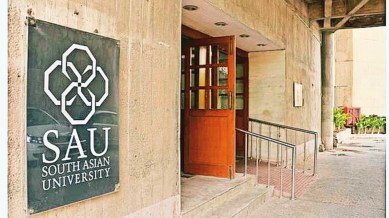
A violent altercation allegedly erupted at South Asian University (SAU) on Wednesday when members of the Akhil Bharatiya Vidyarthi Parishad (ABVP) reportedly clashed with students, including women, and mess staff over the serving of non-vegetarian food on Maha Shivratri.

According to reports, tensions had been brewing in the days leading up to Maha Shivratri as ABVP members insisted that only ‘sattvik’ food be served in the university mess, citing religious sentiments. However, the mess committee decided to provide both vegetarian and non-vegetarian options to accommodate all dietary preferences. Despite this, the issue allegedly escalated when ABVP members, led by Ratan Singh, Anshul Sharma, and Ram Sharma, entered the mess and confronted the staff and students.

They had been discussing this in WhatsApp groups for days. We ensured vegetarian food was available, so why should others be forced to follow their dietary choices?
– Yashada, the mess secretary and a master’s student 

She further alleged that Ratan Singh threw food on the floor and later turned violent, physically assaulting her.

The incident has drawn strong reactions from various student groups. The All India Students’ Association (AISA) condemned the attack, stating:

This is a strategic attempt to instill divisive hate. The ABVP-Admin-BJP nexus stands exposed as no action has been taken against the alleged perpetrators. The demand for separating non-veg food reeks of casteism.

Despite multiple complaints, SAU’s administration has yet to issue a statement on the matter. Students have accused the Dean and Proctor of allegedly shielding ABVP members from accountability. Yashada had reportedly filed a harassment complaint against Ratan Singh earlier, supported by video evidence, but no action was taken.

ABVP, however, denied the allegations, claiming that left-wing students instigated the altercation.

Students observing a fast on Maha Shivratri had requested sattvik food. 110 students had written to the administration, and their request was granted. When they were eating in a separate space, a left cadre member and mess representative allegedly brought fish curry and started arguing. When they were requested to eat elsewhere, she allegedly created a scene and threw food at them; this was intentional, just like the disruption of the Diwali celebrations at Jamia. Those who thrive on division feel threatened by cultural harmony among students.
– an ABVP representative

The Students’ Federation of India (SFI) has called for the immediate suspension of those allegedly involved and a thorough investigation into past complaints.

Students allege that the attack reflects a pattern where right-wing groups resort to violence while the administration remains unresponsive.

What happened at SAU is not an isolated incident. It is part of a broader attempt to create divisions among students in university spaces. The lack of action against those accused of violence is deeply concerning.
– An AISA representative 

Calls for an impartial investigation into the incident have intensified, with student organisations demanding that the university administration take decisive steps to address the alleged assault and ensure accountability. As of now, no official statement has been released by SAU authorities regarding the incident.

Read Also: Jamia Millia Islamia administration cracks down student-led protests; imposes arbitrary disciplinary proceedings

Featured Image Credits: The Indian Express

Ritobrita Mukherjee for DU Beat

[email protected]