Author

DU Beat

Browsing

In a surprising move, Jawaharlal Nehru University (JNU) has decided to shift its entrance examination for all courses including MPhil/ PhD courses for the year 2018-19 to December 2017. Usually, JNU Entrance Examination (JNUEE) happens in May. However this year, the entrance exam will take place on 27 December to 30 December.

For the past two years, JNU was considering shifting its entrance exams for all courses to December from the usual May-June session. The proposal to hold all future entrances in December was put forward at a meeting of the Academic Council (AC) in April 2015, which was thereafter approved in a Standing Committee meeting on June 15, 2015. The reasons given for such a shift were related to logistical issues, where the AC pointed out that JNU doesn’t come as an option at the right time and normally when the JNU admission procedure begins, all other university admissions close. Also n the case of BA admissions, they felt it was better to hold the entrance before the Class XII pre-board exams in January. Although teachers unanimously supported the move in the AC meeting, the four JNU students’ union office bearers opposed it back then.

The move finally comes two years after the AC and Standing Committee approved the proposal. It was put to hold because of reasons accorded to feasibility. The Vice Chancellor said that the university was trying to fill all vacancies available with faculties in MPhil and PhD courses in December. A committee has been formed to find modalities to conduct the exam. The prospectus for 2018-19 has been uploaded on the website, as well as the link for online admissions, opened from 10:00 AM today and will stay open till 13 Oct 2017 at 11.59 p.m.

The University will hold examinations for admission to various programmes of study (MPhil/PhD, MPhil/PhD through JRF, PhD., PhD through JRF, MTech., MPH. , PGDE, MA., MSc., MCA., BA(Hons.) in Foreign languages and Part time courses, MSc (Biotechnology) and allied, MSc (Agri) (Biotechnology)/M.V.Sc., and MTech. Biotechnology programmes )from 27 Dec-30 Dec 2017 in 53 centres across India and in Kathmandu (Nepal).

For full details, applicants can visit the JNU website www.jnu.ac.in  or visit the admissions site.

Image Credits: JNU Website

Oorja Tapan

[email protected]

Union Home Ministry has cancelled the FCRA-2010 (Foreign Contribution Regulation Act) licenses of various acclaimed higher education institutions, including Jawaharlal Nehru University (JNU), University of Delhi, IIT-Delhi, Indira Gandhi National Open University (IGNOU), Punjab University, Gargi College (Delhi), Lady Irwin College (Delhi), Mumbai University, Pune University and others after they reportedly failed to file their annual income and expenditure statements, for the period 2010-11 to 2014-15, to the government. A FCRA licence is mandatory for any organisation which wants to receive funding from abroad.
The list consists of 18,871 names of several top-notch universities, educational institutions and noteworthy non-governmental organisations (NGOs) whose FCRA registrations are cancelled. Prominent associations, trusts and societies are also affected by the Ministry of Home Affairs (MHA) order like Supreme Court Bar Association, Kamala Nehru Education Society, Kasturba Peace Centre, Gandhi Peace Foundation, Nehru Yuva Kendra Sangathan, School Of Planning & Architecture-Delhi, FICCI Socio-Economic Development Foundation, Kamala Nehru Memorial Hospital, Escorts Heart Institute, Cancer Educational Society and People for Animals. Escorts Heart Institute and Research Centre, Armed Forces Flag Day Fund, Doon School Old Boys Association, Sri Guru Tegh Bahadur Khalsa College (Delhi), Dr Zakir Hussain Memorial Trust, Dr Ram Manohar Lohia International Trust, Coordinating Voluntary Adoption Resource Agency, Bombay Diocesan Society, Rajiv Gandhi University of Health Sciences (Karnataka), Indira Gandhi Institute of Child Health (Bengaluru), Shri Mahatma Gandhi Charitable Trust (Gujarat) and Sri Satya Sai Trust also feature on the list.
The organisations were asked to submit their replies by July 23, failing which action would be taken against them. The MHA also directed 1,222 NGOs – including Sri Ramakrishna Math, Ramakrishna Mission, Indore Cancer Foundation Charitable Trust and the Coimbatore Christian Charitable Trust – to authorise their bank accounts and provide relevant details to the government. The move comes after the government found that the organisations – all registered under the FCRA – had not validated the bank accounts through which they receive foreign funds. In a circular issued on September 8, the ministry had asked all NGOs to take rectifying steps to avoid punitive action. A similar request was earlier made to 2,025 NGOs on June 7. Ministry officials said non-validation of such accounts had been halting efforts made by banks to comply with FCRA provisions.
The BJP government has already revoked the registration of over 10,000 NGOs in the last three years for allegedly failing to file annual returns as prescribed by the FCRA. Furthermore, violation of regulations was cited to disallow more than 1,300 NGOs from renewing their registration in the recent past. The NGOs, however, allegedly claim that the government has been selectively targeting them. “It is not a level playing field,” Ravi Chellam, the executive director at Greenpeace India, told Hindustan Times. “When political parties need funding from foreign donors, they amend the law retrospectively. That is a problem – the law should be applied fairly to everyone”, he said.
Promila Kumar, the acting principal of Gargi College, told the Indian Express, “We have filed our returns. In fact, we got a reminder about filing returns recently and we informed the government that we have already complied. I’m not sure why this has happened.”

Image Credits: DU Beat Archives


Oorja Tapan

[email protected]


The National Assessment and Accreditation Council (NAAC), an autonomous body of the University Grant Commission, visited Hansraj College on 3rd & 4th August where the ‘Quality status’ of the institute was audited.  The college has been accredited by the NAAC team with a CGPA of 3.62 and a grade point of A+.

In the context of Higher Education, the accreditation status indicates that the particular Higher Educational Institutions (HEI) – a College, a University, or any other recognised Unit therein, meets the standards of quality as set by the Accreditation agency, in terms of its performance, related to the educational processes and outcomes, covering the curriculum, teaching-learning, evaluation, faculty, research, infrastructure, learning resources, organisation, governance, financial well-being, and student services.

Among DU colleges, Shri Ram College of Commerce became the leader of NAAC’s point table with a score of 3.65, beating Hansraj College by a small margin. It is followed by Miranda House and Lady Shri Ram College with a score of  3.61 each and Hindu College with a score of 3.60.

NAAC’s Top 10 scorers in the University of Delhi with CGPA are:

  • Shri Ram College of Commerce: 3.65
  • Hansraj College: 3.62
  • Miranda House: 3.61
  • Lady Shri Ram College: 3.61
  • Hindu College: 3.60
  • Kirori Mal College: 3.54
  • SGTB Khalsa College: 3.41
  • Shaheed Bhagat Singh Evening College: 3.36
  • Kamla Nehru College: 3.33
  • IP College for Women: 3.33

DU beat congratulates the College and its students for the glorious feat.


Feature Image Credits: DU Beat


Sandeep Samal

[email protected]

10th September is observed as World Suicide Prevention Day. Suicide cases are on the rise in recent years due to reasons that need to be minimised to ensure good mental health.

On 10th September, organisations like the World Health Organization (WHO) and the International Association for Suicide Prevention (IASP) organise various events to promote and conduct activities for spreading awareness about suicide. With the increasing number of suicide rates, let’s look at the leading causes leading to such tragedy:

  • Depression
    There are over 350 million people who suffer from depression all across the world. Low self-esteem is a huge contributor. Everyone sets targets for themselves and failing to complete them can demoralise them and make them question themselves. Family issues are also undeniably a great cause for mental stress. Resorting to alcohol and other drugs seems an easy solution to let go of the stress. But again, this has disastrous effects which ultimately lead to addiction and contribute towards isolation from friends and family.
  • Peer Pressure
    Peers fulfil an essential social requirement everyone has. But their impact can go wrong at times. In a competitive environment, not being able to do what one’s peers do or not achieving something as worthy as one’s peers can inject a sense of low morale in oneself. The thought of not doing something worthwhile terrorises the mind and harms mental health.
  • Cyber Bullying
    Cyber bullying cases have intensified with the rise of the internet’s popularity where over 25% of teens have reported to being repeatedly bullied over the internet. In recent times, there has been an outburst of suicidal cases due to a game called “The Blue Whale Challenge” which targets teens. The challenges include tasks like carving a whale on one’s body and causing self-harm. Eventually, the last challenge of the game requires the person to commit suicide.
  • Relationship Issues
    Being in a relationship is seen as a very normal part of social life today. However, deep attachment to one’s partner and the inability to cope with conflicts induce a great degree of pain that encourages self-harm and even suicide. Such cases make a person’s mind fragile, exposing the individual to suicidal thoughts eventually resulting in suicide.

But amidst all the mental chaos, we must not forget that we have been blessed with the gift of life and that we should rejoice in it. Talking to friends or family members can lessen our burden and also help us find solutions to any problems. Sports, games, music, debates etc. help us in keeping our minds healthy. Hanging out with friends or reading books may help too. Doing social work helps us feel satisfied and fills us with joy. There are adequate ways to cope and solve mental issues that trouble us. We must face them and overcome such hurdles. So this September, let’s smile and spread smiles to let people know that we care.

Feature Image Credits: AM New York

Karan Singhania
[email protected]

Since the last five years, the issues involved in Delhi University Students’ Union (DUSU) elections have always revolved around women’s safety on campus, the number of DTC buses exclusively for DU students, provision of more number of hostels, and a much hue and cry to increase the number of colleges. We can see the deployment of a lot of money and muscle power, as well as caste politics, being essentially ingrained in the DUSU politburo, with special preference to Jat, Gujjar, and Gurjar candidates who deploy their own private machinery to boost their electoral campaigns. Rising violence on campus has been a concern for all student wings, though all of them have insinuated violence as and when the need arose. Very few female candidates contest for the polls and thus, there is a visible undercurrent of patriarchy in the trends of DUSU candidature.

ABVP, the party that won three seats last year and has been a dominant player on the DUSU grounds, has demanded more transparency in the sports, ECA and quota admissions, concessions in admission to students of rural background, an equitable fee structure across colleges, free Wi-Fi services in every department and college of  DU, a Central Placement Cell to work in tandem with Skill Development Department of the government, metro feeder bus facility at major metro stations near colleges, facilitate more DUSU affiliation and a demand for a permanent DUSU office. Some highlights of their manifesto are – efforts to arrange U-Special Generators for evening colleges, struggle for establishment of East and West Campuses, digitalisation of Central and Arts Library, reiteration of their demand for a Sports Complex  in South Campus, issue of University Health Card to all students, student insurance of Five Lakh Rupees for every student at the premium rate of 1 rupee per day, demand for water coolers in every 200 metres of Chhatra Marg and  foot-over  bridge on Ring Road near Khalsa bus stand, another near GTB Nagar red light and a third at Kingsway Camp main red light. ABVP’ s manifesto is quite extensive, specific, detailed, and gives a holistic view for the entire University by covering almost all the issues related to students.

NSUI is quite generalist in its manifesto and guaranteed  preparation of a Charter of Students’ Rights in consultation with the students that will constitute issues relating to pending scholarships, fee rationalisation of fee across colleges (Rs.3000-3500 per annum), process and timeline for various certificates from university, no moral policing or curbs on women’s freedom, tracking incidents of rioting and violent  protests to ensure accountability of perpetrators, provision of dialogue and institutional mechanisms to resolve college-level issues with college councils, ensure exposure for students in the form of guest lectures, seminars and internship opportunities and a transparent DUSU budget. In their bid for ‘ Take back DU’, NSUI  demanded special support for first generation learners, students from marginalised communities, remedial classes and English tutoring to be provided for such students, (Similar to ABVP demands as well). NSUI demanded rent control for private PGs and counselling for students in distress. Their highlights were special Nodal officers for North East students, revised diet rates for sports quota students, U-special buses, and active grievance redress Cell to be opened.

AISA, which is the only party to vouch for a female Presidential candidate this year, raised concerns over rising hooliganism in campus, problems for visually-challenged students, lack of gender sensitisation committees in colleges, the imposition of centralised power of the Ministry of Human Resource Development, and privatisation of higher education. Major highlights and demands include:  ‘A Room of My Own’ movement to ensure hostel facility for all including PH students, active grievance Committee to look into issues of scholarships, admission etc., active committees on sexual harassment, institutionalising the practice of General Body Meetings along the lines of DUTA to ensure responsive functioning of DUSU, reform of DUSU election system by creating effective forums of debate like Presidential Debates in clusters of colleges to ensure informed choice and reduced use of money and muscle power. The issues of sanitisation, DTC bus facilities, digitalisation of DTC bus passes, improved infrastructure, security of women etc., remain common to all the three manifestos.

These are the various demands and steps that the ABVP, NSUI, and AISA have in mind and their unique action plans to reach out to students once they come to power. Such issues must actually be raised in debates across colleges in order to make students aware but due to the hoopla over propaganda politics and money-muscle, these interesting demands do not come to the forefront of DUSU playground and thus, the elections lose their vitality in the eyes of students. We tried our best to make you aware of their concerns and charters, to help you in making an informed decision. It is up to you now to make the right choice. Do exercise your power to vote and cast your vote on September 12.


Oorja Tapan

[email protected]

Lyngdoh Committee Recommendations are perhaps the most cited phrases in DUSU politics today. To understand its importance and relevance, it’s necessary to know that they were approved by the Supreme Court in 2006, to curb the use of muscle power and money in student politics. The aim was to reform the election system to make it more inclusive for students and involve fewer malpractices. Unfortunately, the guidelines have received brickbats from students and politicians alike, as many clauses are unrealistic and utopian.

Lyngdoh had aimed to keep political interference out from student elections but unfortunately failed to realise that this endeavour doesn’t exist without acknowledging the ‘political’ aspect of student political parties. To escape these restrictive guidelines, parties have identified loopholes, a few such examples being:
Clause 6.6.1: The maximum permitted expenditure per candidate shall be INR 5000.
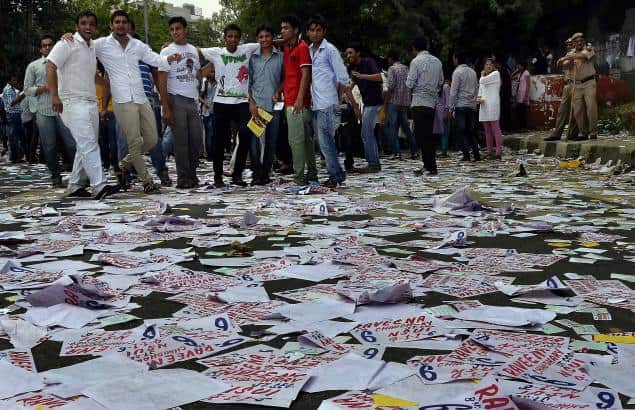
Probably the most flouted clause in the recommendations, parties spend as much as lakhs to print countless pamphlets and hoardings that can be seen across the campus. The loophole that every party takes advantage of is that the guidelines restrict the candidate’s expenditure to INR 5000, but nothing has been mentioned for the candidate’s respective party. All major parties reiterate this reasoning to escape legal action.
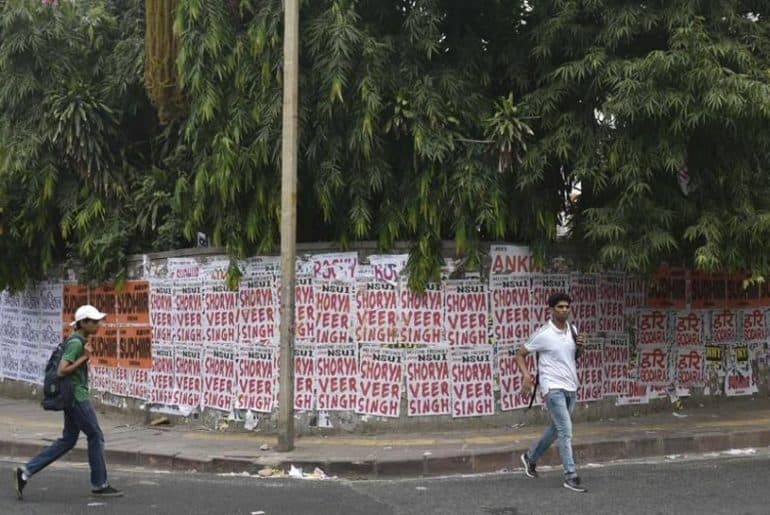
Clause 6.7.5: No candidate shall be permitted to make use of printed posters, printed pamphlets, or any other printed material for the purpose of canvassing. Candidates may only utilize hand-made posters for the purpose of canvassing, provided that such hand-made posters are procured within the expenditure limit set out herein above.
To cleverly counter this, parties have been releasing posters that misspell the name of its candidate but allow it to be distinguished back to the party as well. The use of an extra ‘A’ after the name would save it from any legal consequences.
Clause 6.7.9: During the election period the candidates may hold processions and/or public meetings, provided that they do not, in any manner, disturb classes and other academic and co curricular activities of the college/university. Further, such procession / public meeting may not be held without the prior written permission of the college/university authority.
It’s common knowledge that campaigners do disturb classes and disrupt routine workings in a college. It’s also never the candidate alone who partakes in this, more often the supporters do the loud sloganeering or get involved in brawls. Since the LCR specifies nothing for parties, political outfits do it as per their will, and candidates are absolved from all responsibility for its party’s action.
What could also be a major advantage for political parties is that the LCR are only applicable from the day the nominations are declared. Up until that day, parties can freely distribute pamphlets urging students to join their organisation.
Apart from one clause in the Lyngdoh Committee guidelines that calls for dissociation of student elections and political parties, there is no clause that directly links the entire party with the administration or puts it under the purview of the election officer’s power. This requires an urgent overview of the recommendations to make them more realistic to plug the loopholes and acknowledge the ‘politics’ in student elections.
Image Credits: Hindustan Times
Vijeata Balani
[email protected]

What was once termed as a force to reckon with, is now merely a shadow of its past. Chhatra Yuva Sangharsh Samiti (CYSS), the student wing of the Aam Aadmi Party (AAP) contested in the 2015 Delhi University Students’ Union (DUSU) elections but did not win. CYSS was the star debutante in the 2015 elections and was perceived at the time a strong opposition to the hegemony established by NSUI and ABVP in previous DUSU elections.
Students who were disappointed with the political climate then considered CYSS as a strong third alternative to clean up the murky politics. Despite huge hoardings of Arvind Kejriwal greeting students and asking for votes, CYSS did not win any seat and scored 16% of the total vote share. Barring a candle-light march to protest against ABVP’s hooliganism in the Ramjas row, it has been relatively absent from the DU political scene in 2017.

While it’s a speculative ‘fact’ that parent party’s win directly correlates to the chances of its student wing winning; why did CYSS lose in 2015, when AAP government raked a record 67 out of 70 seats in the Delhi legislative assembly elections? The agendas of CYSS are largely similar in ideology to AAP’s, which pertain to everyday issues of a student and plan to ensure a corruption-free university.

Anmol Panwar, the CYSS spokesperson and Vice-President, in conversation with DU Beat, said, “We boycotted elections last year because we don’t support the current muscle and money power politics in DUSU. Once DUSU candidates are declared, countless pamphlets are thrown in contravention to the Lyngdoh Committee recommendations (LCR). University authorities are aware, complaints are filed, but no action is taken against the perpetrators. Because of this, independent candidates with great ideas lose out to the bigger parties. If the situation changes, we could contest this year too.”
Leading up to the 2015 elections, CYSS was involved in multiple controversies. In 2015, CYSS faced backlash for putting up ‘fake’ posters of opinion polls that it would win 45% of the total votes; the veracity of which could not be verified. Similarly, opposition parties alleged that more than 50 hoardings had been put up across the capital, which was in violation to LCR which states that candidates cannot spend more than INR 5000 in campaigning. In September the same year, a concert, ‘DU Rocks’ was organised which had celebrities like Jasleen Royal, Vishal Dadlani(AAP supporter) and Arvind Kejriwal himself addressing the gathering.

The LCR clearly calls for disassociation of student elections and student representation from political parties. These allegations, amid dwindling support and lack of trust for AAP government in Delhi back then moulded into a sticky situation for CYSS. There’s always a chance the party may make a comeback, the same depending on their ability to garner support through the LCR guidelines it accuses others of not following.

Image Credits: pumirror.in


Vijeata Balani

[email protected]

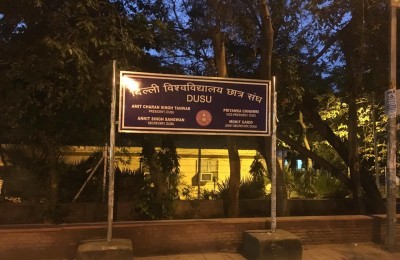
Akhil Bharatiya Vidyarthi Parishad(ABVP), the student wing of RSS organised a press conference on 2nd September to discuss the work accomplished by ABVP-led DUSU last year. The panel consisted of Amit Tanwar, Priyanka Chhawri, and Ankit Singh Sangwan, the three outgoing DUSU office-bearers along with Monica Choudhary, ABVP’s National Secretary, Bharat Kumar, the State Secretary of ABVP and Saket Bahuguna, their National Media Convener.

During the conference, multiple achievements by ABVP in the past years were brought into notice and the rolling issue of discriminatory girls’ hostel rules was discussed. They further went on to talk about their role in a fight for printed mark sheets and hunger strikes held to promote students who had failed their last year of college. The outgoing Vice-President, Priyanka Chhawri spoke in length of the initiatives taken by DUSU in the past year, which included the DU paralympic sporting events and a university wide marathon being organised in North Campus along with cultural events and intellectual seminars under their hood.
Saket Bahuguna, ABVP’s National media convener touched upon subjects like DUSU’s controversial budget and the prevalence of violence across DU. Amid accusations, lies and slander, ABVP alleged opposition parties of putting forth “off-beat agendas to misdirect attention” and the university administration that had failed to competently handle the issue of permanent appointments in the staff. After a one-sided discourse on DUSU’s activities, questions were raised about ABVP’s involvement in the Ramjas issue and their stance on the thousands of posters defacing college walls throughout the campus. On this issue, Saket said, “It is practically impossible to cover all colleges that vote in DUSU in a span of 2 days. Even if we go by the cheapest means of transportation, we cannot cover all cost under 5000 rupees. Demands for a wall of democracy in every college has been placed in front of DU authorities, but no improvement has been observed.”
The conference concluded after the question-answer round and a hopeful parting note for DUSU elections 2017.
The party released its manifesto today.

Image credits: DU Beat archives

Vijeata Balani

[email protected]


With the Democratic Teachers’ Front (DTF) winning the recently held Delhi University Teachers’ Association (DUTA) elections four times in a row, we got an opportunity to have a tête-à-tête with the winning Presidential Candidate Rajib Ray from the Department of Philosophy in Kirori Mal College. Raising legit demands of ad-hoc teacher regularisation, the greater pay scale for the teachers under the 7th pay commission and putting up a tough fight against privatisation of education, DUTA is vital for the functioning of the University of Delhi which comes under the top central universities of India.

Here are the excerpts:

In your manifesto, the major demands raised by the DTF this year involved the resolution of anomalies of the last pay scale, promotion of teachers, and due placement and payment to ad- hoc teachers in DU. How does your Front after coming to power hope to achieve this and through what means?

Ours is not a party, but a Front and the moment you associate the notion of ‘power’ to a union, my conception of an ‘association’ is completely different. So, firstly, I would like to mention that it’s a historic win for any group to have won four consecutive times in a row. All the issues that are happening since a long time and the future is yet to be achieved. Last year the government came up with a Third Amendment which was to reduce the number of teachers at the departments and we led a huge movement in the summer forcing the government to roll back the amendment. The authorities then came up with the Fourth Amendment to which we are still against, but it is definitely better than the previous one.

As far as the appointments are concerned, under the monitoring of the Delhi High Court after our immense efforts concerning the Law Faculty Case, the appointment procedure in the departments have already started and I hope, that without any delay, further processes of appointments shall commence in the various colleges. The recent speech made by our Hon’ Minister of Human Resource Development, Prakash Javadekar, on the new education policy with respect to promotions of teachers, ‘hire and fire’, etc. and seeing the trend of autonomy being given to colleges, it is very disappointing not only for the students but also very bad for the morale of teachers as DU treads upon the path of self-financing courses and reduced public spending.

What major problems can autonomy and steps leading to privatisation have on students’ lives in DU?

Firstly, the pattern of making colleges autonomous in DU is not a new one, but what we need to realise is the brazen manner in which it is being done. The moment the motion for autonomous colleges passes, the college has to get 30 percent of resources on its own. The question is ‘from where’. The colleges will get it from increasing the fees of students despite opening up of new courses and will have to pay the salary of the faculty through the self- financing courses that can lead to lesser salaries of employees. This method is not only lopsided but will also affect the teachers’ morale. The way to get out of this is to sensitise students and teachers in the public realm about the ill effects of autonomy and privatisation, and can vouch for a huge political pressure on the government. This is similar to the way it happened in the case of FYUP roll back with the help of media. So, the solution is to make it a matter of public debate.

Do you believe that the intense regularisation of higher education by multiple regulators like University Grants Commission (UGC), National Council for Teacher Education (NCTE), etc. can help central, deemed, and state universities to improve their performances as we have already seen, that lesser regulation in the case of IITs/IIMs has made them enter the top 200 rankings of the world?

First of all, these rankings that you mention are very subjective and there is the whole nexus of foreign universities that are embedded in these rankings. Also, who decides the world rankings is a matter of debate and on what grounds?  The most important help all sorts of universities need is funding and no such cuts in funding should ever happen. Also, the NAAC rankings are there only to judge the criterion of funding to be provided. Public funded institutions must serve the students well and the recent demographic changes in DU students for the past decade show that students from the lower strata are also coming to DU and for them, funding by such regulators is very important. And with a recent Supreme Court ruling, all regulations are mandatory but what’s happening now is changes are occurring in the university without consulting the ‘LAW Book’. So, arbitrary regulation should be controlled. Also, the case for recently opened Delhi School of Journalism, be it self-financing or not, will depend more on the type of courses it plans to offer and the fee structure for the students as well as the availability of permanent faculty and not visiting lecturers.

How do you plan to revoke the problems caused by Choice-Based Credit System (CBCS) and evil effects of the semester system which now seem to be very much institutionalised in the system?

The major problem is there is no choice being offered to students under CBCS, in terms of courses and subjects due to the unavailability of faculty, lack of infrastructure, and lack of payments to be made to teachers. So, we need more faculty and need to build a number of colleges, which is a long way to travel.

What could be done to improve the student-teacher ratio in DU?

At present in DU, it is 1/50 and we want to improve it further. But, normally in such discussions, our main focus is primarily on the regular students and we tend to ignore or isolate the students of School of Open Learning where the ratio is almost twice. So, immediate steps should be taken by the management for its betterment and what is needed is more number of colleges and placement and promotion of teachers. Also for the promotion of teachers, we need to revise the criteria upon which the teachers are judged; for example, if you are asked  in an interview in 2013 to do something since 2008, it’s a bit unfair as you were not made aware of such guidelines in 2008 and thus on such basis, you are rejected in 2013 interview. That is what is happening to our teachers at DU.

What message do you want to give to students for the upcoming DUSU elections being the DUTA President? Also, are you able to draw any parallels between DUSU and DUTA?

Regardless of my affiliations, I won’t promote any particular student wing here, but what I want is a free and fair election which is the true essence of a democracy. I am appalled at the increasing use of muscle and money power in DUSU elections.

As far as DUTA is concerned, there is not much use of muscle and money power the way it happens in DUSU. Only various student and teacher groups are involved in our elections. Also, there is a huge interference of the state machinery in the conduct of DUSU which is not the case in DUTA.

Finally, what will be your immediate plan of action after coming to power?

We will start our public sensitising programmes in order to make the students and teachers aware of the bad effects of privatisation of education and approach all levels including MHRD, state, and administration of DU. Our plan is to not bend under pressure of any Vice Chancellor or the authorities. We want to make our universities free and restore their ability to question and debate as well as protect it from all outside forces.

Image Credits: The Hindu


Oorja Tapan

[email protected]



Drinking alcohol is a tempting feeling for any teen. But the ill-effects of alcohol are devastating. What starts out as a pleasure-seeking activity soon turns into a self-made trap.

All of us remember the first time we cringed after taking the first sip of bitter, pungent alcohol, and told ourselves, “I finally did it!” What an achievement that felt like. Most of us have a fond memory of the first time we drank alcohol. But slowly and steadily, it becomes more of a habit rather than a “once in a blue moon” thing. And as we grow older, our concepts of partying become associated with alcohol. The intensity of our joy depends more on the amount of alcohol consumed.

Slowly yet steadily, it seeps from our blood veins to our lifestyle, becoming an integral part of the teenage experience. And yet, it ends up disintegrating teen lives. As per a report by DNA India, the World Health Organization estimates that while 30 percent of boys under the age of 15 consume alcohol in India, 31 percent of under-aged girls consume it too. Although the number has decreased in comparison to the past, these numbers are still evidence that alcohol is being consumed by age groups far from eligible.

According to a survey done by the National Institute of Alcohol Abuse and Alcoholism, around 5000 teens under the age of 21 die every year. The vulnerability of teens makes them fall prey to the tempting sensation post-alcohol consumption. It is seen as a thrill-seeking activity, and the impulsive instinct of a teen interprets this as a challenge to gulp down as much as he can. Moreover, those who see drinking as a pleasurable experience are more likely to become alcoholics than those who don’t.

The complexity of this issue is increased by the irregularity of laws regarding alcohol consumption. In India, the minimum age criterion to drink ranges from 18-25, varying in different states. In some states, one can buy alcohol at the age of 18 but can consume it only after the age of 25. It is important to understand that teenage is a budding stage and teens are much more likely to be addicted to things that pose harm, but give the illusion of inducing joy. And this highlights the necessity of regulating laws with uniformity so that the safety and healthy upbringing of the teenagers is ensured.

Alcoholism, just like any other substance abuse, ruptures growth in a person and isolates one from his or her friends and family. Finding joy or solace in something that harms one mentally and physically is dangerous. Its effects on one’s life are no less than catastrophic. The delusion of seeking immense pleasure in an activity which is essentially self-damning makes matters far worse. Regardless of the age and mentality, teenagers are also themselves to blame for drinking in most instances, and thus, it is their responsibility to either find prevention or cure, failing which, they might end up in a trap they built for themselves all on their own.


Karan Singhania

[email protected]

Image Credits: healthyandmodern.com