
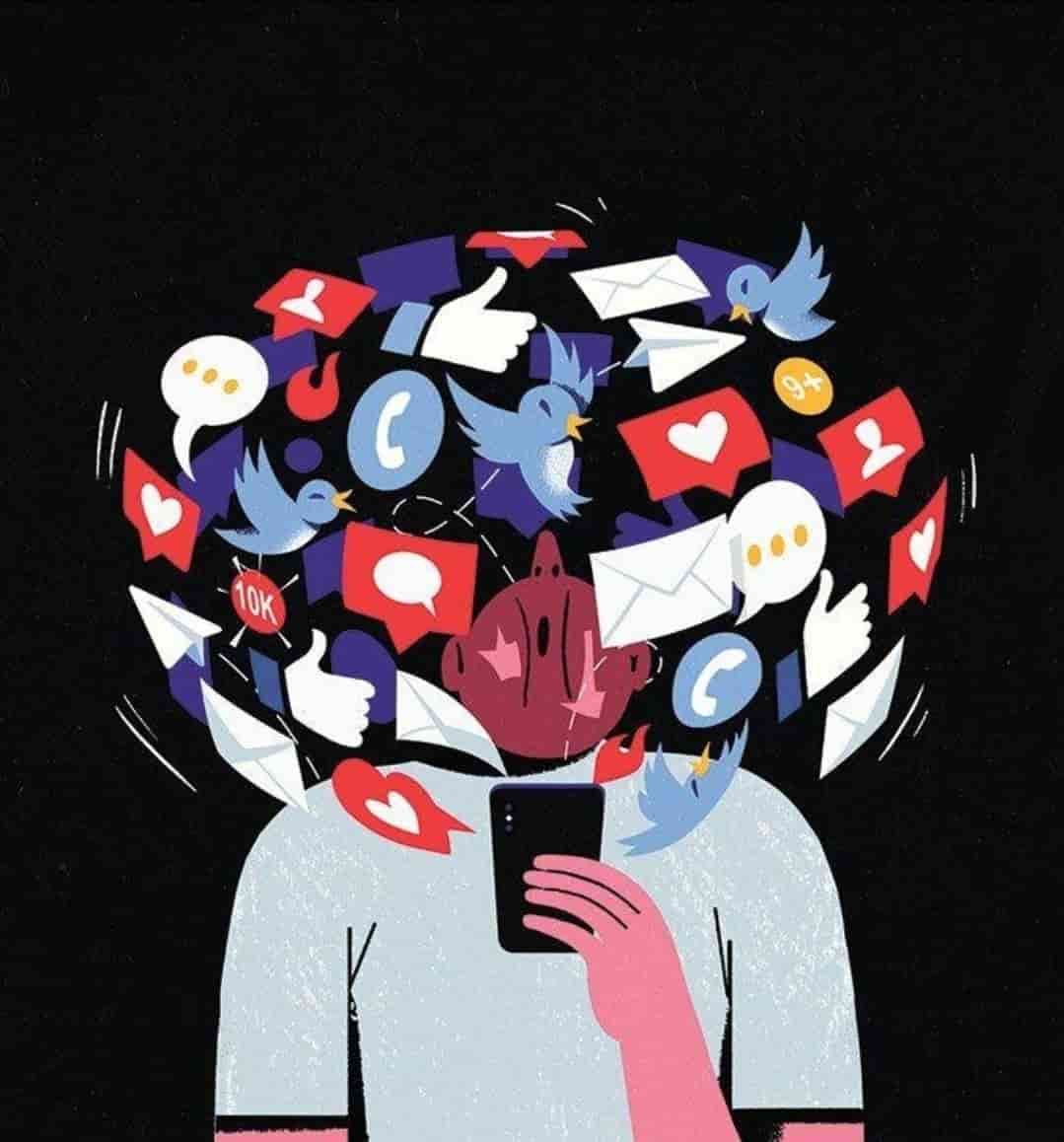
“We are less bored than our ancestors were, but we are more afraid of boredom.” ~Bertrand Russell
When was the last time you were truly bored?
Not bored for the three seconds it takes for a video to load, or bored enough to complain before opening Instagram. I mean the kind of boredom where there is genuinely nothing to do. No music playing, no conversation to have, no notifications to check, no screen to scroll through. Just time. For many of us, that kind of boredom has become almost unfamiliar.
The moment there is a gap in our day, we fill it. We scroll while waiting for class, put on music while travelling, watch something while eating, and reach for our phones when a conversation goes quiet. Even sleep has become something that needs background noise. Silence, once something we simply lived with, has become something we are quick to fill. But why?
The usual answer is that technology has shortened our attention spans. Our phones constantly offer us something new, and we have become accustomed to it. But that only explains how we escape boredom, not why we are so desperate to escape it.
We have become accustomed to filling every empty moment, often without questioning why. Perhaps the more interesting question is not why we get bored, but why being left alone with our thoughts can feel so uncomfortable.
The objective was never really to watch something. It was to avoid the feeling of having nothing to watch. But what exactly are we trying to escape when we run from boredom?
Boredom creates an unusual kind of empty space. Without something external demanding our attention, our own thoughts become harder to ignore. An argument with a friend, a pending assignment that you haven’t started working on, loneliness, uncertainty about the future, or maybe an embarrassing incident– basically, everything we regard as ‘overthinking’.
A 2024 study by Katy Y. Y. Tam and Michael Inzlicht revisits this paradox that despite having almost unlimited access to entertainment, people may actually be experiencing more boredom. According to the study, our attempts to escape boredom through digital media may sometimes be making it worse.
Across seven experiments involving 1,223 participants, Tam and Inzlicht found that boredom encouraged people to switch between videos and fast-forward through content. Participants expected this constant switching to make them less bored. Instead, switching often increased boredom while reducing attention, satisfaction and the sense that the content was meaningful.
We scroll because we are bored, but the constant search for something more interesting may be making it harder to become interested in anything at all. And now, we are stuck in a vicious cycle.
This is also evident in the way we consume short-form content. A video takes a few seconds too long to get to the point, so we swipe. The next one is not interesting enough, so we swipe again. Soon, we have moved through twenty pieces of content without really paying attention to any of them.
This does not mean that every person who checks their phone is secretly avoiding their feelings. Nor is distraction inherently harmful. Sometimes we simply want entertainment. But when every moment of silence is immediately filled, we lose the opportunity to find out what happens when we do not fill it.
A 2014 study published in Science explored this discomfort directly. Participants were asked to sit alone in a room for between 6 and 15 minutes with nothing to do except think. The researchers found that many participants struggled with the experience. In one experiment, some even chose to give themselves mild electric shocks rather than remain alone with their thoughts. The findings have since been debated and should not be reduced to the claim that people universally hate their own thoughts, but the study nevertheless demonstrated how difficult unstructured time can be for some people.There is, however, another side to boredom.
When there is nothing immediately demanding our attention, the mind can wander. In a 2014 study, psychologists Sandi Mann and Rebekah Cadman found that participants who completed boring activities subsequently performed better on certain creative tasks. The researchers suggested that daydreaming could partly explain the relationship between boredom and creativity.
Ironically, this is where boredom becomes interesting. It gives us time to observe.
We notice things differently when we are not constantly being given something to look at. A delayed Metro can become an opportunity to notice the people around us. A walk without headphones can make us aware of the sounds of the street. Sitting in a café without immediately reaching for our phones can make us notice the conversations happening around us.
Our phones have trained us to expect constant novelty. The next image is one swipe away. The next song is one tap away. The next video begins before we have even decided whether we want it. Digital media can divide attention and encourage us to keep searching for something more stimulating rather than remaining with what is already in front of us. Tam and Inzlicht’s broader 2024 review argues that digital media may contribute to boredom through divided attention, heightened expectations for stimulation and ineffective attempts to cope with boredom.
We often speak about the need to “pay attention” to art as though attention were simply a switch we could turn on. But attention is also a habit. The ability to notice a small detail in a painting, sit through a long scene or listen to someone without checking a notification depends, in part, on our willingness to stay when there is no immediate reward. A painting does not change every few seconds. A poem may require more than one reading. A slow film may ask us to wait before it gives us anything. A theatre performance demands that we sit in one place and remain present. Even a museum asks something increasingly difficult of us– to stand still and look.
The answer is not to romanticise boredom or declare phones the enemy or move away to the mountains and adopt the life of a monk. Digital entertainment can give us pleasure, connection and rest. The problem is the assumption that every empty moment needs to be filled.
Because some things can only be noticed when we stop looking for the next thing. Boredom is not the absence of attention.Maybe it is where attention begins.
And the next time the Metro is five minutes late, perhaps we could let those five minutes remain empty.
Not because there is nothing to do, but because there might finally be something to see.
Image Credits: Antonio Sortino & Alice Lagarde
Aarushi Chaubey




Comments are closed.