
From dirty dishes to nuclear deterrence, game theory explains why we cooperate, defect, and sometimes make decisions that leave everyone worse off.
Your roommate hasn’t washed the dishes for three days. You could wash them yourself, confront her, or simply wait and see how long she can tolerate the smell. The problem? She is probably running the same calculation in her head. Congratulations. You are playing game theory.
It turns out that the standoff in your shared kitchen, the checkout queue at a supermarket, and the Cold War all have something surprisingly in common. They are situations where what you do depends on what someone else might do. So, What Exactly Is Game Theory?
In very simple terms, game theory is the study of strategic decision-making. It looks at how people, companies, governments, animals, or even computers make choices when the outcome depends not just on what they do, but also on what others do. If you are deciding whether to carry an umbrella on a cloudy day, your decision depends mostly on the weather. But if you are deciding whether to wash the dishes, your decision depends on whether your roommate will wash them first. That is where game theory begins.
It asks a deceptively simple question: given what the other side might do, what is the smartest move for me?
Modern game theory has a more definite starting point. In 1944, mathematician John von Neumann and economist Oskar Morgenstern published Theory of Games and Economic Behavior, laying much of the mathematical foundation for the field. Their work argued that many economic and social decisions cannot be understood by looking at individuals in isolation; they have to be understood through strategic relationships between people. And perhaps the most famous idea in game theory is the Prisoner’s Dilemma.
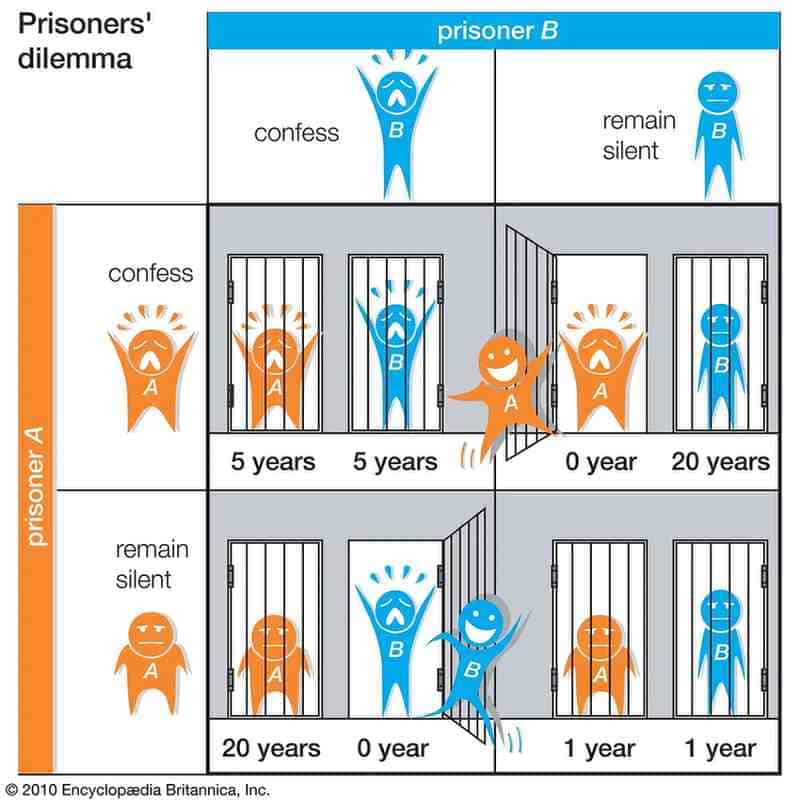
Imagine Tanya and Cinque have been arrested for robbing the Hibernia Savings Bank. They are placed in separate cells, unable to see or communicate with each other. A clever prosecutor gives each of them the same choice: confess or remain silent. If Tanya confesses while Cinque stays silent, Tanya goes free while Cinque receives a heavy sentence. The same applies in reverse.
Now imagine what is going through Tanya’s head.
“If Cinque confesses and I stay silent, I’m doomed. But if I confess and he stays silent, I walk free. Either way, confessing feels like the safer choice.”
Cinque is probably thinking the same thing. So, both confess. And that’s the trap. From an individual perspective, confessing appears to be the rational choice. Yet when both players make that choice, they end up worse off than if they had both stayed silent. The paradox is simple: what seems rational for each person individually can produce a worse outcome for everyone collectively.
Source: Britannica
The classic Prisoner’s Dilemma was developed in 1950 by mathematicians Merrill Flood and Melvin Dresher at the RAND Corporation. It was later formalised and given its famous name by Canadian mathematician Albert W. Tucker.
And suddenly, a story about two fictional criminals starts looking a lot like your kitchen.
Your roommate probably knows that even if she doesn’t do the dishes, you will eventually get tired of looking at them and wash them yourself. From her perspective, doing nothing has an obvious advantage: she gets a clean kitchen without having to do the work. And if you stop washing the dishes to send a message, you might simply create another problem. What if she thinks the same way?
Nobody washes the dishes because nobody wants to be the only person doing all the work. The plates pile up, the glasses disappear under a layer of something suspicious, and eventually your kitchen starts looking like a biological experiment. Neither of you necessarily wants a dirty kitchen. The problem is that both of you have an incentive to wait for the other person to act.
This logic appears in places far removed from your kitchen, too. We’ve all done this at a supermarket. You walk towards the checkout, scan the queues and instinctively choose the shortest one. But here’s the funny part: everyone else is doing the same thing. The shortest queue attracts more people. As more people join it, it becomes slower. Eventually, switching queues may no longer seem worth the effort.
This is close to the intuition behind one of game theory’s most famous concepts: Nash equilibrium. Named after mathematician John Nash, a Nash equilibrium is a situation in which no player can improve their outcome simply by changing their strategy while everyone else keeps theirs unchanged. Everyone is trying to make the best decision for themselves. Yet because everyone is responding to everyone else’s choices, those individual decisions shape the outcome for the whole group.
The stakes get considerably higher when the “roommates” are two nuclear superpowers.
During the Cold War, the United States and the Soviet Union possessed nuclear arsenals capable of devastating each other. Neither side could simply assume that the other would hold back. Each had to consider the same terrifying question: What happens if we attack first? The answer was deterrence.
At the heart of this was the concept of Mutually Assured Destruction, or MAD. The basic logic was brutal. If one side launched a nuclear attack, the other could retaliate. That retaliation could be devastating enough to destroy both sides. The point wasn’t that the United States and the Soviet Union trusted each other. They didn’t need trust.
They needed the certainty that attacking first would come with an unbearable cost. In this sense, the Cold War was shaped by a strategic equilibrium. Neither side could safely improve its position simply by attacking, because the other side had the ability and incentive to retaliate. The result was a strange kind of stability: peace maintained not through friendship, but through the fear of mutual destruction. The war stayed “cold” because the consequences of making the first move were almost unimaginably high.
Game theory isn’t some abstract concept buried inside an economics textbook. It is playing out every day – in your kitchen, at the supermarket checkout and in the decisions made by governments armed with nuclear weapons. Your roommate may not be thinking about John Nash when she leaves the dishes in the sink. But she is still making a strategic decision.
The supermarket queue may seem like a trivial choice, but it follows the same basic logic: your best move depends on what everyone else is doing. And nuclear deterrence takes that logic to its most consequential extreme. But the underlying question is remarkably similar: What should I do when my outcome depends on what you do?
That is game theory.
Arshia Sharma
Image credits: vecteezy.com
Read Also: Delhi Cabinet Approves Private University Bill, Proposes 25% Quota for Delhi Students.




Comments are closed.