
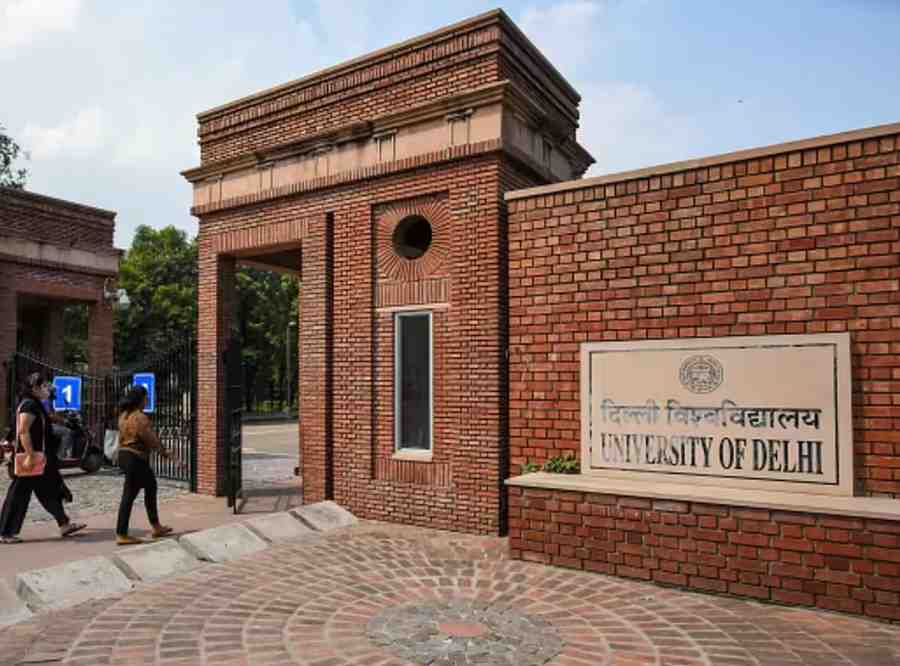
DU faces multiple written pleas against its newly introduced PG programme, and at the next hearing, it shall reveal necessary and developmental changes to the eligibility criteria.
Delhi University is celebrated as one of the most academically proficient educational institutions in this nation for both Undergraduate (UG) and Postgraduate (PG) courses. While the selection criteria for the regarded PG studies follow the same pattern as the UG, there is also a substantial addition to the parameters, notably for the one-year postgraduate programmes.
DU follows the P1, P2, P3 and P4 system, better known as Programme-Specific Eligibility (PSE) priority levels. P1 (Priority 1) candidates are given first preference because their undergraduate qualification has direct academic relevance to the Master’s programme. P2 (Priority 2) includes candidates with other eligible undergraduate backgrounds, such as certain BA programmes/related combinations, who satisfy the programme’s eligibility requirements but have a lower priority than P1 candidates. In practical terms, DU considers eligible P1 candidates first; P2 candidates are considered subsequently for the available seats. This addition has been introduced in the 2026–27 academic session, with admissions starting on 5 July 2026.
However, since its inception, it has received a significant amount of backlash over the selection criteria and eligibility standards. As a result, multiple petitions have been filed with the Delhi High Court, involving around 100 petitioners.
The first hearing was on 31st August, followed by 18th September for multiple pleas. The scrutinized changes have been provided to Delhi University for clarity of the case. Against the contested challenges, DU has failed to comply by filing no counter-reply yet.
The petitions in the case have scrutinized some crucial and cohesive structures of admissions. Part of the PSE programme has been requested to be rectified within the eligibility criteria. These include numerous changes, such as the inclusion of the Bulletin of Information, delayed notifications, and the merit-based system adopted by the University.
Let’s understand the severity of the written pleas by examining each petition separately.
Gaurav Sharma & Ors.—W.P.(C) 12558/2026 (31st Aug, 2026)
This plea was one of the principal foundations that challenged the framework for the newly introduced programme. Their central objection to the petitioners talks about the distinction and segregation that the university has created between two kinds of students who have completed four-year undergraduate degrees: students with a four-year undergraduate honours degree and students with a Four-Year Undergraduate Degree with a Major.
The main objection to this plea resides in the claim of being a uniform structure while simultaneously giving priority to students with a four-year honours degree over students with a four-year degree with a major. As an alternative, petitioners asked the Court to shift DU to conduct admissions without providing any unfair priority to Honours degree students over Major degree holders. Finally, a generalised solution was proposed so as to provide a common merit list. The list would include students of all categories while removing the programme-specific priorities and including more seats.
On 31 August 2026, Justice Jasmeet Singh issued notice on the petition. The information regarding this plea had previously been forwarded to the 18th August hearing. Following that, it was decided to provide DU the right to reply in this case, which has not been fulfilled as of 3rd October.
Shiva Singh — W.P.(C) 12521/2026
This plea was filed individually by a Political Science UG Student for his master’s degree under the new One-Year Programme. According to the University’s subsequent (Grievance Redressal Committee) GRC proceedings, Singh was a student who had completed his four-year undergraduate BA Programme in Economics and Political Science, with Political Science as his Major.
His plea basically meant that the University’s priority system could potentially put a student with an Honours degree in Political Science ahead of a student who had Political Science as a Major, irrespective of their relative marks in the CUET-PG.
The High Court therefore directed the DU’s GRC group to examine the issue and issue a reasoned order within the time as provided under the law.
The GRC subsequently issued a Speaking Order dated 3 September 2026.
According to what was reported in that speaking order, the University’s position was that both Honours and Major students were eligible; however, Honours students had greater subject-specific exposure, and therefore, giving them priority was academically justified.
The GRC also addressed whether students had adequate notice of the eligibility requirements. The Executive Council’s resolution was concerned with eligibility and seats. The reply came with the decision that the administrative changes had been uploaded on the DU website on January 2, 2026, six months prior to the university’s one-year PG admissions.
Therefore, rejecting this plea, the GRC agreed with the eligibility criteria approved by DU’s statutory bodies. It found that both students with a four-year Bachelor’s Honours degree with Research in Political Science and students with a four-year Bachelor’s degree with a Major in Political Science are eligible to apply for the one-year PG programme.
However, students who completed single-discipline undergraduate Honours programmes can reasonably be expected to have greater exposure to the relevant subject. The committee therefore concluded that the priority given to Honours students was a “well-thought-out, academically orientated decision” taken through a multi-stage statutory process involving the university’s departments, Academic Council and Executive Council.
The dispute is consequently about more than one student’s admission to MA Political Science. At its core lies the question of whether students who pursued a subject as a Major in a multidisciplinary four-year degree should compete on the same basis as students who completed Honours in that subject when applying for a one-year master’s programme. DU’s answer, through the GRC, is no. The university maintains that the difference in academic structure, entry requirements and subject-specific credits provides a rational basis for the priority.
Ankit Singh & Ors.—W.P.(C) 13299/2026 (10th Sept, 2026)
The petitioner’s application for the Masters’ Programme was rejected by DU on the basis of the guidelines set by the PSE criteria. In this situation, the major complaint was raised against the lack of properly structured nomenclature for some of these specialised undergraduate courses available for PG students. It challenges DU’s Bulletin because it bases admission on four-year undergraduate scores, all while giving priority to Honours students over Major students.
But in this plea, there is a generalised solution that is provided for a holistic and immediate remedy of inclusion. Such as a non-preferential list over a major or honours degree. And providing a common merit list. The petitioners have requested Respondent No. 2 to mandate DU to introduce respective One-Year Master’s programmes for specialised vocational and programme streams offered under UGCF-2022 as an alternate opportunity. The petition therefore connects the admission problem with the broader implementation of UGC guidelines.
At the onset of this case in September, Justice Jasmeet Singh issued a new notice stating that the DU’s counsel had to accept the notice and should be given time to file a reply/obtain instructions by 1st October 2026.
Ulfat — W.P.(C) 13498/2026
The Court considered Ulfat’s petition on 16 September 2026. The petitioners specifically asked the Delhi High Court to quash and set aside the GRC Speaking Order dated 3 September 2026. This Speaking Order arose from the earlier litigation concerning Shiva Singh, who stood up and filed a plea regarding the lack of seats being filled in the university due to the Honours degree preferential requisites. The GRC had been asked to examine the grievance concerning DU’s Honours priority and had ultimately maintained the University’s position.
The petitioners also seek to challenge the relevant provisions of DU’s 4 July 2026 Bulletin of Information. The delay in this notification led to broad mismanagement in the university’s diaspora. The petitioners believe that the students who had previously completed the degree before the new notifications have been primarily stripped of an official and proper chance to get their required master’s programme. Furthermore, the petitioners contend that this arrangement is prejudicial to students who have completed their undergraduate degree with a major in any subject.
Another important aspect of the petition is its emphasis on the fact that these are the first students graduating through the four-year UGCF system. Entering the new postgraduate framework based on the latest bulletin of information, the petitioners seek justified and appropriate clarifications from DU so that the first batch of students are not prejudiced. Secondarily, so that they have a bias based on the University’s implementation of the new system.
And, similar to the prospectus provided by the previous pleas, Ulfat’s petition also requests Delhi University to provide for a similar common merit list and to extend the number of seats to accommodate all types of students.
In response to this, Delhi University replied, as reflected in the GRC proceedings, that Honours and Major are not academically identical qualifications. DU’s justification is based primarily on subject-specific academic exposure.
The University’s position is that an Honours student has greater disciplinary depth in the relevant subject, which is particularly relevant for a compressed syllabus of a one-year Master’s programme. According to DU’s reasoning, giving Honours students priority is an academically noble criterion rather than an arbitrary or inflexible approach to preference. Students who have studied under the honours degree have a major first hand understanding and depth of the subject as compared to the students from the B.A. programme.
Therefore, the court has taken up this case again on 18th September, while directing the remaining procedural steps and holding off for a response by the university. The matter is currently being listed for the 4th October hearing.
Aryan Yadav & Ors.—W.P.(C) 13723/2026
This plea talks about a very significant and independent detail. The petitioners do not simply challenge the administration’s standards but directly question the University’s decision to organise admission through preferential categories instead of simply considering candidates through an undifferentiated merit process.
By challenging the preferential system, they ask to remove any kind of hegemony of courses and to provide a common traditional exam for all the UG students on a common pool of subjects. By this arrangement, the results of the common exam shall determine the academic cadre and then create a simple framework for students to take up the subject combinations according to their own comfort.
The petitioners recognize that simply striking down the priority system may not automatically solve the immediate problem. They therefore ask DU to develop a suitable transitory mechanism. Specifically, they ask for a supernumerary quota in a suitable proportion to accommodate the petitioners. The purpose is explicitly stated in the plea as ‘so that the present academic year of the students is not wasted’
Another particularly interesting addition to the case was to ask the DU Administration to establish a central online information portal that would provide students with timely information. This indicates that their grievance extends beyond the substantive priority of policy to the communication and information architecture surrounding the admissions process.
This case was listed before the Justice on 18th September, and the case summary was provided to DU, along with the necessary time to file a reply. The next hearing is set for the 3rd of October, while the petitioners await a much-expected grievance in the admission eligibility. The question before Delhi University is no longer merely who gets priority, but whether the transition to a new academic structure can be called equitable when they already face legal scrutiny with the inception of their first batch.
Image Credits: NDTV
Rajarshi Ghosh


Comments are closed.