
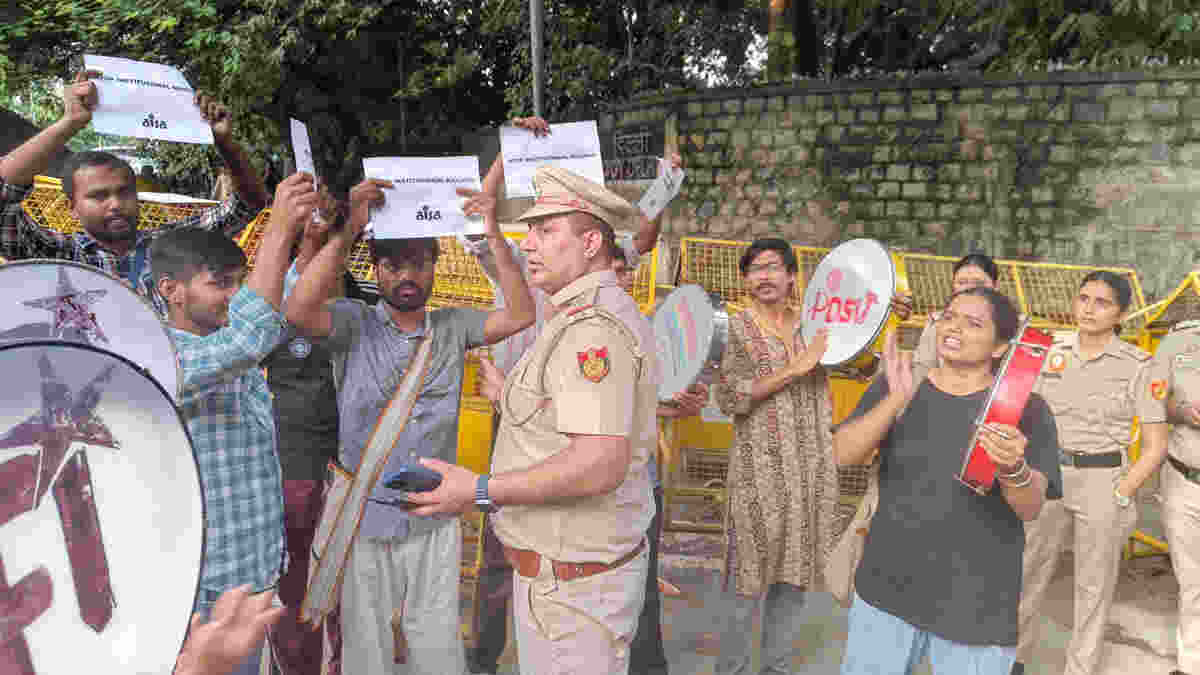
After MSc Physics student Rishikesh Kumar’s death on August 22, students and JNUSU members gathered in protest, reigniting demands for mental health reform and administrative accountability at IIT Delhi—the institute’s eighth on-campus student death since 2023.
IIT Delhi’s campus was thrown into mourning and unrest this week after Rishikesh Kumar, a second-year MSc Physics student, died on the morning of August 22 following a fall from the sixth floor of the Lecture Hall Complex. His death is the eighth student fatality recorded at IIT Delhi over the last 30 months, according to a tally now circulating widely among students and alumni on social media.
According to police accounts, Kumar entered the campus through the main gate around 8 am and made his way to the Lecture Hall Complex, from where he is believed to have allegedly jumped. He was rushed to the campus hospital, where he was declared dead. A resident of Bihar and of Shivalik Hostel, Kumar had reportedly received treatment at a private mental health facility and was, at the time of his death, living off-campus with his mother. The Kishangarh Police Station has opened an investigation, with forensic teams examining the scene.
By the following day, students had begun gathering on campus, and the Jawaharlal Nehru University Students’ Union (JNUSU) organised a solidarity protest demanding a formal inquiry into the circumstances surrounding Kumar’s death. Protesters raised pointed questions about what had pushed a student to this point and called out what they described as institutional negligence and a lack of administrative accountability.
Past instances of student suicides over the years at IIT Delhi have led to accusations of neglect by the family members of victims, leading to open houses, surveys, and promises of reform, including a 12-member committee headed by former NIMHANS dean Professor Santosh Kumar Chaturvedi. That committee’s August 2024 report flagged a culture of toxic academic competition, post-coaching burnout, caste and gender bias, and inadequate, insufficiently sensitive counselling services as recurring institutional stressors. Recommendations included mandatory first-year counselling, a comprehensive anti-discrimination policy, and a reduced first-semester academic load.
Students at this week’s gathering suggested many of these promises have yielded only incremental change. For instance, there has been a reduction in the number of daily exams, and it is one of the few concrete outcomes of years of advocacy, but unfortunately the underlying issues that affect student distress remain mostly unaddressed. IIT Delhi has, in past cases, instituted a protocol to file an FIR after every campus death and extended sympathies to grieving families but has faced continued criticism for not implementing more systemic changes.
The institute has not yet issued a detailed public response specific to Kumar’s death at the time of this report.
Image Source: ETV Bharat
Read Also: Ransomware Group DYSPHOR1A Claims Hit on Delhi University
Aamna Rehman


Comments are closed.