
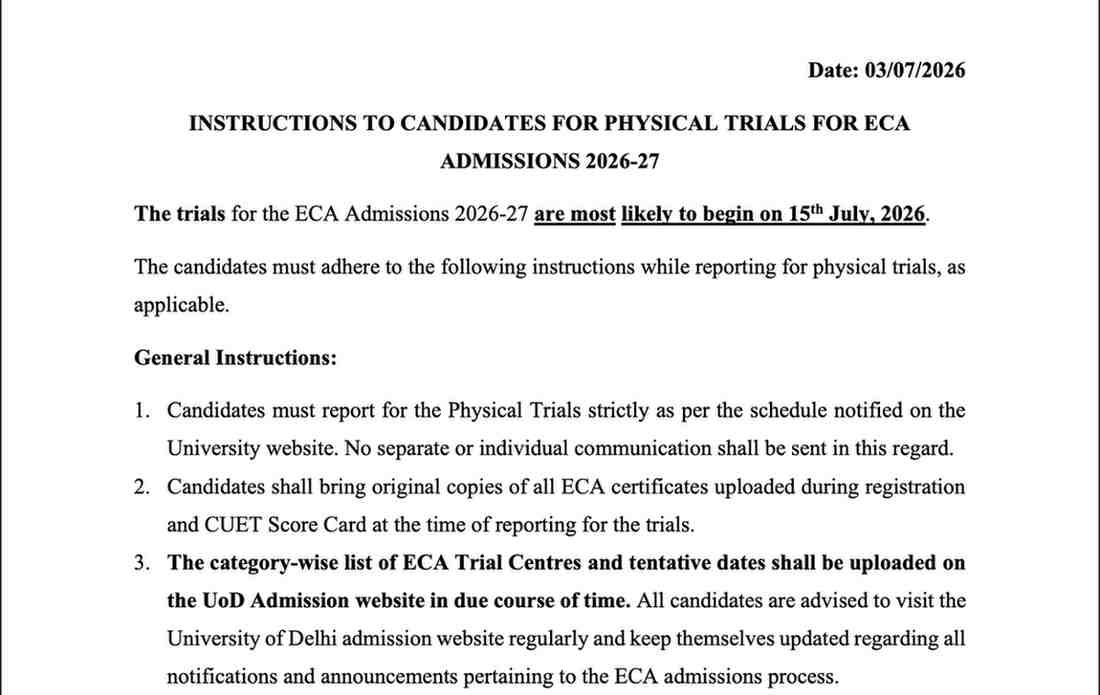
Delhi University has released detailed guidelines for admissions under the Extracurricular Activities (ECA) quota, outlining general instructions and category-specific ECA trial requirements.
On Friday, July 3, Delhi University released a notification regarding admissions under the Extracurricular Activities quota. The notification said that the trials for ECA admissions are most likely to begin on July 15, 2026.
All official schedules and category-wise trial centres will be posted on the UoD Admissions website. No individual communications will be sent to applicants; therefore, they must keep checking the website regularly.
Applicants must report to their allotted centres with the original copies of their uploaded ECA certificates and their CUET scorecard. Unless otherwise specified, accompanists are not permitted during ECA trials. They are required to bring all necessary instruments, costumes, props, and stationery, as borrowing or sharing will not be permitted. Assessment will be based solely on proficiency, with no prescribed syllabus, and the Assessment Committee’s decision will be final. Recording trials or using unauthorised electronic devices, including AI tools, may result in the cancellation of candidature. Rescheduling will only be permitted in exceptional circumstances and with the approval of the ECA Committee.
The category-specific trial guidelines are as follows:
- Creative writing: Participants will write on a topic announced at the venue and will have up to two hours to complete the task. Writing sheets will be provided.
- Dance: Candidates must prepare a 3-5 minute routine of their choice. Props, costumes, and makeup are permitted, while music must be carried on a pen drive. Performances will be assessed on technique, rhythm, expression, stage presentation, and overall artistic merit.
- Debate: Speakers will receive the motion on the spot and may argue either for or against it within four minutes. Reading from notes is not permitted.
- Digital media: Topic and expected output announced on the stage on the spot. Duration will be announced at the venue. Applicants must bring all their own equipment and one electronic copy of previous work. Memory cards must be fully formatted.
- Fine arts: Topic announced on the spot. Duration announced by the committee. Only drawing sheets will be provided. Painting can be done in oil, water, poster, or pastel colours.
- Music Vocal: Applicants must prepare a piece of 3-5 minutes. Indian vocal can be in any language, but Western vocal must be in English. A maximum of one accompanist is allowed, but they may not sing along. Purely instrumental electronic backing apps are allowed, but karaoke with vocals is prohibited.
- Musical instruments (Indian): Applicants must prepare a performance of 3-5 minutes, using notified instruments or approved regional equivalents. Applicants must bring their own instruments and tune them before the slot; no extra time will be provided. Criteria for this category are swar, taal, raag selection, composition, technique, and overall presentation. A maximum of one accompanist shall be permitted.
- Musical instruments (Western): Candidates must perform for 3-5 minutes using a notified instrument. They must bring and tune their own instrument before the trial. One accompanist or instrumental backing track is permitted. Evaluation will be based on rhythm, technique, musicality, composition, and presentation.
- Theatre: Applicants are required to prepare a 4-minute mono-act on a chosen theme. The committee may assign an on-the-spot performance to the applicant. Applicants must bring their own makeup, costumes, props, and background music. Only one accompanist is allowed, only for non-acting specialisations (like scriptwriting).
- Quiz: The quiz will assess current affairs and general factual knowledge. The assessment may include one or more written rounds, all of which will count towards the final score. Answers must be written in blue ink only in the provided booklet (pencil or other colours will not be evaluated).
- Divinity: Candidates must prepare a presentation of 3-5 minutes of Bhajan, kirtan, Shabad, Sikhi Guruvani Declamation, or instrumental, not exceeding 4 minutes. An additional on-the-spot piece may be requested. A maximum of one accompanist is allowed, vocalist if the applicant plays an instrument, or vice versa.
- Yoga: Applicants must present at least 4 asanas from a recognised school within a maximum of 4 minutes. The committee may request additional demonstrations. Applicants must bring their own Yoga mat and accessories (blocks, straps). No props or music is permitted.
The University has reiterated that rescheduling will only be allowed in exceptional cases, such as the unavailability of travel tickets for outstation students, and only with the approval of the ECA Committee. No trial will be rescheduled after the designated dates for a particular category have concluded, including on medical grounds.
Vanshika U Singh
Read Also: DU Opens Registration Portal for One-Year Postgraduate Programmes 2026-27
Image credits: Delhi University Admissions Website

Comments are closed.