
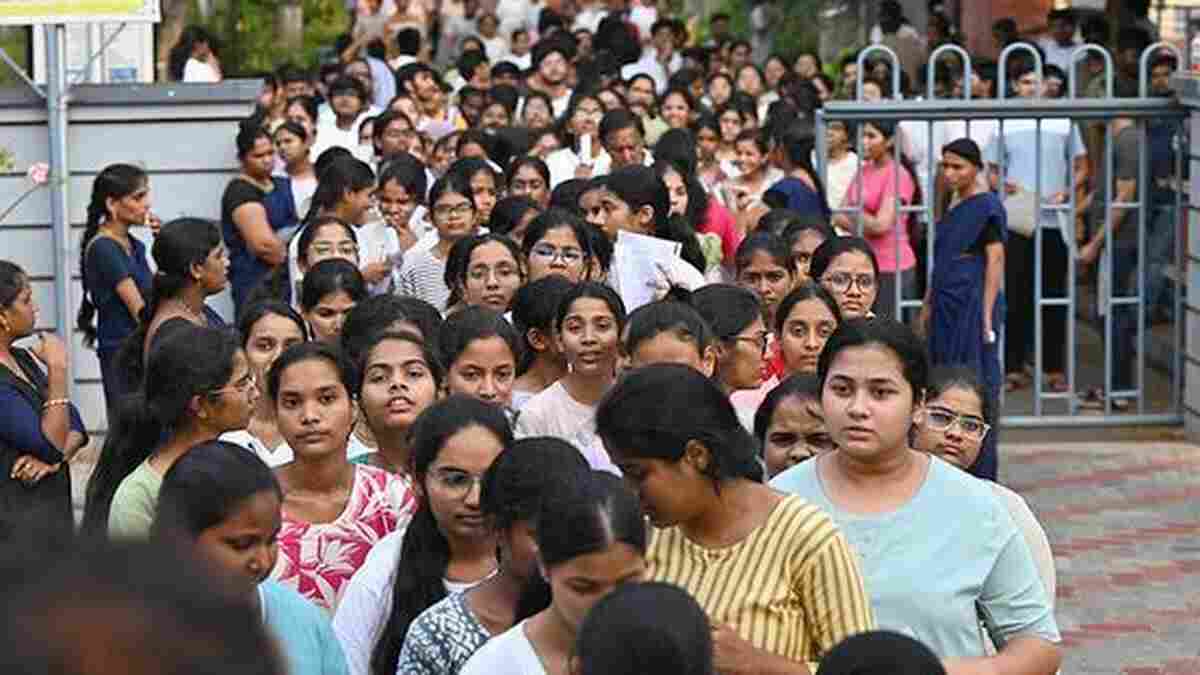
Strict dress code enforcement for the NEET UG re-examination on June 21 triggered a national debate over dignity, religious freedom and exam integrity.
For many candidates appearing in the NEET UG re-examination, the challenge began before they even entered the hall. Stringent dress code enforcement left students across the country questioning where security ends and dignity begins.
The re-examination came in the wake of the cancellation of the May 3 exam following reports of paper leaks in several states. According to the official NTA notice, candidates were advised to wear light clothing, avoid shoes, metallic accessories, jewellery and electronic devices.
In Delhi, Era, who appeared for the re-examination, described the entry process as “traumatising”. Despite arriving nearly an hour before the gates closed and adhering to the prescribed dress code, she was asked to remove her footwear, undo her braided hair, and surrender a religious thread she was wearing. While she acknowledged the intent behind the measures, she questioned their efficacy. “The safety measures are there, but are they working? That’s the question,” she told DU Beat.
Srishti, another candidate from Delhi, described the security checks as “extensive”. She recalled being asked to leave behind her handkerchief and medication. “Luckily, in my case, the discomfort was just the lack of a handkerchief. But I feel, in many cases, it can go a bit extreme”, she said in conversation with DU Beat.
Beyond Delhi, the examination was accompanied by a series of events that raised questions about the implementation of security checks, as reported by Times of India. In Gujarat, students were asked to remove sacred threads and kanthi necklaces, triggering protests outside examination centres. In Rajasthan, eighteen-year-old Kulsum Bano alleged she was stopped from entering her centre because she was wearing a burqa, even though the NTA’s advisory permitted religious dress subject to early reporting. In West Bengal’s Malda, a female candidate alleged she was subjected to an intrusive security check and was asked to lower her clothing to verify the presence of a sanitary pad during frisking. The incident prompted sharp condemnation by students and the Democratic Medical Association, on account of the violation of bodily autonomy.
For many candidates, the issue was not the existence of security checks but the manner in which they were carried out. As the debate continues, the challenge remains: ensuring examination integrity without compromising the dignity of students.
Image Source: The Hindu
Read Also: DU Releases Second Round of CSAS-PG Seat Allocation List
Rishika Jain

Comments are closed.